Free printable botox face chart
A free printable botox face chart maps injection sites and records unit dosages ...

46
Last Updated: Sep 22, 2026

This NeoGraft template is a two-page pre-procedure consent and screening form, not an operative record or a follow-up tracker.
It opens with a procedure description that covers risks, contraindications, and the basics of aftercare, so every patient reads the same information.
An informed consent and photography clause records that the patient understood the advice and agreed to clinical images being kept in their notes.
The screening section runs 11 yes or no questions on medical conditions, pregnancy, autoimmune and neuromuscular disease, allergies, infection, and medications.
Practice management software like Pabau sends the form before the visit and files the signed copy against the patient record.
A two-page pre-procedure form covering the NeoGraft procedure description, its risks, contraindications, and aftercare basics. It also carries the informed consent and clinical photography clause, 11 yes or no screening questions, and five open-text history boxes.
Download templateNeoGraft is an automated follicular unit extraction (FUE) system used in hair restoration practices. It lifts individual follicles from the donor area with pneumatic pressure rather than a scalpel, so the patient is left with no linear strip scar.
The consultation that precedes the procedure carries most of the legal weight. It is where risk is explained, candidacy is questioned, and permission is given in writing. This template covers that stage.
The sections below cover what the form contains and how to run it through a consultation. They also name the records that have to sit alongside it. Every field described here is in the downloadable file.
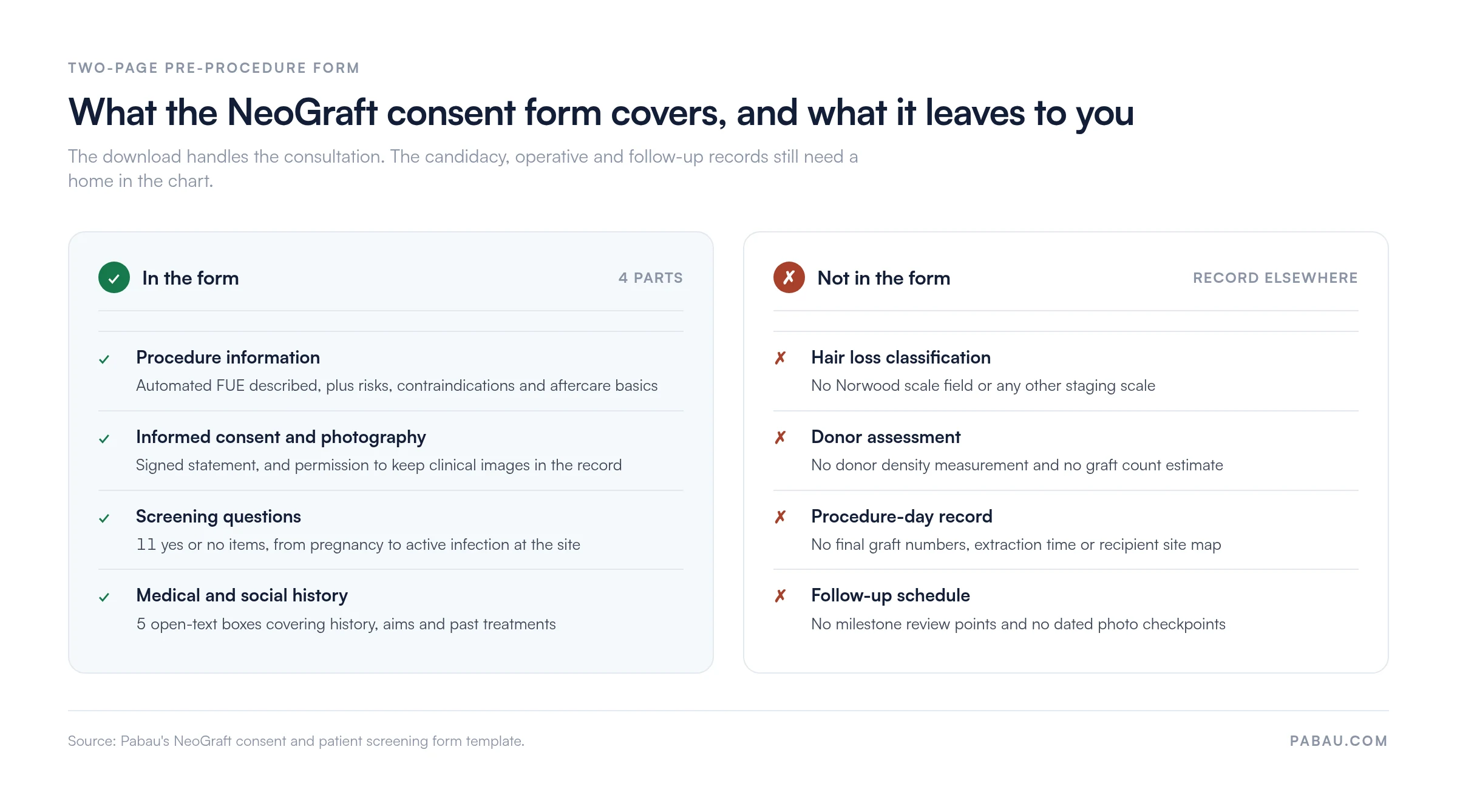
The download is a two-page pre-procedure form. It has four parts, and they run in the order a consultation naturally follows.
The form ends with a line confirming the patient will keep the information and refer back to it during treatment. That is the whole document.
The boundary matters, because each missing piece still has to be recorded somewhere in the chart.
Those belong in your clinical notes and your operative record. The section on what to record alongside consent covers how practices usually handle them.
The panel below sets the form’s four parts against the four records it leaves to you.
The form does its job across five steps, from the first inquiry to the signed copy in the chart.
Hair transplant practices, dermatology practices that offer restoration, and cosmetic surgery centers running FUE all need a consistent consent document. This one is written for the NeoGraft procedure specifically, so the risks match the technique.
Aesthetic groups that offer restoration alongside injectables and skin treatments carry a longer list of consent documents. They tend to keep those in one system, which is what medical spa software is built for.
Solo practitioners use it to keep their own consultations consistent from patient to patient. Multi-site groups use it so a patient in one location signs the same document as a patient in another.
It is also useful for new staff. A technician or coordinator running pre-consultation calls has a fixed list of questions to work through, which shortens training.
Hair restoration is elective and outcome-driven, so disappointment with the result is a common complaint. A signed record of what was explained is the practice’s clearest answer when a patient says the risks were never mentioned.
Standardization also removes variation between practitioners. Practices that move to structured digital consultation forms spend less time preparing for appointments. They also catch candidacy problems earlier, because the same questions get asked every time.

A second benefit is easy to overlook. A completed history form gives whoever performs the procedure a briefing they can read in a minute. That holds even if they did not run the consultation.
Consent is one document in a longer chain. Three other records do the work this form does not, and each needs its own home in the chart.
Those review points are also where you ask the patient how the result feels to them. A structured feedback form pairs a one to five rating with an open comment box, so answers stay comparable.
Timelines are worth stating plainly at consultation. Transplanted hair commonly sheds in the first weeks after the procedure. New growth usually starts at three to four months, and the final result is typically judged at nine to twelve months.
Standardized photographs make that conversation concrete. Take a baseline set at consultation, then further sets at six and twelve months. Kept in before-and-after photo software, they give you an objective record of density.
Consent forms, medical histories, and clinical images are all protected health information. Under HIPAA they need controlled access, an audit trail, and secure storage, which rules out a shared drive or a folder of phone photos.
The photography clause deserves attention of its own. It authorizes images as part of the medical record, so separate permission should be sought before any of them appear in marketing.
Device-related problems should also be logged. Serious injuries or malfunctions involving the NeoGraft system can be reported to the manufacturer and to the FDA through MedWatch. Your internal note should record what happened and when.
Retention rules vary by state, so check the period that applies to you and keep the signed form for at least that long. Our guide to hair transplant compliance covers the wider record-keeping picture.
A PDF is static. It has to be printed, handed over, scanned, and filed. Every one of those steps is a chance for a form to go missing before the procedure date.
Practice management software like Pabau rebuilds the same document as a digital form. The patient completes it on their phone before the appointment and signs on screen. The answers land in their record rather than in a filing cabinet.
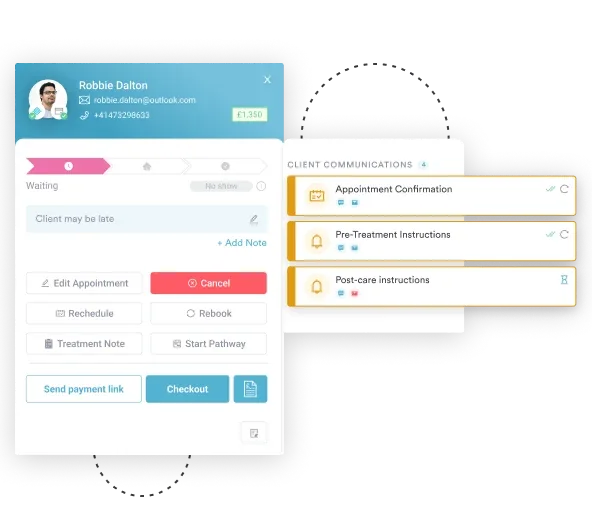
From there the rest of the chain joins up. Automated workflows chase an unsigned form and book the follow-up points you work to. They also send the reminder that gets the patient back at six and twelve months for photographs.
The result is fewer procedure days delayed by paperwork. It also means a complete record when a question comes up years later, and a follow-up schedule nobody has to chase by hand.

Send NeoGraft consent forms before the appointment, capture signatures digitally, and keep screening answers, photographs, and follow-ups in one patient record.

Use this template for what it is. It is a strong pre-procedure consent and screening form, and it will not track a patient through the twelve months that follow.
Practices that treat it as the first link in a chain get the most from it. Pair it with a candidacy assessment, an operative record, a written aftercare sheet, and dated photographs, and the patient file holds up under scrutiny.
The trade-off is administrative. Each of those records is another document to chase on paper, which is why growing practices move the chain into one system. Book a demo to see how Pabau keeps NeoGraft consent, photographs, and follow-ups in a single patient record.

Need the candidacy record this form does not carry? Scalp regions explained maps the donor zones and layers you assess before quoting a graft count.
Working out how long to keep signed forms? Compliance for hair transplant clinics covers retention periods, consent records, and patient data handling.
Chasing forms and photographs by hand? Best hair transplant clinic software in the US compares the systems that store consent against the patient record.
Setting expectations before the consultation? Hair transplant clinic marketing covers how to talk about timelines and outcomes before a patient books.
It is a pre-procedure consent and screening form. It records the risks the patient was told about, their medical history answers, and their written agreement to treatment and to clinical photography.
No. It is a pre-procedure document with no milestone schedule and no photo checkpoints. Follow-up appointments, reminders, and progress photographs belong in your practice management system or your own aftercare record.
New hair growth usually begins three to four months after the procedure, and full results are typically visible at nine to twelve months. The consent form states that timeline so expectations are set before treatment.
The form asks patients to avoid strenuous activity, sun exposure, and swimming for the period their practitioner recommends. It does not print fixed dates, so give those timings on your own aftercare sheet.
The patient authorizes clinical photographs and video, and confirms the images will be kept with their confidential medical records. Ask for separate permission before using any image in marketing.
It names swelling, redness, bleeding, bruising, discomfort, infection, folliculitis, scabbing, numbness, and shock loss. It also covers variable graft survival, asymmetry, and the chance of an unsatisfactory cosmetic outcome.