Nitrates medication list
A nitrates medication list is a point-of-care reference that sets out the main c...

2
Last Updated: Oct 6, 2026

Pabrinex is a high-potency injection of thiamine, riboflavin, pyridoxine, nicotinamide and ascorbic acid, given intravenously or intramuscularly.
It treats Wernicke’s encephalopathy, prevents it during acute alcohol withdrawal, and corrects severe nutritional deficiency.
Wernicke’s dosing is 2 ampoule pairs three times daily for at least 2 days, then 1 pair daily for 3 to 5 days.
Dilute IV Pabrinex in 50 to 100ml of NaCl 0.9% or dextrose 5%, then infuse over at least 30 minutes with resuscitation equipment ready.
Pabau’s clinical record system and digital forms capture every dose, route and monitoring check for audit.
A patient-facing aftercare sheet covering hydration, rest, diet, the 72-hour alcohol restriction, and the side effects to watch for. It closes with a signed patient acknowledgment you can file against the visit.
Download templatePabrinex is one of the most closely watched injectable vitamin preparations in UK secondary care. It arrives as two liquid ampoules that you mix in a single syringe. The dilution, the volume and the infusion time all change with the route, and the drug carries a documented anaphylaxis risk. Before picking a system for a practice that offers Pabrinex alongside aesthetic treatments, read our ranking of medical spa software.
This guide covers the licensed indications, the dosing regimens in the BNF, and the IV and IM administration steps. It also covers what to do when supply runs short. The downloadable sheet above is the patient-facing half of the job.
Pabrinex is a high-potency injection that carries four B vitamins and vitamin C in one preparation:
Each unit comes as an ampoule pair. Both ampoules hold liquid, numbered No. 1 and No. 2, and you draw both into the same syringe immediately before use. The license covers intravenous or intramuscular use only, and you never give it orally. Verify every prescribing decision against the current BNF entry for vitamin B substances with ascorbic acid and your trust formulary.
Pabrinex covers three broad clinical scenarios, each with its own dosing and urgency:
Wernicke’s encephalopathy is the highest-acuity indication. The triad is ophthalmoplegia, ataxia and acute confusion, and it is a medical emergency. If you suspect Wernicke’s clinically, start Pabrinex without waiting for confirmatory imaging. Subclinical thiamine deficiency is common in alcohol dependence, so treat on a low threshold even when the classic triad is absent.
Alcohol withdrawal prophylaxis is the most frequent use. Thiamine and other B vitamin stores fall quickly during withdrawal because of malnutrition and impaired absorption. Give Pabrinex alongside benzodiazepines and supportive care to prevent seizures and Wernicke’s.
Route selection depends on clinical urgency, patient factors and local protocol. Choose IV for Wernicke’s encephalopathy because onset is faster and bioavailability higher. The two routes then diverge further than the shared ampoule pair suggests.
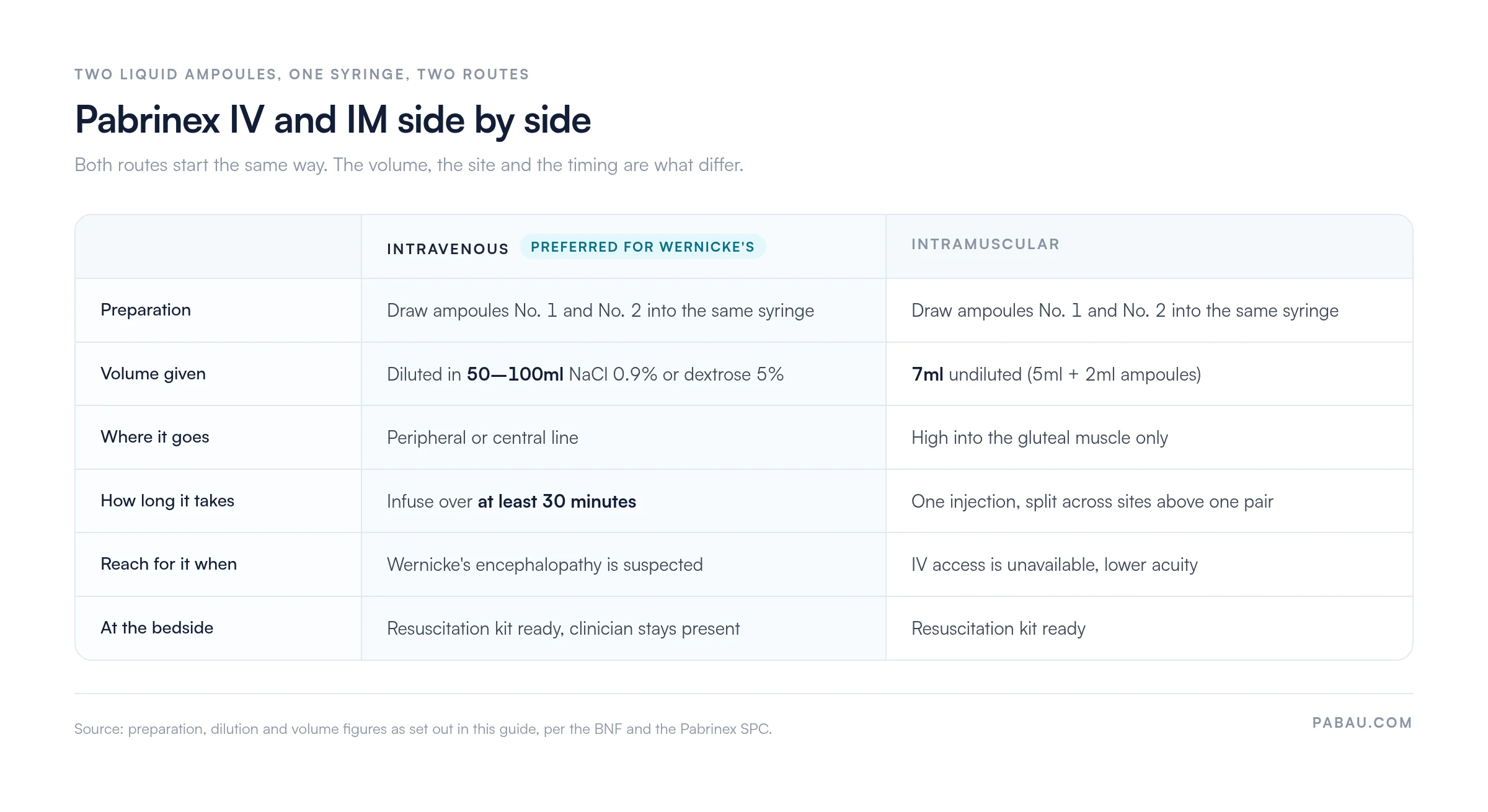
Preparation: Pabrinex IV comes as two liquid ampoules, No. 1 and No. 2. Using an aseptic technique, draw the contents of both ampoules into the same syringe to mix them. Inspect the mixed solution and discard it if it shows discoloration or contains particles.
Record the dilution volume, the diluent, the infusion rate, the start and finish times, and any adverse reaction. Structured clinical forms make those fields mandatory, so none of them ends up buried in free text.

Use IM Pabrinex when IV access is difficult or unavailable. Draw both ampoules into one syringe as above. The IM ampoule pair totals 7ml, a 5ml ampoule plus a 2ml ampoule, and you give it undiluted. Inject high into the gluteal muscle. Avoid the deltoid and vastus lateralis for Pabrinex, because the volume is too large for either site.
IM injection can be painful, so consider local anesthetic infiltration or splitting the dose across two sites when giving more than one pair. Onset is slower than IV, so reserve the route for less urgent situations or where IV is unsuitable.
Anaphylaxis risk is the most important safety concern. Pabrinex carries a documented risk of anaphylactic reactions, including severe bronchospasm, cardiovascular collapse and angioedema. Reactions are rare, and they have been fatal. Local protocol should require resuscitation equipment at the bedside before every IV infusion, with the clinician present throughout.
The wider pattern of reactions to intravenous vitamin preparations is worth reading before you write that protocol. Our guide to IV therapy complications covers screening, early recognition and the escalation steps for each reaction type.

Absolute contraindications: known hypersensitivity to any component. Thiamine hypersensitivity is very rare, but case reports document it.
Relative cautions: established Wernicke-Korsakoff syndrome, where neurological injury may not fully reverse with treatment. Severe hepatic impairment may alter vitamin metabolism. Renal impairment rarely needs a dose adjustment, but use clinical judgment. Pabrinex has no major documented drug interactions.
Pregnancy and breastfeeding do not contraindicate Pabrinex, and clinicians often use it in pregnant women with alcohol withdrawal or hyperemesis gravidarum. B vitamins are essential micronutrients, so the risks of deficiency usually outweigh the theoretical risks of the preparation.
Monitoring requirements depend on the indication and the clinical context:
Digital clinical records should capture the indication, the dose, the route, the dilution, the infusion time, any adverse reaction, and the clinician’s assessment of response. That audit trail is what a CQC inspector and a medicolegal review both ask for.

Pabrinex has been in intermittent short supply since 2021, and the British Society of Gastroenterology shortage guidance sets out what to use instead. None of the alternatives is equivalent:
Check the NHS England supply chain bulletin and your trust pharmacy for the current shortage status before you prescribe an alternative. Unlicensed use needs explicit consent and a documented rationale.
Most patients tolerate Pabrinex well. Common side effects are mild and pass quickly:
Serious adverse reactions are rare. Anaphylaxis presents with bronchospasm, hypotension, angioedema or urticaria. Give adrenaline 0.3 to 0.5mg IM, secure IV access, stop the Pabrinex and follow your local anaphylaxis protocol.
Report every serious adverse reaction through the MHRA Yellow Card scheme and tell your trust medicines governance team.
Use this table for rapid bedside reference. Always check the BNF and your trust formulary before prescribing.
Most services still record Pabrinex on a paper drug chart plus a free-text nursing note. The dose and the route usually make it in. The dilution volume, the infusion start time and the resuscitation check often do not, and those are the fields an inspector asks about.
Practice management software like Pabau replaces that with a structured record. The Pabrinex entry carries its own required fields. A clinician cannot sign it off without the diluent, the volume, the infusion window and the monitoring outcome. Private longevity and infusion practices end up with the same trail an NHS ward keeps.
The aftercare sheet then goes out from that same record. Pabau drafts the patient letter, sends it by email or SMS, and stores the acknowledgment against the visit. In IV therapy practices running several infusion rooms, every team member sees the same treatment history and monitoring data.
The outcome is a shorter audit. Nobody has to reconstruct a Pabrinex dose from a paper chart six months later, because the fields were mandatory at the point of care.

Pabau’s clinical records and digital forms capture the diluent, volume, infusion time and monitoring outcome for every Pabrinex dose. Your audit trail is built at the point of care.

Pabrinex is a straightforward drug to prescribe and an easy one to administer badly. The two liquid ampoules go into one syringe. IV gets 50 to 100ml of diluent and at least half an hour. IM gets 7ml, undiluted, high in the gluteal muscle. Those numbers are most of the safety margin.
The trade-off worth remembering is the shortage. Substituting thiamine monohydrate or oral thiamine is reasonable, but neither is equivalent, and both move the documentation burden onto you. Write the unlicensed decision down as you make it, not afterwards.
Use the downloadable sheet above so patients leave with their aftercare instructions in writing. Book a demo to see how Pabau makes the dilution, infusion and monitoring fields mandatory on every Pabrinex record.

Worried about reactions during an infusion? IV therapy complications sets out the reactions to screen for and how to escalate each one.
Need a second aftercare sheet? Vitamin C injection aftercare instructions gives you a patient handout for high-dose ascorbic acid infusions.
Unsure who may administer? Who can administer IV vitamin therapy explains the delegation and supervision rules by role.
Setting up an infusion service? IV therapy EMR software logs each administration with its time, dilution and monitoring outcome.
Pabrinex is a brand name. The active ingredients are vitamin B substances, meaning thiamine, riboflavin, pyridoxine and nicotinamide, with ascorbic acid. There is no single generic name, because it is a combination preparation. The BNF lists it under vitamin B substances with ascorbic acid.
Yes. Choose IV for Wernicke’s encephalopathy because onset is faster. IM suits patients with no IV access, or less urgent indications such as alcohol withdrawal prophylaxis. The IM ampoule pair totals 7ml and goes high into the gluteal muscle. Warn the patient that it can be painful.
Chronic alcohol use damages the gastrointestinal tract and impairs nutrient absorption, which leads to thiamine and B vitamin deficiency. During acute withdrawal, cellular demand for those vitamins rises as the nervous system comes under stress. Pabrinex replenishes the depleted reserves and prevents Wernicke’s encephalopathy and seizures. Clinicians always give it alongside benzodiazepines, never as a replacement.
Each vitamin in Pabrinex acts as a coenzyme in a different metabolic pathway. Thiamine supports pyruvate dehydrogenase, which drives carbohydrate metabolism and neurological function. Riboflavin supports oxidative reactions and pyridoxine supports neurotransmitter synthesis. Nicotinamide feeds NAD production for cellular energy, and ascorbic acid supports collagen synthesis and antioxidant defense. Together they restore metabolic balance in deficiency states.
During a shortage, clinicians can consider thiamine monohydrate injection, although its license does not cover IV use. High-dose oral thiamine at 100 to 500mg three times daily suits less urgent indications. Neither is equivalent to Pabrinex, and both carry a different safety profile. Always consult pharmacy and a senior clinician, and document unlicensed use clearly.