GLP-1 diet plan
A GLP-1 diet plan is a structured eating framework for patients taking semagluti...

2
Last Updated: Oct 13, 2026
An OAB medication list puts every drug used for overactive bladder in one place. Each entry carries the class, the dose range, and the safety flag that decides who should get it. Seven anticholinergics and two beta-3 agonists make up the nine agents in routine US use.
The age flag is the line that matters most. Oxybutynin immediate release is the one agent the American Geriatrics Society tells practices to avoid in older adults. It is still widely prescribed anyway.
Below you will find the full reference table, dose ceilings and renal adjustments, plus a routine for working the list into prescribing.
A two-page clinical reference covering all nine agents by class, dose range and formulation, with starting doses, ceilings and renal or hepatic adjustments. It also carries a class-selection table, a pre-prescribing checklist and a review-visit record you can write on.
Download template
Two drug classes cover overactive bladder, seven anticholinergics and two beta-3 agonists.
Six anticholinergics carry an FDA indication for overactive bladder, while flavoxate is approved for urinary symptoms of lower tract inflammation.
Oxybutynin immediate release tops out at 20 mg a day, taken as 5 mg four times daily.
Beers Criteria flag oxybutynin immediate release in older adults, so trospium or a beta-3 agonist is the safer opening choice.
Beta-3 agonists skip dry mouth and constipation, but mirabegron lifts blood pressure and inhibits CYP2D6.
Overactive bladder is a symptom syndrome, not a diagnosis you confirm on a test. It means urinary urgency, with or without urge incontinence.
Frequency of eight or more voids in 24 hours and at least one void a night usually come with it. The detrusor contracts during filling, so the urge arrives before the bladder is full.
Drugs are second-line. Bladder training, timed voiding, fluid adjustment and pelvic floor work are first-line in the AUA and SUFU guidelines. Pharmacotherapy starts when those measures have had a fair run and urgency still breaks up the day.
Both drug classes do the same job by different routes. Anticholinergics block muscarinic receptors so the detrusor stops contracting when it should be filling. Beta-3 agonists switch on β3 receptors and relax the muscle instead. Efficacy is broadly comparable, so tolerability and contraindications usually decide the choice.
The table below is the master reference. It lists nine agents across two classes, with the dose range, the available formulations and the one fact that most often changes the prescription.
Flavoxate sits slightly apart from the rest. Its FDA indication covers urinary symptoms caused by lower urinary tract inflammation, not overactive bladder itself. Treat it as an adjacent option rather than a first choice.
Anticholinergics block M3 muscarinic receptors on the detrusor, which stops the involuntary contractions that create urgency. They carry most OAB prescriptions in the US, and six of them hold an FDA indication for the condition.
Flavoxate is the seventh agent in this group, though its approval covers a narrower set of symptoms. What separates them is receptor selectivity, how much crosses into the brain, and which formulations exist.
Beta-3 agonists take the other route. They switch on β3-adrenergic receptors on the detrusor, which relaxes the muscle during filling. Dry mouth, constipation and cognitive effects largely drop away. Blood pressure takes their place as the thing to watch. Two agents are approved.
Record a blood pressure before the first prescription, then again at review. A shared vital signs record keeps both readings in one place. The comparison is then in front of you at review, not scattered across two notes.
Efficacy rarely settles it. Head to head, urgency reduction is similar across the classes. The decision comes down to what the patient cannot tolerate and what they already take.
Six findings in the history do most of the work, and taking them in a fixed order beats weighing them all at once.
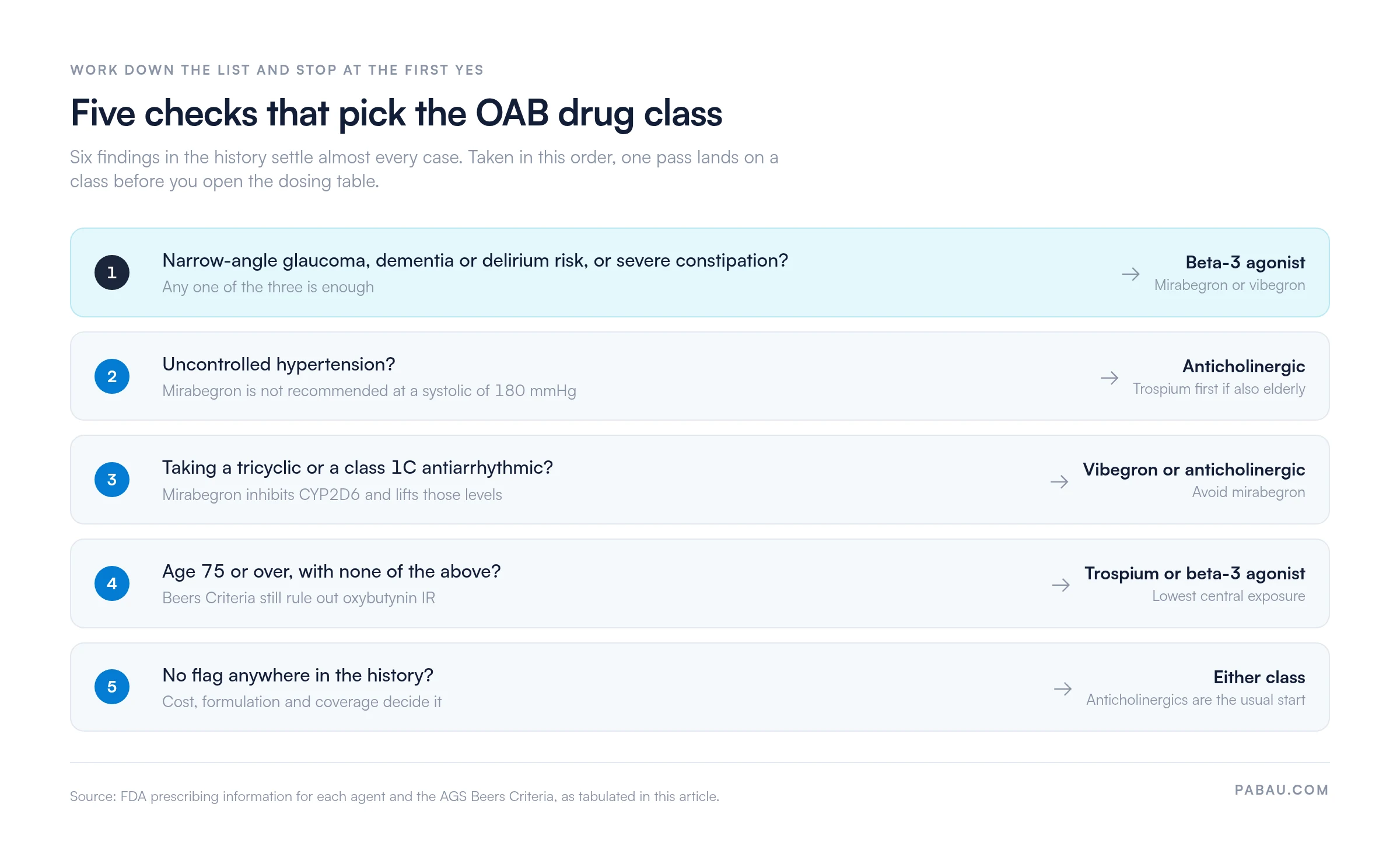
The table below carries the same decisions with the reasoning attached. That is the version worth keeping next to the prescribing screen.
Most OAB prescriptions stop for tolerability, not for lack of effect. Knowing which complaint belongs to which class lets you counsel up front and manage it before the patient quits.
Adherence is worth tracking as carefully as the dose. Ask the patient to keep a medication log between visits. You then arrive at the review knowing whether a poor response is the drug or the schedule.
In adults 65 and over, start with trospium or a beta-3 agonist. Altered pharmacokinetics, more comorbidities and greater sensitivity to anticholinergic load all push the same way. The American Geriatrics Society Beers Criteria name oxybutynin immediate release as the agent to avoid, citing confusion and delirium risk.
Avoid: oxybutynin immediate release. Central anticholinergic effects raise confusion and delirium risk, and the evidence behind the recommendation is strong. Flavoxate carries the same warning.
Use with caution: the extended-release forms and the M3-selective agents. Central exposure is lower, though it does not disappear. Trospium and the beta-3 agonists stay the preferred starting point.
Renal function then sets the ceiling. Mirabegron drops to 25 mg a day once eGFR falls between 15 and 29, and vibegron is not recommended below that. Anticholinergics clear mostly through the liver, but the effects a frail patient feels most, constipation and incomplete emptying, get worse with age.
Book the review at four to eight weeks either way. That is long enough to judge response and short enough to catch a tolerability problem before the patient stops on their own.
Use this table once the prescription is being written and the questions turn numerical. It gives the starting dose, the ceiling and the adjustment that applies when kidney or liver function is reduced.
One figure trips people up more than any other. Oxybutynin immediate release is often quoted with a 15 mg ceiling. The label allows 5 mg four times daily, which is 20 mg.
Two escalation routes matter once oral agents have failed or proved intolerable. Intradetrusor onabotulinumtoxinA is FDA-approved for refractory OAB and is given cystoscopically, usually by a urologist. Desmopressin is narrower, reserved for nocturia, and it carries a hyponatremia risk that rules out casual use.
Sacral neuromodulation and percutaneous tibial nerve stimulation sit alongside them as device options. Both need a referral. The practical job at this stage is a clean handover, naming what was tried, at what dose, for how long, and why it stopped.
A reference only earns its keep once it sits inside the workflow. It also works best when the data behind it is already in the system. Good prescription management keeps doses, formulations and repeat dates in one record, so nobody rebuilds the picture from a printed sheet.
Most of that screening can happen before the patient sits down. Comorbidities, current medications and prior treatment failures all arrive with paperless patient intake. The consult then starts from a complete history rather than a blank page.
Most practices run this list on paper. The reference sits in a drawer or a shared folder. The rationale goes into free text, if it goes anywhere at all. The review depends on somebody remembering to book it.
Practice management software like Pabau closes those loops in one record. Digital intake forms collect the comorbidities and current medications before the appointment, so the contraindication screen is half done by the time the patient arrives. The chosen agent, the dose and the reason then sit on the patient record, not in a separate note.
Automated recalls handle the four-to-eight-week review, so the reassessment is booked at the point of prescribing rather than chased later. Pabau Scribe, our AI scribe, drafts the consultation note while you talk, which gets the prescribing rationale written down while it is fresh.
Every subscription includes those features, so a solo prescriber gets the same recall engine and the same forms as a multi-site group.
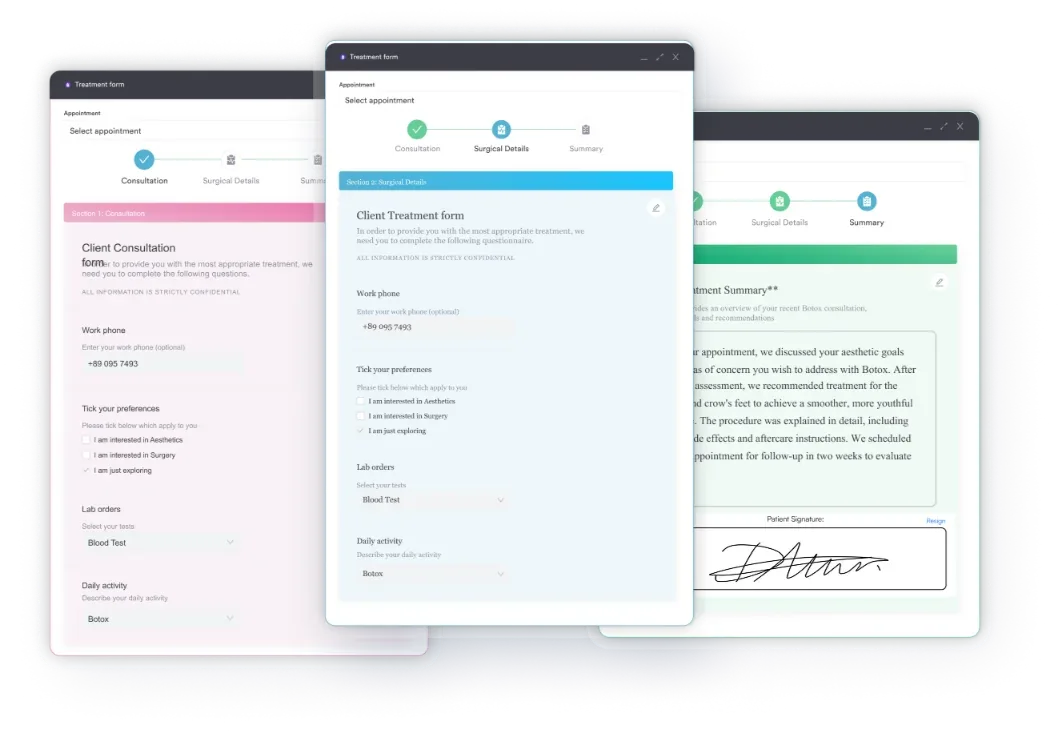

Pabau collects medication history at intake, stores the reason behind each prescription on the patient record, and books the four-to-eight-week review automatically. Your team stops rebuilding the picture from paper.

Two classes and nine agents sound like a lot of choice, but one screen narrows it fast. The contraindications pick the class. Cost, formulation and coverage then pick the agent inside it.
The reference itself is the easy part. Keeping the reasoning attached to the patient, and the review actually booked, is what separates a list that gets used from one that gets printed.
Download the reference, work the five checks into the consult, and book the review before the patient leaves. Book a demo to see how Pabau keeps the medication decision, the rationale and the recall on one patient record.

Recording what the patient actually takes? The medication log template gives you a dated record of doses and missed days between appointments.
Handing the patient a schedule? The medication schedule template lays out timing across the day, which helps when a drug is taken four times daily.
Building reference cards for the team? The drug card template holds the class, the action and the monitoring points for one agent on a single page.
Tracking blood pressure on a beta-3 agonist? The vital signs record keeps the baseline and the review reading side by side.
Documenting a reaction that stops therapy? The adverse reaction form captures the agent, the reaction and the action taken in one place.
Yes. Combination therapy pairs an antimuscarinic with a beta-3 agonist, and solifenacin plus mirabegron is the pairing with the most trial data behind it. It is usually reserved for a partial response to monotherapy at a full dose. Blood pressure monitoring still applies.
Many US plans apply step therapy before covering a beta-3 agonist. In practice that means documenting a trial of a generic antimuscarinic, the dose reached, and why it was stopped. Recording that at the point of switching saves an appeal later.
They can be used, with caution. Both classes can worsen incomplete emptying, so check a post-void residual before starting and again afterwards. Significant retention means treating the obstruction first, rather than adding an OAB drug on top.
Start with frequent sips, sugar-free gum and a saliva substitute, then review any other drying medication on the list. If it persists, move to an extended-release or transdermal formulation, or switch to a beta-3 agonist. Dry mouth is the most common reason patients stop an anticholinergic.