Despina Petrushevska

Pain medication chart: Strength tiers, DEA schedules and free PDF
What is a pain medication chart and how do clinicians use it? A pain medication ...

2
Last Updated: Nov 4, 2026
Free PDF 1 page, print-ready Clinician-reviewed
A nursing discharge note is the nursing record of a patient's condition, medications, instructions and follow-up at the point they leave your care. It tells the next provider what was done and what happens next, and it complements the physician discharge summary without repeating it. Incomplete or late discharge documentation is a recognized contributor to missed follow-up and readmission risk. This guide covers what the note must contain, how to write it step by step and a worked example, with a free template to download.
A one-page nursing discharge note with sections for patient information, diagnosis and treatment, condition at discharge, discharge instructions and medication reconciliation. It also covers information given to the patient and family, and the plan for follow-up care.
Start from scratch, or upload this PDF or any form you already use, and Pabau's AI Form rebuilds it with tick boxes, text fields and a signature. Attach it to the treatment once, and every patient gets it on time.
AI Form rebuilds the consent, history and aftercare forms you already use. You review each one, then publish.
Patients complete forms on their phone before they arrive, so the front desk stops retyping paper.
Every signed form is versioned and attached to the treatment record, ready when you need it.
Set how long a consent stays valid. Returning patients skip forms they have already signed.
Supports HIPAA and GDPR compliance AES-256 encryption 4.8 on G2 4.7 on Capterra Trusted by 4,000+ practices worldwide

A nursing discharge note records the patient’s status, medications, vitals and instructions at the moment of discharge.
It is a nursing document, distinct from the physician discharge summary, though the two should agree.
Medication reconciliation and written discharge instructions are the sections most often left incomplete.
The free template covers seven core sections but has no vital-signs or signature section, so add both if your policy requires them.
Pabau, the practice management platform we build, captures the discharge note as a structured digital form on the patient record.
A nursing discharge note is the nursing team’s record of a patient’s condition and care plan when they leave a facility or service. It captures the clinical status at discharge, the medications the patient is going home on, and the instructions and follow-up they need.
The physician discharge summary is a separate document. It focuses on the diagnosis, the treatment course and the medical plan. The nursing note focuses on the patient’s functional status, their understanding of the instructions, and the practical support they need at home.
Nursing documentation is the nursing team’s own responsibility, so the two records should agree without duplicating each other. The comparison below shows how the work splits.
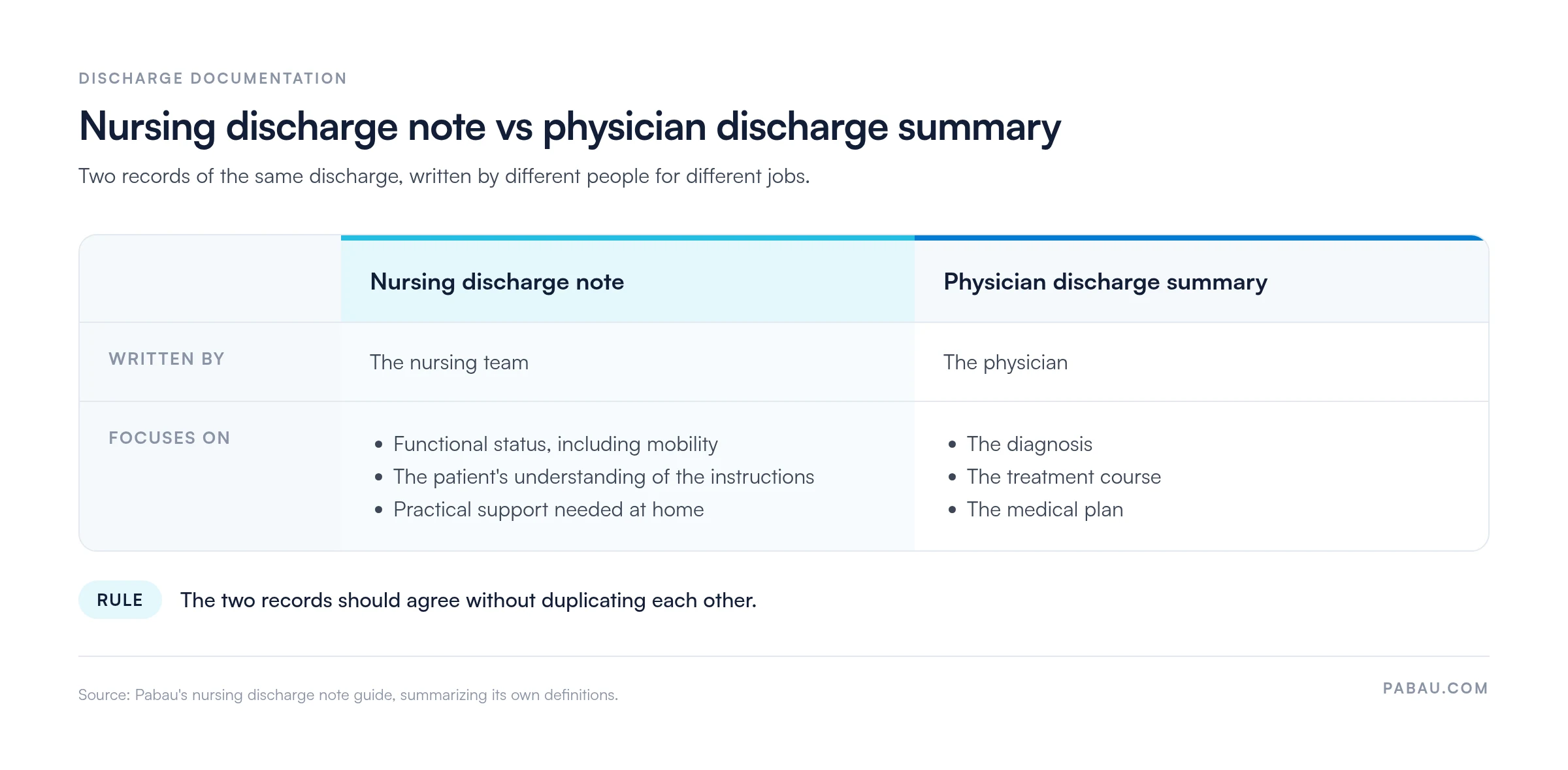
A complete nursing discharge note covers the same core areas in every setting. Each element has a clinical reason for being there.
The written instructions often go home as a separate handout, and our guide to patient discharge instructions covers what to put in it. The exact requirements vary by setting and by state. Check your facility policy and your state board of nursing guidance before you finalize a template.
Writing the note is faster when you work through it in the order the information becomes available. Start while the patient is still with you, not after they have gone.
Many nurses use a SOAP note structure for the clinical narrative, with subjective and objective findings followed by the assessment and plan. This format works well for the body of the note, provided the discharge-specific sections are still clearly labeled.
The free template gives you seven sections, each with space for free-text notes. It has no vital-signs or signature section, so the last two rows below are recommended additions to make yourself. Adapt the rest to your setting.
Consider a 68-year-old patient discharged from a surgical ward after a hip replacement. The patient is mobile with a walker, afebrile and oriented. The note records the final vital signs as within normal limits and lists the new anticoagulant with its dose and duration.
It also states that the patient and their daughter reviewed the written instructions, including wound care and when to seek help. The follow-up section records a physical therapy referral and a wound check at a primary care follow-up within seven days.
The example is only illustrative. Your own notes should reflect the patient in front of you, their orders and your facility’s policy.
Discharge planning starts at admission. The nursing assessment identifies the support a patient will need, and the care plan tracks progress against it. The discharge note hands those plans over to the next setting. That might be home, a community team or a skilled nursing facility.
A discharge planning checklist started at admission keeps those needs visible until the day the patient leaves. The Re-Engineered Discharge (RED) program, later published as an AHRQ toolkit, breaks discharge into defined steps. One of them is a written care plan for home.
In a randomized trial published in 2009, patients who went through RED had about 30% fewer emergency visits and readmissions within 30 days. That result reflects the whole discharge process, not the nursing note on its own.
Discharge note requirements change with the setting. A skilled nursing facility must meet CMS discharge planning conditions for its residents, which shape what the note must cover. Home health and outpatient practices often work to different local policy and to their own state board guidance.
Because the rules differ by state and by facility, treat any single format as a starting point. Confirm the specific requirements with your state board of nursing and your compliance lead before you adopt a template across sites.
The same errors turn up again and again, which makes them easier to prevent. Many come from completing the note after the patient has left.
A template prompts every section, but it can’t check what goes into them. A completed field doesn’t prove the medication list is correct.
On paper, a discharge note gets printed, filled in by hand and scanned into the record later. Until someone scans it, the next clinician can’t find it.
Pabau’s patient intake software lets you rebuild the template as a digital form with the same seven sections. The nurse completes it on a tablet or computer, and it saves straight to the patient record as a structured form.
You can add the vital-signs and signature fields your policy needs while you build it. The digital version then covers more than the PDF, and the next clinician finds the note alongside the rest of the patient’s history.

Pabau’s digital forms turn your discharge template into a structured form that saves to the patient record. The next clinician finds the note where they already look.

A discharge note does its job in the first week after the patient leaves. Write it before they go, reconcile the medication list against the discharge order, and give every follow-up a date and a provider.
The free template gives you seven core sections. Add vital signs and a signature line before you roll it out, and check it against your state board guidance.
Book a demo to see how Pabau keeps your completed discharge notes on the patient record, ready for the next clinician.

Need a broader discharge form? Patient discharge form template covers the administrative side of discharge alongside the clinical note.
Planning the discharge from admission? Discharge plan template tracks the support a patient needs before the day they leave.
Documenting the start of the stay? Admission nursing note shows how to record the assessment your discharge note later closes out.
Writing narrative entries between admission and discharge? Nursing narrative note template gives you a structure for shift-by-shift notes.
Confirming follow-up in writing? Patient follow-up letter template puts the follow-up date and provider in the patient’s hands.
A nursing discharge note is the nursing record of a patient’s condition, medications, vital signs, instructions and follow-up when they leave a facility or service.
Include condition at discharge, final vital signs, medication reconciliation, written discharge instructions, follow-up appointments and the signature. Requirements vary by setting, so check your policy.
The nursing note records the patient’s functional status and the support they need, while the physician discharge summary records the diagnosis and medical plan. The two should agree.
Yes. A template gives you a consistent structure, but you still record this patient’s details and confirm the medication list against the discharge order.