Waist-to-hip ratio chart: Risk bands for women & men (free PDF)
A waist-to-hip ratio chart sorts a patient’s waist-to-hip ratio (WHR) into...

3
Last Updated: Oct 14, 2026
A mind diet plan is a structured eating approach that combines Mediterranean and DASH dietary principles to support cognitive function as people age. Nutritional epidemiologist Dr. Martha Clare Morris developed it at Rush University Medical Center. The plan emphasizes leafy greens, berries, nuts, whole grains, fish, and olive oil, and it limits red meat, butter, cheese, pastries, and fried food.
Research from the Rush Memory and Aging Project links close adherence to the MIND diet with slower cognitive decline. A 2023 trial in the New England Journal of Medicine found more modest benefits when the diet was compared with a standard calorie-restricted diet. So the plan is best presented as a nutrient-dense eating pattern, with no promise of dementia prevention.
This guide gives practitioners and patients a practical MIND diet plan, with a downloadable 7-day meal plan and a quick-reference food list. It also covers how to adapt the plan for older adults and people managing cognitive health.
A printable MIND diet plan with a 7-day meal plan and a food list showing serving frequencies. It also includes a quick food reference guide for patients focused on brain health.
Download template
The MIND diet combines Mediterranean and DASH eating patterns, emphasizing leafy greens, berries, nuts, whole grains, fish, and olive oil for cognitive health support.
Observational research shows slower cognitive decline in older adults who follow the MIND diet consistently, though 2023 trial findings are more modest than initial claims.
The diet specifies 10 brain-healthy food groups to eat regularly and five unhealthy categories to limit, with a serving frequency for each.
Structured meal plans and food lists make the targets easier to follow, especially for older adults who need texture or portion changes.
The MIND diet (Mediterranean-DASH Intervention for Neurodegenerative Delay) is a hybrid dietary framework. It pairs the core foods of a Mediterranean diet plan with the blood-pressure-lowering approach of the DASH (Dietary Approaches to Stop Hypertension) diet. Instead of adopting either diet wholesale, it keeps only the foods with the strongest links to cognitive health.
Dr. Morris and colleagues at Rush University developed the MIND diet for a simple reason. Neither the Mediterranean nor the DASH diet alone fully explained cognitive outcomes in their observational cohorts.
Their research, published in Alzheimer’s & Dementia (2015), identified 10 food groups linked to slower cognitive aging. These are leafy greens, whole grains, berries, nuts, fish, legumes, poultry, olive oil, moderate wine, and other vegetables. They also defined five unhealthy food groups to minimize: red meat, butter and margarine, cheese, pastries and sweets, and fried and fast foods.
Its precision is what makes the MIND diet usable in practice. Each food group has a serving frequency, so practitioners can give patients countable targets instead of generic “eat healthy” advice.
Each of the 10 food groups below is linked to slower cognitive decline in the Rush cohorts, and each has a recommended minimum serving frequency.
The MIND diet caps five food groups. In the research cohorts, these were the foods linked to faster cognitive decline.
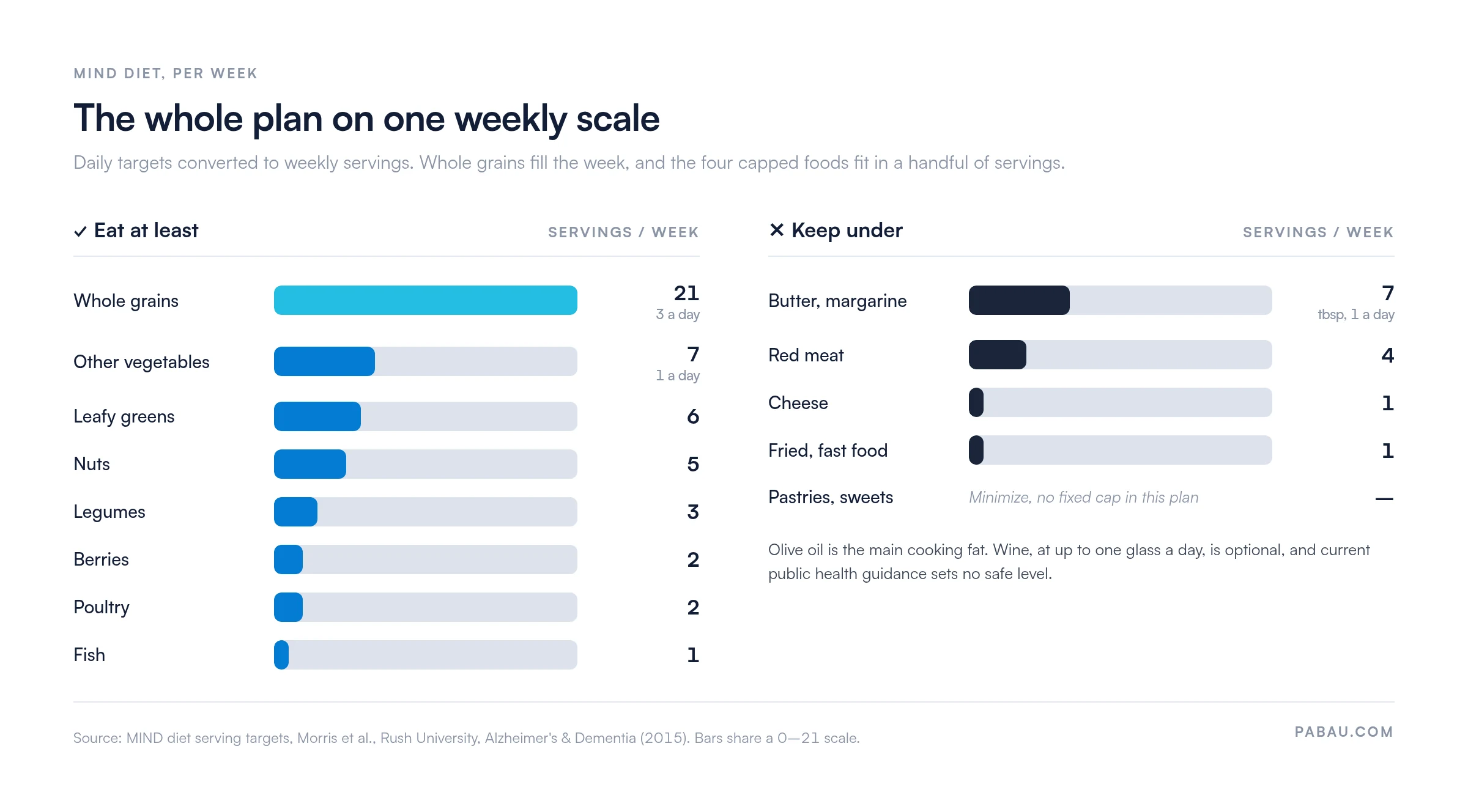
Put every target on the same weekly scale and the shape of the plan becomes clear. Whole grains alone account for 21 servings a week, while red meat, cheese, and fried food together stay under six.
This sample week shows how to spread the 10 MIND food groups across daily meals. Patients can repeat days or swap meals based on preferences, seasonal produce, and individual dietary needs.
The MIND diet was designed around older adults, but aging bodies need a few adjustments. The aim is to keep nutrition adequate while still hitting the food-group targets.
Knowing how the MIND diet differs from its parent diets helps practitioners and patients choose the right approach. The best fit depends on whether cognitive or cardiovascular health is the main goal. For patients whose priority is blood pressure, a DASH diet plan targets sodium more directly.
The core distinction: The MIND diet does not use every element of either parent diet. It keeps only the foods and serving frequencies that independently predict cognitive outcomes. That makes it the more focused choice when cognitive health is the main clinical goal.
The evidence for the MIND diet comes in two tiers. The observational data is strong, and the one large randomized trial is more modest.
Observational evidence (strong): The Rush Memory and Aging Project followed over 900 cognitively normal older adults for up to five years. Participants with the highest MIND diet adherence showed cognitive trajectories equivalent to being 7.5 years younger than those with the lowest adherence. The finding was published in Alzheimer’s & Dementia (2015).
Randomized trial (2023, more modest): The MIND trial was published in the New England Journal of Medicine (Barnes et al., 2023). It randomized 604 cognitively normal older adults to either the MIND diet or a control diet. The trial found no significant cognitive benefit of the MIND diet beyond standard calorie-restricted eating. Observational associations often shrink once they are tested in a randomized controlled trial.
Practitioners can frame the MIND diet like this: “It is associated with slower cognitive aging in observational studies. Recent trial evidence, though, suggests calorie restriction and weight management may drive most of the cognitive benefit. The MIND diet provides a nutrient-dense framework optimized for brain health while supporting overall cardiovascular and metabolic health.”
Patients new to structured eating plans usually do better with a step-by-step start than with a complete dietary overhaul. A simple food diary shows them which food groups they still eat too rarely.
Medical disclaimer: This MIND diet plan template is an educational tool and does not constitute medical or dietary advice. Talk to a healthcare provider or registered dietitian before making major dietary changes. This matters most for people with existing medical conditions, those taking medications, and anyone managing cognitive health concerns. The information presented reflects current research evidence as of 2026 and is not a guarantee of clinical outcomes.
Diet plans often go out on paper. A month later, nobody can say who received one or whether it helped, and adherence notes sit scattered across emails and appointment comments.
Practice management software like Pabau keeps that work in one place. You can send the MIND diet plan through the Client Portal and attach it to the patient record. Digital forms then collect food diaries before each review. Every subscription includes every feature, so forms, the portal, and clinical notes come as one system.
The result is a clear record of what each patient was given and how they are progressing. That makes each nutrition review faster and more personal. Practices that also run weight-management programs get the same tools, because Pabau doubles as streamlined weight-loss clinic software.

Share MIND diet plans through the Client Portal and track adherence with digital forms. Pabau keeps every nutrition review in one practice management system.

Recommend the MIND diet as a nutrient-dense eating pattern for older adults, and be clear that it has not been shown to prevent dementia. Patients who hear that at the first consultation are more likely to stay with the plan once the headlines fade.
Start small, with the printable meal plan and one food swap a week, and review progress at regular appointments. Steady adherence counts for more than a perfect week. Book a demo to see how Pabau helps you share diet plans and track patient progress in one system.

Focusing on inflammation? Anti-inflammatory meal plan template builds a week around omega-3s, produce, and whole grains.
Supporting heart and brain together? Heart healthy diet plan covers the cardiovascular side of the same food choices.
Working with residents in long-term care? Long term care dietitian cheat sheet gives dietitians a quick reference for older patients.
Eat the recommended daily or weekly servings of 10 brain-healthy food groups. These are leafy greens, other vegetables, berries, nuts, fish, legumes, whole grains, poultry, olive oil, and moderate wine. At the same time, limit red meat, butter, cheese, pastries, and fried foods. Use the downloadable 7-day meal plan and food list as a practical implementation guide.
The MIND diet includes leafy greens such as spinach and kale, berries, nuts, whole grains, and other vegetables. It also includes fish (especially fatty fish like salmon), legumes, poultry, and olive oil. These foods are chosen for their associations with slower cognitive aging.
Limit five food groups: red meat, butter and stick margarine, cheese, pastries and sweets, and fried or fast food. Keep red meat under four servings a week and butter under one tablespoon a day. Keep cheese and fried food under one serving a week. Swap butter for olive oil and red meat for fish, poultry, or legumes.
The MIND diet emphasizes antioxidant-rich foods like berries and leafy greens, plus omega-3 fatty acids from fish. These may reduce neuroinflammation and support vascular health, both of which are linked to cognitive function. Observational studies show slower cognitive decline, while randomized trial evidence is more modest.
The MIND diet is associated with slower cognitive aging in observational research. However, clinical trials have not shown that it prevents or cures Alzheimer’s disease. Current evidence suggests it supports brain health and may reduce cognitive decline risk as part of a comprehensive approach to aging.
The MIND diet keeps only the Mediterranean foods most strongly associated with cognitive outcomes. The full Mediterranean diet is built for overall cardiovascular health and longevity. MIND is more targeted toward brain health and cognitive aging.
Yes. This guide includes a downloadable MIND diet plan PDF with a 7-day meal plan and a food list with serving frequencies. It is designed to print cleanly for patients and practice use.
Perfect adherence is unnecessary. Observational research shows cognitive benefits with high adherence, but gradual implementation and consistency matter more than perfection. Work with a registered dietitian to find a sustainable, personalized approach aligned with individual food preferences and cultural eating patterns.