CMMC compliance checklist
A CMMC compliance checklist lists every security practice a Department of Defens...

Last Updated: Oct 6, 2026

A Texas medical power of attorney lets you name a health care agent to make medical decisions once you cannot make them yourself.
Section 166.154 requires two qualifying witnesses or a notary, and Section 166.003 disqualifies the agent, relatives and heirs from being the disinterested witness.
Section 166.162 makes the document ineffective unless the principal first signs an acknowledgment that they read the Section 166.163 disclosure statement.
The agent gains authority only when the attending physician certifies incompetence in writing, not on a date the principal writes on the form.
This download is a working template, not a statutory form, so transfer the details into the Texas HHS form before anyone signs.
A worksheet for gathering the principal’s details, the named health care agent, the scope of authority, special instructions and signature blocks. It is a starting draft rather than the statutory form, so pair it with the Chapter 166 disclosure statement and execution steps below.
Download templateA Texas medical power of attorney (MPOA) names the person who speaks for a patient once that patient cannot speak for themselves. The template above collects the details that decision needs. Texas law then adds three requirements no blank form carries on its own, and this guide walks through each one.
You will also find the practical side. That covers how to complete the document, who may act as agent, and who may witness it. It also covers when the agent’s authority begins, and how a practice verifies and stores the signed copy.
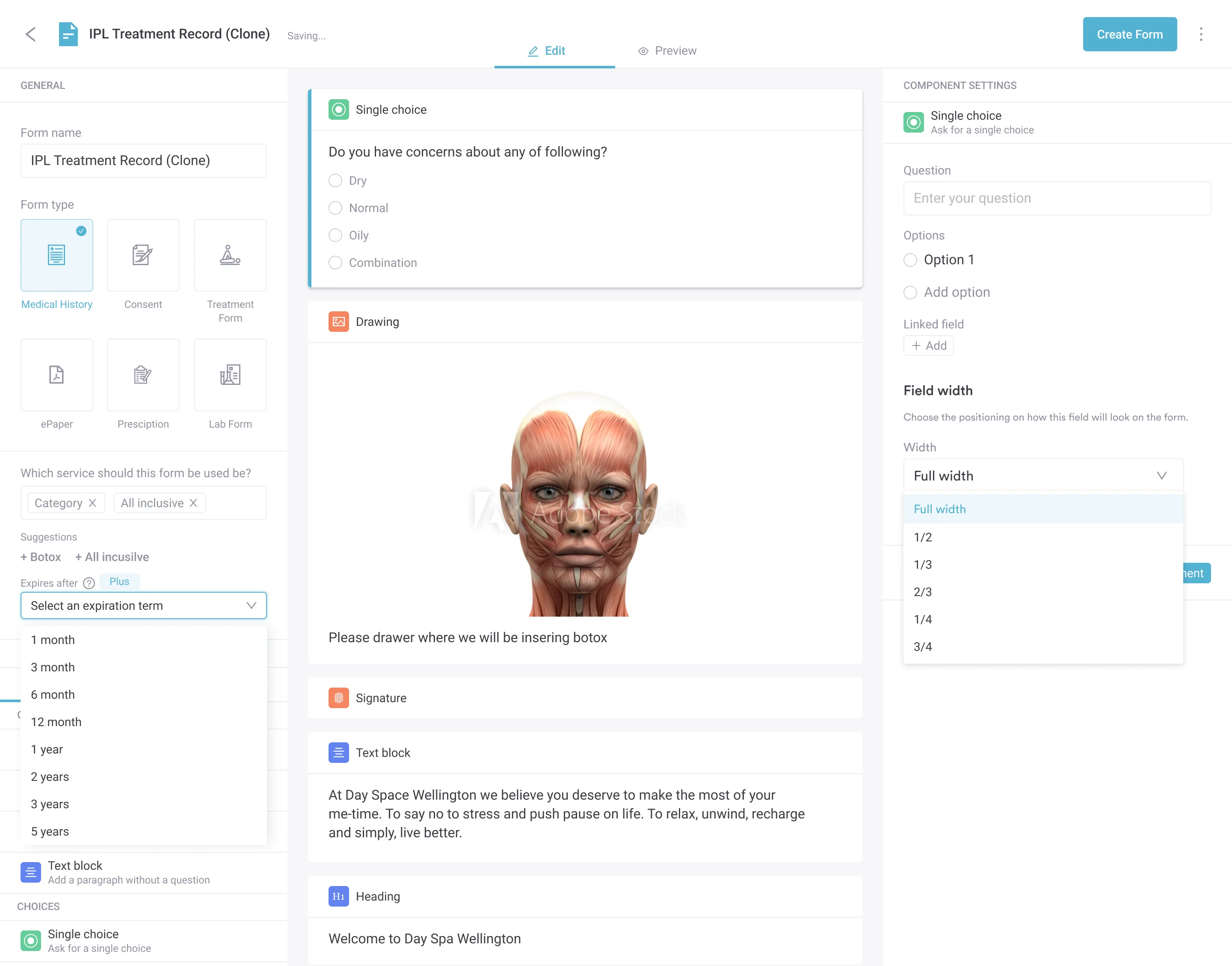
Read this section before you hand the download to a patient. The file is a clinical form template. It gathers the substance of an MPOA, but it is not the statutory form. Signing it alone does not create a valid medical power of attorney in Texas.
What the download does give you is a clean place to draft the decisions before they go on the record:
Three statutory requirements sit outside the file. The table below shows what each one needs, so no one signs prematurely.
Two smaller edits are worth making on the printed copy. Strike the fixed effective-date field, because a date there misleads the principal about when the agent takes over. Rewrite the date fields in month/day/year order, since the file prints them day first.
For the document a patient signs, work from the statutory form in Section 166.164 or the Texas HHS medical power of attorney form. Both already embed the disclosure acknowledgment, the duration wording and the witness attestations. Treat the download as the draft and the statutory form as the record.
An MPOA is a legal document under Texas Health and Safety Code Chapter 166. It lets a principal, meaning the person creating the document, designate a health care agent to make medical decisions for them.
The MPOA is a safety net for unexpected incapacity. A living will, called a directive to physicians in Texas, records end-of-life preferences. The MPOA does something different. It hands decision-making authority to a named person for any medical situation the principal cannot handle.
For a practice, the MPOA is an authorization document. Once you receive and verify a valid MPOA, you know who can consent on the patient’s behalf. That protects the patient’s autonomy and your clinical team’s legal footing at the same time.
An MPOA does not take effect on signing. Under Section 166.152(b), the agent may exercise authority only after the attending physician certifies in writing that the principal is incompetent. That certification is filed in the medical record.
The two-step trigger protects the principal. While they can understand the nature and consequences of a health care decision, they keep full control. Once the physician documents incompetence, the agent steps in, and that authority lasts as long as the incapacity does.
This is why the certification belongs in the patient’s medical record, not in a side note. The competency assessment is what switches the document on. It needs a date, a signature and a place in the chart your team can find.
Most competent adults can serve. Section 166.153 is narrow and specific about who cannot, and the bar exists to keep care decisions away from the people delivering the care.
One point often gets muddled. Heirs and beneficiaries are not barred from acting as agent. They are barred from being the disinterested witness, which is a separate rule covered further down this page.
When you verify an MPOA at the front desk, check the agent’s name against Section 166.153 first. Suppose a member of your own team is named, and is not a relative of the patient. Flag that to your clinical lead before the document goes on file.
The authority is broad by default. An agent can consent to any treatment, procedure or service the principal could consent to themselves. That runs from a routine examination through to major surgery.
Five decisions sit outside that authority. Section 166.152(f) bars the agent from consenting to voluntary inpatient mental health services, convulsive treatment, psychosurgery or abortion. It also bars neglect of the principal through withholding comfort care. No wording in the document can hand the agent those powers.
That reach also covers access to medical records, review of diagnoses, and decisions about hospitalization or refusing treatment. The agent stands in the principal’s shoes for the duration of the incapacity.
Many principals narrow the scope with special instructions. A document might withhold consent to life-sustaining treatment in defined circumstances, or require the agent to weigh the principal’s religious beliefs. Your clinical team has to read those instructions and follow them.
Work through five sections in order. Draft them on the template if that is easier. Then transfer the content onto the Texas HHS form or the Section 166.164 statutory form before signing.
Step five is where most self-made forms fail. Section 166.162 says the MPOA is not effective unless the principal signs a statement confirming they received, read and understood the disclosure statement. That acknowledgment comes before execution, not after it. The flow below shows where each step sits.
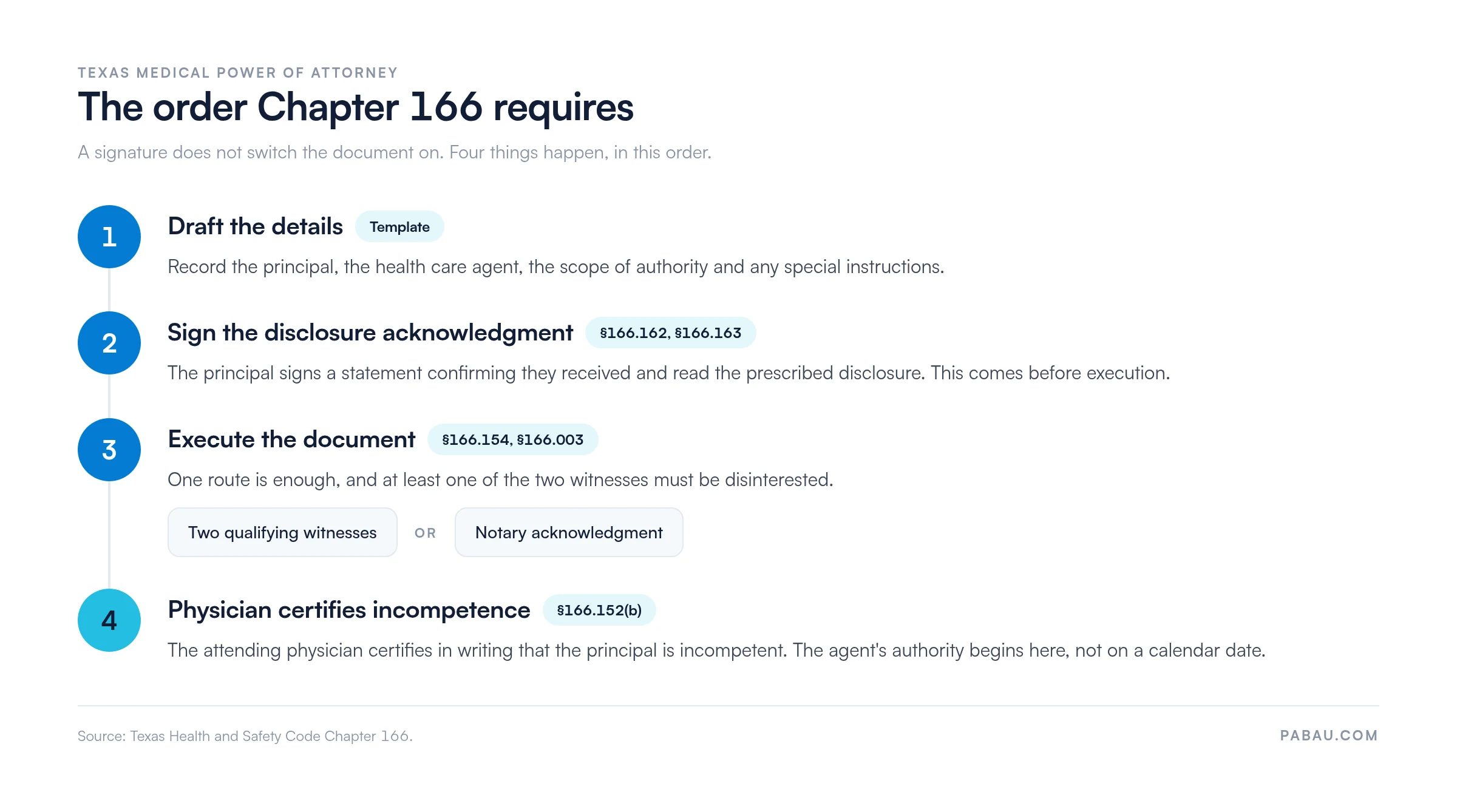
Section 166.154 sets the execution rules, and it offers two routes. The principal can sign in front of two witnesses who qualify under Section 166.003. Alternatively, the principal signs and has that signature acknowledged before a notary public.
The witness route has a condition that trips people up. Both witnesses must be competent adults, and at least one of them must be disinterested under Section 166.003(2). A single generic signature line cannot capture that, which is why the download needs two proper witness blocks.
Only one route is needed. You do not need witnesses and a notary, and the document is not valid with neither. If the principal cannot physically sign, Section 166.154(c) lets another person sign in the principal’s presence at their express direction.
Keeping the signed original or a certified copy in the patient chart is the practical requirement. That filing habit is part of HIPAA compliance for any medical office. Digital forms with electronic signatures can work here where they meet Texas electronic signature law.
A principal can revoke an MPOA at any time, and Section 166.155 does not make competence a condition of doing so. There are three routes.
Divorce is the fourth route, and it works automatically. If the agent is the principal’s spouse and the marriage is dissolved, the agency ends unless the document says otherwise. A replacement MPOA still saves your front desk an argument later.
Chapter 166 authorizes three separate advance planning documents. Knowing which is which stops confusion when a patient arrives holding more than one.
Many Texans hold all three. The MPOA covers ongoing decisions, the directive covers end-of-life wishes, and the out-of-hospital DNR speaks to first responders. Your practice should accept and honor each of them.
The download suits anyone who needs to draft the substance of an MPOA before it goes onto the statutory form.
It does not suit anyone who wants a form to sign today with no further work. That reader should go straight to the Texas HHS form. Readers outside Texas should start from our medical power of attorney template instead.
From the provider side, the MPOA is an authorization tool. When a patient arrives unable to consent, whether through sedation, incapacity or an emergency, the document names who decides. Your practice needs a written workflow for verifying, storing and consulting it.
Start with validity. Check the date, the disclosure acknowledgment, and either two witness signatures or a notary seal. Ask the agent for identification. If the copy is old, unclear or unsigned, request a certified copy before you rely on it.
Before the MPOA is effective, family members have no automatic right to the chart. A signed records authorization is what lets you share information with them, and our Texas HIPAA release form covers that request.
Then store it where the clinical team will look. A secure patient portal lets families upload the document straight into the record. Paper copies go missing, and an emergency is the wrong time to find that out.
Finally, follow the agent’s decisions as you would the patient’s own, and note in the record when consent was given and for what. If a request looks clinically inappropriate, escalate to your ethics or legal contact rather than quietly ignoring the MPOA.
Fold the checks into the routine your team already follows, using compliance software for practices to hold the review dates. Agents move and relationships change, so a document reviewed every few years is easier to act on than an old one.
In many practices the signed MPOA lives in a filing cabinet or a scanned folder on a shared drive. When a patient arrives incapacitated, someone has to go looking for it. The physician’s competency note usually sits somewhere else again.
Practice management software like Pabau keeps both on the same client record as the appointment. Digital forms collect the agent’s details at intake, and the completed document is stored against the patient rather than in a separate archive.
Patients and families can upload a signed MPOA through our online booking and portal pages, so the document reaches the record without a scanning queue. Automated email and SMS campaigns then prompt patients to refresh an aging directive.
The outcome is a shorter check at the desk. Your team opens one record and sees the current MPOA, the disclosure acknowledgment and the certification. They can then tell the agent what they are authorized to decide.

Pabau stores advance directives, intake forms and clinical notes on one client record. Your team can confirm an agent’s authority without hunting through paper files.

A medical power of attorney is only as good as its execution. Texas makes that concrete. Without the signed disclosure acknowledgment under Section 166.162, the document is not effective. Without proper execution under Section 166.154, it does not do the job the principal intended.
So use the download for what it is. Draft the agent, the scope and the instructions on it. Then move that content onto the Texas HHS form or the Section 166.164 statutory form for signing. The trade-off is one extra step now against a document that holds up later.
On your side of the desk, the work is verification and storage. Decide now where a signed MPOA lives and who checks it, before a patient arrives unable to consent. Book a demo to see how Pabau keeps MPOAs and clinical notes on one client record.

Need the version for another state? Medical power of attorney template covers the same agent designation without the Texas-specific rules.
Collecting consent before treatment? Consent for medical treatment gives you a form for the procedure itself, which an MPOA never replaces.
Wondering how long to keep the signed copy? How long to keep medical records sets out the retention periods that apply to advance directives.
Writing the notice patients get at registration? Client rights template spells out what patients may decide and who may decide for them.
Auditing your wider privacy practices? HIPAA compliance for medical offices walks through the safeguards a records workflow needs.
A medical power of attorney (MPOA) is a legal document that lets you name a health care agent. That agent makes medical decisions for you when you cannot make them yourself. Texas Health and Safety Code Chapter 166 governs it.
No. Section 166.154 lets the principal sign in front of two qualifying witnesses instead. Notarization is the alternative to witnesses, not an extra step on top of them.
Most competent adults can serve. Section 166.153 bars the principal’s health care provider and residential care provider, plus their employees. An employee who is a relative of the principal is exempt from that bar.
Yes, but only as the second witness. Section 166.003 requires at least one disinterested witness, and that person cannot be a relative, an heir, or the named agent.
An MPOA gives a named agent decision-making authority for any medical situation once the principal is incapacitated. A living will, called a directive to physicians, records end-of-life preferences and applies when a terminal or irreversible condition is certified.
You have three routes. Give written notice to your agent or to a licensed health or residential care provider. You can also tell them orally and have it noted in your record, or execute a new MPOA. Divorce revokes a spouse agent unless the document says otherwise.
No. It is a worksheet for drafting the agent designation. A valid MPOA also needs the Section 166.163 disclosure statement, the signed acknowledgment required by Section 166.162, and execution under Section 166.154.