High protein grocery list: Free PDF with protein per serving
A high protein grocery list is a shopping guide that groups protein-rich foods b...

Last Updated: Oct 8, 2026
A lying down blood pressure chart sets out the normal, elevated, and hypertensive ranges for supine readings, with a printable log for recording them. Normal supine blood pressure is below 120/80 mmHg, the same threshold the American Heart Association applies to seated readings.
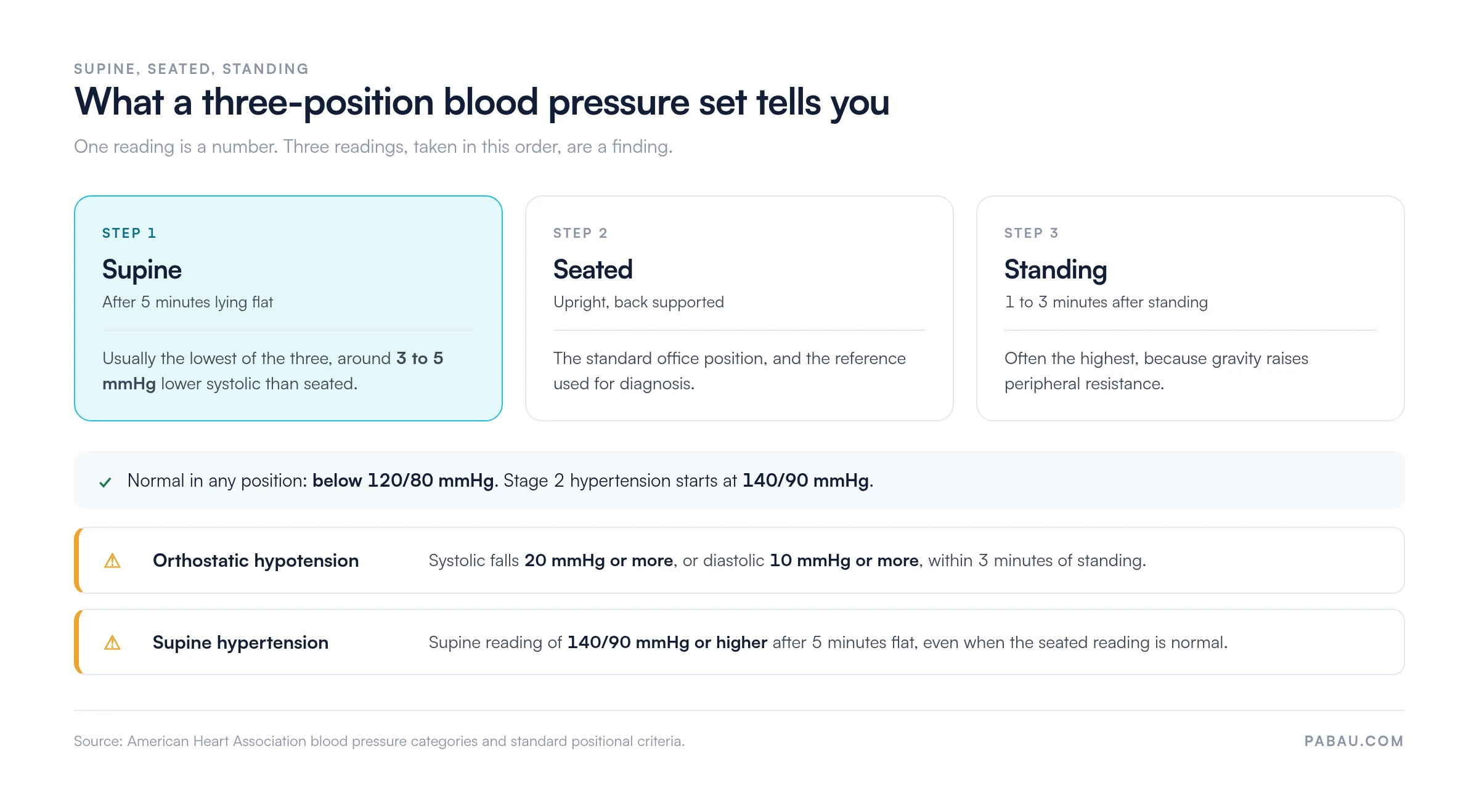
Supine hypertension is diagnosed at 140/90 mmHg or higher after five minutes lying flat, and seated office readings routinely miss it. That is why the chart below logs supine, seated, and standing measurements side by side. Comparing the three positions is what turns a column of numbers into a clinical finding.
The file carries supine reference ranges by category and by age, the orthostatic and supine hypertension criteria, and correct measurement technique. A dated tracking log follows, with columns for position, arm used, and symptoms.
Download template
Normal supine blood pressure is below 120/80 mmHg, the same threshold the American Heart Association applies to seated readings.
Supine readings usually run 3 to 5 mmHg lower systolic than seated ones, because lying flat reduces the heart’s workload.
Supine hypertension reaches 140/90 mmHg or higher after five minutes lying flat, and it can coexist with a normal seated reading.
Orthostatic hypotension is a drop of 20 mmHg systolic or 10 mmHg diastolic within three minutes of standing.
Logging supine, seated, and standing readings on one chart is what makes either pattern visible.
A lying down blood pressure chart organizes normal blood pressure ranges by body position, so supine, seated, and standing readings sit side by side. It shows both components of every reading. Systolic pressure is the top number and diastolic pressure is the bottom number, both measured in mmHg.
Seated office readings alone hide three patterns the chart is built to surface. Supine hypertension, orthostatic hypotension, and white-coat effects all show up only when positions are compared. The printable format also lets patients record readings at home in the evening, which is when the nocturnal pattern appears.
Normal blood pressure is below 120/80 mmHg in any position, according to the American Heart Association. Supine readings often sit slightly lower than seated ones, because lying flat reduces the gravitational load on the heart.
These thresholds hold across every measurement position. A supine reading a few points below them is still normal. A supine reading at or above them puts the patient in the elevated or hypertensive range, whatever position it was taken in.
Blood pressure changes with position because gravity alters blood flow and cardiac load. Lying flat reduces the work the heart does to pump against gravity, which usually produces a slightly lower reading than sitting or standing.
A chart that carries all three positions lets you compare them at a glance. Measurement tracking software does the same job inside the patient record, with the readings dated and attributed as they arrive.
The comparison matters clinically. A patient with a normal seated reading and an elevated supine one may have supine hypertension. Research links that pattern to cardiovascular risk independent of daytime pressure.
Orthostatic hypotension is a drop of 20 mmHg or more in systolic pressure within three minutes of standing. A fall of 10 mmHg or more in diastolic pressure counts too. Symptoms include dizziness, lightheadedness, blurred vision, and fainting.
Including orthostatic vital signs on the chart keeps a treatable condition from being missed. Medication adjustment, hydration advice, or compression stockings can ease the symptoms and prevent falls.
Supine hypertension is persistently elevated blood pressure while lying down, and it can sit alongside a normal or even low seated reading. The threshold is 140/90 mmHg or higher after five minutes lying flat.
A 2023 study published in the journal Hypertension analyzed supine and seated readings from a large cohort. Researchers at Beth Israel Deaconess Medical Center and Harvard Medical School found that supine blood pressure predicts cardiovascular events and mortality on its own. The association was strongest in older patients and those taking antihypertensive medication.
Office visits capture seated readings, so the pattern goes unrecorded unless someone measures in the supine position.
A chart that includes an evening or bedtime supine reading surfaces it, which gives the clinician grounds to adjust therapy or refer. The European Society of Cardiology now recommends this for resistant hypertension and for patients with nocturnal symptoms.
Read together, the three positions and the two thresholds turn a set of numbers into a finding.
Accurate supine measurement depends on standardized technique, because reproducible numbers are what make the positional comparison valid.
This mirrors the technique the American Heart Association recommends for office measurement. Consistency is what makes a pattern visible over weeks rather than days. Home logs kept this way are increasingly used to judge medication effects and guide dose changes.
Supine readings taken in the evening or just before sleep capture the nocturnal dip. Blood pressure normally falls 10 to 20 percent during sleep. When that fall does not happen, the pattern is called non-dipping, and it carries increased cardiovascular and cerebrovascular risk.
Both the American Heart Association and the European Society of Cardiology support home monitoring, supine readings included, alongside in-office assessment. An evening log shows whether a patient is a dipper, a non-dipper, or someone with supine hypertension despite normal daytime numbers. That distinction guides how hard to push treatment.
Ambulatory 24-hour monitoring remains the gold standard for confirming suspected supine hypertension, because it records continuously across every position and time of day.
The American College of Cardiology and the American Heart Association point to specific scenarios where supine measurement improves cardiovascular risk detection.
Building supine measurement into GP clinic software keeps the assessment consistent from one visit to the next. A structured chart stored in the patient record also creates an audit trail and makes trends easy to read over time.
A printable chart lets patients take part in managing their own cardiovascular health. Most people can measure at home with a validated automated monitor after a short demonstration.
Patients who log supine readings consistently are quicker to connect symptoms to a pattern, which brings orthostatic hypotension and supine hypertension forward. A secure patient portal lets the clinician read those home readings remotely, so continuity holds without an extra appointment.
Targets shift only subtly with age. The 2017 American Heart Association guidelines define hypertension as 130/80 mmHg or higher for every adult from 18 upward. Clinical practice still allows older patients some latitude, because over-treatment brings its own risk of falls and cognitive impairment.
These thresholds apply to supine readings just as they do to seated ones. Older adults with supine hypertension often need slower medication titration, so treatment does not tip them into symptomatic orthostatic hypotension. The elderly blood pressure chart sets out the same ranges with the age-specific caveats alongside them.
Blood pressure logs contain protected health information, known as PHI, so they belong in a system with access controls and an audit trail. A chart stored in the patient record is time-stamped and linked to the person it belongs to, which a standalone printout never is.
Check that your own template and any patient-completed logs are handled under your practice’s data protection policy. Encrypted portals and secure messaging cut the risk of accidental disclosure while keeping patients involved in their own monitoring.
Where a reading arrives out of range, an alert on the record is more reliable than a clinician noticing at the next review. Our guide to blood pressure monitoring covers how practices set those thresholds and what happens when one fires.
Most practices collect supine readings on paper. The patient fills in a printed chart at home and brings it to the appointment. Someone then types the numbers into the record, or nobody does.
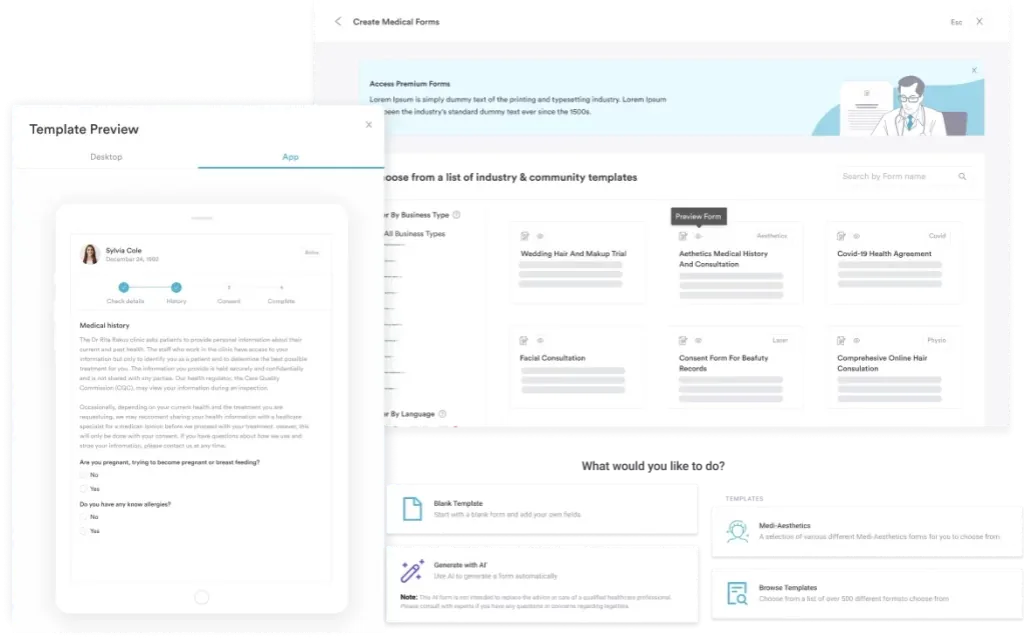
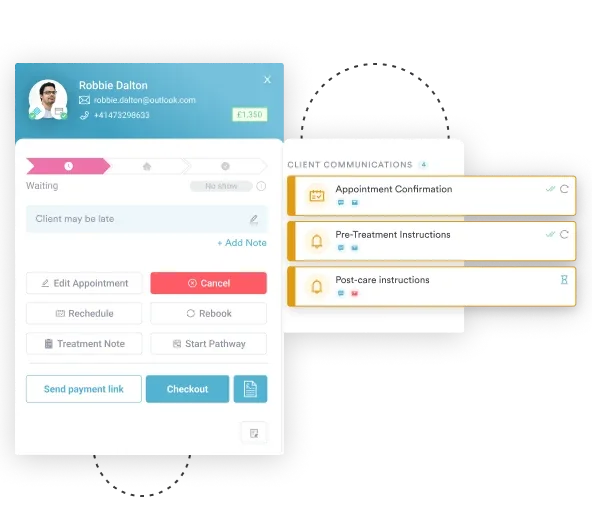
Practice management software like Pabau closes that loop. The chart goes out as a digital form and the patient completes it on their phone. The readings land against their record, already dated and attributed. Automated reminders chase the next entry, so the log stays complete without your team calling anyone.
The outcome is a positional record you can read at a glance. Supine, seated, and standing values sit in one timeline next to medication changes. The decision to titrate up or back off then has evidence behind it.

Pabau’s digital forms and automated reminders collect supine, seated, and standing readings against the patient record. Your team sees the positional trend without chasing a paper chart.

A single supine reading tells you very little. The value sits in the comparison, and then in the series. What the seated number does when the patient lies flat matters more than either figure alone.
Start with the positions you already take and add one. Let the patient rest flat for five minutes, take the reading, then take another on standing, and log both on the same sheet. Four weeks of that tells you more about cardiovascular risk than another year of seated office readings.
The trade-off is the admin. A positional protocol only survives if recording it costs the team almost nothing. That is why the chart belongs in the patient record rather than in a drawer. Book a demo to see how Pabau collects supine readings from patients and files them against the right record.

Need the seated reference ranges too? The normal blood pressure chart covers every category at a glance, without the positional detail.
Tracking readings over months? The blood pressure log gives patients a dated sheet built for daily home entries.
Measuring children? The pediatric blood pressure chart works from percentiles by age, height, and sex rather than fixed adult thresholds.
Logging overnight vitals? The sleeping heart rate chart pairs well with evening supine readings when you are assessing nocturnal patterns.
Screening for peripheral arterial disease? Our guide to the ankle brachial index explains a second supine measurement worth taking in the same visit.
Yes. Lying down usually lowers systolic pressure by 3 to 5 mmHg compared with sitting, because gravity puts less load on the heart. Some patients show the opposite pattern, called supine hypertension, which needs its own monitoring.
Normal supine blood pressure is below 120/80 mmHg, in line with American Heart Association guidelines. Readings of 120 to 129 systolic with diastolic under 80 are elevated. Stage 1 hypertension is 130 to 139 over 80 to 89, and stage 2 is 140/90 or higher.
Lower, for most people, compared with sitting or standing. Older adults are the exception more often than younger ones. Supine hypertension makes the lying-down reading the highest of the three, and it raises cardiovascular risk.
By comparing supine and standing readings. A fall of 20 mmHg or more in systolic pressure, or 10 mmHg or more in diastolic, within three minutes of standing meets the definition. Dizziness or fainting on standing often accompanies it.
The American Heart Association recommends measuring at the same time each day, ideally in the evening, for at least four to seven days. That establishes a baseline. Patients on new or adjusted medication often benefit from daily readings for a few weeks.
Yes, which is the reason positional assessment is worth the extra two minutes. A seated reading under 130/80 can sit beside a supine reading over 140/90 in the same patient. Only a chart that records both will show it.