Despina Petrushevska

OT SOAP note sample: Free template and worked examples
Download your free OT SOAP note sample A four-page form with an identifying head...

3
Last Updated: Nov 5, 2026
Free PDF 2 pages, print-ready Clinician-reviewed
The Loyola Generativity Scale (LGS) is a 20-item self-report questionnaire that measures generative concern, an adult’s interest in guiding and caring for the next generation. Dan McAdams and Ed de St. Aubin published it in 1992, basing it on Erik Erikson’s seventh psychosocial stage, generativity versus stagnation.
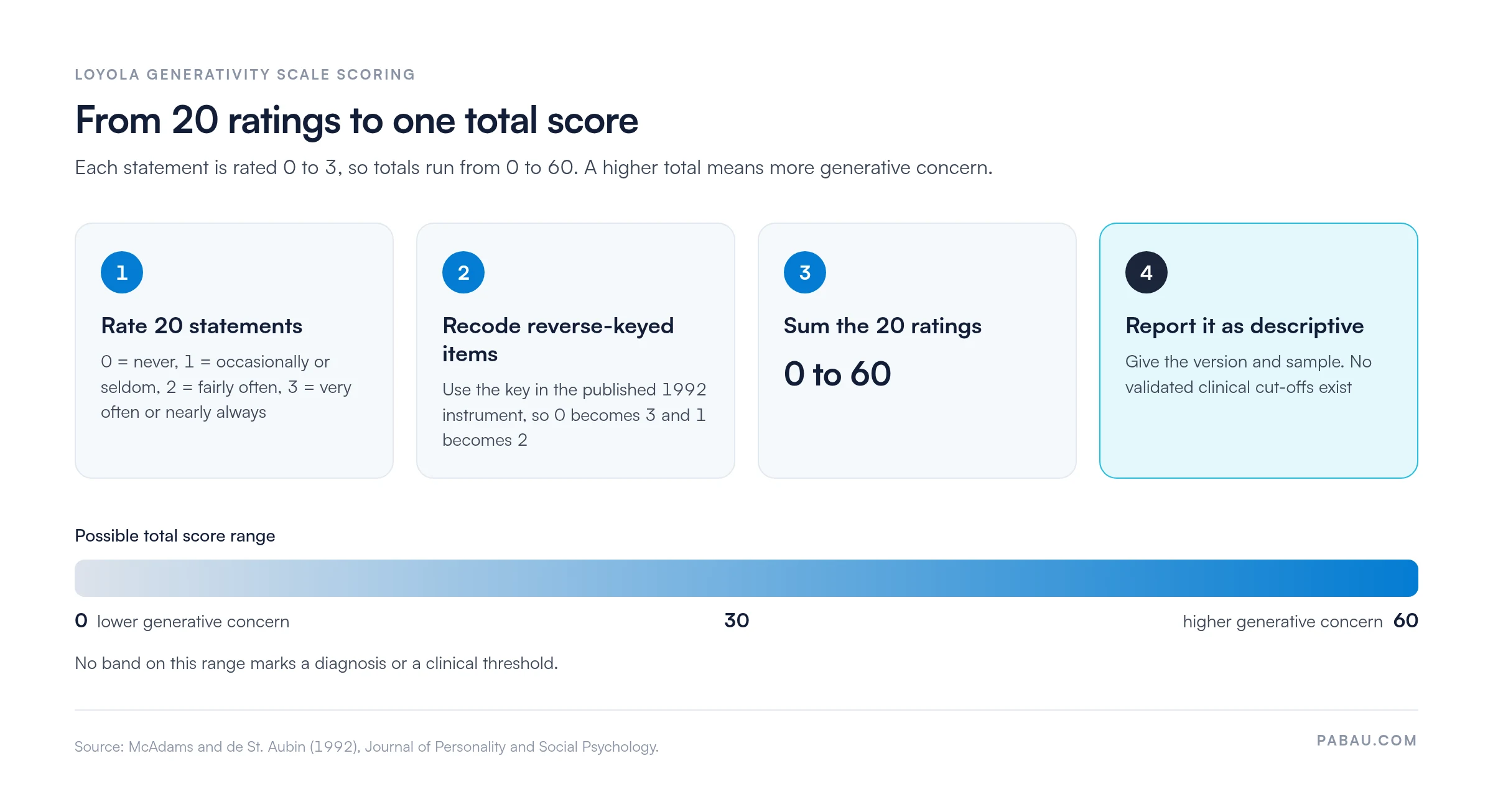
Respondents rate each statement from 0 (never) to 3 (very often or nearly always). Reverse-keyed items are recoded, and the ratings are summed into a total of 0 to 60. Researchers, psychology educators and therapists use the total as a descriptive measure, because the scale has no validated clinical cut-offs.
A ready-to-use copy of the scale items, 0-3 response format and a total-score line, with name and date fields for each respondent.
Start from scratch, or upload this PDF or any form you already use, and Pabau's AI Form rebuilds it with tick boxes, text fields and a signature. Attach it to the treatment once, and every patient gets it on time.
AI Form rebuilds the consent, history and aftercare forms you already use. You review each one, then publish.
Patients complete forms on their phone before they arrive, so the front desk stops retyping paper.
Every signed form is versioned and attached to the treatment record, ready when you need it.
Set how long a consent stays valid. Returning patients skip forms they have already signed.
Supports HIPAA and GDPR compliance AES-256 encryption 4.8 on G2 4.7 on Capterra Trusted by 4,000+ practices worldwide

The Loyola Generativity Scale is a 20-item self-report measure of generative concern in adults.
It is grounded in Erikson’s seventh stage, generativity versus stagnation.
Each item is rated 0 to 3, and reverse-keyed items are recoded per the published instrument before the total is summed.
No validated clinical cut-off scores exist, so it should not be used as a diagnostic tool.
Pabau’s digital forms let teams distribute and store completed scales within client records.
The Loyola Generativity Scale captures how strongly an adult cares for and contributes to the next generation. Respondents rate how often each statement applies to them, and the statements return to three themes.
Erik Erikson proposed eight psychosocial stages across the lifespan, and the seventh, typical of midlife, centers on generativity versus stagnation. The scale operationalizes the generative side of that conflict, which is why it appears in developmental and gerontological research.
Researchers measure generativity because it has been linked to well-being and life satisfaction, particularly among older adults. When a study needs a direct measure of that outcome too, a life satisfaction scale can run alongside the LGS.
Dan McAdams and Ed de St. Aubin developed the Loyola Generativity Scale and published it in 1992 in the Journal of Personality and Social Psychology. Both worked at Loyola University Chicago at the time, which is where the name comes from. Cite that 1992 paper whenever you report LGS results.
The standard LGS has 20 items rated 0 to 3, where 0 means never and 3 means very often or nearly always. The total is the sum of all 20 ratings, so scores run from 0 to 60. The items cover teaching others, creative work, volunteering and being remembered after death.
To score the LGS, recode the reverse-keyed items and then sum all 20 ratings. The original McAdams and de St. Aubin (1992) scale includes reverse-keyed items, so recode them as the published instrument specifies. On a 0 to 3 scale, a recoded rating is 3 minus the original rating.
Compare any copy you use against the published instrument before you score it, because a change in wording can flip an item’s direction. Use the total as a descriptive research value, not a diagnosis. The diagram below shows how 20 ratings become one total.
McAdams and de St. Aubin (1992) reported adequate internal consistency and test-retest reliability for the LGS. Their paper also supported its validity by relating scale scores to generative acts and to generative themes in autobiographical accounts.
Later studies have used the scale with older adult and college student samples. Check the coefficients for the sample closest to yours, because reliability can shift between populations and versions. If you expect respondents to answer in a socially desirable way, consider adding a check such as the Marlowe-Crowne scale.
Shorter versions of the Loyola Generativity Scale are referenced in the literature for studies where time is limited. Confirm the item count and source citation before you use one. A short form may not carry the same psychometric evidence as the full 20 items.
The scale has been used with older adults, midlife adults and college students. Translations and adaptations exist, but validation varies by culture and translation, so check the version used and note the sample when you interpret results.
The Generative Behavior Checklist, published in the same 1992 paper, records how often a person performed specific generative acts. Choose the LGS when you need a self-report rating of generative concern, and the checklist when you need a behavioral profile.
If you are building a wider battery, our set of psychological questionnaires covers other self-report measures you can pair with it.
Administer the scale only in settings where the research or training purpose is clear. Practices that manage completed forms electronically can use digital forms to keep each response in the right patient record.

The downloadable PDF is a ready-to-use copy of the scale items, 0-3 response format and a total-score line. It carries no reverse-scoring key, so take the key from the published instrument. Cite McAdams and de St. Aubin (1992) in any report, and check usage permissions before commercial or institutional use.
Therapists and coaches who use the LGS outside a lab often print the PDF and collect it at the session. Someone then types the total into the notes later. Paper copies go missing between visits, and comparing a score with an earlier one means searching through files.
Pabau, the software for therapy practices we build, turns the scale into a digital form that patients complete before their appointment. Each completed form is saved to the patient’s file in Client records, next to their notes and earlier responses.
Because every completed copy stays on file, you can schedule a repeat administration months later and compare the two totals in one place.

Pabau’s digital forms send the Loyola Generativity Scale before the session and save each completed copy to the patient’s record. Session time then goes on discussing the answers.

The LGS earns its place when you need a quick, well-cited reading of how much an adult invests in the next generation. Its value depends on scoring it the way McAdams and de St. Aubin designed it, with reverse-keyed items recoded before you sum.
Treat any total as a description of one person at one point in time, never as a diagnosis. Record the version, the sample and the date, and the score stays comparable when you repeat it. Book a demo to see how Pabau sends, stores and tracks self-report scales like the LGS for your practice.

Measuring hope alongside generativity? Adult hope scale covers the 12-item measure of goal-directed thinking and how to score it.
Interested in what respondents value? Valued living questionnaire shows how to rate the importance of life areas against how consistently people act on them.
Adding a self-esteem measure? Rosenberg self-esteem scale explains the 10-item scale and its scoring.
Looking at how people handle stress? Coping self-efficacy scale walks through a self-report measure of confidence in coping.
Working with older adults? Geriatric depression scale scoring explains how to score a mood screen built for later life.
The Loyola Generativity Scale measures generative concern, an adult’s interest in guiding and contributing to the next generation. It is based on Erikson’s generativity versus stagnation stage.
Recode the reverse-keyed items as the original McAdams and de St. Aubin (1992) instrument specifies. Then sum all 20 ratings for a total of 0 to 60. Report the total with the version used, since no validated clinical cut-offs exist.
Shorter versions are referenced in the literature, but confirm the item count and citation before use. A short form may carry different psychometric evidence than the full 20-item scale.
Dan McAdams and Ed de St. Aubin developed it and published it in 1992 in the Journal of Personality and Social Psychology. Both were at Loyola University Chicago at the time, which gave the scale its name.