Psychosis spectrum test: What it screens for and how it works
A psychosis spectrum test is a short clinical screening tool that checks for hal...

Last Updated: Oct 5, 2026

Psychological questionnaires are standardized, validated instruments that produce consistent, defensible documentation at intake and through treatment.
The most-used measures are PHQ-9 for depression, GAD-7 for anxiety, PCL-5 for trauma, plus personality and wellbeing scales. Each one is free or affordable for private practice.
Scoring means summing the item responses and reading the total against published cut-offs. On PHQ-9, a single point can move a client into the next severity band.
Practice management software like Pabau sends questionnaires out before the appointment and files the responses in the client record automatically. That removes the printing, the scanning, and the re-typing.
A print-ready set of validated screeners covering depression, anxiety, trauma, personality, and wellbeing. Built for mental health practitioners who need consistent intake and progress documentation.
Download templateValidated psychological questionnaires are the backbone of clinical intake and progress monitoring. Whether you work as a therapist, psychiatrist, psychologist, or counselor, a standardized tool gives you structured information about a client’s mental health. That reduces bias and creates records you can defend later.
This guide covers the measures clinicians reach for most often. It shows you how to score and interpret them, and how to run them through your practice without paper.
Psychological questionnaires are standardized, validated instruments that measure constructs like mood, anxiety, personality traits, trauma symptoms, and wellbeing. Unlike an informal checklist or an unstructured interview, each one has been tested on clinical populations. Their reliability and validity are documented in peer-reviewed literature.
The primary advantage is consistency. Every client answers the same questions in the same order, scored the same way. That makes it possible to compare results over time and to justify a clinical decision during an audit.
These instruments fall into broad clinical domains. Most practices run a core set for the commonest presenting problems, which means depression, anxiety, and trauma. Personality and attachment measures get added when the clinical picture calls for them.
Depression screening. PHQ-9, the Patient Health Questionnaire, is the standard depression measure in primary care and in mental health settings. It is free, validated across populations, and endorsed by NICE and the NHS for routine use. Our PHQ-9 and GAD-7 template puts both forms on one sheet if you screen for the two together.
Anxiety screening. GAD-7 screens for generalized anxiety disorder using seven Likert-scale items. Its brevity is the point, because it fits into an intake slot that is already full. Like PHQ-9, it sits in the public domain and is widely adopted across clinical settings.
Trauma screening. The PCL-5 is the 20-item checklist most practices use for post-traumatic stress disorder, or PTSD. It runs longer than the brief screeners, so it earns its place at intake rather than at every session.
Most of these questionnaires use a Likert-type response scale, usually 0 to 3 or 1 to 4. Each item is answered on a frequency or intensity gradient. Scoring means summing the responses and comparing the total against published cut-off thresholds.
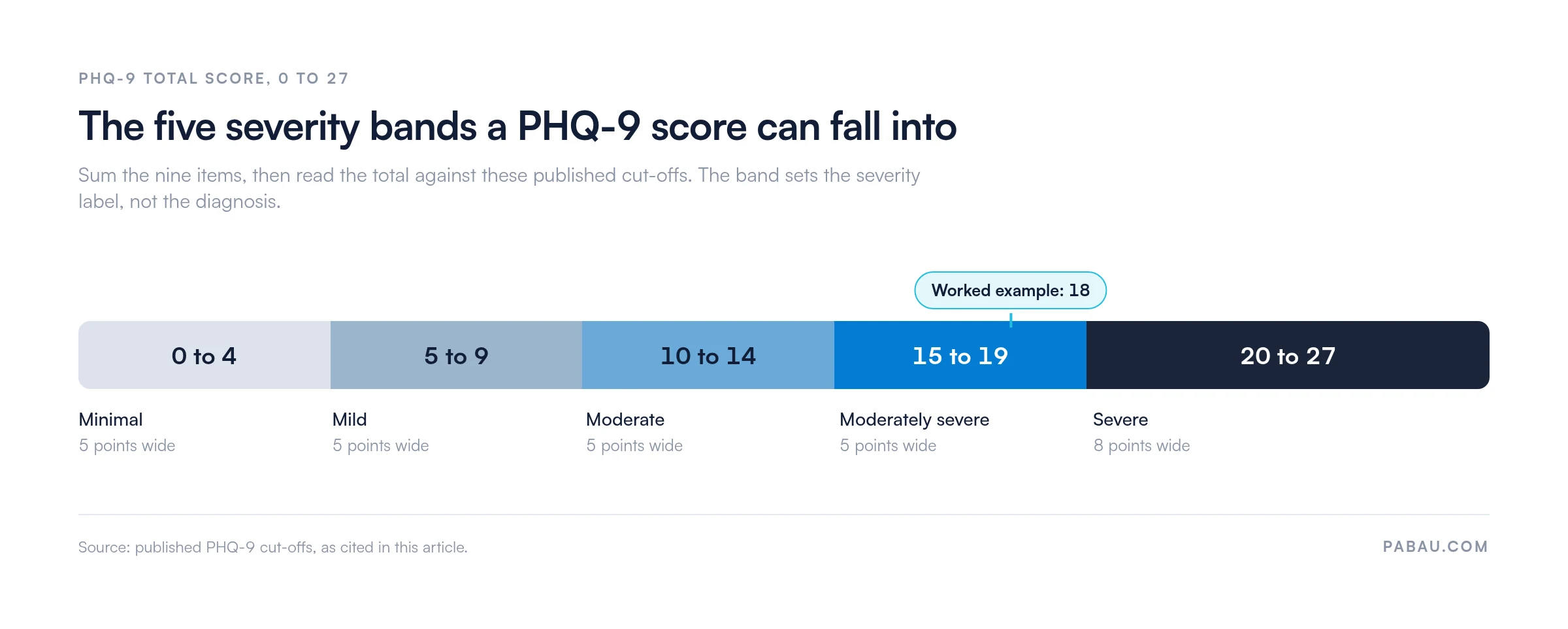
Those bands are tighter than they look. PHQ-9 splits 27 possible points five ways, so a single point can move a client from mild into moderate.
Minimal is 0 to 4, mild is 5 to 9, and moderate is 10 to 14. Moderately severe runs 15 to 19, and severe is 20 to 27.
One common mistake. A cut-off score is not a diagnosis. These instruments screen for symptoms and grade severity, and that is where their job ends. Read every result alongside the clinical interview, the history, and what you observe in the room.
Fitting screeners into intake is a question of timing, storage, and follow-up. The most common approach in private practice is to send them before the first appointment, through a client portal or a secure link.
That structures the information gathering and saves session time. You also open the consultation with baseline scores already in front of you. Any therapy practice management system worth using will attach the form to the upcoming appointment for you.
There are three administration points worth building into your process:
Each point serves a different clinical purpose, so record which one applies alongside the client’s notes.
Data protection. Questionnaire responses are sensitive mental health data under UK GDPR and US HIPAA rules. Store them somewhere secure and encrypted, whether that is a locked cabinet or an electronic record with access controls. Never email a score in plain text, and never leave responses in an unencrypted shared folder.
Paper administration still happens in plenty of practices. Digital delivery cuts scoring errors and stores responses in the client record automatically. Completed forms also come back faster, because the client fills them in at home.
The workflow itself is short. Send the questionnaire through your platform’s client portal, set a completion deadline, and route the responses into the client’s record. Purpose-built digital intake forms do the sending and the filing in one step.
A generic form builder cannot see the appointment, so someone still has to move each file by hand. A dedicated mental health EMR keeps the completed screener, the treatment plan, and the progress note in one client file.
That matters at review time, when you need the PHQ-9 trend and the notes that explain it side by side. Digital delivery also leaves a timestamped trail of when each questionnaire was sent, completed, and reviewed.
Most practices still run screening by hand. Someone prints the form, hands it over in the waiting room, adds up the items, then types the total into the note. Each of those steps is somewhere a digit gets transposed or a form never reaches the file.
Pabau moves that sequence in front of the appointment instead. You attach the questionnaire to the client’s upcoming visit, and they complete it on their own device. The answers land in the client record automatically, so nobody scans or re-types anything.
Storage and audit come with it. Responses sit inside a system with access controls and logging, and the record shows when each form was sent, completed, and reviewed. That is the trail an inspector asks for.
The outcome is a shorter first session. You open the appointment already knowing the client’s PHQ-9 total, so the time goes on the conversation rather than on arithmetic.

Pabau’s digital intake forms go out before the appointment and land straight in the client record. Access controls and an audit trail sit behind them, so your first session starts with the score already in front of you.

The instruments are the easy part. PHQ-9, GAD-7, and PCL-5 are free, validated, and quick to complete. What separates a practice with defensible records from one without is consistency. The same measure has to reach every client at the same points in treatment.
So pick a small core set and commit to it. Two screeners you administer reliably beat six you administer when you remember. Write the score and its interpretation into the note the same day. A total with no clinical reading attached is a number nobody can defend later.
The trade-off worth remembering is that a questionnaire tightens your documentation, not your diagnosis. It gives you a number to track and a record to stand behind, and the clinical decision stays yours. Book a demo to see how Pabau sends screening forms out ahead of the session and files the results in the client record.

Need a framework for the intake conversation itself? Psychiatric evaluation template walks through a full mental health assessment, section by section.
Want a broader intake form to sit alongside the screeners? Mental health intake form collects history, risk, and presenting problem before the first session.
Want to streamline clinical documentation after intake? Pabau Scribe, our AI scribe, drafts structured notes from the session, saving therapists hours of paperwork each week.
Looking for an alternative depression measure? Beck Depression Inventory gives you a longer read on depressive symptoms than PHQ-9 does.
Need a personality measure for longer-term therapy planning? 16PF questionnaire profiles sixteen personality factors to inform relational and treatment goals.
They measure mental health symptoms and traits during intake, progress monitoring, and outcome evaluation. The standardized scores support diagnostic accuracy and show how a client responds to therapy over time.
Yes. PHQ-9, GAD-7, and PCL-5 are free and public domain, and all three are rigorously validated in peer-reviewed research. Commercial instruments may add norms or extra features. The free measures are still defensible clinically and accepted across the NHS, the American Psychological Association, and private practice.
Yes. Brief outcome measures like PHQ-9 and GAD-7 are designed for repeated use, so you can track session-to-session progress. Longer personality and attachment questionnaires are usually administered once at intake, unless the clinical picture changes.
Electronic responses belong in a HIPAA and GDPR-compliant practice management system with encryption, access controls, and audit logging. Paper forms go in a locked cabinet. Never email a score in plain text, and never park responses in a consumer cloud app.
No. These instruments screen for symptoms and grade severity. They inform diagnostic decision-making, but they never replace clinical judgment. Read every score alongside your full assessment before you name a diagnosis.
A Likert scale asks the client to rate each statement on a spectrum. On PHQ-9 that runs from 0 for not at all to 3 for nearly every day. The gradient captures frequency rather than a yes or no, which gives you richer clinical data.