HIPAA compliant texting: What you can send patients & how to communicate securely
HIPAA compliant texting is possible when a text holds no protected health inform...

Last Updated: Oct 16, 2026
A kettlebell exercise plan is a structured training program that uses a single weight to build strength, conditioning, and power across your whole body. Unlike random kettlebell sessions, a plan sets the progression, the weekly schedule, and the exercise order, so you know what to do each day. The template below runs for 12 weeks and trains you four days a week. It suits a first-time lifter and an experienced one adding conditioning work.
A 12-week program with four training days a week, plus sets, reps, rest periods, and form cues for every movement. It also marks the active recovery day and the two rest days, so you know when to stop as well as when to train.
Download template
A kettlebell exercise plan pairs foundational movements (swing, squat, deadlift) with weekly progressions and rest days to build strength and conditioning systematically.
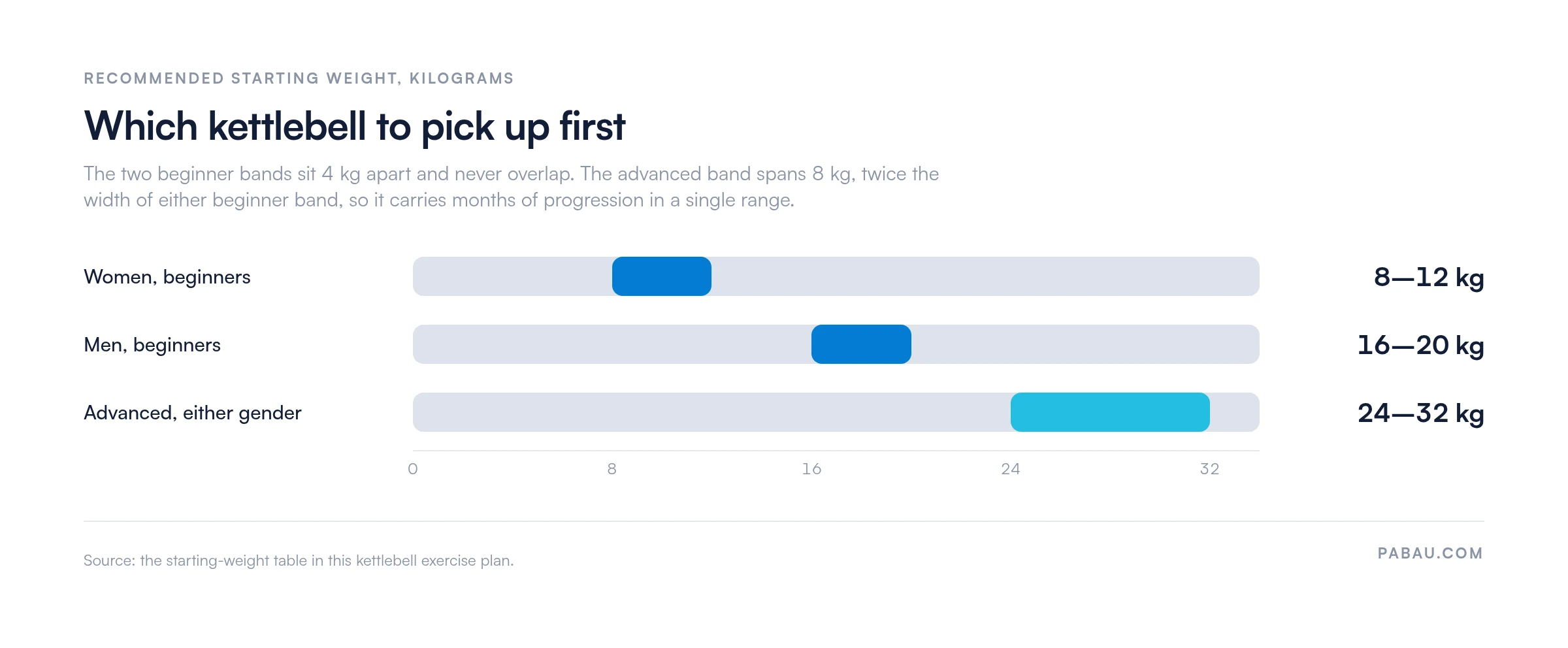
Beginners train four days a week, starting with an 8-12 kg kettlebell for women and 16-20 kg for men.
Progressive overload, which means adding weight, reps, or density, is how you keep making gains month after month.
Download our free kettlebell exercise plan PDF for a ready-to-use 12-week program with daily workouts, rest days, and form cues.
A structured kettlebell exercise plan answers the “what do I do today?” question. Most beginners either guess their workouts and stall, or jump between exercises without tracking what they lifted. A plan removes the guesswork. You follow the days, the sets, the reps, and the rest periods, and your body adapts faster because the stimulus stays consistent.
Kettlebell training is also efficient. One bell covers pressing, pulling, squatting, and hinging, so you need very little equipment and very little space.
The ballistic movements (swings, cleans, snatches) keep burning calories after the session through elevated post-exercise oxygen consumption. The plan pairs those explosive lifts with grind lifts such as deadlifts and presses, giving you strength and conditioning in the same week.
Starting with the right kettlebell weight prevents injury and keeps you engaged. Too heavy and your form breaks down. Too light and you never feel the challenge.
Plotted on one scale, the three bands show how much room you have before the next bell becomes necessary.
A simple test: If you can perform 10 kettlebell swings with crisp hip extension and a controlled descent, the weight is right for you. If you are training at a gym, try two or three sizes before buying one. Our beginner gym exercise plan covers the rest of that setup.
The template structures your training across 12 weeks and splits the sessions by focus. Power days cover swings, cleans, and snatches. Strength days cover deadlifts, presses, and goblet squats, and one day each week is active recovery.
These six movements form the backbone of most kettlebell training. Mastering the movement pattern matters more than the weight on the handle.
The kettlebell swing is a ballistic hip-extension movement: The weight hangs from your arms while your hips drive it forward to chest height. Form cue: Stand with feet shoulder-width apart, kettlebell on the ground between your feet. Hinge at the hips (not the knees), grab the handle with both hands, and drive your hips forward explosively. The bell swings up to chest height while your arms stay relaxed. Control the descent, then repeat. The power comes from hip drive, never from pulling with the arms.
Hold the kettlebell by the horns (the sides of the handle) at chest height. Squat down until your elbows touch the insides of your knees, then drive through your heels to stand. Why it works: The front-loaded weight keeps your torso upright and teaches proper squat depth. Most beginners get more quad and glute activation from goblet squats than from bodyweight squats.
Place the kettlebell on the ground between your feet. Hinge at the hips, keep your chest up, grab the handle, and drive through your heels to pull the kettlebell up. Form cue: Your shoulders sit directly over or slightly in front of the handle at the start. Your back stays neutral rather than rounded. This builds posterior-chain strength: Glutes, hamstrings, and lower back.
The clean is a short explosive pull that racks the kettlebell at shoulder height, and the press pushes it overhead. Beginners often need 2-4 weeks to groove the clean pattern, so start light. Why include it: Cleans teach explosive hip extension, and presses build shoulder and core stability. Together they give you a full-body movement in one rep.
Lie on your back with the kettlebell pressed overhead in one arm, with the other arm resting at 45 degrees for balance. Roll to your elbow, then post your hand and sweep your bottom leg underneath. Reach your back knee down and stand up, keeping the kettlebell locked overhead throughout. The movement is slow and deliberate, and it builds shoulder stability, core strength, and body awareness. Flag: This is an intermediate-to-advanced exercise, so save it until week 4 to 6 of the plan.
An explosive one-arm pull that drives the kettlebell from the ground to overhead in one movement. Advanced movement: Poor snatch form can strain the wrist or shoulder. Learn it on video or under coaching first. Keeping your form notes and video references in one place makes it easier to review cues between sessions.
The template spreads the work across the week, so you are not doing heavy strength training every single day. This pattern pairs power and strength with active recovery and complete rest.
That gives you four training days, one active recovery day, and two rest days. The split suits beginners, and as your fitness improves the plan moves you to higher reps, heavier bells, or greater density. Density means doing the same work in less time.
Saturday and Sunday stay open for walking, yoga, or an easy run. Runners who want to keep lifting on those days can follow our strength plan for runners instead.
Progressive overload is the engine of a kettlebell exercise plan. Your muscles adapt, so progress stops once the stimulus stops changing. The template guides three methods:
The plan shows the progression week by week. If you stall and cannot hit your reps with good form, stay at that weight for an extra week before advancing.
Kettlebell training is safe when your form is solid. Four mistakes account for most beginner injuries:
If you have a pre-existing shoulder, lower back, or wrist issue, consult a healthcare provider before starting.
A kettlebell session burns calories while you train and keeps your metabolic rate elevated for hours afterward. The compound, ballistic movements demand high energy expenditure. Paired with a caloric deficit and a consistent diet, kettlebell training can support fat loss while you hold on to muscle. Results still depend on diet, sleep, and consistency, so the training is one piece of the picture.
If a practice supervises your program, your sessions and your weigh-ins belong in the same record. Weight loss program software keeps training, diet, and results together for the next review.
Trainers, physical therapists, and weight loss practices who hand out a plan like this usually spend the following weeks chasing it. The program sits in a PDF, the session notes sit in a folder, and the next appointment sits in a separate calendar.
Practice management software like Pabau keeps all three in one patient record. You attach the plan to the patient file, book the weekly sessions from the same screen, and write the session note against that booking.
Automated reminders go out before each session, so fewer patients miss a training day. When someone comes back after a break, their previous weights and reps are already on the record. Nobody has to reconstruct where they left off.
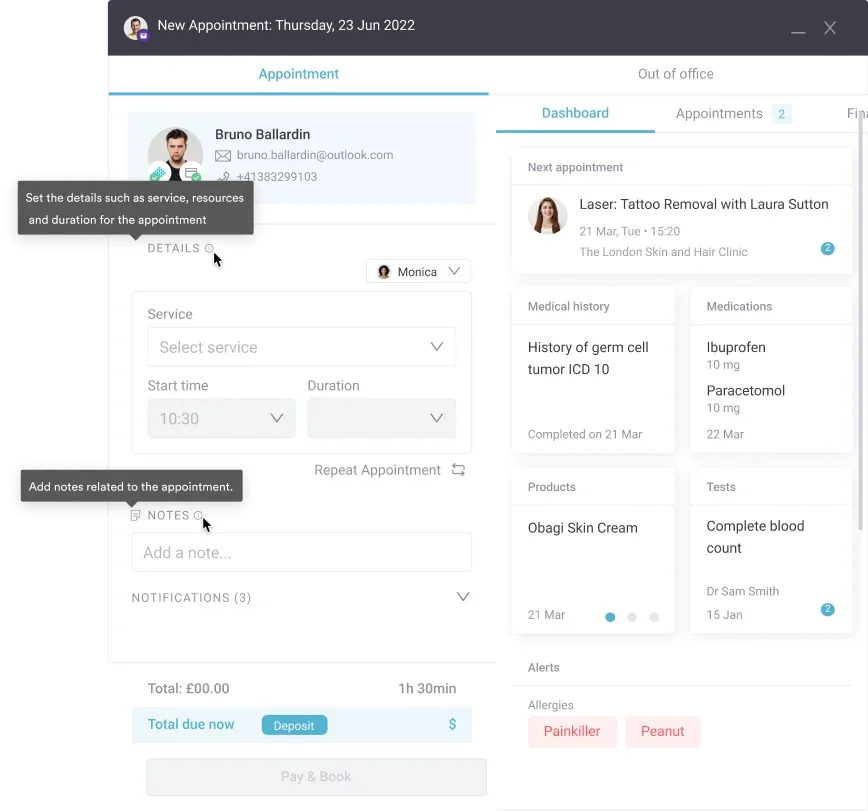

Pabau keeps the exercise plan, the appointment, and the session notes on one patient record. Your team books the next session and writes the note without leaving the screen.

The plan works when you keep the weight honest and the rest days intact. Beginners lose more progress to skipped recovery than to a bell that was too light.
Pick the size that lets you swing ten clean reps. Run the four training days for a full 12 weeks, and add load only when your form holds. The trade is simple: Slower jumps in weight buy you fewer weeks lost to a strained back.
If you coach this plan for a living, the admin around it is the hard part. Book a demo to see how Pabau keeps each patient’s sessions, notes, and progress in one record.

Training at a gym instead? Gym exercise plan for beginners sets out a five-day template for training with gym equipment.
Want conditioning without more lifting? Jumping rope exercise plan is a four-week beginner template you can run alongside this one.
Training mainly for fat loss? Weightloss workout plan builds the week around fat loss rather than strength.
A kettlebell exercise plan is a structured training program that schedules specific movements, sets, reps, and rest periods across days and weeks. It builds strength and conditioning systematically, so the stimulus stays consistent and the progress is measurable.
Women typically start with 8-12 kg (18-26 lbs), men with 16-20 kg (35-44 lbs). The test: You should be able to perform 10 kettlebell swings with full hip extension and controlled form. If the weight forces compensation patterns, such as rounding your back or pulling with your arms, go lighter.
This template trains you four days a week, on Monday, Tuesday, Thursday, and Friday. Wednesday is active recovery, and the weekend is rest. That spacing puts a recovery day after every two hard sessions, which is what keeps beginners progressing.
Progressive overload means gradually increasing the demand on your muscles: Heavier weight, more reps, more sets, or shorter rest periods. Without it, your body adapts to the same stimulus and progress plateaus. The plan advances you every 1-2 weeks.