Getting along with siblings worksheet
A getting along with siblings worksheet is a printable that helps children and t...

2
Last Updated: Oct 23, 2026

A letter of indemnity, or LOI, is a written promise to cover another party’s loss from one named transaction or event.
Shipping, banking, and commercial contracts are where they turn up most. In shipping, an LOI releases cargo when the original bill of lading is missing.
The template sets out nine sections. Four of them decide whether a court will enforce the letter: scope, monetary limit and expiry, governing law, and signing authority.
A signature from someone who cannot bind the company makes the letter unenforceable, so ask for the board resolution or power of attorney first.
No bank stands behind an ordinary LOI. If the indemnitor cannot pay, the only route left is litigation.
A three-page indemnity letter with fields for both parties, the transaction, and the scope of cover. It also carries ready-made operative wording, the monetary limit and expiry, governing law, and an authority check.
Download templateA letter of indemnity is a written promise to cover somebody else’s loss if a named event goes wrong. It moves cargo, releases securities, and unblocks payments when the usual paperwork cannot be produced. No bank stands behind it, though. Whether it pays out comes down to the wording on the page.
That is where these letters fail. A vague scope, a missing expiry date, or a signature from someone who cannot bind the company all survive the signing. The parties find out later, once money is at stake.
Below is what belongs in each field, when this letter is the right instrument, and where it leaves both sides exposed.
It promises money, and only for one named event. One party, the indemnitor, agrees to compensate the other, the indemnitee, for loss, damage, or liability.
The trigger is a specific act, transaction, or circumstance written into the letter. Outside it, the letter has no effect.
In practical terms it works as a financial safety net. Somebody needs to release goods, securities, or payment without the standard documentary proof.
The indemnity covers what happens if that decision turns out badly. The letter is binding in most jurisdictions, though how it was drafted and signed decides whether a court will hold the indemnitor to it.
One feature separates an LOI from the other instruments people compare it to. There is no cash and no third-party guarantee behind it. It is a promise to pay if a named event happens, backed only by the signer’s balance sheet.
The template above runs to nine numbered sections, in the order a reader works through them. Five of those sections simply record facts. The other four decide whether the letter holds up, so they are flagged below.
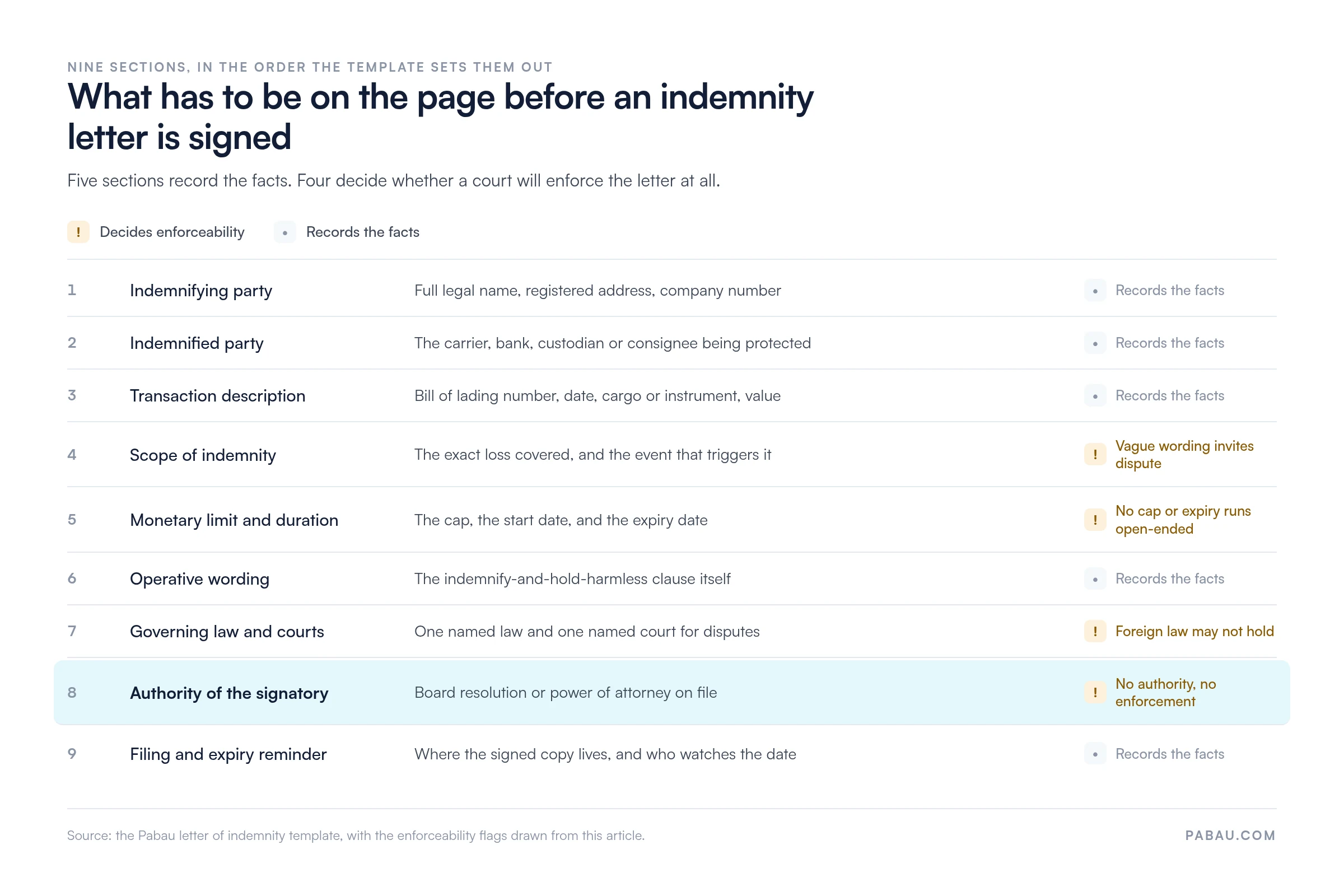
Here is what each section needs to say before the letter goes out.
The execution block closes the letter. The indemnitor’s authorized signatory signs and dates it, and the indemnified party countersigns to accept.
Three settings account for almost every indemnity letter written. Each one solves the same problem: a decision has to be made now, and the paperwork that would normally justify it is missing.
This is the classic use. Goods reach the destination port, but the shipper or consignee cannot produce the original bill of lading. Release the cargo and the carrier is exposed if somebody else turns up with the original and claims ownership. Hold the cargo and demurrage starts running.
The letter breaks the deadlock. The shipper or consignee promises to cover any claim arising from releasing the cargo without the original bill. The carrier gets a route to yes, and the goods move.
Banks ask for an LOI when securities, certificates, or instruments cannot be produced. A shareholder who has lost a share certificate gives one to the custodian. It covers the custodian against a third party who later produces the original.
Trade finance uses them the same way. An indemnity can cover a bank against discrepancies in a documentary credit submission, or against missing documents that would otherwise stop a payment going through.
The sequence rarely starts with a blank page. Whoever needs the release asks for it, and the counterparty replies with the wording it is prepared to accept. Carriers in particular tend to send their own standard form back.
From there it moves in four steps. The indemnitor fills in the transaction and scope fields. An authorized officer signs, with the evidence of authority attached. The counterparty countersigns and acts. Somebody then files the signed copy and sets a reminder for the expiry date.
Step two is where most delay happens. Finding out who is allowed to sign, and proving it, takes longer than drafting the letter did.
A weak draft only shows up when a claim lands, which is the worst moment to discover it. Work through these eight steps in order and the letter will hold.
Reading a finished letter is quicker than reading rules about one. Here is a shipping example, with a note under each clause on the job it does.
[Date]. Establishes when the indemnity takes effect.
TO: [Carrier Name], [Address]. Identifies the indemnitee, the party being protected.
RE: Letter of indemnity, Bill of Lading No. [XXX], dated [Date]. Ties the letter to one transaction.
Dear [Carrier Representative],
We, [Shipper/Consignee Name], hereby irrevocably and unconditionally indemnify and hold harmless [Carrier Name] against all loss, damage, liability, and expense, including legal fees. That indemnity covers the release of the cargo described in the above-referenced bill of lading. It applies where the cargo is released without production of the original bill.
Why it works: the clause names the transaction, the cargo, and the exact scenario. A court can tell what is covered and what is not.
This indemnity shall remain valid for twelve (12) months from the date of cargo release. It is limited to a maximum of [USD amount].
Why it works: a stated cap and expiry date close off open-ended exposure.
The undersigned is duly authorized to execute this letter of indemnity on behalf of [Company Name]. The undersigned warrants that this letter is a binding obligation of [Company Name].
Why it works: the warranty protects the carrier if the signer later claims they had no right to sign.
This letter shall be governed by and construed in accordance with the laws of [Jurisdiction], and disputes shall be resolved in the courts of [City/Country].
Why it works: one law and one court, so nobody argues about where a dispute belongs.
A properly executed indemnity letter is binding, but three conditions have to hold. The wording must be clear, the signature must come from someone able to bind the company, and there must be consideration. Consideration is the value passing between the parties, usually the release of the cargo or the payment.
Jurisdiction matters too. Courts in the UK and most other common-law countries treat these letters as enforceable. Some civil-law countries take a different view, so the governing-law clause matters most on a cross-border deal.
International shipping letters are rarely drafted from scratch. Most are written on the standard-form wordings published by the International Group of P&I Clubs, which both sides already recognize. Starting from a known text makes the terms easier to agree and easier to enforce.
Authority is the condition people skip. A signature from a junior employee, or from anyone acting outside their remit, leaves the indemnitee with no recourse at all.
Ask for the board resolution or the written authority that names the signer. A medical power of attorney is a useful example of how a grant of authority names its holder and its limits.
Both parties give something up by using an indemnity letter instead of a bank instrument. It helps to know which risk you are accepting before you sign.
These three instruments get treated as interchangeable, and they are not. The table below sets them side by side on the points that decide which one a deal needs.
Which one to pick. An indemnity letter is the fastest and cheapest route, and it puts the most risk on the party being protected. A letter of credit or a surety bond costs money and removes that risk. Let the indemnitor’s creditworthiness and the size of the transaction settle it.
Most disputes trace back to a check nobody ran. Work down this list before the letter is executed, whichever side of it you are on.
Finance and compliance teams handling several at once tend to run the same checks inside compliance management software, so the evidence sits with the document.
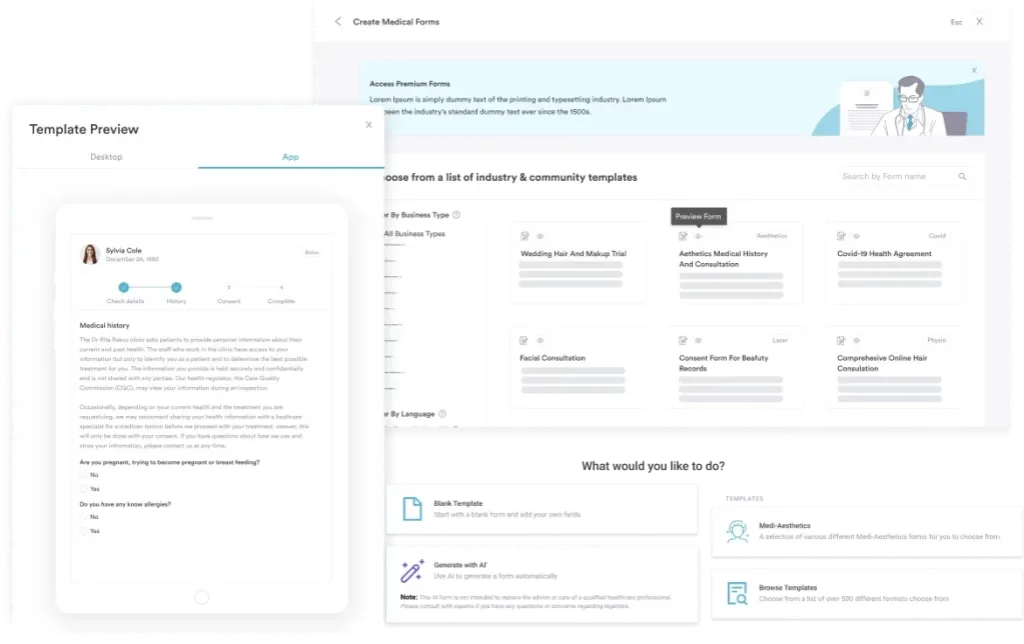
Retention is a separate question from expiry. The indemnity may lapse after 12 months, but the signed copy usually needs keeping for years afterwards. Our guide to medical record retention sets out how long a practice holds signed paperwork on file, and the same logic applies here.
Teams handling a handful of indemnity letters at once get the most value from consistent filing and expiry tracking. Book a demo to see how document and compliance workflows cover both.
Experience is no protection against these. They come up on high-value transactions as often as on routine ones.
A practice that signs an indemnity letter usually files it wherever the signed copy lands, in a shared drive or an email thread. Producing it at review then takes a search, and the expiry date passes with nobody watching for it.
Practice management software like Pabau handles the documentation side of that problem. Digital forms collect details and signatures on screen. Each completed document is filed against the record it belongs to, with the date and the signatory attached.
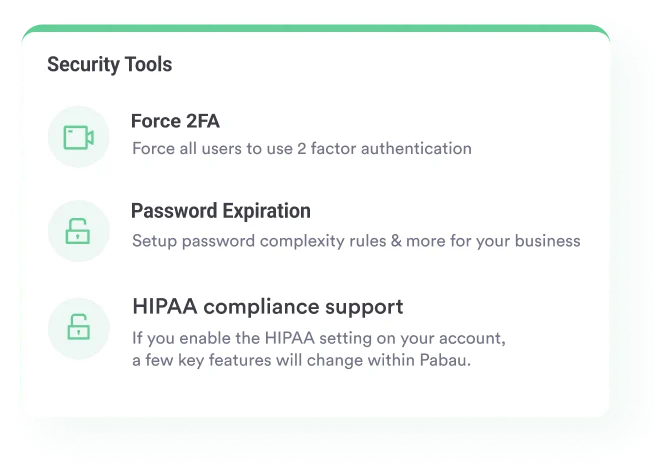
The same system holds the rest of the practice’s compliance paperwork, from consent forms to treatment records. So your team has one place to look when an auditor, an insurer, or a counterparty asks what was signed and when.
None of that drafts the letter for you, and it does not replace legal advice on the wording. What it does is keep the signed copy where you left it, with a date attached. You can produce it the day somebody needs to prove the indemnity existed.

Pabau files completed forms, consents, and signed documents against the record they belong to, with the date and signature attached. Your team can produce the right paperwork at review without searching a shared drive.

An indemnity letter buys speed by shifting risk onto the party being protected. That trade is worth making when you know who is signing and what they can pay. It is a bad trade when either answer is a guess.
So do the boring parts properly. Name one scenario, set a cap and an expiry date, and get the evidence of authority before the letter is countersigned. Those four decisions are what a court will look at, and they take an afternoon rather than a legal budget.
Then think about where the signed copy goes, because a letter nobody can find protects nobody. Fill in the template above, file it against the transaction, and diary the expiry. The filing is the step that slips once the deal has moved on.
Book a demo and we will show you how Pabau keeps signed documents findable and in date.

Need to see how a written authority is set out? Medical power of attorney shows how a grant of authority names its holder, its limits, and its witnesses.
Wondering how long to keep the signed copy? How long to keep medical records sets out the retention periods that apply to signed paperwork.
Storing signed documents somewhere safer than a shared drive? EHR security covers the access controls, audit logs, and encryption worth having in place.
Asked to produce paperwork for an audit? Medical chart audit explains what an auditor asks for and how to have it ready on the day.
Not quite. A hold harmless clause usually sits inside a larger contract, while an indemnity letter stands alone and covers one named event. The obligation can be almost identical. What decides the cover is the wording, not the label on the document.
Yes, and in shipping the carrier often insists on it. A bank counter-signature puts a creditworthy institution behind the promise, which removes the main weakness of an ordinary indemnity letter. Banks charge for this and will usually want security in return.
Usually not. In common-law jurisdictions a signed letter is binding without a notary. Some counterparties and some civil-law countries still ask for notarization or a witness, so check what the other side requires before signing.
Not on your own. Once the other party has acted on the letter, the obligation runs until the stated expiry date. Cancelling it early takes written agreement from both sides.
Nobody charges a fee to issue one, which is why it moves faster than a letter of credit. The cost arrives later, as a contingent liability sitting on the indemnitor’s books until the letter expires.