CPT code 52648: Laser ablation of the prostate billing guide
What CPT code 52648 covers, and what it bundles in CPT code 52648 is the code fo...

Last Updated: Oct 21, 2026
Billable Code Specific Code
M26.9 is the billable ICD-10-CM code for dentofacial anomaly, unspecified.
The code sits in the M26-M27 block, "Dentofacial anomalies [including malocclusion] and other disorders of jaw." It is valid for submission in all HIPAA-covered healthcare transactions for fiscal year 2026 and beyond.
M26 is a parent code, and its subcategories run from M26.0 through M26.89. Between them they cover jaw size, jaw-cranial base relationship, dental arch relationship, tooth position, functional abnormalities, temporomandibular joint disorders, and dental alveolar anomalies. Use M26.9 only when the documentation cannot support one of them.
Let Pabau's smart automation suggest the right codes, reduce claim denials, and keep your practice compliant—effortlessly.
Automate repetitive tasks and focus on what matters most—your patients.
Reduce coding errors and ensure compliance with the latest regulations.
Clean claims, fewer denials, and faster reimbursements.
Powerful insights and reporting to help your practice thrive.
HIPAA compliant SOC 2 certified GDPR-compliant Trusted by 4,000+ clinics worldwide

M26.9 is a billable ICD-10-CM code for dentofacial anomaly, unspecified. It is valid for FY2026 and every HIPAA-covered transaction.
Use M26.9 only when the provider note cannot support a more specific code from M26.0 through M26.8.
M26.4 covers malocclusion, unspecified. It is more specific than M26.9, so a note that says only “malocclusion” is not an M26.9 claim.
Query the provider before you assign M26.9, and record in the note why a specific code was ruled out.
Practice management software like Pabau keeps the note, the diagnosis code, and the claim in one record, so documentation gets checked before submission.
The table below summarizes the administrative and clinical attributes of M26.9:
Knowing the hierarchy helps you select the most specific code the note supports. M26.9 fits into the musculoskeletal classification as follows:
Review the full M26 category before you settle on M26.9. The ICD-10-CM code index groups these blocks by chapter, so you can confirm whether a jaw finding belongs in M26 or somewhere else entirely.
Before you use M26.9, work through every M26 subcategory. The right-hand column flags which ones branch into more specific codes, so you know where to keep looking:
Two rows in that table are the ones coders miss. M26.4 and M26.9 both read as “unspecified”, but ICD-10 code M26.4 is the more specific of the two. Reach for M26.9 only when the note will not even support malocclusion.
Assign M26.9 only when the clinical documentation cannot support a more specific M26.x code. AAPC coding guidance is clear that a coder queries the provider before defaulting to an unspecified code. The rows below set out the order to work through:
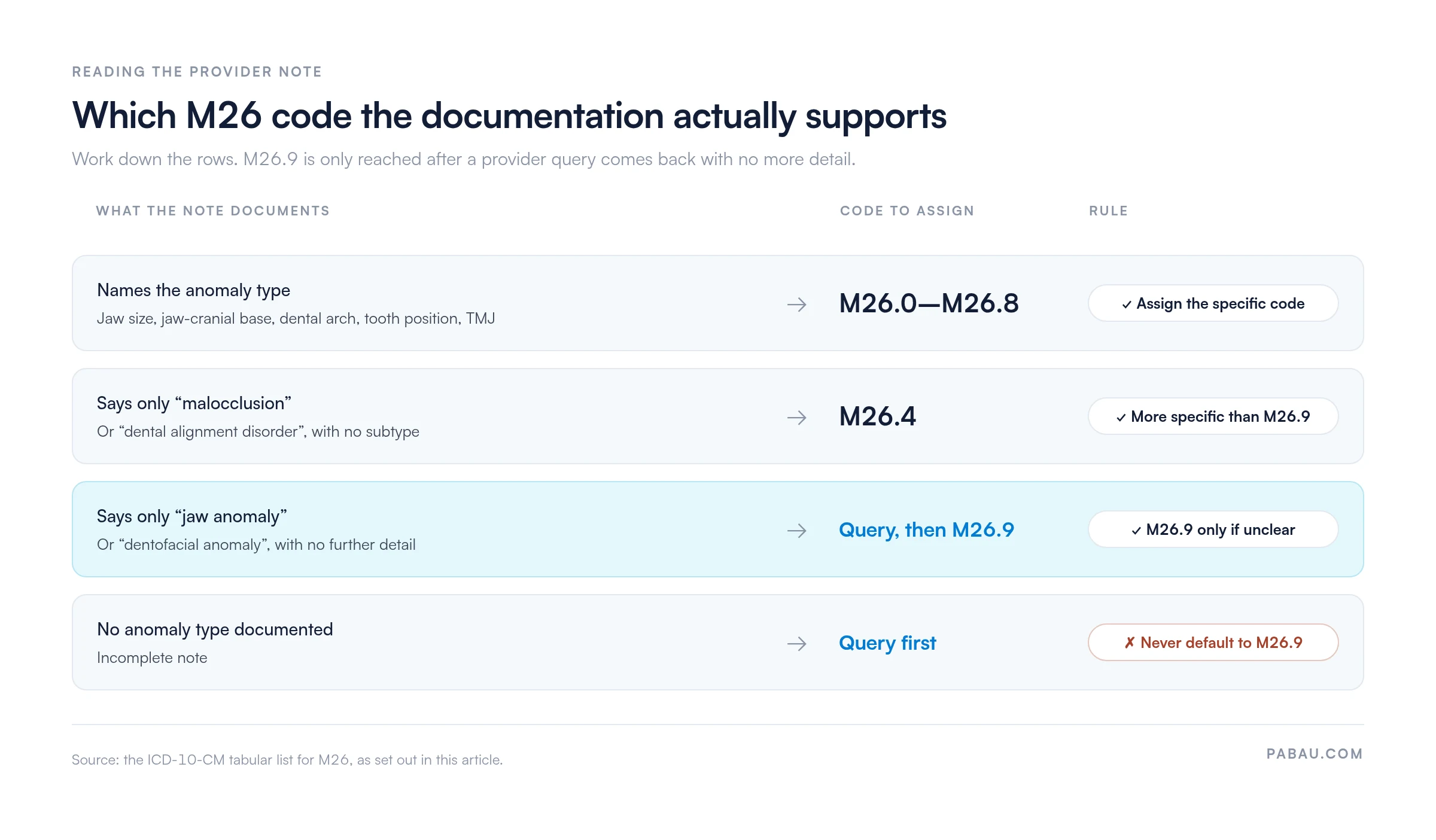
The same logic, with the wording to look for in the note:
Provider notes supporting M26.9 should include:
The last item matters more than it looks. An unspecified diagnosis attached to an expensive procedure is what triggers a records request. The note has to carry the reason the specificity stops where it does.
The ICD-10-CM index maps these synonym terms to M26.9. You will meet these phrasings in clinical notes:
For practices reconciling legacy records or mapping historical diagnosis codes, the ICD-9-CM equivalent is:
M26.9 is a valid billable code, but payers apply extra scrutiny to unspecified diagnoses. Some deny the claim or request additional documentation, particularly when:
Prior authorization is the easiest of those three to get ahead of. A standard prior authorization form keeps the payer’s requirements and the clinical justification together before the procedure is booked.
Keep the supporting clinical notes and imaging reports on file so you can defend the claim if it is challenged. Good claims software for coders flags unspecified diagnoses on the way out and prompts someone to check the documentation first.
In dental and orthodontic billing, M26.9 travels with procedure codes for diagnosis, treatment, and follow-up. Common pairings include:
Surgical cases carry their own procedure coding, and the descriptors matter as much as the diagnosis. Check the operative report against the code before the claim goes out.
In most dental and orthodontic practices, the diagnosis code and the note that has to justify it live in different places. The provider writes up the visit, someone else builds the claim, and nobody compares the two until a denial lands.
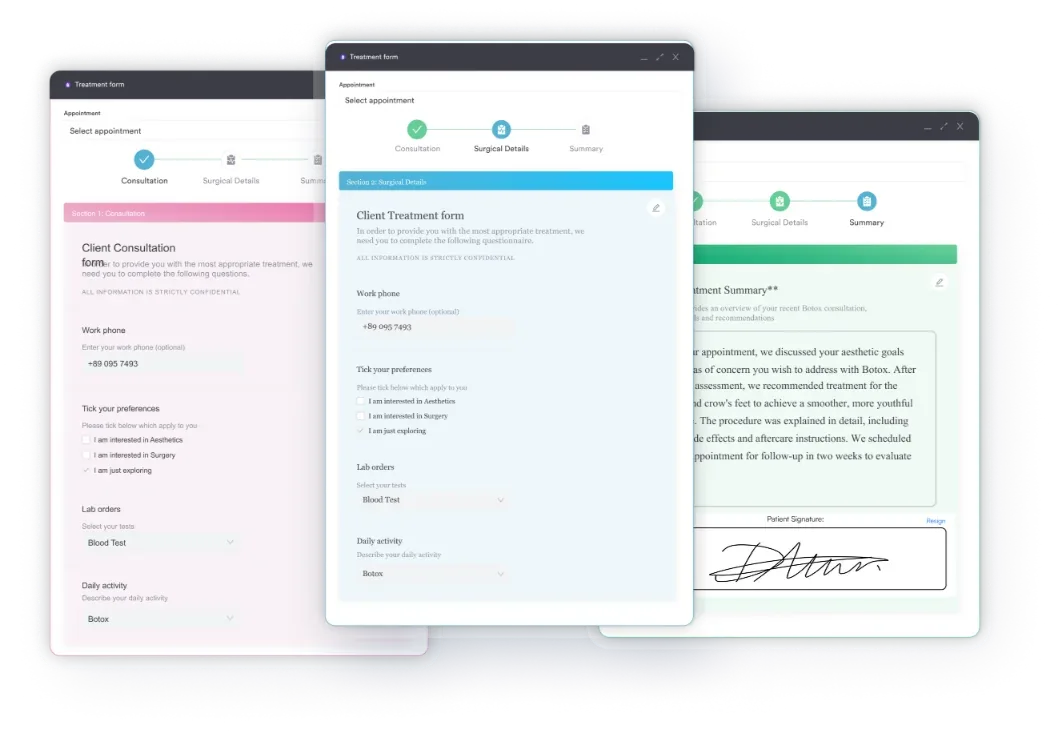
Practice management software like Pabau keeps them together. Client records, treatment notes, and digital forms sit in the same file as the appointment and the invoice. The wording behind M26.9 is on screen while the claim is being built, not two systems away.
Pabau’s claims tools then take the submission itself. The patient’s insurer sits on their record, so invoices route to the right payer automatically. In the US, claims go out through Claim.MD, with eligibility checks and status tracking in the same dashboard.
That combination is what makes unspecified codes safer to submit. When a payer asks why M26.9 was assigned, the answer is already in the record.

Pabau holds client records, treatment notes, and insurance claims in a single system. The documentation behind an unspecified code gets checked before the claim leaves your practice.

Run one check before you submit. If the provider note names the type of dentofacial anomaly, assign the matching code from M26.0 through M26.8 instead. If it says only “malocclusion”, use M26.4. Save M26.9 for genuinely unspecified cases, and query the provider when the note is thin. That query takes minutes now and prevents a denial later.
M26.9 belongs on a claim only after the documentation has been exhausted. Read the note, work through M26.0 to M26.8, and ask the provider before you assign it.
The habit worth building is that query. One question usually turns an unspecified claim into a specific one, and specific claims get paid without a records request. The trade-off is a day of delay against a month of appeals.
Book a demo to see how Pabau keeps the note, the diagnosis code, and the claim in one record for your dental or orthodontic practice.

Coding a temporomandibular joint procedure? CPT code 21050 walks through condylectomy of the temporomandibular joint and the documentation payers expect.
Billing a chin or jaw augmentation? CPT code 21120 covers genioplasty augmentation, including how medical necessity gets established.
Planning mandibular surgery for a jaw anomaly? CPT code 21196 covers mandibular osteotomy billing and the medical necessity it has to show.
Getting denials on unspecified diagnoses? Denial codes in medical billing lists the top 20 CARC codes and the fix for each one.
M26.9 is the ICD-10-CM code for dentofacial anomaly, unspecified. It covers a structural or functional abnormality of the jaw, teeth, or bite. Use it when the documentation does not identify the specific type.
Yes, M26.9 is a valid and billable diagnosis code for HIPAA-covered healthcare transactions in 2026 and all subsequent fiscal years.
Use M26.9 only when the provider note cannot support a more specific code from M26.0 through M26.8. If the note names jaw size, jaw-cranial base alignment, dental arch relationship, or tooth position, assign the matching code. Query the provider before defaulting to M26.9.
The legacy ICD-9-CM equivalent is 524.9, unspecified dentofacial anomalies. That mapping helps practices reconciling historical records.
M26.9 covers structural or functional abnormalities of the jaw, teeth, and bite that cannot be categorized more specifically. That includes unspecified jaw size anomalies, dental alignment disorders, jaw-cranial base relationship disorders, and temporomandibular dysfunction without further detail.
Common pairings include CDT D8080 for comprehensive orthodontic treatment of the adolescent dentition, and CPT 21193 for reconstruction of the mandibular rami. Cone beam imaging is reported with CDT D0367 or D0368. The procedure code always follows the intervention performed.
Some payers scrutinize unspecified codes and may deny the claim or request additional clinical notes. Include provider documentation explaining why a more specific code was not assigned. Imaging or examination findings strengthen the record when they are available.
The M26 group runs from M26.0 to M26.9. It covers jaw size, jaw-cranial base relationship, dental arch relationship, and tooth position anomalies. It also covers malocclusion, functional abnormalities, temporomandibular joint disorders, dental alveolar anomalies, and other dentofacial anomalies. M26.9 closes the group as the unspecified option.