ICD-10 Code S46.999A: Other injury, unspecified shoulder muscle
ICD-10 code S46.999A: Quick reference card ICD-10 code S46.999A is the billable ...

Last Updated: Oct 27, 2026
Billable Code Specific Code
I70.8 is the billable ICD-10-CM code for atherosclerosis of other arteries.
Two rules decide most I70.8 claims, and neither is obvious from the code description. The category's Excludes2 notes move four arterial beds out of I70 altogether. Those same notes let I70.8 and atheroembolism share a claim, which an Excludes1 note would forbid.
Let Pabau's smart automation suggest the right codes, reduce claim denials, and keep your practice compliant—effortlessly.
Automate repetitive tasks and focus on what matters most—your patients.
Reduce coding errors and ensure compliance with the latest regulations.
Clean claims, fewer denials, and faster reimbursements.
Powerful insights and reporting to help your practice thrive.
HIPAA compliant SOC 2 certified GDPR-compliant Trusted by 4,000+ clinics worldwide

I70.8 is the billable ICD-10-CM code for atherosclerosis of arteries that no other I70 subcategory covers.
Atheroembolism (I75.-) sits in an Excludes2 note under I70, so both codes can be reported when each condition is documented.
Mesenteric atherosclerosis is not an I70.8 example, because the Excludes2 note routes it to K55.1.
Add a tobacco code such as Z87.891, Z72.0 or F17.2- whenever the record documents exposure or dependence.
Practice management software like Pabau keeps the arterial site in the record, so coders reach the right subcode first time.
Quick reference for coders, and for the billing workflow that carries the claim afterward. Coded diagnoses only reach a payer once faster claims management gets them onto a submitted claim.

Atherosclerosis is the buildup of fatty plaque in an arterial wall. It occurs in many vascular beds, and ICD-10-CM gives the common ones their own subcategory. I70.8 picks up the rest, so it is the code for a named artery that the tabular list never names.
Vascular specialists and cardiologists use it most often for the splenic artery and other unnamed visceral vessels. The word “arteriosclerosis” is an accepted synonym under the I70 block header, so it maps to the same code family. Documentation that says “arteriosclerosis of the splenic artery” still reaches I70.8.
I70.8 is the residual subcategory, so it is only correct once the specific ones are ruled out. Reading the family in order prevents the most expensive kind of error, which is a valid code applied to the wrong site.
The instructional notes sit at category level, so they govern I70.8 as well as its siblings. The map below shows where each documented site sends the code, including the beds that leave I70 altogether.
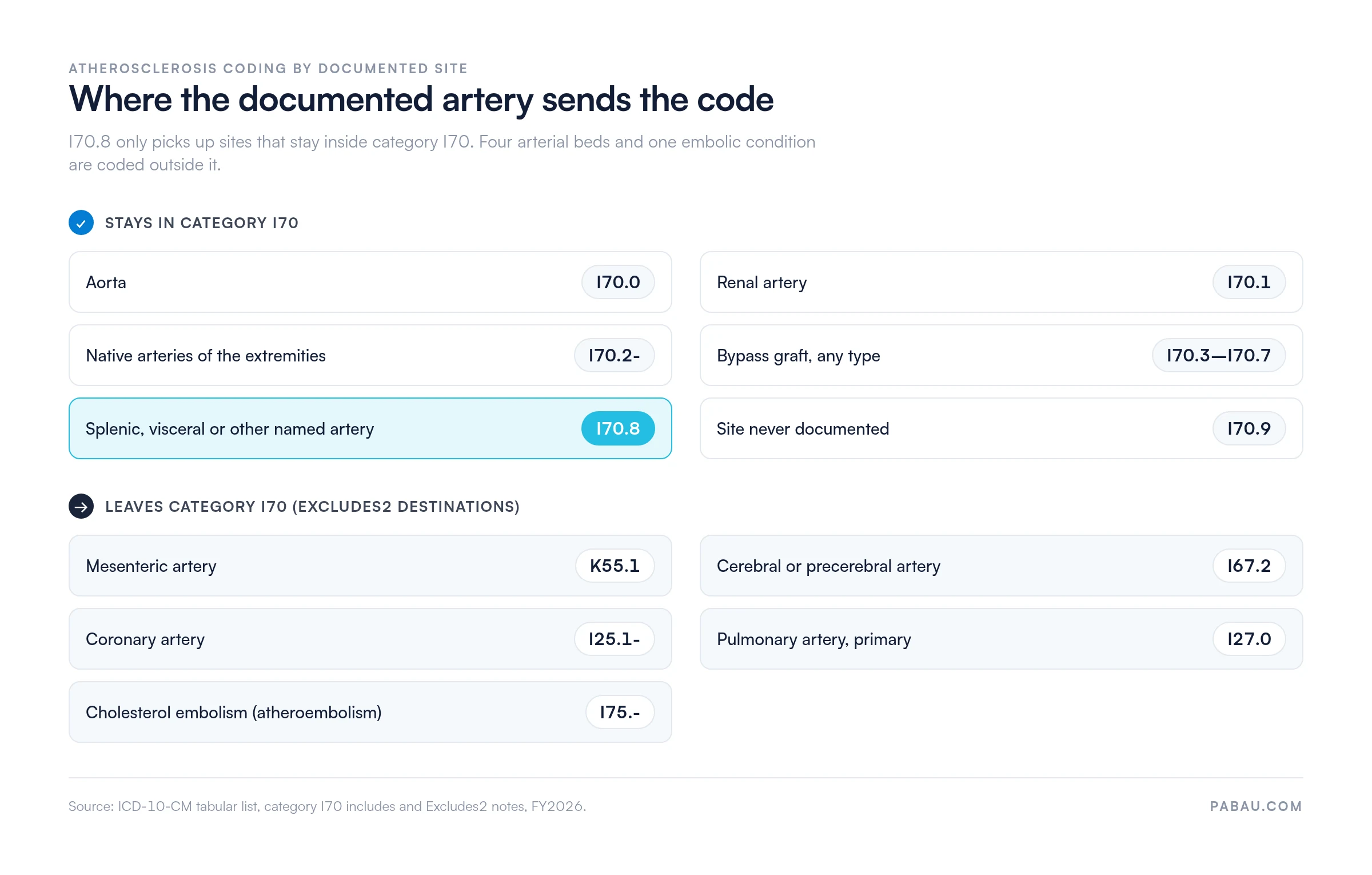
The Excludes2 note is where I70.8 claims come unstuck. These five conditions are not part of category I70, so each one carries its own code:
Excludes2 is the note that gets read as Excludes1 most often, and the two mean opposite things. Excludes1 bars two codes from the same encounter. Excludes2 says the excluded condition is not part of I70, so both codes are reportable when the record supports each one.
Selecting I70.8 correctly takes documentation that confirms atherosclerosis and names the arterial site. Work through these steps in order:
FY2026 guidance leaves I70.8 unchanged in both sequencing and applicability. The full subcategory list is indexed on our ICD-10-CM code index if a neighboring code turns out to fit the record better.
Three mistakes account for most I70.8 rework, and all three start in the clinical note rather than the coding step.
Error 1: Treating atheroembolism as an Excludes1 conflict. Atherosclerosis is chronic plaque buildup, while atheroembolism is cholesterol debris embolizing into smaller vessels. They pair under an Excludes2 note, so I70.8 and I75.- can both be reported when each is separately documented. Code only I75.- when the note describes cholesterol embolism alone.
Error 2: Under-documenting the arterial site. A note that says “atherosclerosis” and stops is not codable to a site. Ask clinicians to name the vessel, whether that is splenic, visceral, carotid or mesenteric. Coders can then route it, and the routing often lands outside I70. I70.8 stays defensible only where the vessel is named and has no subcategory of its own.
Error 3: Omitting the tobacco codes. Most patients with atherosclerosis have some tobacco history in the record. Leaving out Z87.891 or Z72.0 drops comorbidity detail, which lowers risk-adjustment scores under value-based contracts.
All three errors cost less to catch at submission than on appeal. Coders working across specialties often keep a medical coding cheat sheet at the desk for residual-code decisions like this one.
Vascular claims rarely carry one diagnosis. These are the codes that most often share a claim with I70.8, or take its place:
Practices auditing legacy claims or migrating historical records need the crosswalk from the older system:
Digital records that keep a code history let a billing team spot legacy codes and flag conversions with an incomplete audit trail.
In most practices, the vessel name lives in free-text narrative. A coder reads “atherosclerosis, follow up in six months”, cannot see the site, and either queries the clinician or falls back on I70.9. Both outcomes cost time, and the second one weakens the claim.
Practice management software like Pabau moves that detail into structured fields. Vascular intake forms and treatment note templates ask for the vessel by name. The answer gets captured while the patient is still in the room. Tobacco status sits in the same record, which is where the Z87.891 and Z72.0 decisions come from.
Coders then work from a note that already answers the question the tabular list asks. Queries drop, I70.9 stops standing in for a site that was documented, and the claim goes out with a code the record supports.

Pabau’s structured intake forms and treatment notes record the vessel and the tobacco status at the point of care. Coders get the specificity that I70.8 requires, so fewer claims go out on an unspecified code.

I70.8 is easy to assign and easy to over-assign. It is correct for a named artery with no subcategory of its own, and wrong for the five sites the Excludes2 notes send elsewhere. Reading those notes as permissions rather than prohibitions is what separates a clean claim from a rework queue.
The lasting fix is upstream. When the note names the vessel and the tobacco status, code selection stops being a judgment call. FY2026 guidance gives you no reason to revisit that decision next October. Book a demo to see how Pabau captures that detail at the point of care, so your vascular claims go out coded to the site.

Need the history-of-tobacco code rules? ICD-10 code Z87.891 covers when a past nicotine dependence still belongs on the claim.
Coding a current smoker? ICD-10 code Z72.0 explains tobacco use without dependence, and the notes that bar it from pairing with F17.-.
Documentation says dependence, not use? ICD-10 code F17.210 walks through cigarette dependence and the specificity each subcode needs.
Claim came back denied? Denial codes in medical billing maps the CARC codes that specificity problems trigger most often.
Coding cardiac plaque instead? ICD-10 code I24.9 covers acute coronary syndrome, one of the presentations that never reaches I70.8.
I70.8 is the ICD-10-CM diagnosis code for atherosclerosis of other arteries. It covers plaque in a named artery that has no subcategory of its own inside I70. The specific subcategories are I70.0 for the aorta, I70.1 for renal arteries, I70.2- for limb arteries and I70.3 through I70.7 for bypass grafts.
Yes. I70.8 is a specific four-character code that is valid for claim submission and HIPAA-covered encounters. It needs no further characters.
I70.8 includes atherosclerosis and arteriosclerosis of arteries that the I70 subcategories do not name. Splenic artery atherosclerosis and plaque in other unnamed visceral vessels are the common examples.
No. The Excludes2 note under category I70 routes mesenteric atherosclerosis to K55.1, so it never belongs on I70.8. Cerebral and precerebral sites go to I67.2, coronary disease to I25.1- and primary pulmonary atherosclerosis to I27.0.
I70.8 applies when the artery is documented but has no subcategory of its own. I70.9 applies when atherosclerosis is diagnosed and the site is never documented. Use I70.8 whenever the record names the vessel.
Yes. Atheroembolism (I75.-) sits in an Excludes2 note under I70, not an Excludes1 note. Both codes can be reported for the same encounter when each condition is separately documented. Report I75.- alone when the note describes cholesterol embolism only.
Add a tobacco code whenever the record documents exposure or dependence. The options are Z87.891 for a personal history of nicotine dependence, Z72.0 for tobacco use and F17.2- for current nicotine dependence.