Treatment summary
A treatment summary is a written record of what care was delivered during an epi...

3
Last Updated: Oct 16, 2026

A gout medication list covers two separate jobs. One settles the acute flare, the other lowers serum uric acid to prevent the next one.
NSAIDs and low-dose colchicine are first line for an acute attack. Corticosteroids are the alternative when those are contraindicated.
Allopurinol is the first-line urate-lowering therapy. Start at 100 mg daily and titrate toward a serum uric acid below 6 mg/dL.
Renal function, drug interactions and cardiovascular history decide which agent is safe for a given patient.
Practice management software like Pabau holds the regimen, the monitoring schedule and the lab results on one patient record.
Every agent from this article in one printable table, with columns for strength, route, frequency, monitoring requirement and review date. Space is left for patient-specific notes and the next review.
Download templateA gout medication list is a clinical reference setting out every drug used to treat gout, with its dose, route and monitoring requirement.
It splits into two halves. One half settles the acute flare, the other lowers serum uric acid so the next flare never starts.
Mixing the two halves up costs the patient weeks. Allopurinol does nothing for an attack already in progress, and an NSAID does nothing about the crystals that caused it. The order matters as much as the choice of drug.
Below are the acute agents with their doses, and the urate-lowering options with their titration and monitoring rules. A five-step routine for working through the list in a consultation follows.
Gout happens when monosodium urate crystals build up in a joint and set off an inflammatory response. Managing it takes two things at once. Symptoms have to be controlled during the flare, and uric acid has to come down and stay down between flares.
The list records the same fields for every agent: drug name, strength, route, frequency, monitoring requirement and review date. Written that way, it works as a prescribing check and as the documentation the note needs. The chart below sets out both tracks with the doses used in this article.
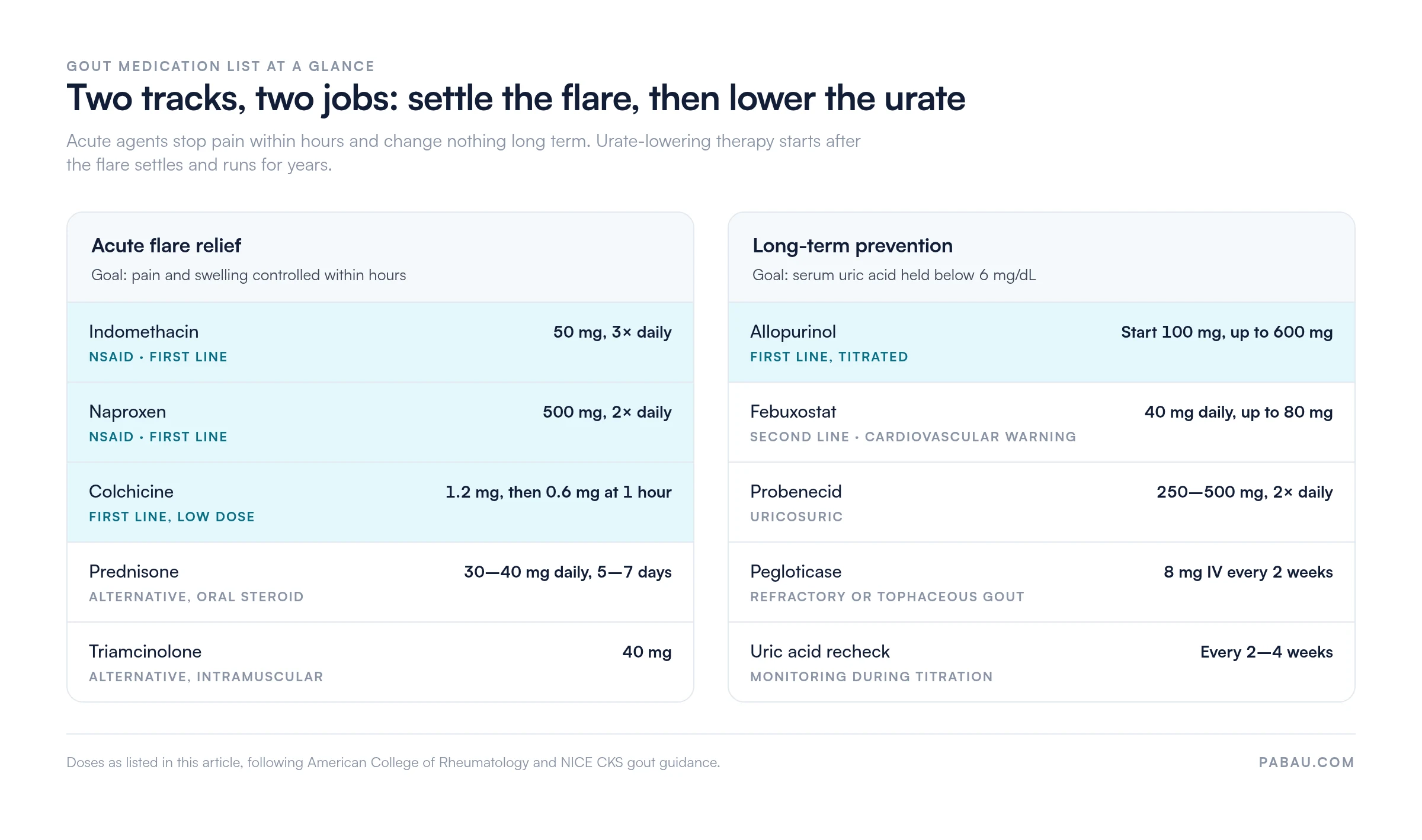
According to the American College of Rheumatology (ACR), clinicians should pick agents on patient factors such as renal function, contraindications and prior responses. The reference earns its place in primary care, urgent care and rheumatology practices seeing gout every week.
Acute flare treatments come first on the list. These agents work quickly to reduce pain, swelling and joint inflammation during an active attack. Three medication classes dominate acute gout management: NSAIDs, colchicine and corticosteroids.
Any complete list should note the contraindications for each class. NSAIDs are avoided in patients with active peptic ulcer disease or significant renal impairment. Colchicine needs a dose adjustment in renal failure, and corticosteroids can worsen glycemic control in diabetic patients.
Those checks are easier to make in the moment than to remember afterwards. Prescription management software holds the strength, frequency and route against the patient record and warns about allergies and interactions before the script goes out.

Long-term prevention depends on medications that lower serum uric acid below the target of 6 mg/dL. This half of the list covers xanthine oxidase inhibitors, uricosuric agents and one biologic option.
The NICE clinical knowledge summary on gout stresses that urate-lowering therapy starts after the acute attack resolves. It is reserved for patients who have had recurrent episodes. A printed list helps confirm the timing and the sequence of these agents.
Many patients try to self-manage with over-the-counter NSAIDs before they seek clinical care. Ibuprofen at 200-400 mg three times daily and naproxen at 220 mg twice daily are widely available, though both are weaker than prescription-strength formulations. Note on the list that these options do nothing for long-term prevention and can delay urate-lowering therapy.
Dietary supplements such as vitamin C and tart cherry extract have mixed evidence behind them. Lifestyle changes across fluid intake, dietary purines and alcohol do support medical therapy. Neither belongs on the list as a primary prevention method, because neither replaces a urate-lowering drug.
Step five is where most of the follow-up is won or lost. It is also the step that gets rushed at the end of a consultation. An AI medical scribe can lift the regimen and the review interval straight out of the conversation, so the note matches what was actually prescribed.
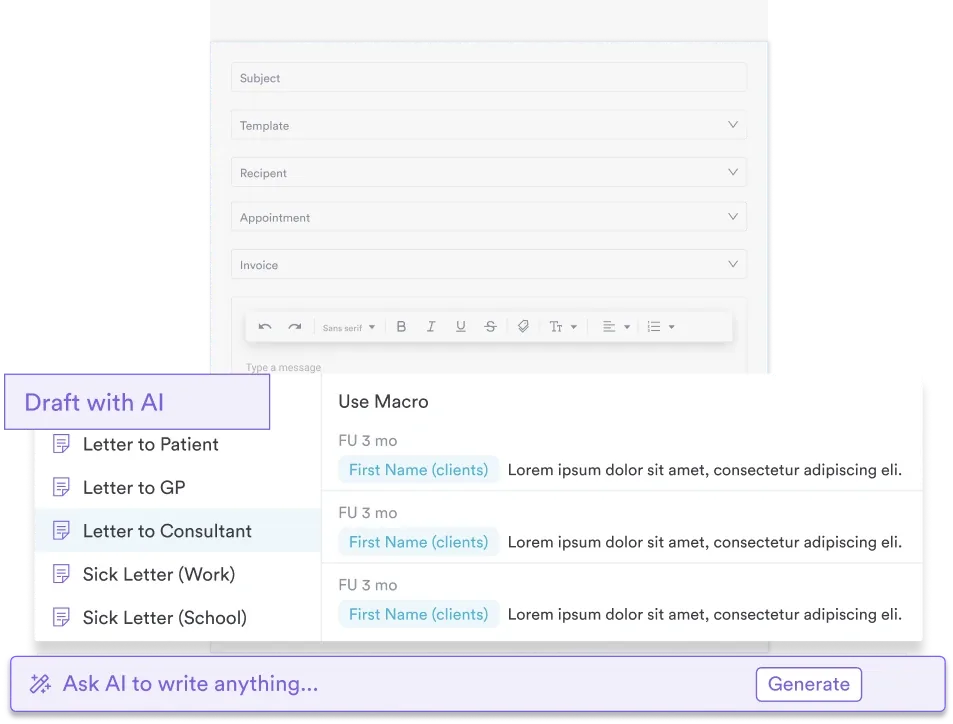
Primary care clinicians managing hyperuricemia and acute gout get the most out of a structured reference, because they see the condition in short appointments. Practices running on GP clinic software can keep the list beside the patient record. The prescriber then checks it in the same window as the notes.
Rheumatologists treating complex or refractory gout use the same reference to confirm that urate-lowering therapy has been escalated properly. Nurses giving medications in urgent care and walk-in settings rely on it to check dosing safety and patient eligibility.
Pharmacists use it to counsel patients on interactions, dietary considerations and monitoring schedules. A wider medication review catches the rest of the patient’s regimen, which is where the colchicine and statin interaction usually shows up. That review matters most in patients over 65, where an OAB drug reference flags the anticholinergic the Beers Criteria tell prescribers to avoid.
Consistency: A standardized list means every clinician in the practice picks medications from the same evidence-based framework. That reduces variation between prescribers and makes outcomes easier to compare.
Documentation clarity: Structured fields for drug name, strength, route, frequency and monitoring schedule create an auditable record. That detail supports regulatory compliance and protects the practice if a dose escalation or an interaction is later questioned.
Faster prescribing: A visual checklist of acute and preventive options speeds up decisions in high-volume settings. Clinicians confirm contraindications and renal adjustments against the list before prescribing, which cuts errors.
Patient safety: Putting the monitored parameters on the list means the follow-up labs get booked. That matters most for allopurinol, with its hypersensitivity monitoring, and febuxostat, with its cardiovascular warning.
In most practices a gout regimen ends up in three places. The dose sits in the consultation note, the lab request sits in the pathology system, and the review date sits in someone’s diary. When the patient comes back, the clinician rebuilds the picture from memory.
Practice management software like Pabau keeps them together. The prescription, the uric acid result and the next review sit on one patient record. The prescriber can see whether the last titration worked before changing the dose. Pabau Scribe, our AI scribe, drafts the note from the consultation itself.
Automated recalls cover the 2-4 week lab checks during titration, and the digital version of this list attaches to the record instead of being printed. Your team stops chasing results, and the patient stops dropping off the follow-up schedule.

Pabau’s digital forms and patient records hold the medication, the uric acid target and the next lab date together. Your team stops chasing results between visits.

The sequencing is the part worth carrying out of this list. Settle the flare with an NSAID, low-dose colchicine or a steroid. Then start allopurinol once the joint has calmed and the patient has had more than one attack.
What decides the outcome is rarely the first prescription. It is whether the uric acid gets rechecked, the dose gets titrated, and the target below 6 mg/dL is actually reached. Practices lose gout patients between visits, not in the consultation.
So print the list, or hold it in the patient record where the next clinician will see it. Book a demo to see how Pabau keeps the regimen, the lab schedule and the review date on one record.

Need a wider view of the patient’s regimen? Medication review template captures every drug a patient takes, which is where the colchicine and statin interaction shows up.
Prescribing an NSAID for a patient with poor renal function? Acute kidney injury nursing care plan sets out the monitoring an at-risk patient needs.
Recording pain during a flare? Abbey pain scale gives you a structured score for patients who cannot describe the pain themselves.
Comparing systems for a primary care practice? Primary care software walks through what to look for in records, prescribing and patient recall.
For acute flares, NSAIDs such as indomethacin or naproxen are first line if renal function is normal. For long-term prevention, allopurinol is the first-line urate-lowering therapy recommended by the American College of Rheumatology. The best choice depends on renal function, comorbidities and prior drug responses.
Low-dose colchicine is 1.2 mg followed by 0.6 mg at one hour. Started early, it usually reduces pain and inflammation within 12-24 hours. Efficacy drops sharply once symptoms have run more than 36 hours. NSAIDs often work faster, within 4-6 hours, for acute pain relief.
Common side effects include rash, nausea and diarrhea. Rare but serious effects include allopurinol hypersensitivity syndrome, which brings fever, rash and liver dysfunction. It occurs in roughly 1 per 1,000 patients, particularly those carrying the HLA-B*5801 allele. Close monitoring during the first 8 weeks of therapy is essential.
Yes, ibuprofen is an over-the-counter NSAID that works for mild to moderate gout flares. Standard dosing is 200-400 mg three times daily. Prescription-strength NSAIDs give faster and more complete relief, at indomethacin 50 mg three times daily or naproxen 500 mg twice daily. Avoid NSAIDs in patients with renal impairment, peptic ulcer disease or cardiovascular contraindications.
Allopurinol usually needs 2-4 weeks at therapeutic doses to lower serum uric acid and reduce attack frequency. Full preventive benefit may take 6 months of sustained therapy. Continue prophylactic colchicine or an NSAID during the first 3-6 months, to prevent paradoxical flares as uric acid levels drop.