Free model waiver form + what it is and when your practice needs one
A model waiver form is a signed document that lets a healthcare practice use a p...

2
Last Updated: Sep 29, 2026

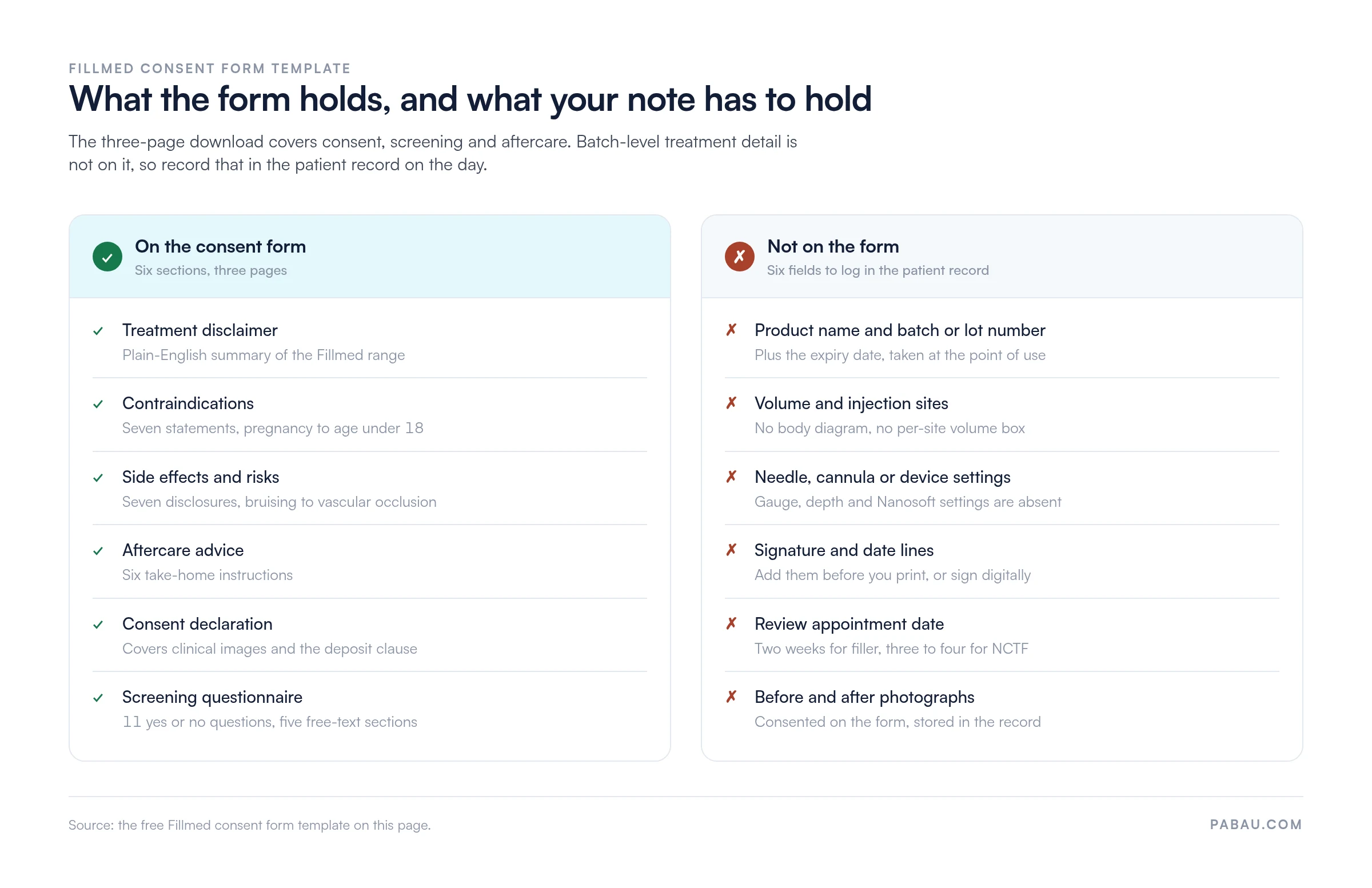
The free template on this page is a Fillmed consent and aftercare form, not a treatment record with product fields.
It covers the treatment disclaimer, seven contraindications, seven side effects and risks, six aftercare instructions, and a consent questionnaire.
Batch numbers, product names, injection sites, volumes and device settings belong in the patient’s clinical note, which this form does not hold.
MHRA recall handling and CQC inspection both rest on that batch-level detail, so record it at the point of use.
Pabau, practice management software for aesthetic practices, turns the form into a digital consent with e-signature and secure storage.
A print-ready Fillmed consent form covering the treatment disclaimer, contraindications, side effects and risks, and aftercare advice. It ends with a consent declaration, 11 screening questions, and five free-text sections for history, aims and concerns.
Download templateFillmed products span injectable skin boosters, dermal fillers, medical-grade peels and mesotherapy. Each of those treatments needs consent that names the risks the patient is accepting. The form on this page gives you that document, ready to print.
One limit matters before you print it. The form carries no batch number, product or injection-site fields, so your clinical note still has to record those. Below you’ll find what the form contains, how to use it, and what to document alongside it for each Fillmed range.
The download is a three-page PDF written for the whole Fillmed range rather than one product. It’s a print-ready document, not an interactive form, so it has no fillable fields. Print it for the patient, or rebuild it inside your own digital consent workflow.
Page one speaks to the patient. Pages two and three carry the consent declaration and the screening questionnaire.

The form lists seven situations in which treatment must not proceed. Read them with the patient rather than handing the page over in silence.
The questionnaire asks about most of these again in yes or no form. That repetition earns its place. The patient reads the rule, then answers for themselves, and you have both on the page.
The risk section is written to be read aloud at consultation. It covers the whole range, so injectable, peel and mesotherapy risks sit together.
Documented expectation-setting about outcomes is the first item an insurer or a complaint handler asks to see.
The aftercare section is written for the patient to take home. It applies across the Fillmed range rather than to a single product.
Give the patient a copy and note in the record that you did. Aftercare the patient denies receiving is hard to defend later.
The form handles consent. It doesn’t record the treatment itself, so a second document has to do that job.
Add a signature and date line before you print, or capture the signature digitally. The remaining items go into your notes on the day of treatment. Pabau, practice management software for aesthetic practices, stores those details against the same appointment as the signed consent. The two columns below split the form’s job from the note’s.
The workflow runs in five steps, and only the first two happen on the PDF itself.
Steps three to five are where paper systems leak. A structured treatment record prompts for each field before the note can be closed.
NCTF 135 HA is a skin booster rather than a filler. It combines hyaluronic acid with vitamins, amino acids and coenzymes, delivered by mesotherapy. The goal is skin quality over several weeks, not immediate volume.
Your NCTF note should record the batch number and expiry date, any dilution used, the number of passes, and the injection depth. Add the total volume and the areas treated, which are usually the face, neck and décolletage.
Results build over three to six weeks as hydration and collagen remodeling improve. Set a review at two to four weeks, and photograph the skin so texture change is measurable later.
Art Filler is the dermal filler range, used for volume and contour. It includes Art Filler Universal, Lips, Volume, Fine Lines and Lips Soft.
Hyaluronic acid filler lasts roughly 9 to 18 months, and placement is anatomically precise. Record the exact product rather than the range name, along with the batch number and the volume per syringe. Note the volume placed at each site. Record whether you used a needle or a cannula, and the gauge or cannula size.
Before and after photographs are standard of care for filler work, and the consent form already covers clinical imaging. Pabau’s before-and-after photo tools store those images in the patient record, time-stamped against the treatment date.
Skin Perfusion is Fillmed’s professional serum line, applied topically rather than injected. Record which serum you used, the date, the area treated, and whether it followed a procedure or stood alone.
Nanosoft is a microneedle device that delivers NCTF or compatible serums into the superficial dermis. Its settings are part of the protocol, so log the needle depth in millimeters and the number of passes.
Both are usually delivered as a course, so record the session number every time. Note the patient’s comfort during the session, plus any redness or swelling before they leave.
Fillmed injectables are regulated as medical devices in the UK. Batch-level records are what let you act if the MHRA or the supplier announces a recall.
The treatment note is the only document linking a patient to a specific batch and date. Without it, you can’t tell a patient whether their product was affected. CQC inspectors ask aesthetic practices for exactly this trail.
Under UK GDPR and ICO guidance, health records must be held securely and kept for a defined period. Aesthetic practices commonly retain an adult record for eight years after the last appointment. A child’s record is usually kept until their 25th birthday.
Suspected adverse incidents involving a Fillmed product are reported to the MHRA through the Yellow Card scheme. You will need the product, the batch number and the treatment date to file one.
A paper consent in a filing cabinet is hard to find when a patient calls three weeks later about a lump. It also carries no audit trail, so you can’t show who completed it or when.
Stored digitally, the same form gets a timestamp, a named author and encryption that meets UK GDPR expectations. Pabau’s compliance tools hold the signed consent, the clinical note and the photographs together.
The difference shows most during a recall. A digital record lists every patient treated with one batch in seconds, instead of a morning spent opening folders.
Work through this the first few times, and it becomes habit. The first list belongs on the form, the second in your clinical note.
The usual setup prints the consent, files it, then records the treatment detail somewhere else. Consent and clinical record drift apart, and the batch number is what goes missing.
With Pabau you rebuild this form once as a digital intake and consent form. The patient completes it on a tablet or before they arrive, and the answers, signature and timestamp attach to that appointment.
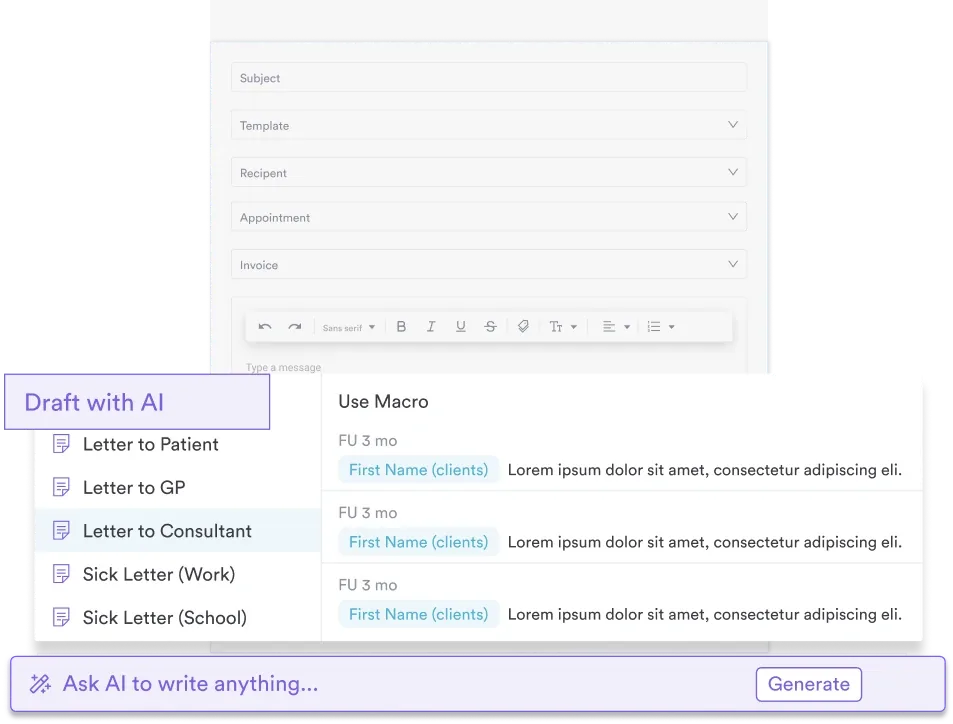
The treatment note then sits beside it, holding the product, batch, sites and volumes. When a recall lands you search by batch and get the patient list, then send letters from the same screen.
Every Pabau subscription includes all of it, from e-signature and photo storage to access controls and retention. Onboarding is structured, so the form is live before your next Fillmed treatment day.

Pabau stores signed Fillmed consent, batch numbers and treatment photographs against the same appointment. You can trace a batch to its patients in seconds, and show that aftercare was given.

The form on this page is a solid consent document and not a treatment record. Be clear about which job it does, and the rest of your paperwork falls into place.
The detail that decides a recall or an inspection is the batch number, and no consent form will capture it for you. Record it at the point of use, every time.
Practices that keep consent and treatment detail in one system stop losing that trail. Book a demo to see how Pabau keeps Fillmed consent, batch records and aftercare in a single patient file.

Need a consultation form to pair with this consent? Med spa consultation form template gives you the pre-treatment questions that sit in front of a Fillmed consent.
Auditing your practice against UK duties? Medical spa compliance checklist walks through consent, retention and traceability obligations line by line.
Want consultations that convert? The importance of consultations shows how to set expectations before a filler appointment is booked.
Choosing software for an aesthetics practice? Best aesthetic clinic software compares the systems that store consent, notes and photographs in one record.
No. The template is a consent, contraindication and aftercare form, so it carries no product, batch, volume or injection-site fields. Record those in the patient’s clinical note on the day of treatment, alongside the signed consent.
Aesthetic practices in the UK commonly keep an adult treatment record for eight years after the last appointment. A child’s record is usually kept until their 25th birthday. Batch numbers stay in the record for that whole period.
Search your records for the batch or lot number and list every patient treated with it. Contact each one, tell them what to watch for, and log that contact. Report any adverse incident to the MHRA through the Yellow Card scheme.
Yes, provided every area and product is named before the patient signs. If you later decide to treat another area, take fresh consent that names the new area, product and technique.
You need the original note with the product, batch, date, volumes and practitioner, plus a new entry describing the reported effect. Together they let you trace the batch, contact the supplier, and report the incident if that is needed.