Monika Lazarevska

Emotional intelligence scale: Free PDF and how to score it
Download your free emotional intelligence scale A three-page questionnaire with ...

Last Updated: Nov 2, 2026
Free PDF 2 pages, print-ready Clinician-reviewed
The Dissociative Symptoms Scale is a self-report questionnaire that measures how often a patient had dissociative experiences in the past week. This free PDF holds the brief, 8-item version (DSS-B). Patients rate moments of unreality, reliving an upsetting past, hearing or seeing things that weren't there, and losing track of their surroundings.
Answers run from "Not at all" to "More than once a day." Add the eight scores for a total from 0 to 32. No clinical cutoff exists, so the scale earns its keep through repetition. Give it weekly, and the trend tells you more than any single number.
A two-page, 8-item patient questionnaire asking how often each dissociative experience happened in the past week. Every item offers five options, from "Not at all" to "More than once a day."
Start from scratch, or upload this PDF or any form you already use, and Pabau's AI Form rebuilds it with tick boxes, text fields and a signature. Attach it to the treatment once, and every patient gets it on time.
AI Form rebuilds the consent, history and aftercare forms you already use. You review each one, then publish.
Patients complete forms on their phone before they arrive, so the front desk stops retyping paper.
Every signed form is versioned and attached to the treatment record, ready when you need it.
Set how long a consent stays valid. Returning patients skip forms they have already signed.
Supports HIPAA and GDPR compliance AES-256 encryption 4.8 on G2 4.7 on Capterra Trusted by 4,000+ practices worldwide

This PDF is the 8-item brief Dissociative Symptoms Scale (DSS-B), not the 28-item DES-II.
Each item asks how often an experience happened in the past week, on five options from “Not at all” to “More than once a day.”
The items cover unreality, reliving an upsetting past, sensory misperceptions, and losing track of surroundings.
Score each item from 0 to 4 and add them for a total of 0 to 32. No clinical cutoff has been established.
A high total is a prompt for a clinical interview, never a diagnosis on its own.
The Dissociative Symptoms Scale (DSS) is a self-report questionnaire that measures how often a patient had dissociative experiences in the past week. Carlson and colleagues published the full 20-item version in 2018, and staff at the VA National Center for PTSD developed it.
The free PDF on this page is the brief version, the DSS-B, published by Macia and colleagues in 2022. Its eight items are drawn from the full DSS (items 2, 4, 6, 8, 14, 15, 17 and 18).
Our PDF prints the questions and answer options but not the source reference. Note the citation (Macia et al., 2022, Assessment) in the patient record when you file a completed form.
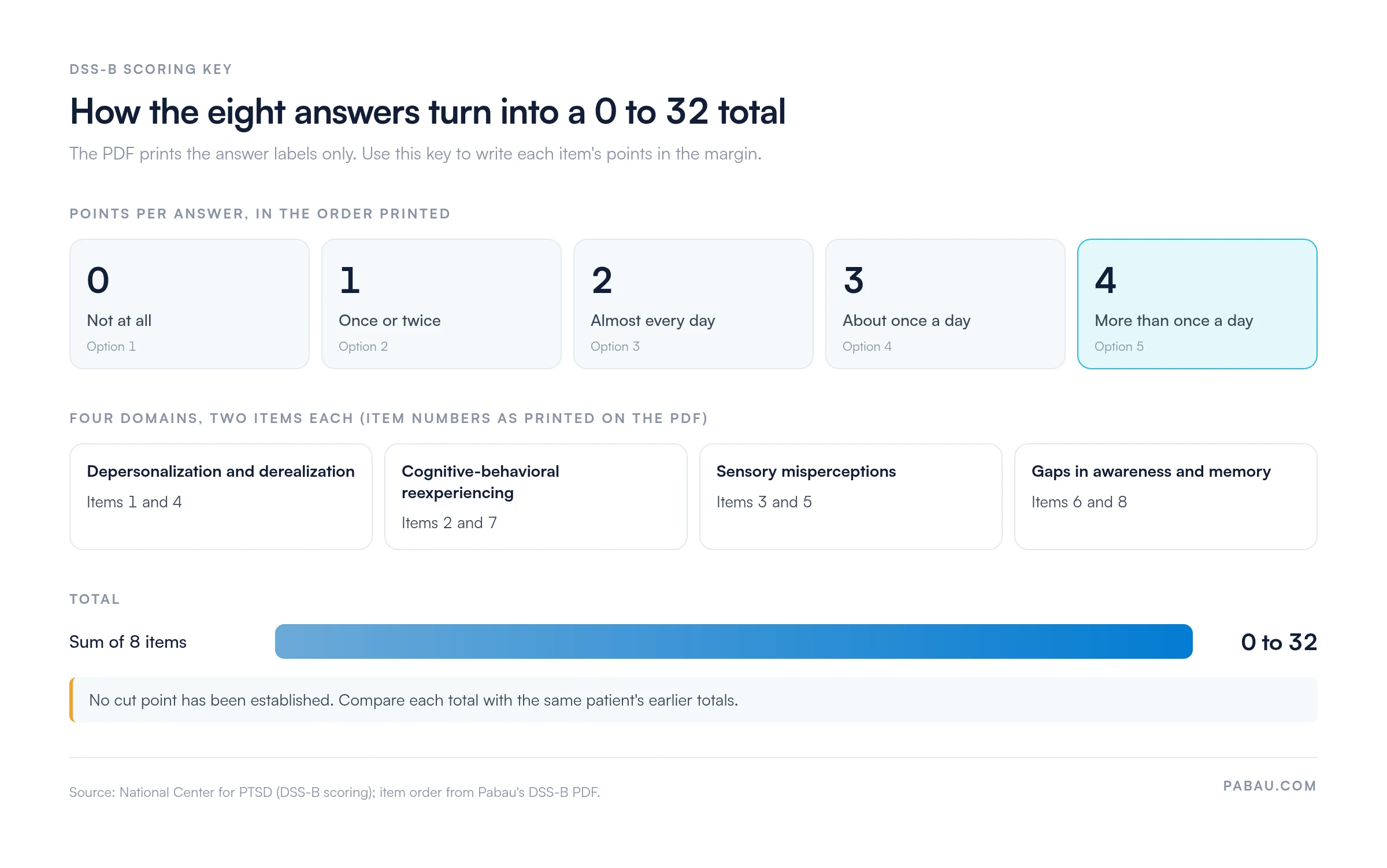
The form opens with one instruction: “Indicate how much each thing has happened to you in the past week.” The eight items then fall into four domains, two items each, matching the subscales of the full DSS.
Domain labels follow the National Center for PTSD’s subscale map for the full DSS. The PDF itself prints the items without domain headings, so patients see a plain list of eight questions.
Every item carries the same five options, printed in this order:
Yes, “Almost every day” really does come before “About once a day,” on our PDF and on the published version. Keep that order in a digital copy, because the published scoring follows it.
The two names sound alike, which is how they get mixed up on intake paperwork. The DSS-B and the Dissociative Experiences Scale II (DES-II) are separate tools with different items, scales and scoring.
Use the DSS-B to track how often symptoms happened recently. Use the Dissociative Experiences Scale template for a broader screen of everyday dissociative experiences.
The cutoff of 30, the mean-score method and the percentage scale belong to the DES-II only. Never apply them to a completed DSS-B.
Score each item from 0 for “Not at all” to 4 for “More than once a day,” then add the eight scores together. That published method gives a total between 0 and 32.
Our PDF prints the answer labels without numbers, so the key below is worth keeping next to the form.
No cut points have been established; research on cut points is in progress. So how do you read a total? Read three signals together:
Because the window is one week, the DSS-B suits repeat use across a course of treatment. A falling total over several weeks is easier to read than a single score taken once.
Qualified mental health professionals working with adults who have trauma histories or PTSD symptoms are the main users. The brief form suits quick assessment.
The DSS-B measures dissociation only. When PTSD symptoms are also in question, the PCL-5 PTSD checklist covers them with its own 20 items.
Items 3 and 5 ask about hearing or seeing things that weren’t there. A high rating needs follow-up questions, because it can point to dissociation, psychosis or another cause. A psychosis spectrum test can help structure that conversation.
The DSM-5 diagnostic criteria, published by the American Psychiatric Association, remain the reference for any diagnosis.
The scale has clear limits. It screens rather than diagnoses, it covers only the past week, and it does not replace a structured interview. The International Society for the Study of Trauma and Dissociation (ISSTD) is a useful reference for clinicians working with dissociative presentations.
Knowing the scoring is half the job. The other half is where the form sits in a session, and here is the route that works:
Questions about reliving an upsetting past can stir strong feelings, so leave time to talk them through. A grounding techniques worksheet gives a patient something practical to use if detachment comes up mid-session.
Each of these mistakes changes what the total means. Watch for them:
If the patient’s answers still don’t add up, a mental status exam gives you a structured way to fill in the picture.
Many practices still print the DSS-B, score it by hand, and scan it into the patient file. Weekly repeats then mean a stack of paper and totals that nobody has charted.
Pabau, the practice management platform we build for healthcare practices, lets you rebuild the eight items as a digital form. Patients complete it on their phone before the session. Each answer maps to its 0 to 4 value, so the total is calculated and stored against the patient record.
You open the session with the score and the item pattern already in front of you. Repeat totals sit side by side in the record, so you see change across treatment at a glance. It’s one small part of simpler therapy practice management, and it saves a scoring step every week.

Send the DSS-B as a digital form, score it automatically, and keep every weekly total in the patient record. Pabau gives mental health practices one place for forms, notes and follow-up.

Treat the DSS-B as a weekly measure, not a verdict. Without a cutoff, its value comes from repetition. Ask the same eight questions, score them the same way, and compare each total with the patient’s earlier ones.
The trade-off is depth. Eight items and a one-week window can’t replace the DES-II for a broader screen, or a clinical interview for diagnosis. Book a demo to see how Pabau sends, scores and charts weekly symptom measures for mental health practices.

Need a broader dissociation screen? Dissociative Experiences Scale template covers the 28-item DES-II and how its percentage scores work.
Screening for PTSD alongside dissociation? PCL-5 PTSD checklist explains scoring and interpretation for the 20-item PTSD self-report.
Looking at trauma responses more widely? Trauma response test gives clinicians a free template for mapping how patients react to trauma.
Want a skill to offer after a high score? Grounding techniques worksheet helps patients reconnect with their surroundings during detachment.
Planning nursing care for trauma? PTSD nursing care plan sets out goals and interventions for patients with PTSD.
Yes. Staff at the VA’s National Center for PTSD created the DSS, and both the full scale and the DSS-B are free PDFs on its website. Cite Macia et al. (2022) when you file a completed brief form.
The full DSS has 20 items and sums to a total from 0 to 80, with subscale scores taken as the mean of their items. The DSS-B keeps eight of those items and sums them to a total from 0 to 32.
No. The scale counts how often symptoms happened in one week, which flags who needs a closer look. A diagnosis still rests on a clinical interview against the DSM-5 criteria.
Yes. The Clinician-Administered Dissociative States Scale (CADSS) adds clinician observation and measures dissociation in the present moment. The DSS-B is self-report and covers the past week instead.
Yes. Its one-week window makes weekly or per-session repeats sensible. A run of totals shows whether symptoms are easing across treatment.