Ballard scale newborn
The Ballard scale newborn assessment estimates a baby’s gestational age by...

1
Last Updated: Sep 30, 2026

Cervical dilation runs from 0 cm, a closed cervix, to 10 cm, which is full dilation and the point where pushing begins.
Active labor starts at 6 cm under the 2014 ACOG and SMFM consensus, not the 4 cm used by older guidance.
Dilation and effacement are separate measurements, so chart the centimeters and the percentage at every exam.
Expect roughly 1.2 cm per hour for first-time mothers and 1.5 cm per hour for repeat mothers once active labor begins.
Arrest of dilation means no change for 4 hours or more with adequate contractions, or 6 hours if contractions are inadequate.
A ready-to-use reference chart for obstetricians and midwives covering cervical dilation from 0-10 cm across labor stages, with effacement percentages, clinical timelines, and documentation fields.
Download templateA dilated pregnancy chart tracks how far the cervix has opened, from 0 cm at the start to 10 cm at full dilation. Get the reading or the timing wrong and the record no longer supports the decision you made.
This guide walks through what each centimeter means, how dilation pairs with effacement, and how long each phase usually takes. It also lists the fields to chart at every exam, so your partograph holds up when someone reviews it later.
Cervical dilation is the opening of the cervix, measured in centimeters from 0, meaning closed, to 10, meaning fully dilated. The cervix has to reach 10 cm before the baby can pass through the birth canal.
A clinician confirms the number by exam, and the finding sits alongside the rest of the pelvic exam documentation.
Dilation does not happen in isolation. The cervix also effaces, which means it thins and shortens, and both changes get plotted on a partograph.
A partograph is the graphic record of labor progress used in delivery units worldwide. Keeping both values in one structured place means every clinician reads the same picture at handover.
The table below pairs each band of dilation with its labor stage, the cervical changes, and what the patient is likely to feel. Use it as the reference behind your partograph entries.
Record every finding with the time of the exam, the cervical consistency, and the effacement percentage. Plotted over time, those entries show whether labor is tracking normally against the Friedman or Zhang curves.
Labor moves through early, active, and transition phases. Each one carries its own dilation range, contraction pattern, and decision point. The chart below shows how all three sit on the 0 to 10 cm scale.
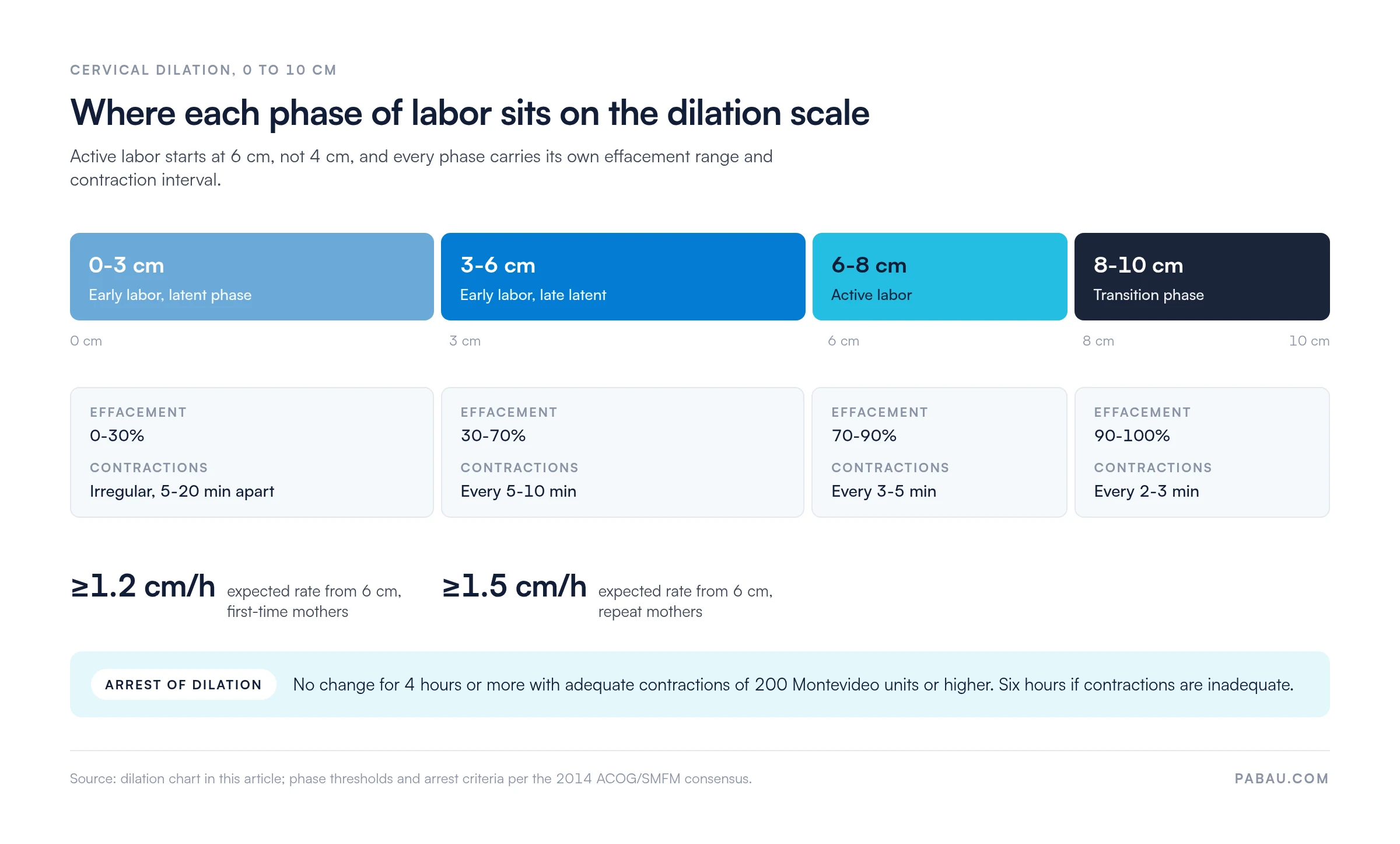
Early labor is the longest phase and the least uncomfortable. Contractions are mild to moderate, irregular, and usually 5 to 20 minutes apart.
Most patients can still walk, eat, and hold a conversation. The cervix opens slowly to 6 cm over several hours in a first-time mother, and often much faster in a repeat mother.
The 2014 ACOG and SMFM consensus statement defines active labor as 6 cm or more with strong, regular contractions. Older guidance used 4 cm, and 6 cm is now the evidence-based threshold because it cuts unnecessary intervention.
From there, dilation runs at about 1.2 cm per hour in first-time mothers and 1.5 cm per hour in repeat mothers.
Transition is the most intense phase and the shortest, lasting 15 minutes to an hour. Contractions come every 2 to 3 minutes and sometimes overlap. Patients often say they feel overwhelmed or nauseous, or that they cannot carry on.
Once the cervix reaches 10 cm, the chart hands over to the second stage. The next numbers you record are the Apgar score at one and five minutes.
Effacement is the thinning and shortening of the cervix. Dilation is the opening. Both progress during labor, and neither number tells you the other. A cervix can be 4 cm dilated and only half effaced, so record both at every exam rather than one.
Chart effacement as a percentage: 0% for a thick, long cervix, 50% for half-thinned, and 100% for paper-thin.
Both values move together through labor, though the rate varies by parity. Timestamped entries then give you a record that stands up for continuity of care and for medico-legal review.
The Friedman curve, published in 1954, is still the reference most units picture when they talk about normal progress. It plots the expected rate of dilation through active labor, which is what makes a stall visible.
The 2014 ACOG Safe Prevention of Primary Cesarean Delivery bulletin then reset the criteria. It moved active labor to 6 cm rather than 4 cm. Arrest now needs no change for ≥4 hours with adequate contractions (≥6 hours if inadequate).
Modern partographs, including the WHO version and most in-house forms, draw this curve on the page for you. The value is the shared format. When every clinician fills the same fields in the same order, a stall shows up as a flat line.
Patients usually notice changes before the next exam. None of these signs confirm dilation on their own, since only an exam gives you a number. They do tell you where to look first, and when to bring someone in.
Log the time each sign appeared, how the patient described it, and what you did next. Symptom history collected before arrival speeds up triage, because the assessment starts from something rather than from scratch.

Dilation timelines vary by parity, maternal age, induction status, and individual physiology. The figures below follow ACOG’s evidence-based guidance, and they describe what is typical rather than what is required.
Treat these as averages. Labor can run faster or slower than the table and still be entirely normal. What counts is documented progress over time, so read the partograph rather than the clock. Avoid giving a patient a delivery time based on one dilation reading.
Chart 11 things at every exam. The list looks long, and a structured template turns it into one quick, repeatable entry.
Practices running on OB/GYN EMR software can fix the field order once, so nobody has to remember it at 3 AM.
Pair every dilation entry with the fetal heart rate, and read it against the normal fetal heart rate bands for the gestation. Then plot the point on the partograph. If progress crosses the alert line, escalate the assessment and review the plan with the on-call obstetrician.
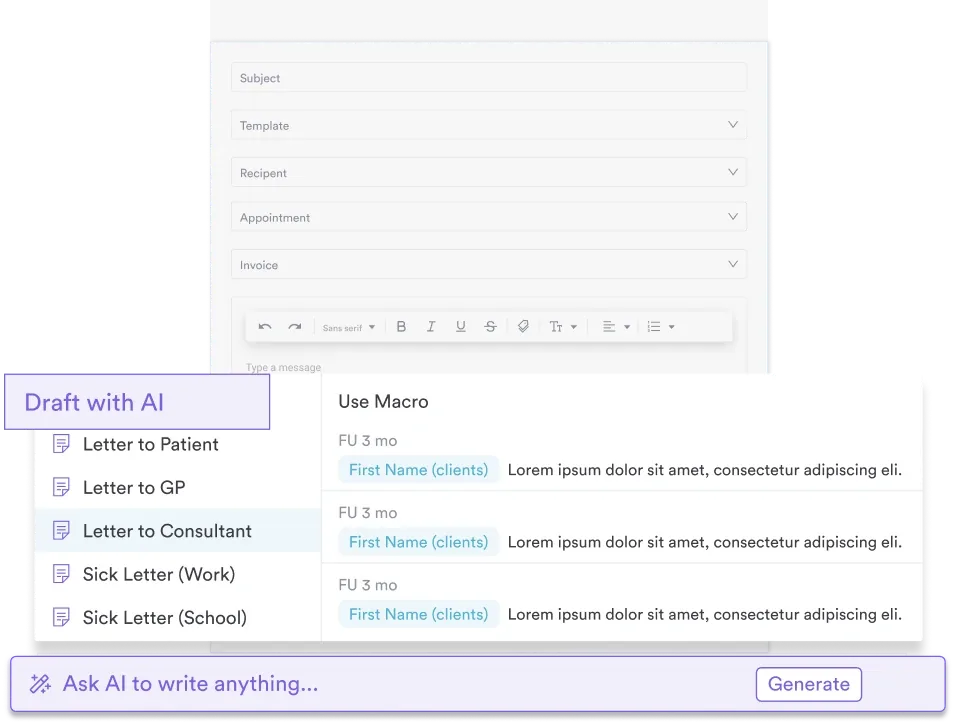
Most labor records still live in two places. The readings go on a paper partograph at the bedside, and a summary gets typed into the system hours later. That second step is where exam times drift and small details fall away.
Practice management software like Pabau keeps the whole episode in one client record. Custom forms hold the dilation, effacement, station, and fetal heart rate fields in the order your team examines.
Each entry carries its own timestamp, so the hourly rate is already there when a colleague asks for it.
Plenty of obstetric teams run fertility services from the same front desk. Pabau’s fertility clinic software keeps those episodes on one patient timeline, so a labor record sits with the earlier scans and results. That saves rekeying, and the postpartum follow-up gets booked from the same screen.

Pabau’s EMR simplifies cervical dilation charting, partograph plotting, and real-time team communication during labor.

A dilated pregnancy chart earns its place when the numbers on it can still be trusted six hours later. In practice that means an exam time on every entry, effacement recorded next to the centimeters, and contraction adequacy written down before anyone calls arrest.
Print the chart, or build the same fields into your notes template. Either way, keep one format across the whole team, because a partograph only reads clearly when everyone fills it the same way.
Book a demo to see how Pabau holds dilation, effacement, and fetal heart rate in one labor record your team can hand over cleanly.

Planning a birth after a previous cesarean? VBAC birth plan sets out the monitoring and decision points a trial of labor needs.
Tracking blood pressure across the pregnancy? Blood pressure pregnancy chart gives you the thresholds and the fields to chart at each antenatal visit.
Want the patient’s preferences on record before labor starts? Mama Natural birth plan template captures pain relief choices and delivery preferences on one page.
Checking fetal wellbeing before labor begins? Nonstress test explains the procedure and how to read a reactive or nonreactive result.
Need a plan for the first six weeks after delivery? Postpartum care plan covers recovery checks, feeding support, and follow-up scheduling.
Usually not. Modern low-dose epidurals have little effect on how quickly the cervix opens during the first stage. They can lengthen the pushing stage, which is why guidelines allow extra time when a block is in place. Note the time the block goes in, then keep plotting dilation as usual.
Yes. A cervix can sit at 1 or 2 cm for weeks before labor starts, and this is common in repeat mothers. Dilation on its own is not labor. Labor needs regular contractions plus a documented change in dilation or effacement over time. Record the finding, note the lack of change, and avoid giving a date.
Only as often as a decision requires. Many units check roughly every four hours in established labor, and sooner when the plan depends on the result. Fewer exams lower the infection risk, which matters most once the membranes have ruptured. Give every exam a time, a reason, and a full set of findings.
The Bishop score rates how ready the cervix is for induction, not how far labor has gone. It scores five features: dilation, effacement, station, cervical consistency, and cervical position. A total of 8 or more suggests a favorable cervix and a shorter induction. Dilation is only one line of it, so record both.