Montgomery-Åsberg Depression Rating Scale (MADRS)
The Montgomery-Åsberg Depression Rating Scale (MADRS) is a clinician-administer...

Last Updated: Oct 6, 2026

The COWS assessment is an 11-item clinician-administered scale that measures opioid withdrawal severity.
The scale bands total scores as 5 to 12 mild, 13 to 24 moderate, 25 to 36 moderately severe, and above 36 severe.
A score of 8 or above is the standard threshold for buprenorphine induction, which places it inside the mild band.
Reassessment timing and documentation requirements vary by clinical setting and treatment protocol.
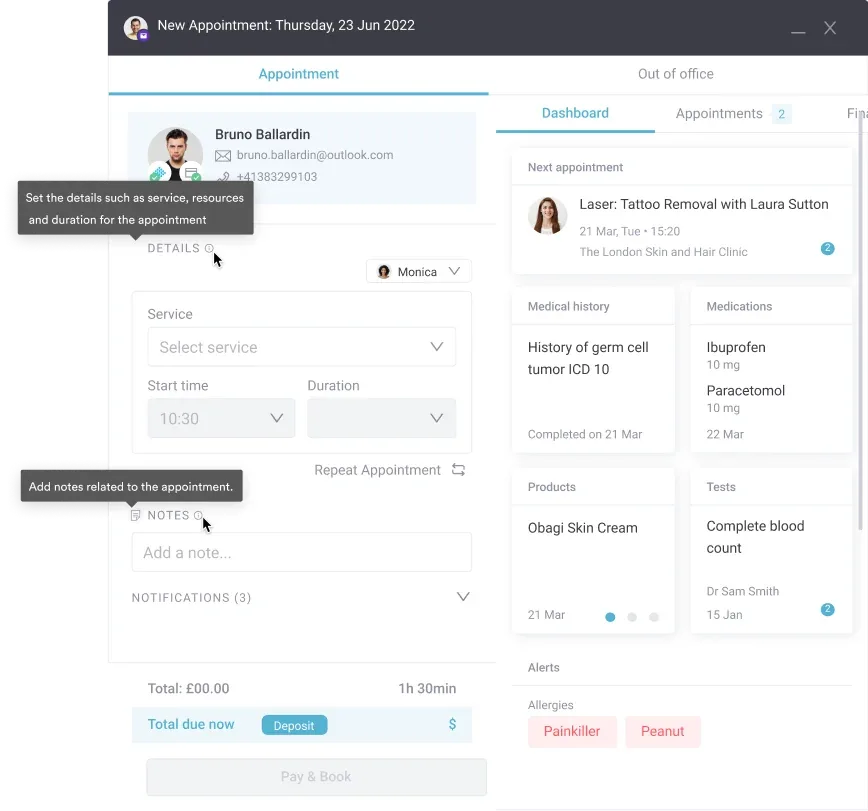
Practice management software like Pabau embeds the COWS form in the patient record, so scores sit beside the treatment timeline.
An 11-item clinician-administered scale for rating opioid withdrawal severity. It carries the scoring anchor for every item, the four interpretation bands from mild to severe, and the treatment guidance that follows each band.
Download templateOpioid withdrawal is easy to underrate at the bedside. The Clinical Opiate Withdrawal Scale turns what a clinician sees and hears into a single number, and that number decides whether buprenorphine starts today.
This page explains what each of the 11 items scores, how to read the total, and when to reassess. It also sets out what belongs in the chart afterwards. The COWS assessment form above is free to download.
The Clinical Opiate Withdrawal Scale (COWS assessment) is a validated 11-item tool. Clinicians use it to measure the severity of opioid withdrawal in patients with opioid use disorder. The total score guides treatment decisions, including symptom management and eligibility for buprenorphine induction.
The scale standardizes withdrawal assessment across clinical settings. It gives every clinician the same scoring framework, which reduces rater bias and makes one nurse’s severity rating comparable to another’s. The 11 items span physiological, behavioral, and subjective symptoms observed during the assessment interview.
Clinical judgment alone leaves no trace in the chart. A structured COWS form gives every patient the same evaluation and leaves an auditable record behind. That record supports 42 CFR Part 2 confidentiality requirements and HIPAA-compliant documentation for opioid use disorder programs.
Each item is weighted, and individual items contribute up to five points depending on symptom severity. The total is the sum of all 11 items, so it runs from 0 to 48.
Reproducible scores start with the setting. Use a quiet, comfortable room where the patient feels safe describing withdrawal symptoms, then work through these six steps.
The total maps onto four severity bands, and each band points to a different level of care. The boundaries below follow the published COWS scale, which is where a lot of internal protocols quietly drift.
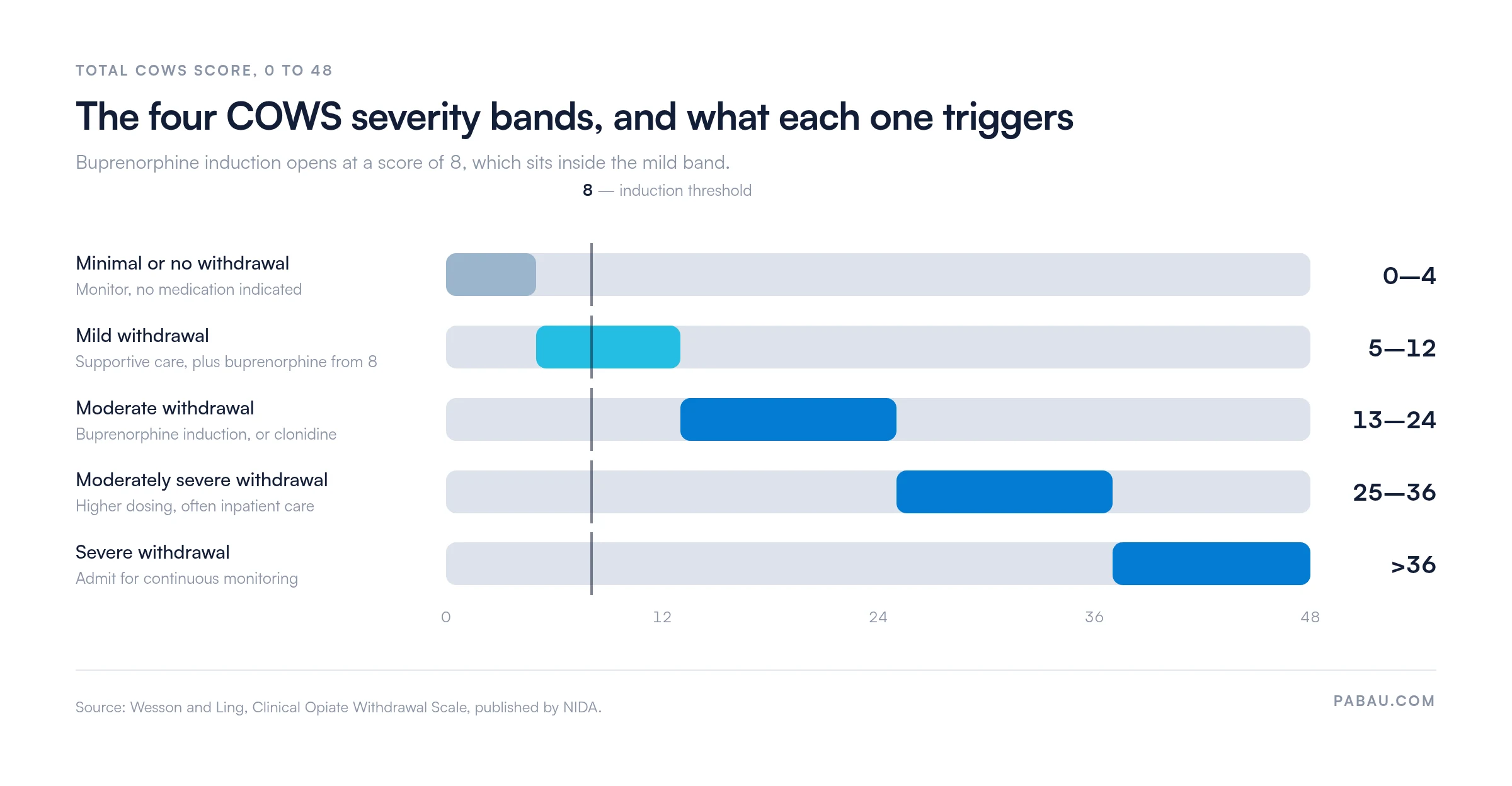
A score of 8 or above is the standard trigger for buprenorphine and naloxone induction eligibility under SAMHSA guidance. That trigger sits inside the mild band rather than at the top of it. Below 8, induction risks precipitated withdrawal. At or above it, waiting leaves a patient in treatable distress.
Each band points to a different action. A mental health EMR can carry that protocol beside the score. The next step is then on screen while the patient is still in the room. What you do next also depends on the patient’s wider medical context.
Whichever band the patient falls into, the action you take belongs in a written plan. A substance abuse treatment plan gives you the goals, interventions, and review dates to record once induction is underway.
Practices treating both opioid and alcohol use disorder ask what separates the COWS assessment from the CIWA-Ar. Both are validated withdrawal scales. They measure different substance withdrawal profiles and carry different medication protocols.
If your caseload covers alcohol withdrawal too, that side of the workflow needs its own paperwork. An alcohol withdrawal care plan sets out the monitoring intervals and benzodiazepine triggers the CIWA-Ar calls for.
The COWS works as a monitoring tool across the whole withdrawal and early stabilization period, not as a one-off screening. How often you repeat it depends on the setting and on how the patient responds.
Documenting the COWS properly protects the practice as much as the patient. Every record needs the same data elements.
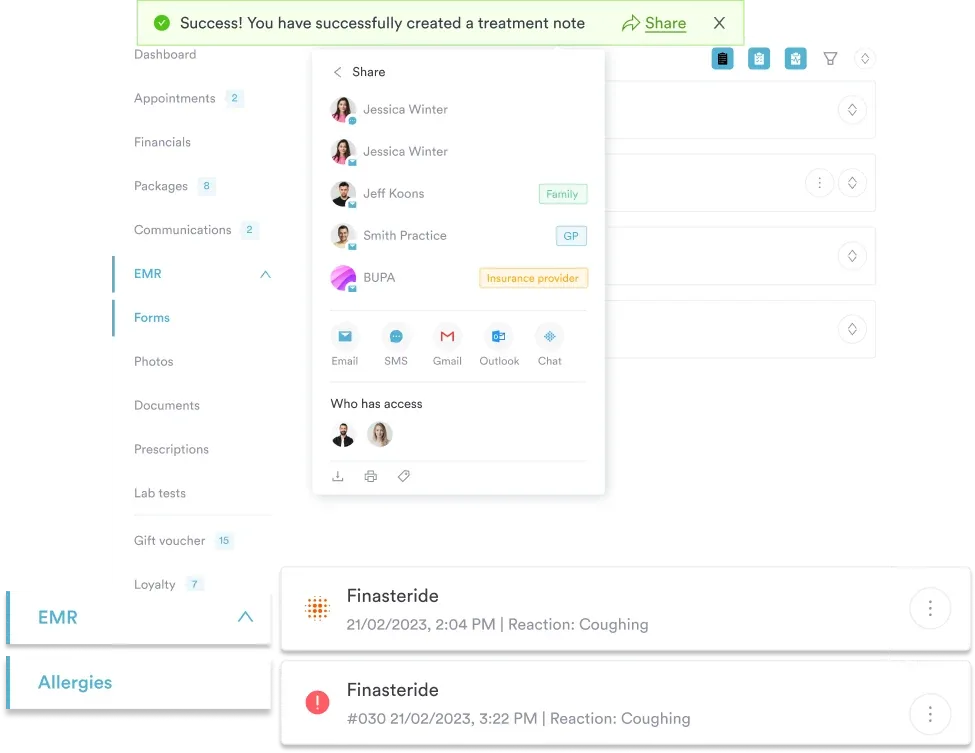
Building the scale as one of your digital patient forms handles the timestamp, the clinician attribution, and the arithmetic on its own. Those are the three places where paper records most often fail an audit.
The COWS stratifies severity quickly because its 11 items cover the physiological, behavioral, and subjective sides of withdrawal at once. That breadth is what lets a clinician move from observation to a care-level decision in a few minutes.
Consistency is what makes the score useful over time. Scoring every patient on the same scale produces comparable data, gives new clinicians something concrete to train against, and leaves an auditable record. That holds whether you score on paper or inside the software you use to run a therapy practice.
The score still does not replace clinical judgment. Your knowledge of the patient’s history, use pattern, co-occurring conditions, and social support shapes the treatment plan around the number. Treat the total as a clinical aid, not a rule.
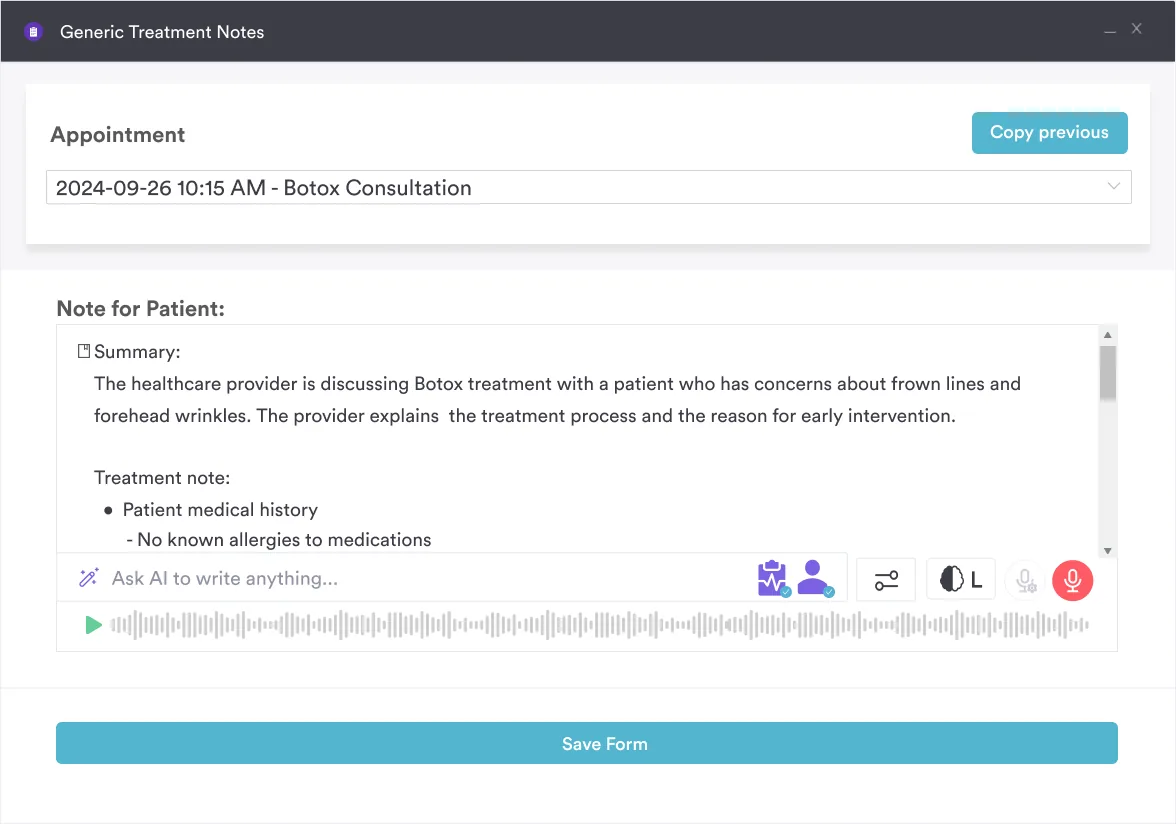
Paper COWS forms create predictable friction. Forms go missing, handwriting gets misread, items get skipped, and nobody is prompted when the next reassessment falls due. Practice management software like Pabau holds the COWS form inside the patient record instead.
A digital form timestamps each assessment, attributes it to the clinician who scored it, and totals the 11 items automatically. It links the result to the treatment plan and flags the next reassessment before the interval lapses. The opioid use disorder workflow stays in one place, from first contact through to maintenance.
What your team ends up with is a record you can hand to a 42 CFR Part 2 audit without reconstructing dates or signatures afterwards.

Pabau’s digital forms record each COWS score in the patient’s chart, total the 11 items, and flag the next reassessment before the interval lapses. Your team works from one audit-ready record instead of a paper file.

The COWS score is a decision tool, not a verdict. It tells you whether withdrawal is severe enough to start buprenorphine and which setting the patient belongs in. It cannot tell you how the patient arrived at your door or what waits for them at home.
So download the form, check your protocol against the published bands, and write down what each score led you to do. Consistency is what makes the second assessment worth comparing against the first, and comparison is where the clinical value sits.
Book a demo to see how Pabau records COWS scores, reassessment dates, and treatment decisions in one patient chart.

Managing alcohol withdrawal as well? Alcohol withdrawal nursing care plan template covers the CIWA-Ar side of the same workflow.
Ready to write the plan after induction? Substance abuse treatment plan gives you the goals and interventions structure to fill in.
Screening before you prescribe? Opioid risk tool scores a patient’s risk of misuse before long-term opioid therapy starts.
Need the full intake picture first? Comprehensive biopsychosocial assessment captures the history, use pattern, and supports around the patient.
The COWS assessment measures the severity of opioid withdrawal symptoms. The score guides treatment decisions, including whether to start buprenorphine and whether the patient needs an outpatient or inpatient setting.
Perform an initial assessment at presentation, then reassess 4-6 hours after buprenorphine induction and daily for the first 3 days. Reassess weekly during stabilization, before any dose reduction, and immediately if symptoms worsen. Frequency depends on the treatment setting and the clinical response.
A score of 8 or above is the standard threshold for buprenorphine and naloxone induction under SAMHSA guidance. That threshold sits inside the mild band, which runs from 5 to 12. Moderate withdrawal starts at 13, moderately severe at 25, and severe above 36.
Licensed clinicians may administer the COWS. That includes physicians, nurse practitioners, physician assistants, registered nurses, and clinical social workers trained in opioid use disorder care. Scope of practice and licensing requirements vary by state and clinical setting.
Yes, the COWS is a validated, evidence-based instrument published in peer-reviewed addiction medicine literature and endorsed by SAMHSA. Its reliability and validity are well-established across diverse patient populations and treatment settings.