Physician credentialing checklist
A physician credentialing checklist lists every license, certificate, verificati...

Last Updated: Oct 23, 2026
A case conceptualization is your working explanation of why a patient’s problem persists and what treatment should target. It links the presenting problem to the factors that maintain it, then turns that link into a treatment direction. Get it right, and every intervention has a clear reason behind it. Skip it, and sessions tend to drift toward managing symptoms week by week.
Most clinicians draft the first version after intake, then revise it as new information surfaces. Below, you’ll find the six core components, a step-by-step method, and how CBT, ACT, DBT and psychodynamic formulations differ. There’s also a worked anxiety example, a pre-sign-off checklist, and a free template to download.
A two-page clinical form with sections for biological, psychological, social and cultural considerations, plus problem, diagnostic, risk and treatment considerations. It also records strengths and resources, previous treatment, and what the patient thinks.
Download template
A case conceptualization is a working hypothesis linking a patient’s problem to the factors that maintain it.
Most formulations cover the presenting problem, history, maintaining factors, strengths, diagnosis and treatment direction.
Your therapy model changes which maintaining factors you emphasize, while the basic structure stays the same.
Every planned intervention should trace back to a maintaining factor, or the formulation needs another look.
Update the formulation as new information emerges, rather than treating the first version as final.
In Pabau, the practice management platform we build, treatment notes and Client records keep your formulation attached to the patient file.
A case conceptualization explains why a patient’s difficulties persist and what needs to change. A diagnosis names the condition. The formulation explains the mechanisms behind it, in this patient’s life.
In practice, it does three jobs. It guides treatment planning and gives you a plain rationale to share with the patient. It also lets you check whether the working model still fits as sessions continue. To do any of that, though, it needs the right building blocks.
Most formulations share the same building blocks, whatever the theoretical orientation. The table below summarizes them.
Keep the presenting problem and the formulation separate. The first records what the patient reports, while the second is your interpretation of it.
Start with intake data, then move from description to explanation. Each step below builds on the one before it.
Next, turn those targets into a psychology treatment plan with measurable goals and review dates. Revisit the formulation after the first few sessions and at each scheduled review. Revise it whenever new information changes your understanding.
The basic structure stays the same across approaches. What shifts is the theory that explains maintenance, and the targets that follow from it.
A CBT formulation uses the cognitive model, which links thoughts, feelings, behaviors, physiology and environment. You map how a situation triggers an automatic thought. That thought drives emotion and behavior, which in turn confirm the thought. Sketching the cognitive triangle with the patient is a quick way to share this part of the formulation.
An ACT formulation is organized around psychological flexibility, using the six core processes of the hexaflex model. It shows where experiential avoidance narrows a patient’s values-based choices. An ACT hexaflex template gives you a ready layout for mapping each process.
A DBT formulation begins with biosocial theory. This proposes that emotion dysregulation arises from biological vulnerability interacting with an invalidating environment.
The formulation then identifies the behaviors that serve to regulate emotion, and the skills that could replace them. A behavior chain analysis traces each target behavior back to the event that prompted it.
A psychodynamic formulation organizes the material around early relationships, recurring patterns, defense mechanisms and unconscious conflicts. You use these patterns to understand how the patient relates to you and to others.
A worked example makes the structure concrete. This one uses a patient presenting with generalized anxiety and avoidance at work.
Notice how the treatment direction follows from the maintaining factors. The diagram below shows the cycle those factors form, and which link each intervention targets.
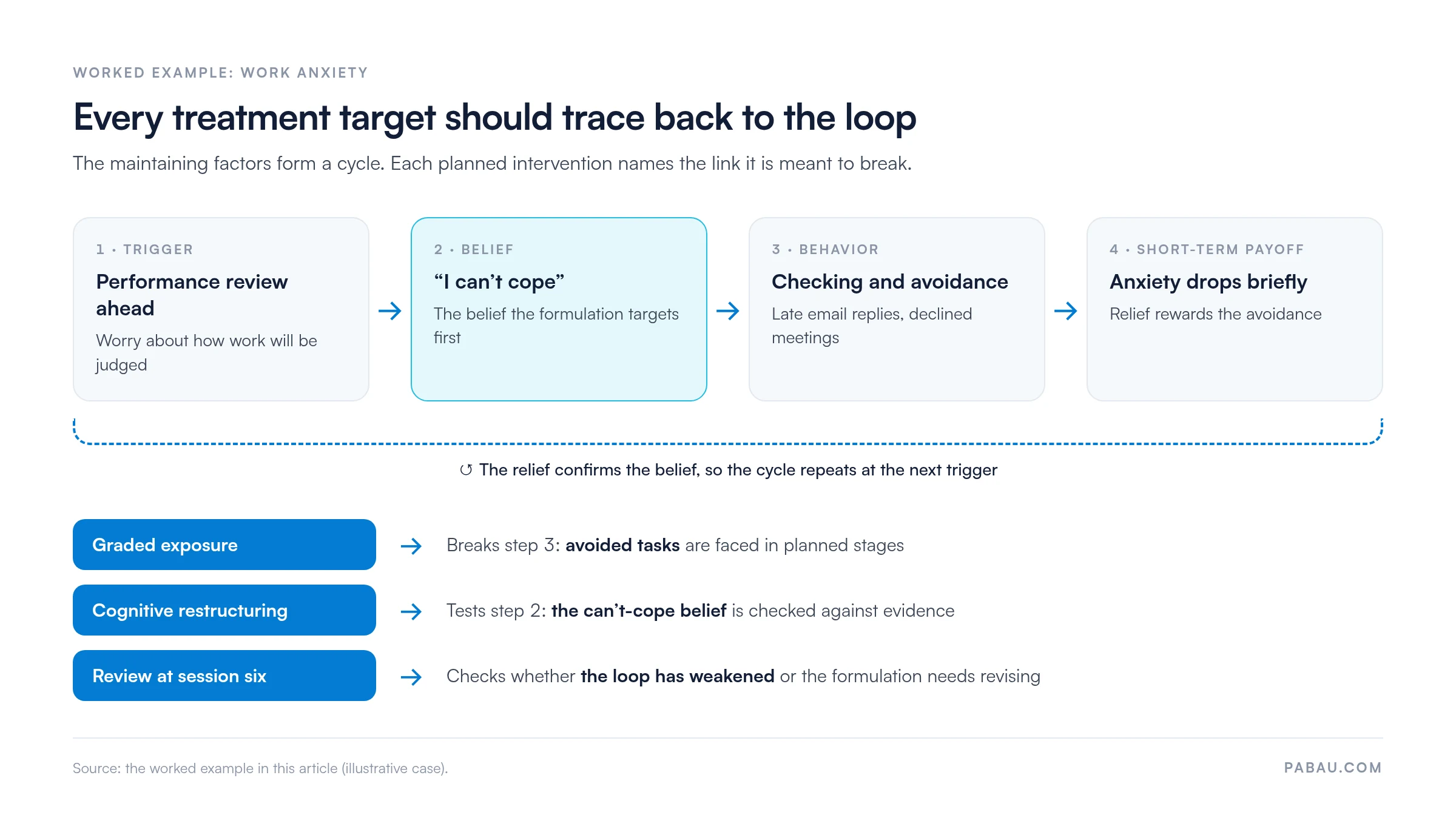
If the formulation can’t explain a planned intervention, revisit the formulation before you proceed.
Weak formulations tend to fail in a few predictable ways. Watch for these when you review a draft.
Run through these checks before the formulation goes into the patient record.
The downloadable form groups its prompts into biological, psychological, social and cultural considerations. It also has space for problem, diagnostic, risk and treatment considerations. Adapt the headings to your service and your professional body’s requirements.
Many therapists still keep formulations in Word documents or paper folders, apart from their session notes. When the formulation sits outside the record, it’s hard to see when it was last revised.
Pabau keeps the two together. Its digital intake forms capture history in a structured format before the first session. Client records then hold the completed formulation alongside treatment notes, so each revision sits next to the sessions that prompted it.
Because forms, notes and appointments share one system, reviews are easier to schedule and track. See what that looks like for simpler therapy practice management, or compare options on the mental health EMR page.

Pabau’s digital forms, treatment notes and Client records keep intake, formulation and session history in one patient file. Each revision stays dated and easy to find at review time.

A formulation earns its keep when it changes what you do in the next session. If a planned intervention can’t be traced to a maintaining factor, either the plan or the formulation needs work.
So start small. Draft the six components after intake, test them against the patient’s response, and date each revision. The trade-off is a little extra writing up front, in exchange for treatment that stays focused on what keeps the problem going.
Book a demo to see how Pabau keeps intake forms, formulations and session notes together in one patient record.

Need the full background first? Biopsychosocial history template gives you a structured intake layout for the history your formulation draws on.
Want a deeper assessment format? Comprehensive biopsychosocial assessment covers biological, psychological and social factors in one document.
Ready to turn targets into goals? Individualized treatment plan template helps you set measurable goals that follow from the formulation.
Confirming a working diagnosis? Diagnostic assessment template keeps the diagnostic impression documented separately from your formulation.
Tracking whether the formulation still fits? Progress notes for psychotherapy shows how to record session-by-session change you can review against it.
The 5 Ps are presenting, predisposing, precipitating, perpetuating and protective factors. Together they answer what the problem is, why this person, why now, why it continues, and what already helps.
No. A treatment plan lists goals, interventions and review dates. The case conceptualization explains why those goals were chosen, so the plan should follow from it.
There’s no fixed length. A working formulation often fits on one or two pages, and a short narrative summary can be enough for routine reviews. Clear links between factors matter more than length.
No. A formulation explains mechanisms, so you can draft one before a diagnosis is confirmed. Record any working diagnosis separately, as the template’s diagnostic section allows.
It’s a formulation you build with the patient rather than for them. Kuyken, Padesky and Dudley describe this collaboration as central to CBT, with the patient’s own words shaping each version.