HIPAA compliant texting: What you can send patients & how to communicate securely
HIPAA compliant texting is possible when a text holds no protected health inform...

Last Updated: Oct 16, 2026
The BSA medical form, officially the Annual Health and Medical Record (AHMR), is the health form Scouting America requires from every youth and adult participant. It has three parts. Parts A and B cover consent and self-reported health history, and every participant completes them before any activity. Part C is a physical examination signed by a licensed healthcare provider. It is required only for high-adventure programs and resident camps lasting more than 72 hours.
Every part expires one year after it is signed, so renewal comes round annually. The form also stays on paper. Scouting America asks units, districts and councils not to scan or store it electronically. This guide covers who completes each part, how to fill it out, and where the official copy comes from.
A free two-page patient intake form for collecting contact details, relevant history, medication, allergies and consent at the front desk. It supports your Part C appointments. It is not Scouting America’s official AHMR and has no Part A, B or C section.
Download template
The BSA medical form is the Annual Health and Medical Record, and Scouting America requires it from every participant.
Parts A and B cover consent and health history, and every youth and adult completes them before any activity.
Part C is a physical exam signed by a licensed provider. It applies only to high-adventure programs and resident camps over 72 hours.
Every part expires one year after signing, so Part C has to be dated within a year of the activity.
Download the fillable PDF from Scouting America. Units and councils are asked not to scan or store it electronically.
The BSA medical form is Scouting America’s standard health and medical record. It documents a participant’s health status and captures the consents needed before any Scouting activity. The form does three jobs:
Every program uses it, from Cub Scouts through Scouts BSA and adult leadership. Scouting America’s official AHMR page carries the authoritative guidance on what each part requires. The record is issued annually and renewed each year for continued participation.
Parts A and B are completed by the participant, with a parent or guardian for anyone under 18. Both are renewed every year. Part A carries the informed consent and release of liability language. Signing it confirms the participant understands the risks of Scouting activities and authorizes emergency medical treatment.
Practices that run these physicals collect their own paperwork at the same time. Intake software for practices lets the front desk gather history and consent before the patient arrives.

Part B collects the health history, including:
Both parts are signed and dated by the participant and the parent or guardian. They are required before any Scouting activity begins, whatever the activity type.
Part C is the physical examination form, signed by a licensed healthcare provider. It is required only for high-adventure activities and resident camps lasting more than 72 hours.
The exam can be conducted and signed by a licensed physician, physician assistant, nurse practitioner or other qualified provider. It covers vital signs, a general health assessment, and confirmation that the participant is medically cleared for high-adventure participation. Part C must be dated within one year of the planned activity.
Providers who sign a batch of Part C exams each spring still need their own audit trail. Compliance management software keeps each signed exam against the patient record and flags it before the year is up.
Every youth and adult participant completes Parts A and B before any Scouting activity. Whether Part C is needed depends on where the Scout is going.
The BSA medical form is valid for one year. Parts A and B expire a year from the date they were signed. Part C expires a year from the date of the physical examination. A form signed more than 12 months ago is not valid, even if the participant’s health has not changed.
For resident camps lasting more than 72 hours, Part C must be dated within one year of the camp start date. Troop leaders usually set a calendar reminder so families renew before the deadline.
Providers see the other side of the same deadline. Patient record management keeps each exam date on the chart, so the practice knows when a family is due back.

Completing the form correctly keeps a Scout’s activity approval on schedule. The path runs from the download through to the signed paper copy the unit files, and five steps cover it.
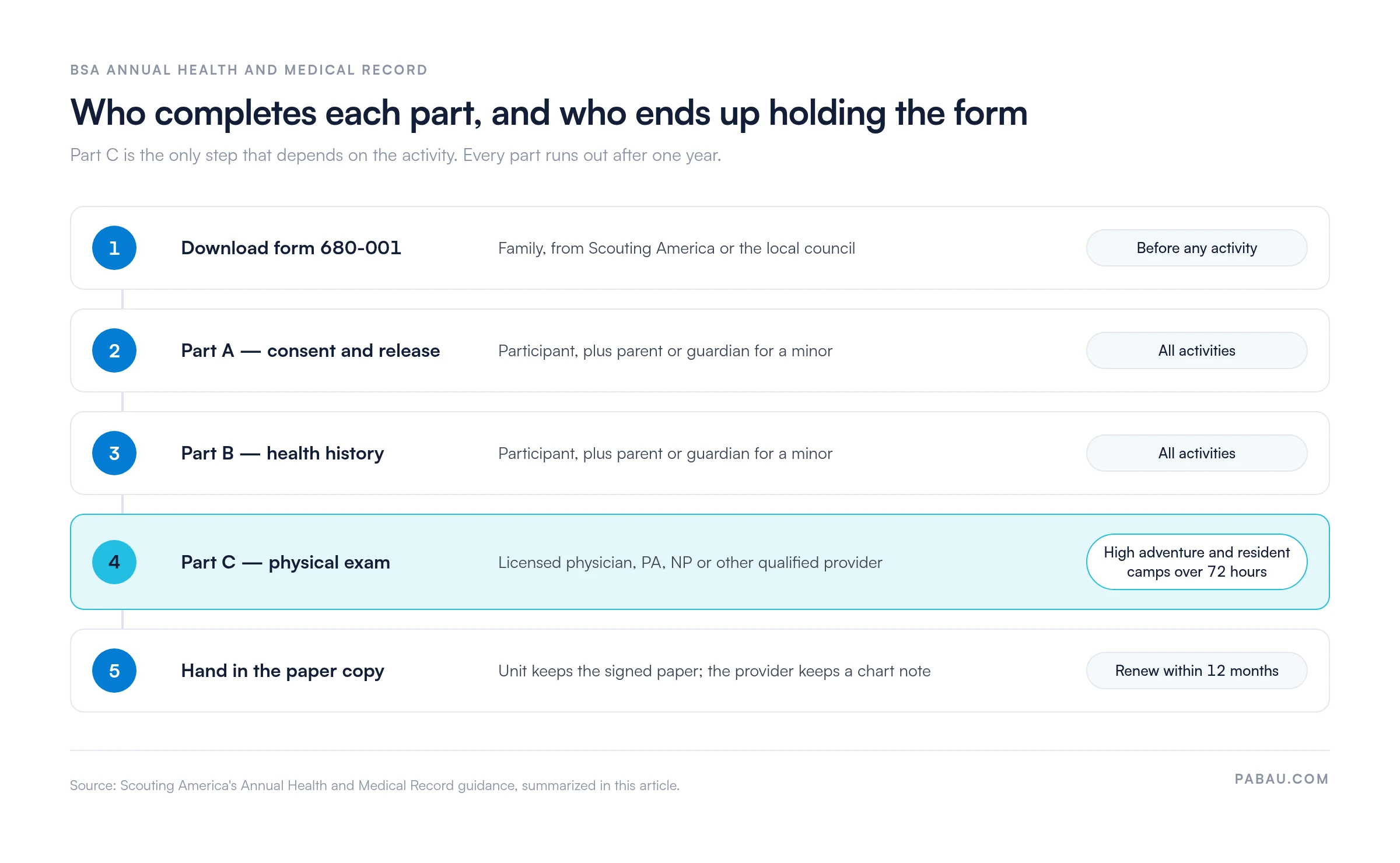
Step 1: Download the official form. Get the fillable PDF from Scouting America’s website, or from your local troop or council. The AHMR is revised only occasionally. Check the printed date on the copy you are holding, and download a fresh one if you are unsure.
Step 2: Complete Part A (informed consent and release). Read the consent language carefully. The participant and the parent or guardian print, sign and date it. This section establishes legal consent for participation and for emergency medical treatment.
Step 3: Complete Part B (health history). Fill in every health history field accurately, and leave no blanks. Write “none” or “N/A” where a condition does not apply. Include all current medications, supplements and allergies, because the provider reviewing Part C works from what you wrote.
Step 4: Book Part C with a licensed healthcare provider. Schedule an appointment with a physician, PA or NP. Bring the completed Parts A and B along with a blank copy of Part C for the provider. They conduct the physical examination, document the findings and sign Part C with the date of the exam.
Step 5: Hand the complete form to your troop or council. All three parts must be on file before the Scout can join a high-adventure or resident camp activity. Give them the signed paper copy, because Scouting America asks units not to accept scanned versions.
Scouting America owns the Annual Health and Medical Record and the document is copyrighted, so no one else can host it. Download form 680-001, with its Part A, Part B and Part C sections, from Scouting America’s official AHMR page. Your local council can also supply a printed copy.
The template at the top of this page is a different document. It is a general clinical intake form for the practice side of the appointment. Use it at the front desk to collect the basics before a Part C physical begins. The two-page form covers:
That template is a Pabau document, not a Scouting America one. It carries no Part A consent and liability language, no health history questionnaire, and no section for a provider to certify a physical examination. For all three, use the official AHMR.
If you need a consent document of your own for a patient under 18, our consent form for minors covers guardian authorization for treatment.
A provider who performs a Part C examination writes it up in the patient chart. That chart note is a medical record like any other, and the practice’s usual privacy and retention rules apply to it. Scouting America is clear that the AHMR itself is not subject to HIPAA when a unit or council handles it.
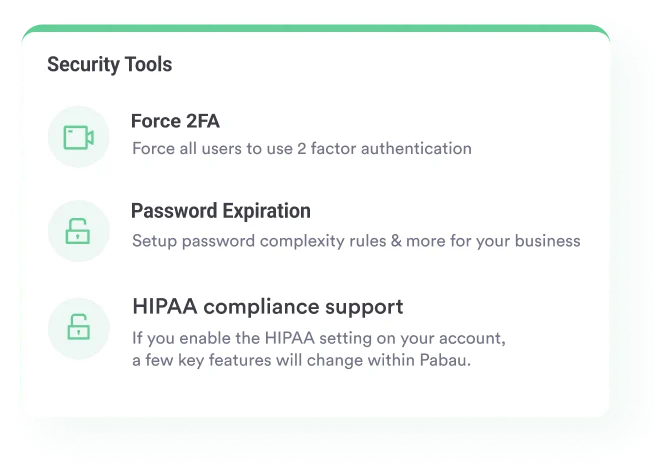
Troop leaders and council coordinators work under the opposite instruction. Scouting America asks units, districts and councils not to digitize the AHMR at all, so it must not be scanned, emailed or stored electronically. Only the individual participant may complete the electronic version. The signed paper copy is what travels with the unit.
Practices that see a steady stream of Scouts can still capture their own intake paperwork digitally before the appointment. Getting patients to fill in forms before their appointments is its own workflow, and reminders do most of the work. The AHMR stays on paper and goes home with the family.
A practice that runs Scout physicals every spring usually tracks them on paper or in a spreadsheet. The exam note sits in one system and the appointment in another. The date a family is due back tends to live in someone’s head.
Practice management software like Pabau keeps them together. The intake form the family completes online drops straight onto the patient record. The exam note, the consent and the appointment then sit in one place. You can set a recall for 11 months out, so the reminder reaches the family before the camp roster closes.
Every Pabau subscription includes the whole platform, so charting, forms, recalls and reporting come as standard. Nothing about Scout season needs a separate tool.

Pabau collects intake forms before the visit, files the exam note on the patient record, and sets the renewal recall. Your front desk stops chasing paperwork when camp deadlines land.

Most of the confusion around the BSA medical form comes down to one question. Which parts does this activity need? Parts A and B are needed every time, and Part C only for high adventure and resident camps over 72 hours.
The date is the part that catches people out. A Part C signed 13 months before camp is not valid, however thorough the exam was. Book the physical with the camp date in mind, not the school year.
For providers, the work is quieter but it repeats. Every exam you sign becomes a chart note someone will ask you about a year later. Book a demo to see how Pabau files each Part C exam on the patient record and prompts the renewal on time.

Still chasing paperwork on the morning of the appointment? How to get forms completed before appointments sets out the reminders and follow-ups that work.
Need a consent document for an adult patient? Medical consent form for adults is a free template covering treatment authorization and signatures.
Handling a request for a patient’s own records? Medical record request form gives you a release form you can hand over at the front desk.
Comparing tools for collecting intake digitally? Patient intake software walks through what to look for before you commit to one.
The BSA medical form is designed for Scouting America activities and includes informed consent language tailored to the risks of Scouting programs. It combines health history (Part B), consent (Part A), and medical clearance (Part C) in one standardized document required by all councils.
Yes, the participant can complete the fillable PDF on a computer. Scouting America asks units, districts and councils not to digitize the form, so it should not be scanned, emailed or stored electronically. Print the completed record and hand in the signed paper copy.
Part C can be signed by a licensed physician, physician assistant, nurse practitioner, or another qualified provider authorized to examine patients in your state. Scope of practice varies, so verify your provider’s credentials with your local council.
The Scout cannot take part in high-adventure activities or overnight resident camps while Part C is expired. Schedule the physical examination well in advance, so the form is current before the activity begins.
Parts A and B are required before any activity. Part C is required only for high-adventure activities and resident camps lasting more than 72 hours. Day camps and local meetings do not require Part C.
Not long at all. Scouting America discourages districts and councils from retaining AHMR records. Unit leaders are asked to destroy or return the form once a participant leaves the unit or the record becomes outdated. A provider who performed the physical keeps their own chart note under standard medical record retention rules.