HCPCS code J0900: Testosterone cypionate billing guide
HCPCS code J0900: definition and quick-reference data HCPCS code J0900 is the al...

Last Updated: Oct 16, 2026
V5040 is the HCPCS Level II code for hearing aid, monaural, body worn, bone conduction. It reports the device itself: a single-ear aid whose body-worn amplifier drives a bone vibrator held behind the ear.
The fitting goes on its own claim line under a dispensing fee code such as V5241. Traditional Medicare excludes both lines by statute.
Let Pabau's smart automation suggest the right codes, reduce claim denials, and keep your practice compliant—effortlessly.
Automate repetitive tasks and focus on what matters most—your patients.
Reduce coding errors and ensure compliance with the latest regulations.
Clean claims, fewer denials, and faster reimbursements.
Powerful insights and reporting to help your practice thrive.
HIPAA compliant SOC 2 certified GDPR-compliant Trusted by 4,000+ clinics worldwide

HCPCS Code V5040 describes a hearing aid device that fits one ear, is worn on the body, and works by bone conduction.
V5040 is a device code, not a dispensing fee, so the fitting goes on its own line under V5241.
Medicare Part B excludes hearing aids by statute, so neither V5040 nor V5241 is payable under traditional Medicare.
A headband-worn processor from an osseointegrated system bills as L8692, not V5040, even though both are body worn.
Pabau, the practice software we build, keeps the audiogram, device details, and diagnosis in one record for every V5040 claim.
HCPCS Code V5040 is a Level II alphanumeric code maintained by the Centers for Medicare and Medicaid Services (CMS). Its official long description is: Hearing aid, monaural, body worn, bone conduction.
V5040 sits in the V5030 to V5060 block of monaural hearing aid device codes. Each code in that block names a style of hardware. The professional work of fitting and dispensing the aid is reported with a separate dispensing fee code.
That split is the most common source of confusion with this code. V5040 is sometimes mistaken for the monaural dispensing fee, which is V5241. Billing the fee under V5040 tells the payer you dispensed a bone conduction device you never supplied.
V5040 covers one device configuration. Each part of the descriptor narrows it, so confirm all three before you bill.
Bone conduction suits patients who cannot use an air conduction aid. Typical candidates have conductive or mixed hearing loss, ear canal atresia, microtia, or chronically draining ears that cannot tolerate an earmold.
Body-worn bone conduction aids are now a small share of fittings. They still appear in pediatric audiology, where a child is too young for an implanted device, and with adults who need high output.
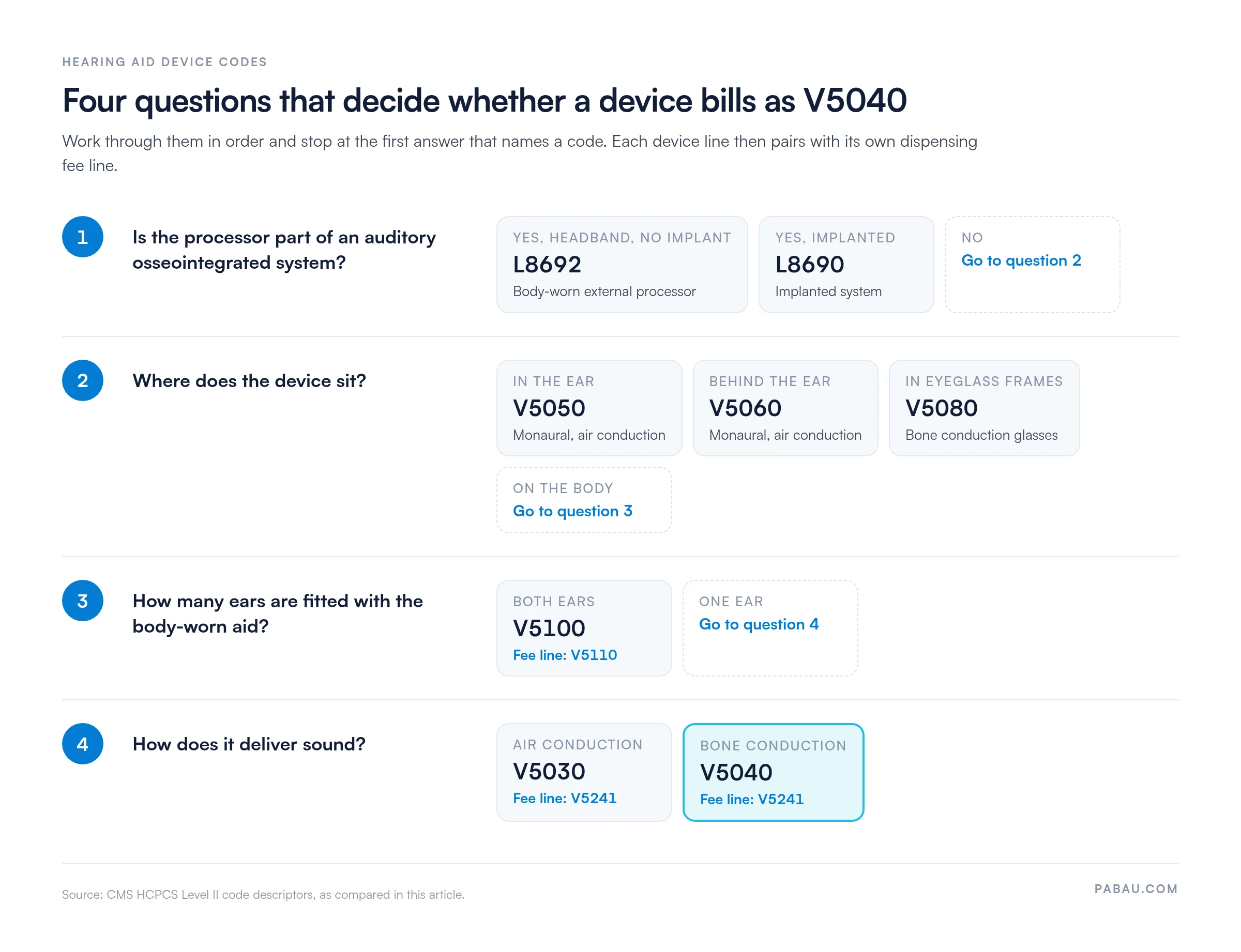
Choosing the device code depends on two questions: how the device is worn, and how it delivers sound. The table compares V5040 with sibling device codes such as V5030, plus the codes most often confused with it.
The V5040 vs L8692 decision trips up the most claims. Both describe a body-worn bone conduction device on a headband. L8692 applies when the processor belongs to an auditory osseointegrated system, which implanted patients later use with an abutment.
A conventional bone conduction hearing aid with no osseointegrated counterpart stays on V5040. Check the manufacturer’s product documentation before you choose. Implanted systems bill under L8690, and replacement processors under L8691.
The decision path below puts those questions in the order a coder should ask them.
A V5040 dispensing visit usually produces at least two claim lines. The device goes on one line and the professional fitting goes on another. Neither code absorbs the other.
A binaural fitting changes both lines. Two body-worn aids bill under the bilateral device code V5100. The fee becomes V5110, the bilateral dispensing fee that pairs with V5100.
Payers differ on whether V5010 and V5011 can be billed alongside the dispensing fee. Many fold fitting and orientation into V5241, so check the payer policy before you add them.
Traditional Medicare Part B excludes hearing aids by statute. The exclusion sits in Section 1862(a)(7) of the Social Security Act, so it is not a local coverage decision. V5040 is non-covered under Part B however well medical necessity is documented.
The exclusion reaches the dispensing fee too, so V5241 is not payable under Part B either. Medicare treats a non-osseointegrated headband processor billed as L8692 as a hearing aid as well. Osseointegrated implants under L8690 follow different coverage rules.
An Advance Beneficiary Notice (ABN) is not required for a statutorily excluded item. Many practices still use a voluntary notice to set the patient’s payment expectation in writing. Where a secondary payer needs a Medicare denial first, submit with the GY modifier.
Medicare Advantage plans may add supplemental hearing benefits. Covered device styles, allowances, and prior authorization rules vary by plan and contract year. Confirm V5040 with the patient’s own plan before you order the device.
Medicaid hearing aid coverage for adults is an optional benefit, so each state decides whether to cover V5040. For children under 21, the EPSDT mandate requires states to cover medically necessary hearing aids.
Commercial plans vary just as widely. Some cover hearing aids up to a benefit maximum, others exclude them, and state hearing aid mandates for children apply to some fully insured plans. Verify benefits for the specific device code, not only for hearing aids in general.
Medicare publishes no allowable amount for V5040, because the item is excluded rather than priced. What you collect depends on the payer, and the dispensing fee is priced separately from the device.
Use the AAPC HCPCS code lookup to confirm the code is active and to catch annual descriptor changes. State programs and Medicare Advantage plans reset rates each year, so check figures before the new plan year.
When a state fee schedule prices hearing aids by invoice, keep the manufacturer invoice for the V5040 device with the claim. Payers that pay at acquisition cost often ask for it before they release payment, and a missing invoice stalls the claim.
Any professional licensed under state law to dispense hearing aids can bill V5040. Billing authority follows the dispensing provider’s license and the scope-of-practice rules in their state.
The billing NPI should carry the taxonomy code for the dispensing specialty. Audiologists use 231H00000X, and hearing instrument specialists use 237700000X. Some Medicaid programs restrict hearing aid claims to audiologists, so check enrollment rules first.
Thin documentation is one of the most common reasons hearing aid claims are denied or recouped after payment. Good medical billing compliance for V5040 starts with a record that explains why bone conduction was chosen.
Some Medicaid programs and Medicare Advantage plans require prior authorization before dispensing, so check policy before you order. Audiograms and serial numbers are protected health information, so store them in a HIPAA-compliant system.
Every V5040 claim needs a diagnosis that supports amplification by bone conduction. Conductive and mixed hearing loss codes, such as H90.0, carry most claims. Structural ear codes support the choice of device.
Code to the highest specificity the audiogram supports. A diagnosis whose laterality does not match the fitted ear is a common reason reviewers flag hearing aid claims.
V5040 goes on the CMS-1500 claim form, with one unit per device. Modifier rules come from the payer, and following them is part of submitting a clean claim.
The errors that deny V5040 claims most often are predictable:
Track denial codes at the code level. A run of V5040 denials from one payer usually points to a device code mismatch or a coverage policy change.
Most hearing care practices assemble a V5040 claim from several places. The audiogram sits in the testing software, and the order arrives as a scanned letter. The serial number lives on a paper fitting sheet.
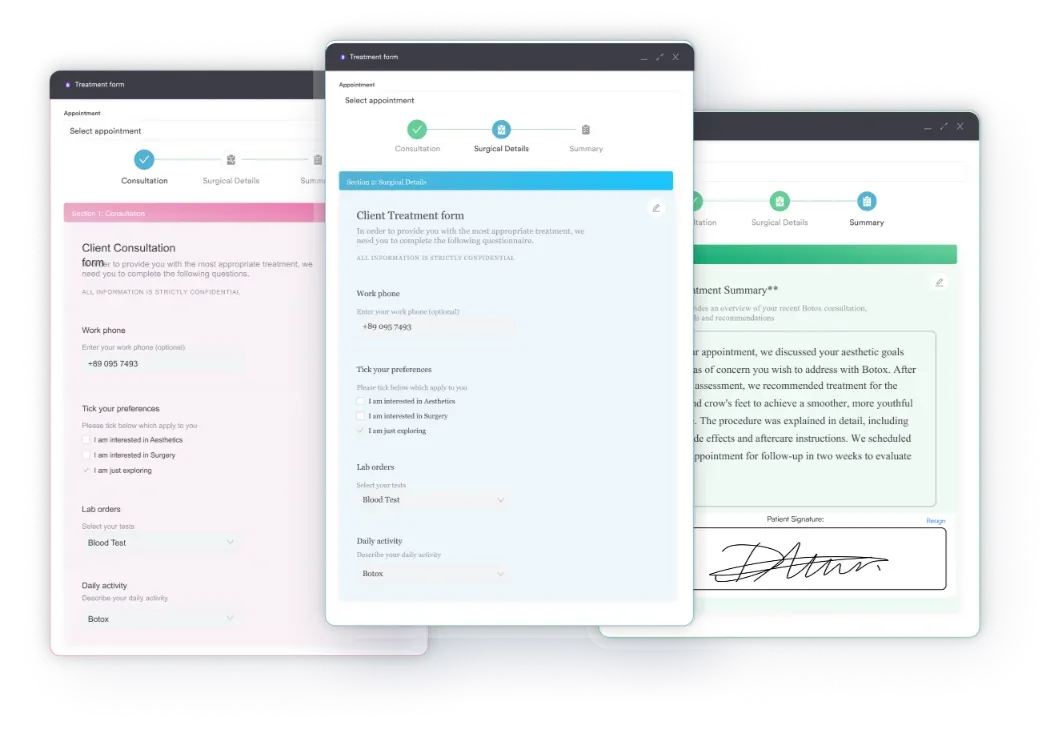
Pabau keeps the audiogram, the order, and the device details in one patient record. Intake forms collect the audiological history before the visit. Treatment notes hold the device model, serial number, and bone conduction rationale against the dispensing visit. Pabau’s claims software for audiologists then works from that record.
With the fitted ear, device style, and diagnosis in one place, the person coding can see whether the device is V5040, V5030, or L8692. The dispensing fee line goes out with the device line, built from the same notes.

Pabau holds the audiogram, device details, and diagnosis in the patient record, so the device and dispensing fee lines go out together and complete.

V5040 names a piece of hardware, and claim errors start when it stands in for something else. The fitting fee, a headband processor, and an air conduction body aid each have their own codes. A claim that puts any of them on V5040 describes a device the patient never received.
Practices that get these claims paid settle the device code at the fitting, with the audiogram and product details in hand. The dispensing fee then follows on its own line. Book a demo to see how Pabau keeps V5040 documentation complete from fitting to claim.

HCPCS Code V5040 is the Level II code for a monaural, body-worn, bone conduction hearing aid. A body-worn amplifier drives a bone vibrator held behind the ear. The code reports the device, not the fitting service.
No. V5040 is a device code. The monaural dispensing fee is V5241, which is billed on its own line alongside V5040. A bilateral body-worn pair bills under V5100 with the V5110 fee, and V5090 is the unspecified dispensing fee.
Both are monaural, body-worn hearing aids. V5030 delivers sound by air conduction through the ear canal. V5040 delivers it by bone conduction through a vibrator on the skull, bypassing the outer and middle ear.
L8692 covers the external sound processor of an auditory osseointegrated device, worn on a headband without an implant. A conventional bone conduction hearing aid with no osseointegrated counterpart stays on V5040. Check the manufacturer’s product documentation before you choose.
No. Medicare Part B excludes hearing aids by statute, so V5040 and its dispensing fee are not payable under traditional Medicare. Some Medicare Advantage plans add supplemental hearing benefits. Verify coverage with the patient’s plan before you order the device.
Medicaid must cover medically necessary hearing aids, including V5040, for children under 21 through EPSDT. Adult coverage is optional, so it varies by state. Most programs that cover hearing aids require prior authorization.