HCPCS code C1731: Catheter billing, OPPS reimbursement, and denial guide
HCPCS code C1731: Official descriptor and code series context HCPCS code C1731 i...

Last Updated: Oct 8, 2026
T1018 is the HCPCS Level II code for school-based individualized education program (IEP) services, bundled. It covers the full set of IEP services delivered to a Medicaid-enrolled child in one claim line.
Two errors drive most T1018 denials. The first is billing component therapy codes separately on the same date, which is unbundling. The second is billing for a child who holds an IEP but is not enrolled in Medicaid. Medicare never covers T1018, so a claim sent to a Medicare payer is rejected at the outset.
Let Pabau's smart automation suggest the right codes, reduce claim denials, and keep your practice compliant—effortlessly.
Automate repetitive tasks and focus on what matters most—your patients.
Reduce coding errors and ensure compliance with the latest regulations.
Clean claims, fewer denials, and faster reimbursements.
Powerful insights and reporting to help your practice thrive.
HIPAA compliant SOC 2 certified GDPR-compliant Trusted by 4,000+ clinics worldwide

HCPCS Code T1018 is a temporary T-code for bundled school-based IEP services, billable to Medicaid only, not Medicare.
T1018 is strictly bundled, so billing component services separately on the same claim counts as improper unbundling.
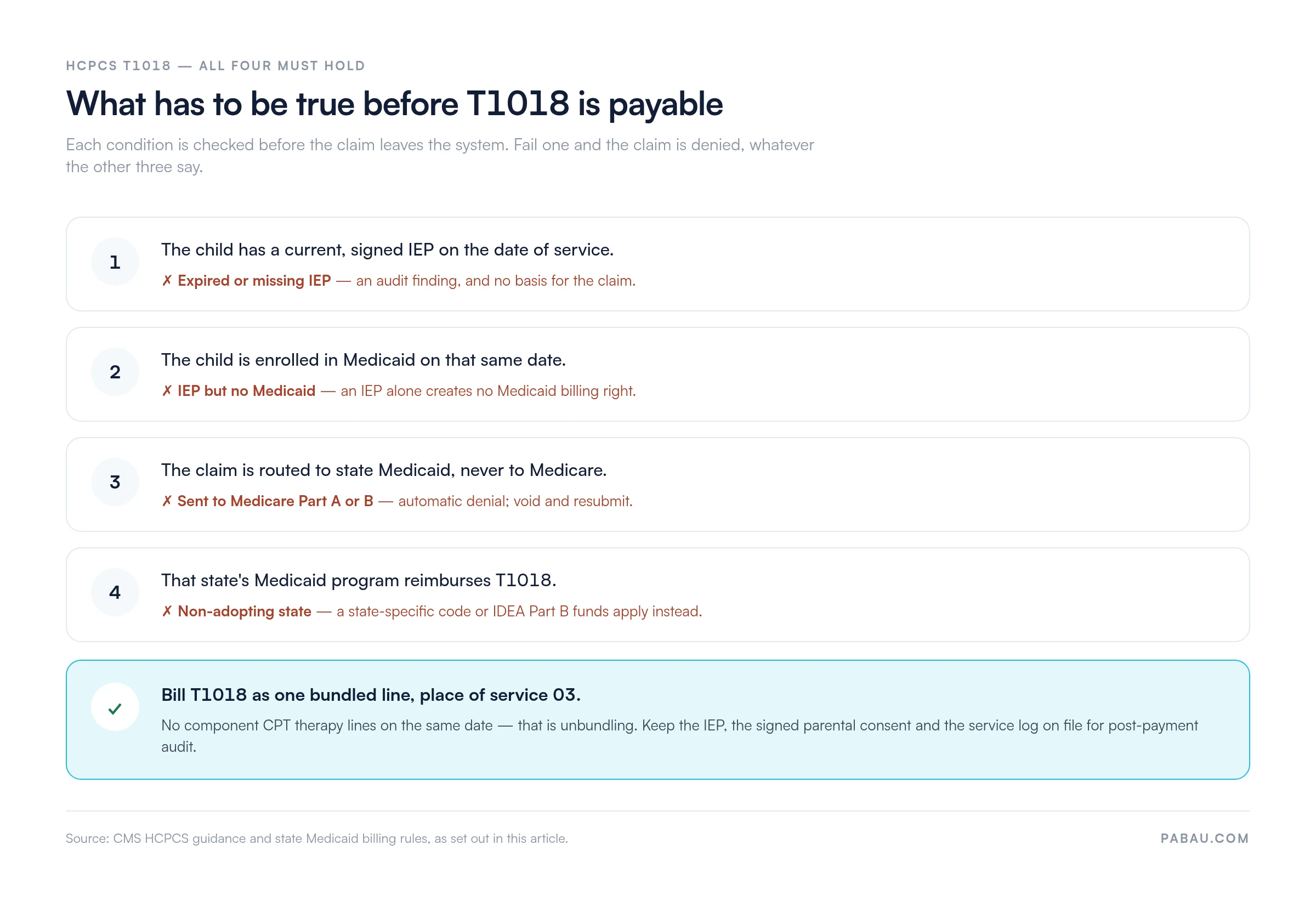
A current signed IEP and active Medicaid enrollment must both be true on the date of service.
Rates are set by each state Medicaid program, and some states do not cover T1018 at all.
Practice management software like Pabau routes T-code claims to Medicaid only and tracks the IEP documentation.
HCPCS Code T1018 is a Level II temporary code for “school-based individualized education program (IEP) services, bundled.” The Centers for Medicare & Medicaid Services (CMS) maintains it for Medicaid and state agency use.
Temporary T-codes work differently from CPT codes. They need no AMA maintenance and no annual review, so state Medicaid agencies can adopt them on their own payment schedules. That is why T1018 appears on Medicaid fee schedules but never on Medicare Part B tables.
The word “bundled” in the descriptor is the single largest source of billing errors on this code. When CMS or a state Medicaid agency marks a code as bundled, the payment already covers the full set of services. Submitting a component service under a separate code on the same claim date is unbundling, and audits flag it.
Configure T1018 in your billing system as a single-line code, with no unbundled CPT lines attached to the same session.
The table below shows the verified code attributes for HCPCS Code T1018 in 2026.
T1018 covers the bundled set of services delivered to a Medicaid-eligible child under an active IEP in a school setting. The Individuals with Disabilities Education Act (IDEA) authorizes those services.
IDEA requires schools to give eligible children a free appropriate public education. Many of those services are Medicaid-reimbursable when the child holds both an IEP and active Medicaid enrollment. What T1018 bundles depends on state Medicaid policy, and usually includes the following.
Two eligibility conditions must both be true before T1018 applies. First, the child must have a current, signed IEP. Second, the child must be enrolled in Medicaid on the date of service.
An IEP alone creates no Medicaid billing right, and Medicaid enrollment without an IEP does not trigger T1018 either. Confirm both through insurance eligibility verification before you submit a claim.
EPSDT (Early and Periodic Screening, Diagnostic, and Treatment) often intersects with school-based IEP billing. It requires state Medicaid programs to cover any medically necessary service for children under 21. That holds even where the state plan does not ordinarily cover the service category.
When a school-based IEP service meets the EPSDT medical necessity threshold, a state may be required to reimburse it under T1018. Standard coverage limits do not override that, though the application varies by state policy.
Medicare does not cover T1018. T-codes are temporary HCPCS Level II codes that CMS maintains for Medicaid and other state agency programs. Submitting T1018 to Medicare Part A or Part B produces an automatic denial.
If a school district or provider routes T1018 to Medicare by mistake, void the claim and resubmit it to the correct state Medicaid payer. Flagging T-codes at claim generation prevents most misdirected submissions.
Medicaid coverage for T1018 differs sharply across states. Some states use it as the primary vehicle for reimbursing school-based IEP services. Others have built state-specific codes, or use alternative HCPCS codes for the same service bundle.
A third group does not reimburse school-based IEP services through Medicaid at all, relying instead on IDEA Part B funds. Check the state Medicaid agency’s billing manual before billing T1018 anywhere. The code existing nationally does not mean the state pays it.
There is no national fee schedule for HCPCS Code T1018. Each state’s Medicaid agency sets its own rate and publishes it in that state’s Medicaid fee schedule.
Reported rates run from under $50 per bundled service day to several hundred dollars. The spread depends on how broadly a state defines the bundled service set. It also depends on how intensively the services were delivered.
Two steps get you accurate 2026 rate information. First, find the state Medicaid agency’s most recent HCPCS fee schedule publication, which is usually updated each state fiscal year. Second, confirm whether the state bills T1018 per day, per visit, or per unit. That decides how the units field is populated on the CMS-1500 form.
The AAPC HCPCS code reference gives baseline code context, but authoritative rate data comes from each state’s Medicaid agency directly.
Request the state Medicaid fee schedule update from the agency’s provider relations team each October. Many states align T1018 rate changes with the federal fiscal year, which starts in October. Carrying last year’s rate into Q1 is a common underpayment that billing teams only catch at reconciliation.
Billing T1018 correctly starts with matching the documentation in the IEP file to the claim. The steps below reflect what Medicaid school-based service programs most commonly require, and some states add their own.
Four conditions decide whether the claim is payable at all, and the steps below assume every one of them holds.
School districts often bill T1018 in batches, so a documentation problem can replicate across dozens of claims before anyone notices. Reviewing a sample of T1018 claims each month against the IEP file catches systemic issues early.
Billing software that supports HCPCS Level II T-codes can populate the POS code automatically and flag claims missing consent documentation. It can also route T1018 to Medicaid payers only, which prevents accidental Medicare submission.
State Medicaid policy governs modifiers for T1018, not a single national standard. The modifiers below are the most commonly applicable, so verify which ones your state Medicaid program accepts before appending them.
Incorrect modifier usage is a common cause of T1018 rejections. A modifier one state accepts can trigger a payer edit in another. Checking the denial reason codes on rejected T1018 claims often points straight at the modifier.
When a denial reads “invalid modifier combination,” pull the state Medicaid billing manual for that state’s current T1018 requirements.
T1018 sits at the end of the T1013-T1018 range, which AAPC and CMS title Other Services. The table below identifies the adjacent codes and says when each applies instead of T1018.
When a child receives only one IEP service type on a given day, check whether T1018’s bundled structure still fits. A specialty-specific HCPCS or CPT code may reflect the service actually provided, and the distinction matters at audit.
IEP-related documentation also has to survive the state Medicaid audit lookback period. Keep the plan, the consent form and the service logs for as long as that state requires.
Cross-reference every T1018 claim against the child’s current IEP before submitting. IEP plans are updated annually at minimum, and billing T1018 under an expired IEP is an audit finding waiting to happen. Set a calendar alert in your practice management system for every IEP renewal date. Flag any child whose renewal falls inside the current billing cycle.
School-based Medicaid billing for IEP services asks four things of a billing system at once.
Pabau handles HCPCS Level II codes, T-codes included. Its claims management software routes claims to Medicaid payers and blocks them from Medicare submission. That stops the misdirected claims described above.
Pabau’s digital forms let school-based providers build structured IEP service delivery logs. Each log captures provider credentials, the IEP goal reference, service duration and parental consent status.
Those records stay linked to the child’s profile and come back during a Medicaid audit without a manual file search.
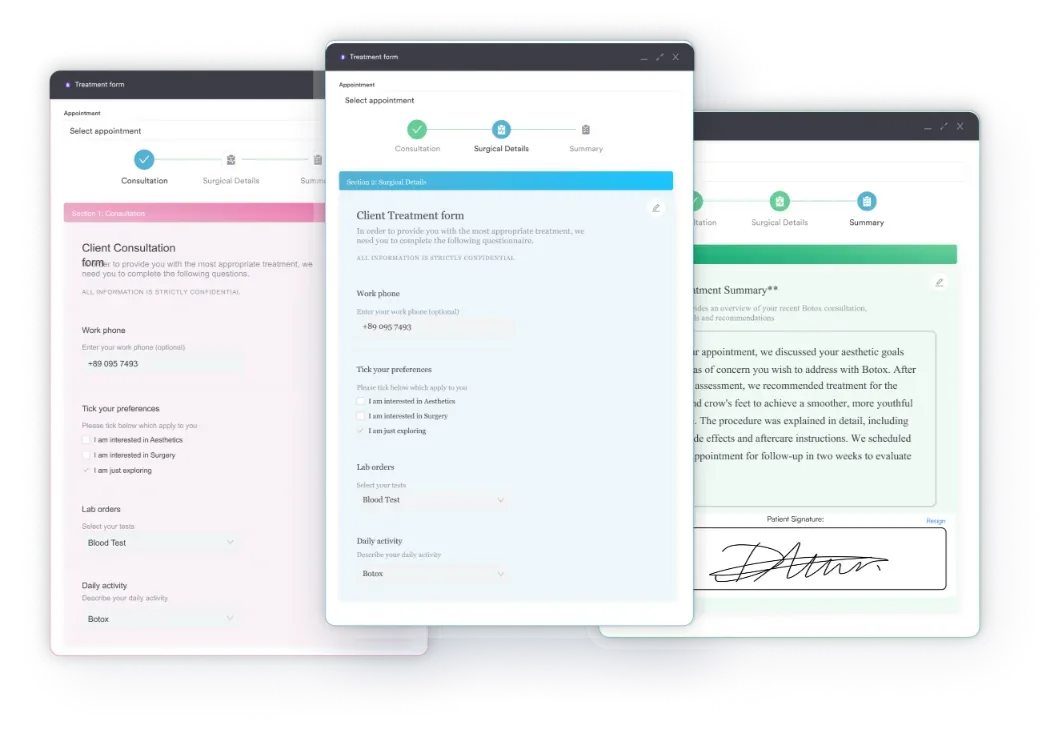
A clean T1018 claim needs the POS code, the modifier, the IEP currency and Medicaid eligibility checked before it leaves the system. Pabau’s automated workflows surface those checks at claim generation, rather than leaving each one to memory.

Pabau’s claims management supports HCPCS Level II T-codes, populates place of service 03, and keeps Medicaid-only codes away from Medicare. Your school-based claims leave the system already checked.

T1018 is one of the few codes where the billing decision is made before anyone opens the claim form. The IEP, the parental consent and the Medicaid enrollment either line up on the date of service, or they do not.
So the work that protects T1018 revenue sits upstream, in the documentation the school collects and the eligibility it checks. Build those checks into the point where the claim is created. Unbundling, expired IEPs and Medicare misroutes then stop reaching the payer.
One trade-off is worth remembering. Every state writes its own rules for this code, so a workflow tuned to one state’s Medicaid manual will not travel unchanged to the next. Book a demo to see how Pabau keeps school-based claims checked before they reach the payer.

Need a primer on Medicaid claim submission workflows? Revenue cycle management explained covers the end-to-end process from eligibility check through payment posting.
Facing repeated T1018 denials? Denial management in healthcare explains how to categorize, appeal, and prevent the most common claim rejection patterns.
Need compliance documentation guidance? Medical billing compliance essentials outlines the record-retention and audit-readiness requirements that apply to Medicaid school-based billing.
HCPCS Code T1018 is used to bill Medicaid for bundled school-based individualized education program (IEP) services delivered to Medicaid-eligible children. It covers the full set of IEP-specified services as a single bundled Medicaid claim line. Those services include speech therapy, occupational therapy, physical therapy and counseling, under eligibility criteria established by IDEA.
No. T1018 is not covered by Medicare. T-codes are HCPCS Level II temporary codes maintained by CMS exclusively for Medicaid and state agency billing. Submitting T1018 to Medicare Part A or Part B results in an automatic denial. Claims must be routed to the child’s state Medicaid program only.
The most common modifiers for T1018 are the state-assigned Medicaid modifiers, U1-U9 and UA-UZ. Others include HO for master’s-level providers, TT for a group setting, and GT for telehealth. Accepted modifiers vary by state Medicaid program, so confirm with the state’s billing manual before appending any modifier.
There is no national fee schedule for T1018. Reimbursement rates are set independently by each state Medicaid agency and published in state-specific HCPCS fee schedules. Rates vary widely by state and by how broadly the bundled service set is defined. Contact your state Medicaid agency’s provider relations team or check the state Medicaid billing manual for current 2026 rates.
Billing T1018 requires a current signed IEP and documented parental consent to bill Medicaid. You also need service delivery logs showing the services provided and the provider’s credentials, plus verification of Medicaid enrollment on the date of service. Most states also require IEP goal references in progress notes, and they may audit those records after payment.
T1018 is a bundled code covering multiple IEP services in a single claim line. Adjacent codes in the T1013-T1018 range cover discrete unbundled services. T1013 bills sign language interpretation per 15 minutes, T1016 covers case management per 15 minutes, and T1017 covers targeted case management. Use T1018 only when the full bundled IEP service set was delivered and the state Medicaid program accepts the bundled code.