CPT code 92521: Speech fluency evaluation billing guide
CPT code 92521: Definition and clinical scope CPT code 92521 is defined by the A...

Last Updated: Oct 5, 2026
S0170 is the HCPCS Level II code for anastrozole, oral, 1 mg. One billing unit equals one 1 mg tablet, so a 30-tablet fill is billed as 30 units.
S0170 is a temporary national S-code for non-Medicare payers. Medicare Part B does not accept it, so Medicare patients get anastrozole through a Part D pharmacy claim billed by NDC. Some Medicaid programs and commercial payers accept S0170, while many require an NDC-based pharmacy claim instead.
Let Pabau's smart automation suggest the right codes, reduce claim denials, and keep your practice compliant—effortlessly.
Automate repetitive tasks and focus on what matters most—your patients.
Reduce coding errors and ensure compliance with the latest regulations.
Clean claims, fewer denials, and faster reimbursements.
Powerful insights and reporting to help your practice thrive.
HIPAA compliant SOC 2 certified GDPR-compliant Trusted by 4,000+ clinics worldwide

S0170 covers anastrozole, oral, 1 mg, so one unit equals one tablet and a 30-tablet fill is billed as 30 units.
Medicare Part B does not accept S-series codes, so Medicare patients get anastrozole through a Part D pharmacy claim billed by NDC.
Some Medicaid programs and commercial payers accept S0170, but many require an NDC-based pharmacy claim instead. Verify with each payer.
Practice software such as Pabau submits S0170 claims and tracks each claim’s status, which cuts manual re-entry for billing staff.
HCPCS Code S0170 is an S-series HCPCS Level II code with the official descriptor Anastrozole, oral, 1 mg. One billing unit equals one 1 mg tablet. S-series codes are temporary national codes that CMS maintains for state Medicaid programs and commercial payers.
Unlike most J-codes, which report Part B drugs, S-codes are not recognized by Medicare’s Part B benefit. According to the CMS HCPCS overview, S-series codes exist to meet the coding needs of non-Medicare payers.
S0170 sent to Part B is denied because it sits outside Medicare’s recognized Level II set. Medicare patients get anastrozole through a Part D prescription drug claim instead.
Anastrozole is an aromatase inhibitor approved by the FDA for hormone receptor-positive (HR+) breast cancer in both the adjuvant (post-surgery) and advanced (metastatic) settings. It works by blocking the enzyme aromatase, reducing estrogen production, and slowing tumor growth in ER-positive cancers.
Anastrozole is an oral tablet taken once daily. Because patients take it at home, it does not qualify as a Medicare Part B incident-to drug. That is why S0170 exists as an oral drug code for non-Medicare payers, and why Medicare routes this drug through Part D instead.
The reference table below covers the billing attributes coders need before submitting HCPCS Code S0170 claims.
Some Medicaid programs and commercial payers accept S0170, but many require an NDC-based pharmacy claim instead, so verify with each payer. S-series codes are not part of the Medicare Part B fee schedule, and CMS does not publish a Part B allowable rate for them.
Anastrozole belongs under Medicare Part D, the prescription drug benefit. Oral drugs that patients take at home are covered there, not as incident-to infusions or injections under Part B’s medical benefit. Submitting S0170 to Medicare Part B is a coverage mismatch that generates an automatic denial.
Many states have oral chemotherapy parity laws that require commercial insurers to cover oral oncolytics at the same cost-sharing level as intravenous chemotherapy. These laws shape what the patient pays, not what goes on the claim, and they do not change Medicare’s benefit rules.
For Medicare beneficiaries, the pharmacy dispenses anastrozole and submits a Part D drug claim using the National Drug Code (NDC), not S0170.
S0170 billing starts with the unit convention, whichever claims software for practices submits the claim. One unit equals one milligram of anastrozole, and the standard tablet is 1 mg, so one unit equals one tablet.
A 30-day supply is billed as 30 units, and a 90-day supply as 90 units. Underbilling the unit count is a frequent error on anastrozole claims.
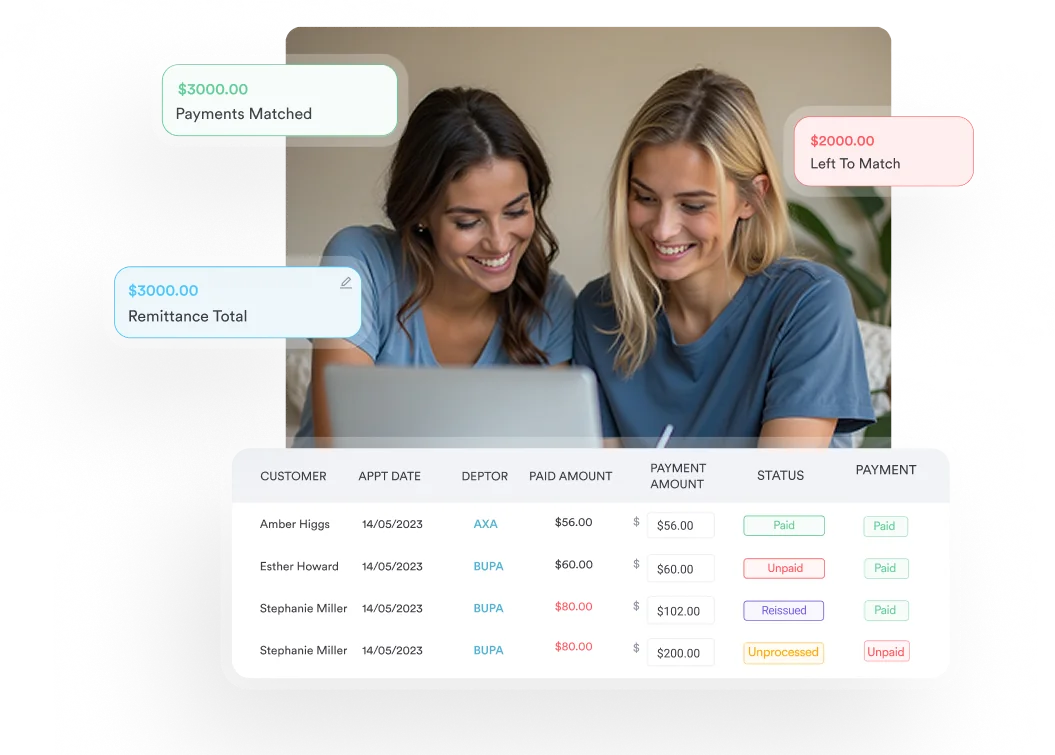
Our guide to medical billing workflows shows how a claim moves from charge entry to payment, and where these six steps fit.
Bill S0170 in units that match the dispensed quantity exactly. A 30-tablet fill is 30 units, not 1. Check your payer’s NDC reporting requirements before submitting, because Medicaid programs that require an NDC deny claims that arrive without one.
Payers require a linked diagnosis code that supports the medical necessity of anastrozole. The table below covers the ICD-10-CM codes most commonly submitted with HCPCS Code S0170.
Specificity matters. An unspecified C50 code used when laterality is documented rarely causes a denial, but audits flag unspecified codes when the record contains the detail. Coders should always capture the most specific code the documentation supports.
Prior authorization for anastrozole is required by many commercial payers and some state Medicaid programs, though requirements vary by plan and policy year. Practices billing HCPCS Code S0170 regularly should verify PA status for each patient’s plan before dispensing.
Common PA criteria for anastrozole include confirmation of HR+ breast cancer status (usually a pathology report) and the treatment setting (adjuvant or advanced). Some plans also want evidence that tamoxifen was considered or contraindicated. The prescriber’s NPI and specialty are also typically required on PA requests for oncology drugs.
There is no published Medicare Part B fee schedule rate for HCPCS Code S0170 because S-series codes are outside the Medicare Part B allowable set. Reimbursement rates for S0170 are set individually by each payer.
Medicaid reimbursement for anastrozole typically follows the state’s drug pricing basis. The most common bases are Average Wholesale Price (AWP) minus a percentage discount, or Maximum Allowable Cost (MAC) pricing. Rates differ by state and are published in each state’s Medicaid fee schedule. Commercial payer rates reflect contracted formulary pricing and vary by plan tier.
For current payer-specific rates, check the payer’s online fee schedule portal or ask the plan’s provider relations team. S0170 reimbursement reflects each payer’s contracted rate for the oral drug rather than a CMS-published national rate. The AAPC HCPCS code reference helps confirm the code’s current descriptor, but any dollar figure for S0170 is payer-specific and subject to annual change.
Two alternatives are regularly confused with S0170 when billing anastrozole: J8999 and NDC-only billing. Picking the wrong one, or sending S0170 to a payer that does not accept S-series codes, produces a denial that requires resubmission.
When using J8999 as a fallback, include the drug name (anastrozole), the unit dose (1 mg), and the NDC in the claim narrative field. Without that detail, unlisted drug claims are usually denied for insufficient documentation. The other route is an NDC-only pharmacy claim, which some payers require for oral drugs.
The payer’s billing manual settles which route applies, and the PGM Billing HCPCS lookup tool confirms each code’s current descriptor. The diagram below maps each payer type to its claim route.
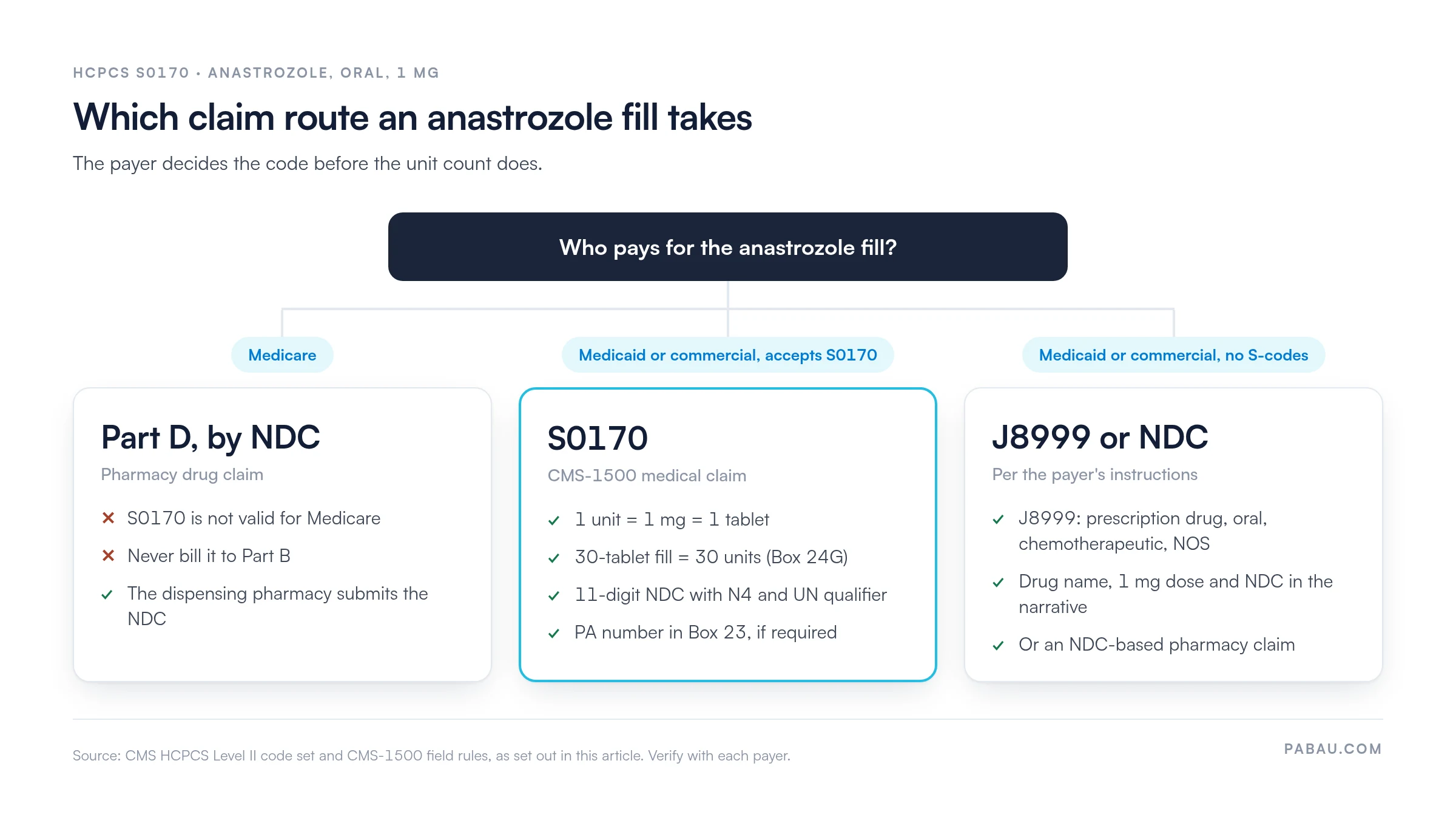
S0170 denials cluster around six causes, and most are preventable with eligibility checks and a documentation review before submission. Each denial arrives with claim denial codes that name the cause. A structured denial management process keeps the same error from recurring across patients.
Clean documentation is cheaper to assemble before submission than after a denial, and it anchors medical billing compliance for oral chemotherapy. The checklist below covers what payers expect in the file behind an S0170 claim.
A superbill that captures these data points at dispensing means nobody has to dig for them when a denial arrives. Practices dispensing anastrozole regularly should build an S0170 checklist into the dispensing workflow, rather than relying on billing staff to catch missing fields after submission.
Set a calendar reminder 30 days before each anastrozole PA expiration date. Most payers require the renewal to be approved before the prior authorization expires, not after. A lapsed PA on an ongoing hormonal therapy claim is a denial that requires both a retroactive PA request and a corrected claim submission.
An S0170 claim usually fails on a field someone typed twice: the unit count, the NDC, or the PA number. Billing staff copy those values from the prescription into a separate billing tool, then chase the payer by phone when a claim stalls.
Pabau submits claims electronically from the patient record and tracks each claim’s status after it goes out. Your team enters the units, NDC and PA number once, and the claim carries the data already in the record.
The payoff is less manual re-entry and one place to see which S0170 claims are paid, pending or denied. Staff spend their time fixing the few denials instead of hunting for them.

Pabau’s claims management submits your S0170 claims and tracks each status, so billing staff spend less time re-keying claim data and chasing payers.

Settle the payer route before you count a single unit. Medicare fills go to the pharmacy as Part D claims, and payers without S-codes need J8999 or an NDC-based pharmacy claim. Only the payers that accept S-series codes should ever see S0170.
Once the route is right, the remaining denials come from three fields: units, NDC and PA dates. A dispensing checklist catches the first two, and a renewal calendar protects a course of therapy that runs five years or more.
Pabau’s claims management submits S0170 claims and tracks every status, so your team re-keys less and spots denials sooner. Book a demo to see how it fits your oral drug billing workflow.

Need a structured approach to managing claim denials? Denial management in healthcare covers root cause analysis frameworks and workflow strategies for reducing denial rates across billing teams.
Want to understand how drug billing fits into broader revenue cycle processes? What is revenue cycle management explains the end-to-end claims workflow from eligibility verification to payment posting.
Looking for guidance on keeping drug billing documentation clean? Submitting a clean claim walks through the fields and documentation standards that prevent administrative denials before claims reach the payer.
HCPCS Code S0170 covers anastrozole, oral, 1 mg, an aromatase inhibitor used to treat hormone receptor-positive breast cancer. One unit equals one milligram, so billing units should match the total milligrams dispensed.
S0170 is not covered under Medicare Part B. As an S-series HCPCS code, it falls outside the Medicare Part B fee schedule. Anastrozole for Medicare patients is covered under Part D as a prescription drug and billed using the drug’s National Drug Code through the pharmacy benefit.
Six denial reasons recur on S0170 claims. The payer may not accept S-series codes, or the 11-digit NDC may be missing or invalid. Prior authorization may be missing or expired, or the diagnosis may not match the approved indication. The other two are an incorrect unit count and an oral drug sent to Medicare Part B instead of the Part D pharmacy benefit. The denials section above covers the fix for each.
Prior authorization requirements vary by payer and plan year. Many commercial payers and some Medicaid programs require PA for anastrozole. Clinical criteria typically include pathology confirming HR+ status, the treatment line, and in some plans, documentation that tamoxifen was considered or contraindicated. Verify PA requirements with each payer before dispensing.