

CCSD code G5100: Bypass of duodenum billing guide
CCSD code G5100 bills a bypass that leaves the duodenum in place CCSD code G5100...

Last Updated: Oct 16, 2026
S0169 is the HCPCS Level II code for calcitrol, oral, 0.25 microgram. One unit equals 0.25 microgram of calcitriol, the active form of vitamin D, taken by mouth.
Prescribers use oral calcitriol to manage hypocalcemia and metabolic bone disease in dialysis patients, secondary hyperparathyroidism in chronic kidney disease, and hypocalcemia in hypoparathyroidism. S0169 belongs to the temporary national S-series, which Medicaid programs and commercial payers use rather than Medicare.
Let Pabau's smart automation suggest the right codes, reduce claim denials, and keep your practice compliant—effortlessly.
Automate repetitive tasks and focus on what matters most—your patients.
Reduce coding errors and ensure compliance with the latest regulations.
Clean claims, fewer denials, and faster reimbursements.
Powerful insights and reporting to help your practice thrive.
HIPAA compliant SOC 2 certified GDPR-compliant Trusted by 4,000+ clinics worldwide

HCPCS code S0169 covers calcitriol taken by mouth, at one unit per 0.25 microgram. A patient on a 0.5 microgram daily capsule bills as two units.
The official HCPCS descriptor spells the drug Calcitrol, without the second i, so a charge master search for calcitriol can miss the code.
S-series codes sit outside the Medicare fee schedule. For dialysis patients, oral calcitriol is already paid inside the ESRD bundled rate.
N25.0 renal osteodystrophy, N25.81 secondary hyperparathyroidism of renal origin and E83.51 hypocalcemia are the diagnoses most often paired with S0169.
Practice management software like Pabau stores HCPCS codes with their unit basis and NDC, so drug claims leave the practice with the right quantity.
HCPCS code S0169 is the Healthcare Common Procedure Coding System Level II code for calcitrol, oral, 0.25 microgram. One unit equals a single 0.25 microgram dose of calcitriol, the active form of vitamin D, taken by mouth. Other oral drugs in the same S-series range include chlorambucil, billed under S0172.
The code is maintained by CMS through the HCPCS Level II code system, which covers drugs, biologicals and supplies that CPT does not describe.
S0169 sits in the S-series, a set of temporary national codes created for Medicaid programs and private payers. Medicare does not pay S-codes under its standard fee schedule. That single fact decides where most S0169 claims can be sent. It is why the code shows up on Medicaid and commercial claims far more often than anywhere else.
One quirk trips up billers before the claim is even built. The official descriptor reads Calcitrol, dropping the second i from calcitriol. Search a charge master or payer fee schedule for the correct drug spelling and the code may not come back at all.
The quick-reference table below captures the core billing attributes of S0169. Verify the descriptor and status against the current CMS HCPCS Alpha-Numeric file each year, because S-codes are reviewed and revised annually.
S0169 covers calcitriol in oral form, dispensed as 0.25 microgram capsules, 0.5 microgram capsules or an oral solution. Calcitriol is the fully activated form of vitamin D, so it works without the conversion step that failing kidneys can no longer perform. The best-known brand is Rocaltrol, and generic calcitriol capsules carry their own National Drug Codes.
The FDA-labeled uses for oral calcitriol all sit in calcium and phosphate metabolism:
Claims also reach payers with osteoporosis diagnoses attached, because calcitriol is prescribed for postmenopausal bone loss in some treatment protocols. That use falls outside the US label, so expect a medical necessity review and keep the supporting rationale in the chart.
Several nearby products do not belong on an S0169 claim:
Most state Medicaid programs require the 11-digit NDC of the dispensed product alongside the HCPCS code. The NDC goes in the qualifier field as N4 followed by the digits, then the unit qualifier. A missing or malformed NDC is rejected at the clearinghouse before a human reviewer ever opens the claim.
S-series HCPCS codes are not part of Medicare’s standard fee schedule. CMS created them as temporary codes for Medicaid programs and private insurers, so a claim sent to traditional Medicare under S0169 will be denied.
Dialysis patients add a second layer. Oral calcitriol is an oral equivalent of an injectable renal dialysis drug. Medicare therefore treats it as a renal dialysis service inside the ESRD prospective payment system. The dialysis facility is paid for it through the bundled rate, and no separate drug line is payable.
The pharmacy-versus-medical split is worth settling before you bill. Calcitriol is a self-administered oral drug, so most plans pay for it at the pharmacy counter under the drug benefit. S0169 exists for the cases where a payer wants the drug reported on a professional or institutional claim instead.
Medicaid is the primary payer for S0169, and the rules are state-administered. Coverage criteria, claim forms and NDC requirements differ from one program to the next. Practices billing across several states need a protocol per state. The rules that recur across most programs are these:
Teams new to billing for dispensed drugs should start with one standing procedure. Record the NDC and the microgram strength at the moment the drug is supplied. Reconstructing both from a prescription note days later is where the errors start.
Every S0169 claim needs a supporting ICD-10-CM diagnosis code to establish medical necessity. Because calcitriol treats disordered calcium and phosphate metabolism, the supporting diagnoses cluster in the renal and endocrine chapters rather than anywhere else. Our ICD-10-CM code index lists those chapters in full.
Sequence the diagnosis that drives the prescription first. A dialysis patient on calcitriol for renal bone disease leads with N25.0, then carries N18.6 and Z99.2 as supporting codes. Leading with the kidney stage alone tells the payer nothing about why a vitamin D analog was supplied.
No. Calcitriol under S0169 is swallowed, so there is no injection or infusion service to report. CPT 96372 covers subcutaneous and intramuscular injections and has no application here. Billing it alongside S0169 invites a denial and, on audit, a look at the rest of your drug claims.
The mix-up usually comes from the injectable sibling code. J0636 covers calcitriol given by injection, and that service does carry an administration charge when the payer allows one. Confirm the route in the clinical note before choosing between the two codes.
An evaluation and management visit is a different question. Where the prescriber performs and documents a separately identifiable assessment on the same day, the E/M service is reported on its own terms. Check each payer’s current clean claim requirements rather than assuming one contract’s rule applies across all of them.
S0169 claims that reach a human reviewer are most often denied for thin documentation. Electronic claims carry the data elements below, and the clinical record has to support each one.
Practices billing for several prescribers do better with a structured template than with free-text notes. A template that prompts for strength, NDC, quantity and the supporting labs makes claim scrubbing quicker and audit responses much shorter.
Store S0169 in the charge master under both spellings, Calcitrol and calcitriol, and put the 0.25 microgram unit basis in the item description. Staff searching for the drug will find the code, and the unit basis stops the quantity being read as capsules.
S0169 does not work in isolation. Knowing the adjacent codes prevents miscoding when a patient moves between routes or switches to another vitamin D analog. It also helps when a charge master entry predates the current code set.
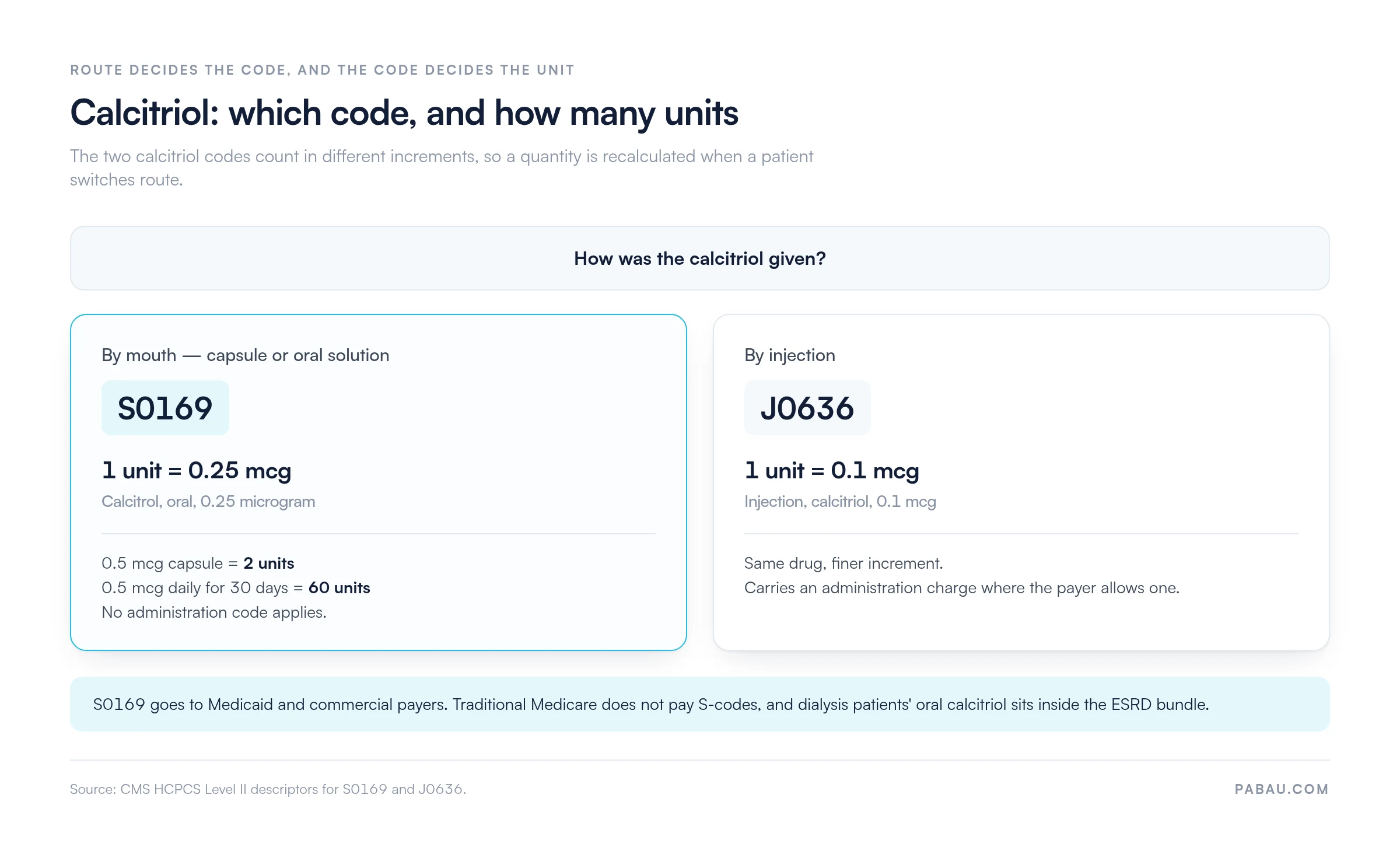
The J0636 pairing deserves a second look, because the two codes count in different increments. Calcitriol given by injection bills per 0.1 microgram, while the oral code bills per 0.25 microgram. A patient stepping down from intravenous to oral therapy therefore needs the quantity recalculated, not carried across.
Ondansetron splits the same way, since S0119 counts oral doses in 4 mg units while injected ondansetron counts in 1 mg.
The panel below sets the two unit bases side by side, with the worked example for each. Our guide to J0636 covers the injectable side in full.
Denials on S0169 cluster around a short, predictable list. Most are workflow problems rather than clinical ones, which means they can be designed out once.
Other oral drug codes repeat the capsule-counting trap, since S0176 bills hydroxyurea in 500 mg units rather than per capsule.
A dialysis patient’s renal vitamin supplement sets its unit differently again, since S0194 bills one unit per 100 capsules.
Systematic denial management starts by tracking which remittance codes show up on rejected S0169 lines. CO-B15 and CO-97 point at bundling, while CO-151 points at the quantity billed. Sorting denials by that signal tells you quickly whether the cause is the charge master, a training issue or a payer policy change.
Audit S0169 claims quarterly on three columns: Units billed, NDC present, and the first-listed diagnosis. Ten minutes of report time catches the quantity and sequencing errors that quietly cost renal and endocrine practices money on every fill.
Drug billing has more moving parts than procedure billing. The NDC has to travel from the package to the record to the claim without re-entry. The quantity has to be derived from micrograms rather than counted in capsules. The diagnosis that justified the prescription has to be sequenced first.
Practices stitching that chain together by hand repeat the work on every fill. Practice management software with claims management built in takes the repetition out. Pabau stores each HCPCS code with its unit basis and its NDC. The billing detail then flows from the encounter record to the claim in one step.
For renal, endocrine and primary care teams supplying vitamin D analogs, that means fewer quantity corrections and a shorter route from prescription to paid claim.
Integrated billing also supports the HIPAA requirements that govern electronic claims, from correct code set use to audit-ready records. The superbill for each encounter should already hold S0169, the unit count, the NDC, the rendering provider NPI and the diagnosis. A biller can then post it without rebuilding the record.

Practice management software like Pabau stores each HCPCS code with its unit basis and NDC. A 0.5 microgram calcitriol capsule then reaches the claim as two units, not one. See how the claims workflow handles it.

HCPCS code S0169 is a small code with two sharp edges. The unit basis of 0.25 microgram catches teams who count capsules, and the descriptor’s Calcitrol spelling hides the code from anyone searching for calcitriol.
Set the charge master up once with the right unit basis and both spellings. Record the NDC and strength as the drug is supplied, then sequence the metabolic diagnosis first.
Renal and endocrine practices supply oral vitamin D analogs week in, week out. Practice management software like Pabau keeps the code, the unit basis and the NDC together from the record to the claim.
To see how it handles drug billing end to end, book a demo.

Billing the injectable form of the same drug? HCPCS code J0636 covers injected calcitriol, its 0.1 microgram unit basis and the Medicare rules that apply to it.
Looking at drug-code denials across the whole practice? Revenue cycle management explained shows how to structure the workflow that catches quantity and NDC errors before submission.
Need the documentation side tightened up? Medical billing compliance sets out the record-keeping that supports drug claims through an audit.
HCPCS code S0169 is the HCPCS Level II code for calcitrol, oral, 0.25 microgram. One unit equals 0.25 microgram of calcitriol, the active form of vitamin D, taken by mouth. It is an S-series temporary national code used by Medicaid and commercial payers rather than Medicare.
S0169 covers oral calcitriol, supplied as 0.25 and 0.5 microgram capsules or an oral solution, and sold under the brand name Rocaltrol. It does not cover injectable calcitriol, which is billed with J0636, or other vitamin D analogs such as doxercalciferol and paricalcitol.
No. Traditional Medicare does not pay S-series HCPCS codes, so an S0169 claim sent there will be denied. For dialysis patients, oral calcitriol is a renal dialysis service paid inside the ESRD bundle. It is not separately billable there either.
N25.0 renal osteodystrophy, N25.81 secondary hyperparathyroidism of renal origin and E83.51 hypocalcemia are the most common pairings. Dialysis patients usually carry N18.6 and Z99.2 as supporting codes, while E89.2 and E20.0 cover hypoparathyroidism. Sequence the diagnosis that drove the prescription first.
One unit is 0.25 microgram of oral calcitriol. A 0.5 microgram capsule is two units, and a 30-day supply taken once daily comes to 60 units. Counting capsules instead of micrograms is the most common quantity error on this code.
Route and unit basis. S0169 is oral calcitriol billed per 0.25 microgram, while J0636 is injected calcitriol billed per 0.1 microgram. A patient moving from intravenous to oral therapy needs the quantity recalculated rather than carried across.



