

CCSD code G5100: Bypass of duodenum billing guide
CCSD code G5100 bills a bypass that leaves the duodenum in place CCSD code G5100...

Last Updated: Oct 16, 2026
HCPCS code S0140 bills saquinavir, 200 mg, an oral HIV protease inhibitor taken with ritonavir. It's an S-code, a temporary national code built for commercial insurers and Medicaid rather than Medicare.
That payer split is the fact to hold onto. Medicare gives S0140 coverage code I, so it won't pay the code at all. Send it to the wrong plan and the claim comes straight back. Units cause the next most common error, because one unit equals 200 mg. Below, we walk through both checks, then follow the claim from prescription to payment.
Let Pabau's smart automation suggest the right codes, reduce claim denials, and keep your practice compliant—effortlessly.
Automate repetitive tasks and focus on what matters most—your patients.
Reduce coding errors and ensure compliance with the latest regulations.
Clean claims, fewer denials, and faster reimbursements.
Powerful insights and reporting to help your practice thrive.
HIPAA compliant SOC 2 certified GDPR-compliant Trusted by 4,000+ clinics worldwide

HCPCS code S0140 describes saquinavir, 200 mg, an oral HIV protease inhibitor taken with ritonavir.
Medicare doesn’t pay S0140 (coverage code I), so bill it only to plans that accept S-codes.
Each unit equals 200 mg, so a 1,000 mg dose bills as 5 units.
Pair the claim with B20 or Z21, matched to the patient’s documented HIV status.
Record the prescription, NDC, dose, quantity and days supply before the claim goes out.
HCPCS code S0140 is the Level II code for saquinavir, 200 mg. Saquinavir is an HIV-1 protease inhibitor, best known by the brand name Invirase. Patients swallow it as a capsule or tablet, always alongside a low dose of ritonavir.
There’s no injection involved, and no J-code describes the drug. If a reference pairs S0140 with a steroid injection or a J-code, it’s describing a different drug.
CMS added S0140 on April 1, 2003, as one of its S-codes. These temporary national codes serve private insurers and Medicaid programs that need codes Medicare doesn’t use.
AAPC’s code listing places it in the non-Medicare drug codes range, S0012 to S0197. For the wider code set, see our HCPCS codes library.
Before you think about units or diagnoses, check who’s paying. Medicare assigns S0140 coverage code I, so it won’t pay the code. That holds across every Medicare payment system, and an appeal won’t change it.
For Medicare patients, oral HIV drugs run through Part D instead. Those are pharmacy claims, identified by the NDC rather than a HCPCS code. Antiretrovirals are also one of Part D’s protected drug classes.
Here’s how the main payer types usually handle S0140:
In short, S0140 lives on medical claims for payers that ask for it. When a plan wants a pharmacy claim, the NDC does the work and S0140 isn’t used.
The descriptor sets the billing unit at 200 mg. So you divide the milligrams dispensed by 200, and that’s your unit count.
Let’s walk through an example. The standard adult regimen on the Invirase label is 1,000 mg of saquinavir with 100 mg of ritonavir, twice daily.
Tablets make the math messier. Saquinavir also came as a 500 mg tablet, and each tablet equals 2.5 units. Some payers want whole units, so ask how they round before you bill.
The NDC quantity is a separate number. It counts capsules or tablets, not milligrams. A 30-day supply of 500 mg tablets is 120 tablets, yet it’s 300 HCPCS units. Both figures belong on the claim, each in its own box, as the breakdown below shows.
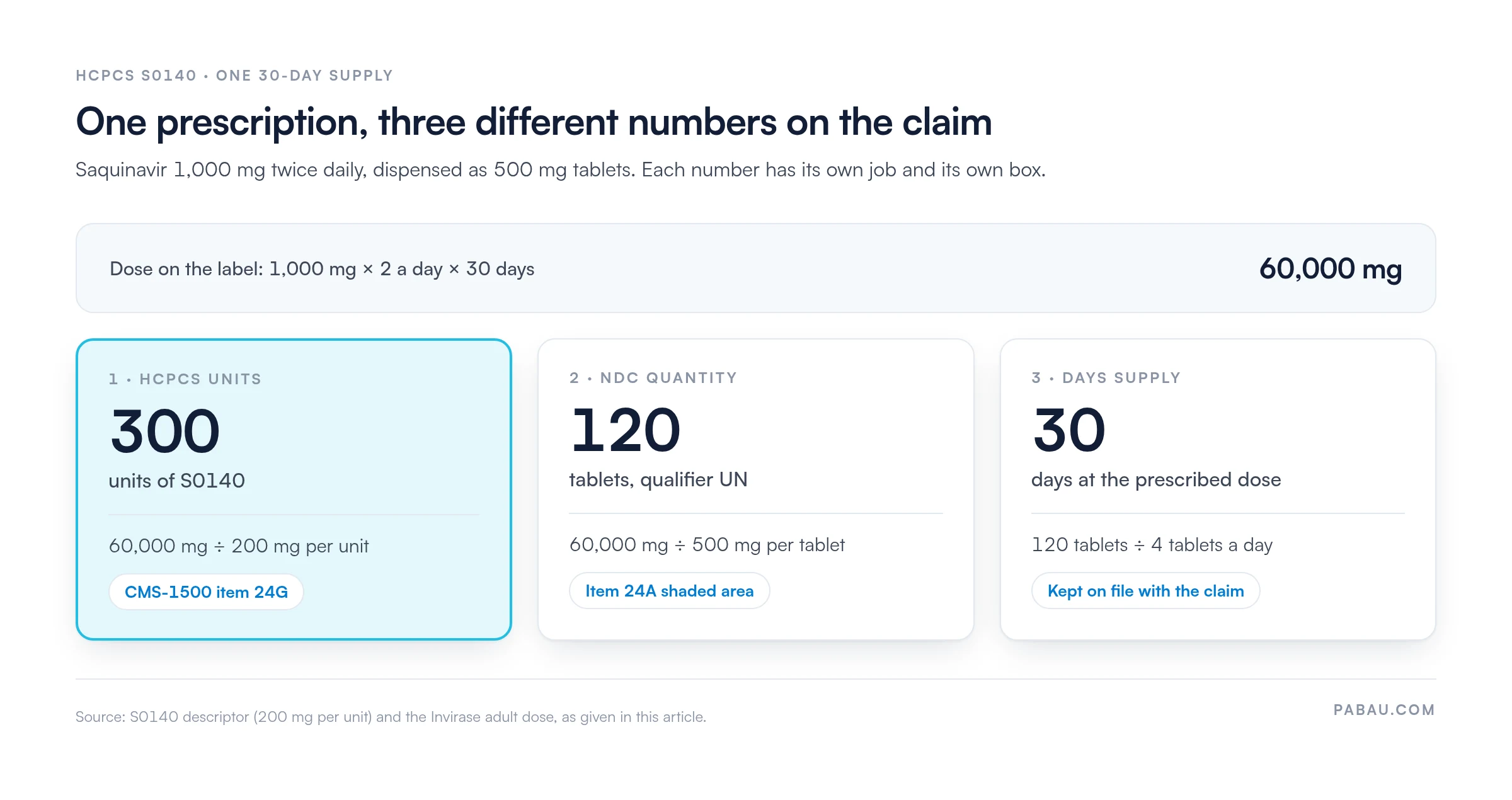
Ritonavir isn’t part of S0140, so it never adds to the unit count. Record it in the notes, because the payer may ask why saquinavir is dosed twice daily.
Saquinavir treats HIV-1 infection, so every claim needs an HIV diagnosis. Two ICD-10-CM codes do most of the work.
The sequencing rule trips people up. Once a patient has been coded B20, later encounters stay B20, even when symptoms settle. Don’t step back to Z21.
Pregnancy changes the order too. An O98.7- code comes first, followed by B20 or Z21. Whichever code you choose, the chart has to support it in plain words.
Payers rarely deny S0140 for clinical reasons. Instead, they deny it because a detail is missing. Keep these six on file for every claim:
Some plans also want prior authorization for antiretrovirals. If so, keep the reference number with these records. Our guide to the prior authorization process explains the steps, and a medical prior authorization form keeps requests consistent.
With the records in place, the claim itself follows a fairly fixed path. On a CMS-1500, it runs like this:
If a claim does come back, the remittance codes tell you why. Read them before you correct anything, so the resubmission fixes the field the payer flagged.
Most S0140 denials come from a short list of errors. Here’s what each one looks like, and the fix.
Give each claim a final pass before it leaves. It takes two minutes and saves a resubmission.
Oral drug claims rarely fail on medicine. They fail on small details, such as a missing NDC or a unit count off by a factor. Catching those by hand means rechecking each claim against the chart.
Pabau, the practice management and billing platform we build, pre-fills claims from the patient record. The diagnosis on file seeds the claim, and built-in ICD-10-CM and HCPCS libraries make each code quick to look up. Before a claim can be sent, Pabau also checks that required fields, like membership numbers and authorization codes, are complete.
In the US, claims go out through Claim.MD. Eligibility checks, claim-status tracking and electronic remittance posting all happen in the same place. See how it works in our claims management software.

Pabau pre-fills claims from the patient record and checks required fields before sending. US claims go out through Claim.MD, with eligibility checks and status tracking.

S0140 rewards billers who check two things first, the payer and the unit. Get the payer wrong, and no amount of documentation saves the claim. Get the unit wrong, and you’re either underpaid or flagged for overbilling.
Saquinavir is seldom prescribed today, so you may see S0140 only a few times a year. That’s exactly why it causes trouble. Write the 200 mg rule and the B20 or Z21 pairing into your workflow, so the claim stops depending on memory.
Book a demo to see how Pabau pre-fills drug claims from the record, so rarely used codes go out right the first time.

Fighting the same denials every month? Denial management in healthcare shows how to track denial patterns and fix their root causes.
Spending hours chasing authorizations? Prior authorization software compares tools that speed up approvals for drugs and procedures.
Billing Medicare patients alongside commercial plans? Medicare billing explains how Medicare claims differ, including the parts that don’t use S-codes.
Submitting to UnitedHealthcare? UnitedHealthcare prior authorization form gives you a ready-made request to fill in.
The FDA Orange Book lists Invirase, the branded saquinavir, as discontinued. Roche also stopped making the 200 mg hard capsules in the UK in 2012. S0140 is still a valid HCPCS code, so it can still appear on older claims and audits.
Saquinavir is poorly absorbed on its own. A low dose of ritonavir blocks CYP3A4, the liver enzyme that breaks saquinavir down. That keeps saquinavir levels high enough for twice-daily dosing.
Both delivered saquinavir. Invirase came as hard capsules, and later as 500 mg tablets. Fortovase was a soft gel capsule designed to improve absorption. Roche withdrew Fortovase in 2006 after demand fell.
No. Saquinavir is approved only to treat HIV-1 infection, in combination with other antiretrovirals. HIV prevention uses different drugs, so a PrEP visit shouldn’t carry S0140.
It means Medicare Part B doesn’t price the code separately. For S0140 that’s a formality, since Medicare doesn’t pay the code at all. Commercial and Medicaid rates come from your contracts and state fee schedules.



