

CPT code 48152: Whipple procedure without pancreatojejunostomy
CPT code 48152: Official description and procedure overview CPT code 48152 descr...

Last Updated: Nov 13, 2026
S0088 is the HCPCS Level II code for imatinib, 100 mg, the oral tyrosine kinase inhibitor sold as Gleevec. One unit equals 100 mg dispensed, so a 400 mg daily dose for 30 days bills as 120 units.
S0088 is a temporary S-code created for private payers. Commercial plans and most state Medicaid programs accept it, but Medicare Part B does not pay S-codes. Medicare patients get imatinib through their Part D drug plan instead.
Let Pabau's smart automation suggest the right codes, reduce claim denials, and keep your practice compliant—effortlessly.
Automate repetitive tasks and focus on what matters most—your patients.
Reduce coding errors and ensure compliance with the latest regulations.
Clean claims, fewer denials, and faster reimbursements.
Powerful insights and reporting to help your practice thrive.
HIPAA compliant SOC 2 certified GDPR-compliant Trusted by 4,000+ clinics worldwide

HCPCS Code S0088 reports oral imatinib, 100 mg per unit. Specialty pharmacies dispense it for CML and GIST, and it is not an injectable J-code drug.
Units are reported per 100 mg dispensed, so a 400 mg daily dose for 30 days bills as 120 units on one claim line.
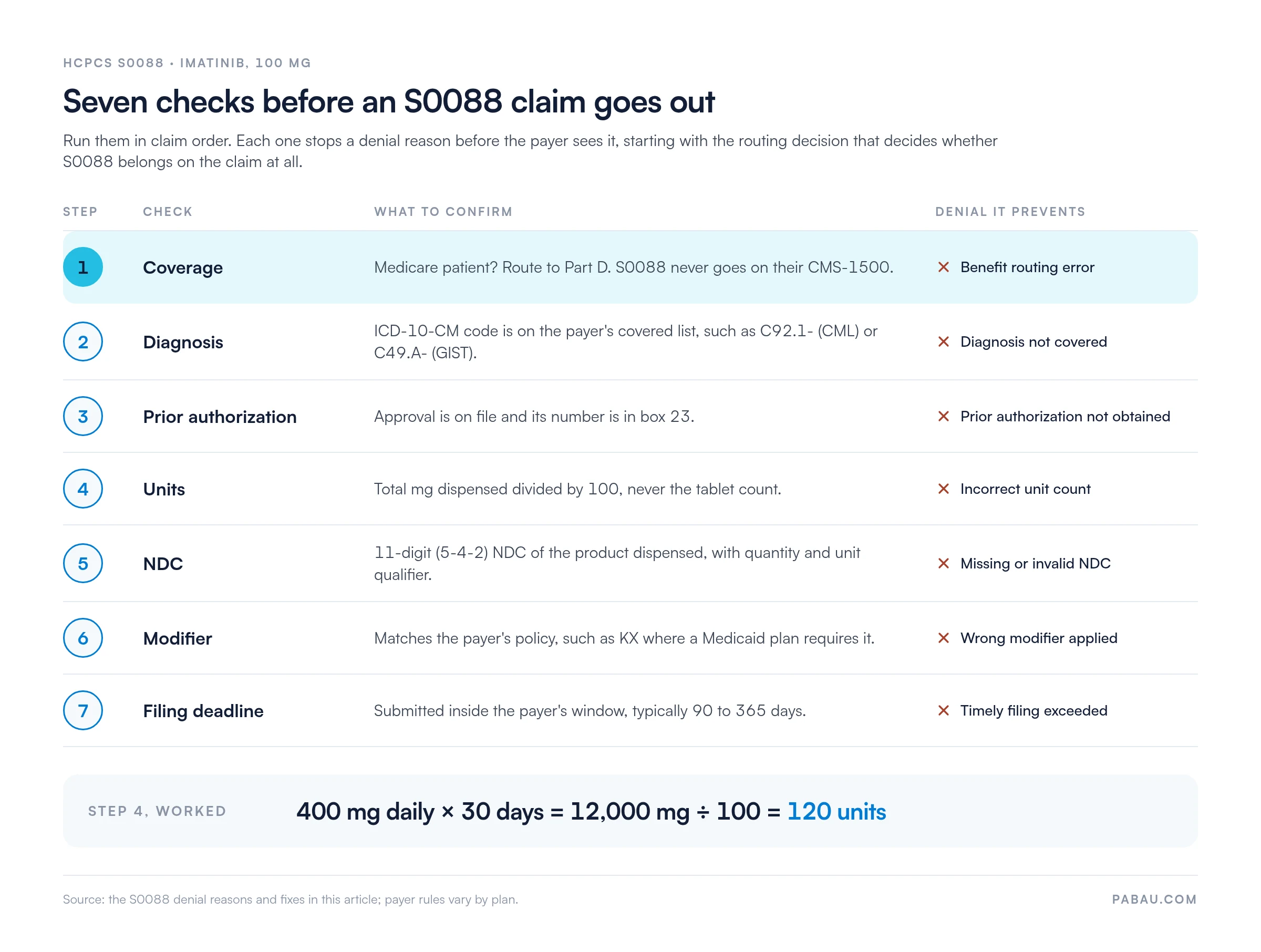
Medicare Part B does not reimburse S0088. Medicare patients get imatinib through Part D, the pharmacy benefit, not on a CMS-1500 claim.
Dasatinib and nilotinib have no dedicated HCPCS code and bill under J8999, so neither belongs on an S0088 line.
Pabau tracks prior authorization codes on the patient’s case and submits US claims through the Claim.MD clearinghouse, with remittances posted to the same record.
HCPCS Code S0088 is the Level II code for oral imatinib, and its official descriptor is “Imatinib, 100 mg.” One unit equals 100 mg dispensed. Commercial payers and most state Medicaid programs accept the code, but Medicare Part B does not.
S0088 belongs to the S-code range of HCPCS Level II. These temporary codes are maintained by America’s Health Insurance Plans for drugs and services the AMA’s CPT set does not cover. The range covers injectables as well as oral drugs. HCPCS S0148, for example, reports pegylated interferon alfa-2b per 10 mcg. Oral tacrine hydrochloride, 10 mg, is reported under HCPCS S0014.
Neighboring S-codes and the rest of Level II are in our quick HCPCS code lookup. The table below summarizes the reference facts billers need before submitting a claim.
Imatinib is a self-administered oral drug, so patients take it at home rather than in an infusion chair. That oral dispensing decides both the code category (an S-code rather than a J-code) and the benefit the claim routes to.
S0088 covers FDA-approved oral imatinib mesylate tablet formulations dispensed through a specialty pharmacy. Payer coverage is generally limited to oncology indications with supporting pathology documentation.
Covered uses: chronic myeloid leukemia (CML) in all phases, gastrointestinal stromal tumor (GIST), and other FDA-approved oncology indications that the payer’s diagnosis list accepts. Generic imatinib tablets from any FDA-approved manufacturer bill under S0088, reported with the NDC of the product dispensed.
Excluded from S0088:
Every S0088 claim needs a supported ICD-10-CM diagnosis code, and CML and GIST account for most claims. Payers that restrict coverage to listed diagnosis codes deny off-label or non-covered conditions, whatever the medical necessity documentation says.
Always verify the accepted ICD-10-CM list with the individual payer’s coverage policy before submission. Some commercial plans restrict imatinib coverage to BCR/ABL-positive CML only, requiring documentation of cytogenetic or molecular confirmation in the medical record.
S0088 is billed per 100 mg of imatinib dispensed. The HCPCS descriptor fixes that unit, and it applies whatever tablet strength the pharmacy dispenses. Miscounting units is one of the most frequent errors on imatinib claims.
NDC reporting: Most payers require the National Drug Code to accompany S0088 on the claim. The NDC must match the manufacturer’s product dispensed, in 11-digit format (5-4-2) with the quantity and unit qualifier.
Several FDA-approved manufacturers make generic imatinib, and the list changes over time. Verify the current NDC against the CMS HCPCS code set resources and the dispensing pharmacy’s NDC crosswalk files.
Modifier selection depends on the payer type and the dispensing scenario. Applying the wrong modifier is a leading cause of S0088 claim rejection by commercial plans.
Always confirm modifier requirements directly with each payer before submission. Modifier policies can change with annual contract updates and are not uniform across commercial plans.
Run a payer-specific modifier audit before the start of each plan year. Pull your last 90 days of S0088 claims and check whether modifier requirements changed in the new coverage period. A single modifier mismatch across a 90-day specialty pharmacy supply creates a large correctable denial batch.
The most consequential billing decision for S0088 is benefit routing. A claim sent to the wrong benefit is denied automatically, and only a full resubmission to the correct payer arm fixes it. A grounding in medical billing fundamentals helps billing staff route drug claims correctly from the start.
Medicare covers imatinib under Part D as a prescription drug, because patients take it themselves by mouth. S0088 on a CMS-1500 to Medicare Part B generates a denial.
Oral chemotherapy parity laws do not create a Part B billing pathway for self-administered oral oncolytics either. Direct Medicare patients and their caregivers to their Part D plan for coverage and copay assistance.
Most commercial payers and state Medicaid plans require prior authorization before imatinib is dispensed under S0088. Approval confirms clinical eligibility only and does not guarantee payment. Reimbursement still depends on claim accuracy, timely filing, and the benefit limits in force when the claim is processed.
The following documentation is typically required when submitting a PA request for imatinib:
A standard prior authorization form collects these items in one document for each imatinib request.
When a PA is denied on the first submission, most payers allow a peer-to-peer review request within 10 to 14 days. If the peer-to-peer does not resolve the denial, a formal appeal using the full clinical record typically follows. PA requirements and timeframes vary by plan, so check with the payer before starting the authorization.
S0088 denials cluster around a small set of correctable errors. Effective denial management in healthcare starts with naming the error behind each denial before resubmission, because the fix differs for each one.
Each of these denials can be caught before submission, in the order the claim is built. The chart below runs the seven checks from benefit routing to the filing deadline.
Billers coding oral oncology drugs sometimes reach for the wrong code when S0088 is correct, or the reverse. The comparison below covers the codes most often confused with S0088, including neighboring S-codes for unrelated drugs.
When a payer does not accept S0088, confirm the fallback code with the payer before switching. Some commercial plans want an unlisted code, and others want a plan-specific one.
Billing J9999 when a specific S-code exists may lead to downcoding or a denial for coding inconsistency. Verify accepted code lists against AAPC’s HCPCS code lookup and individual payer portals.
Payers conducting post-payment audits on oral chemotherapy claims routinely look for the same set of medical record elements. A missing record is the most common reason a paid claim is recouped after a retrospective review. For oral oncology claims, medical billing compliance means having these documents in the chart before the claim goes out.
Documentation should be retrievable within 30 days of an audit request. Practices coordinating specialty pharmacy on paper often struggle here. Their dispense records and physician orders sit in separate systems, with no linked audit trail between them.
Create a dedicated oncology documentation checklist in your EHR for every new imatinib patient. Include fields for the pathology confirmation date, PA approval number, dispense record attachment, and ICD-10-CM code mapped to the clinical record. Completing this at initiation prevents retroactive documentation scrambles during audits.
Oral oncology billing often runs across three places. The specialty pharmacy holds the dispense record, the payer portal holds the authorization, and the claim is keyed into a separate billing tool. Each handoff is a chance to lose the PA number or the NDC.
Pabau, the practice management platform we build, keeps the authorization and the claim on the same patient record. The auth code, its dates and the approved sessions are tracked on the case, and Pabau warns the team when one is missing.
Pabau’s claims management software then sends US claims as CMS-1500/837P files through the Claim.MD clearinghouse, with eligibility checks before submission.
Electronic remittances post back against the same record, so a denial sits next to the claim that caused it. Correcting a unit count or adding a missing NDC then takes one resubmission from that record. Our guide to revenue cycle management shows where submission, remittance posting and denial work fit together.

Pabau tracks prior authorizations on the patient’s case and submits US claims through the Claim.MD clearinghouse. Remittances post back to the same record, so the team sees each S0088 decision next to its claim.

Start every imatinib claim with the patient’s coverage, because it decides whether S0088 belongs on the claim at all. A Medicare patient’s imatinib goes through Part D, so no CMS-1500 should carry the code for them. For everyone else, check the unit count twice: total milligrams dispensed divided by 100.
Payer rules on S-codes, modifiers and prior authorization shift with each plan year. Treat the payer’s current policy as the final word over any reference table, this one included. Book a demo to see how Pabau keeps imatinib authorizations, claims and remittances on one patient record.

Getting the S0088 prior authorization approved the first time? The prior authorization process, step by step walks through each stage from request to payer decision, and how to avoid the delays.
Checking a patient’s plan before the imatinib claim goes out? Insurance eligibility verification explains how to confirm coverage and benefit type before you submit.
Filling in the claim form for a commercial or Medicaid payer? The CMS-1500 form template shows where codes, units and modifiers go, box by box.
Also billing oral antiemetics alongside oral chemotherapy? HCPCS code S0119 covers oral ondansetron 4 mg, the S-code that sits next to S0088.
HCPCS Code S0088 covers oral imatinib, billed at one unit per 100 mg dispensed. Specialty pharmacies dispense it for FDA-approved oncology indications, including chronic myeloid leukemia and gastrointestinal stromal tumor. Commercial payers and most state Medicaid programs accept the code, but Medicare Part B does not reimburse S-codes.
Bill one unit per 100 mg dispensed. A 400 mg daily dose is 4 units a day, so a 30-day supply bills as 120 units. Report the total units for the whole dispense quantity on a single claim line, not a daily unit count.
Imatinib is covered under Medicare Part D, the pharmacy benefit. Under Part B, Medicare does not reimburse HCPCS S-codes, so an S0088 line on a CMS-1500 is denied automatically. Medicare patients access imatinib through their Part D prescription drug plan.
Modifier requirements vary by payer. Some Medicaid plans require the KX modifier to confirm that prior authorization criteria have been met. The GY modifier applies only when billing for a denial record under non-covered plans and should never appear on a standard commercial claim. Always verify modifier requirements with each payer’s current coverage policy or provider manual.
Prior authorization is required by most commercial payers and state Medicaid programs for imatinib dispensed under S0088. PA approval confirms clinical eligibility but does not guarantee payment. Required documentation typically includes pathology confirmation of diagnosis, physician order, disease staging, and prior treatment history. Verify PA requirements with the specific payer before dispensing.
The NDC must match the specific manufacturer’s product dispensed, since multiple FDA-approved generic imatinib manufacturers exist. Use the CMS HCPCS code set resources and the dispensing pharmacy’s NDC crosswalk files to identify the current valid NDC. Report the NDC in 11-digit format (5-4-2) with the corresponding quantity and unit qualifier on the claim.



