CPT code 21011: Excision of soft tissue tumor of the face
CPT code 21011: Official descriptor and procedure overview CPT code 21011, as pu...

Last Updated: Oct 8, 2026
S0034 is the HCPCS Level II code for injection, ofloxacin, 400 mg.
Billers reach for S0034 when treating urinary tract infections, pelvic inflammatory disease, and other bacterial infections that call for injectable therapy. One unit covers one 400 mg dose, and the claim needs an ICD-10 code that names the infection treated.
Let Pabau's smart automation suggest the right codes, reduce claim denials, and keep your practice compliant—effortlessly.
Automate repetitive tasks and focus on what matters most—your patients.
Reduce coding errors and ensure compliance with the latest regulations.
Clean claims, fewer denials, and faster reimbursements.
Powerful insights and reporting to help your practice thrive.
HIPAA compliant SOC 2 certified GDPR-compliant Trusted by 4,000+ clinics worldwide

HCPCS Code S0034 covers injection of ofloxacin, 400 mg, and sits in the S-series of temporary national codes. The S-series was established by the Blue Cross Blue Shield Association and the Health Insurance Association of America, now part of AHIP.
Medicare does not reimburse S-series codes. S0034 is accepted by Medicaid managed care and most commercial insurers, though acceptance varies by state and individual plan.
Bill one unit per 400 mg dose and pair S0034 with an ICD-10 diagnosis code that documents the bacterial infection requiring ofloxacin treatment.
Practice management software like Pabau flags payer-specific coverage rules at the point of care, which cuts denials on codes like S0034.
HCPCS Code S0034 is a Level II temporary national code that describes the injection of ofloxacin at a dosage of 400 mg per administration. The code sits in the S-series section of the Healthcare Common Procedure Coding System (HCPCS). That section covers drugs, biologicals, and supplies used primarily in non-Medicare settings.
According to the Centers for Medicare and Medicaid Services (CMS), S-codes are classified as temporary national codes. They sit outside the permanent HCPCS Level II code set that CMS maintains.
The unit of service is one unit per 400 mg dose. Payers may require quantity reporting when several doses are administered in a single encounter. Verify each plan’s billing manual before submitting.
Ofloxacin is a broad-spectrum fluoroquinolone antibiotic approved by the FDA for treatment of several bacterial infections. The injectable formulation is used when oral therapy is not feasible or when rapid systemic coverage is required.
Availability is the practical constraint on this code. Floxin IV, the branded injectable formulation, has been discontinued in the US, and injectable ofloxacin is largely unavailable on the domestic market. Confirm supply with your pharmacy before you build a treatment protocol around the injection.
Clinicians administering ofloxacin by injection should document the route and the clinical rationale in the patient record. That record is what supports medical necessity at billing time.
FDA-approved indications for ofloxacin relevant to injectable use include the following:
Ofloxacin carries an FDA Boxed Warning for serious adverse effects including tendinitis, tendon rupture, peripheral neuropathy, and CNS effects. Document the clinical decision to use a fluoroquinolone over alternative agents, particularly in patients with known risk factors.
Payer coverage for S0034 splits across three groups, and that split decides which code you submit. Knowing where the patient’s plan sits before the drug is administered is the single most useful step toward a clean claim. The chart below maps each payer group to the code it accepts.
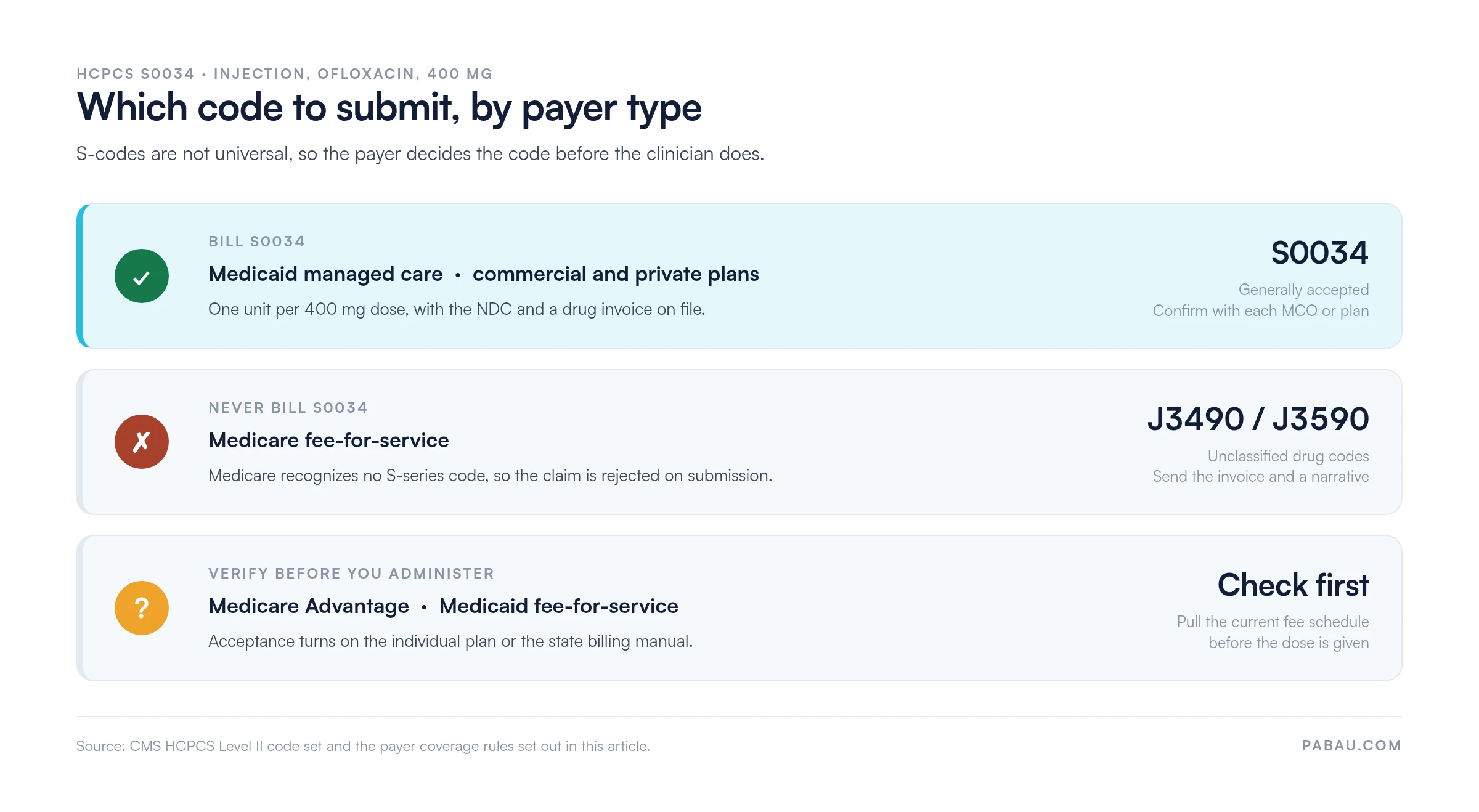
Medicare does not reimburse S-series HCPCS codes, because CMS does not maintain them. CMS manages the permanent national HCPCS Level II codes, the A through V codes, and the S-series sits outside that structure. When treating Medicare fee-for-service patients with ofloxacin injection, billers have two practical options:
Submitting an S-code against a Medicare patient is one of the faster routes to a denial. Expect CO-96, the non-covered charge code, or a related remark such as CO-B7 or CO-204. Routing Medicare claims down the correct path from the start keeps recoverable denials from aging into write-offs.
Accurate billing for S0034 rests on the unit of service, the diagnosis code, and the payer’s acceptance of S-series codes. Work through these steps before you submit any claim for ofloxacin injection.
Check your state Medicaid managed care organization’s (MCO) billing manual annually. S-code coverage policies are not standardized across states, and individual MCOs within one state can set different rules for injectable drug codes. A blanket assumption that ‘Medicaid covers S-codes’ is a common source of avoidable denials.
Choosing the right diagnosis code is required to establish medical necessity for the ofloxacin injection. The ICD-10-CM codes below are the ones most frequently linked to S0034, based on ofloxacin’s FDA-approved indications. Confirm the specific code against the patient’s documented clinical findings, not just the drug administered.
Use the most specific ICD-10-CM code the clinical documentation supports. Vague codes raise the risk of a medical-necessity denial, particularly with commercial injectable drug policies that require a documented infection type. The full ICD-10-CM code index lists every genitourinary and respiratory code these pairings draw from.
The S-series sits within HCPCS Level II but operates differently from the permanent national codes that CMS maintains. Knowing the structure helps billers answer coverage questions and pick the right code when a drug has both a permanent code and an S-series alternative.
S0034 does not always apply, most often because the payer rejects S-codes. Billers then reference an adjacent S-series code, or fall back to the permanent unclassified drug codes. The table below lists the most relevant codes in context.
When billing J3490 as a fallback, always include the drug name, dosage, and NDC in the claim narrative. Payers use this information to cross-reference the drug invoice and price the claim correctly. Treat the narrative field as a required element rather than optional text.
Thin documentation is the leading cause of post-payment audits and denials for injectable drug codes. A claim for S0034 can clear front-end edits and still be recouped in a retrospective audit. The deciding factor is whether the medical record supports the service billed.
Practices that struggle with consistent documentation usually need a structured intake and clinical note workflow. Documentation standards have to be applied at the point of care rather than reconstructed after the fact. Building the required data points into a standard note template is the most reliable way to keep injectable drug claims audit-ready.
Run a quarterly internal audit on your S-code claims. Pull a sample of five to ten S0034 encounters and cross-reference the medical record against the claim data. Check that the diagnosis code, drug dosage, route of administration, and prescriber order are all present and consistent. Finding a documentation problem internally costs far less than having a payer find it.
Most practices catch an S-code problem after the remittance arrives. The biller submits S0034, the Medicare claim rejects, and someone reworks it weeks later from a thin memory of the encounter.
Practice management software like Pabau moves that check to the front of the process. Payer rules sit against each plan record, so the biller sees whether the plan takes S-series codes. That check happens while the ofloxacin injection is being coded, before the claim leaves the practice.
Drug details captured in the clinical note carry through to the claim without re-entry. Dose, route, lot number and NDC land in the same record an auditor will later ask for.
The outcome is fewer reworked claims and a shorter path from encounter to payment. Pabau’s claims management software keeps the supporting documentation attached to the claim. A retrospective audit then does not send staff hunting through paper files.

Pabau’s claims management software helps practices configure payer-specific rules, flag non-covered codes before submission, and keep injectable drug billing compliant across Medicaid and commercial plans.

S0034 is a simple code to bill correctly and an easy one to bill at the wrong payer. The Medicare exclusion and the state-by-state Medicaid variation cause most of the denials this code produces.
Decide the code before the dose is given, not after the remittance comes back. Check the plan’s acceptance of S-series codes and report one unit per 400 mg. Attach the ICD-10 code that names the infection being treated. Practices that build that check into the encounter rarely meet this code again in a denial queue.
Book a demo to see how Pabau flags a non-covered code before the claim is submitted.

Need to understand how clean claims reduce S-code rejections? What is a clean claim covers the documentation and formatting standards that prevent front-end rejections on injectable drug codes.
Want a structured approach to denial prevention? Denial management in healthcare outlines how to categorize, track, and appeal claim rejections, including those from S-code submissions.
Trying to decode a rejection on the remittance? Denial codes in medical billing explains what CO-96 and its neighbours mean and what each one asks you to do next.
Looking for guidance on the broader billing process? What is revenue cycle management explains how injectable drug billing fits into the end-to-end financial workflow for clinical practices.
New to the mechanics behind the claim? What is medical billing walks through the steps between the encounter and the payment that codes like S0034 sit inside.
HCPCS Code S0034 is the billing code for injection of ofloxacin, 400 mg. Medicaid managed care plans and commercial insurers use it to reimburse this injectable fluoroquinolone antibiotic. It applies when ofloxacin is given by injection for UTIs, pelvic inflammatory disease, or lower respiratory tract infections.
No. Medicare does not recognize or reimburse S-series HCPCS codes, including S0034. The S-series was established by the Blue Cross Blue Shield Association and the Health Insurance Association of America. That association is now part of AHIP, and CMS does not maintain these codes. They therefore sit outside Medicare’s billing system. For Medicare patients requiring ofloxacin injection, billers typically use J3490 (unclassified drugs) with a drug invoice attached.
One unit of S0034 equals one injection of ofloxacin at 400 mg. Report quantity 1 for a single 400 mg dose. If a protocol requires a different total dose, calculate units on the 400 mg per-unit convention. Document the dosage in the medical record to support the quantity billed.
Medicaid managed care organizations (MCOs) and most commercial insurers accept S-codes, including S0034, though acceptance varies by individual plan and state Medicaid program. Traditional Medicare fee-for-service does not accept S-codes. Some Medicare Advantage plans may accept them, so verify with each plan directly before submitting.
The codes most often paired with S0034 are N39.0 (urinary tract infection) and N10 (acute pyelonephritis). Pelvic infections use N73.0 or N73.9, prostatitis uses N41.0, and cellulitis uses L03.90. A lower respiratory infection is coded with J18.9. Always choose the most specific code supported by the clinical documentation.
S0034 is the specific code for ofloxacin 400 mg injection and is used when the payer accepts HCPCS S-codes. J3490 is the unclassified drug code used when a payer does not accept S-codes, typically Medicare. J3490 also requires a drug invoice and a narrative naming the drug, dose, and NDC number. That information lets the payer price the claim correctly.