CPT code 59618: Cesarean after attempted VBAC billing guide
CPT code 59618 bills a cesarean after a VBAC attempt CPT code 59618 is the globa...

Last Updated: Nov 4, 2026
P9603 is the HCPCS Level II code for the per-mile travel allowance in laboratory specimen collection. It is paid when a trained technician collects a specimen from a homebound or nursing home bound patient. The descriptor ends with prorated miles actually traveled, which is what marks the per-mile basis.
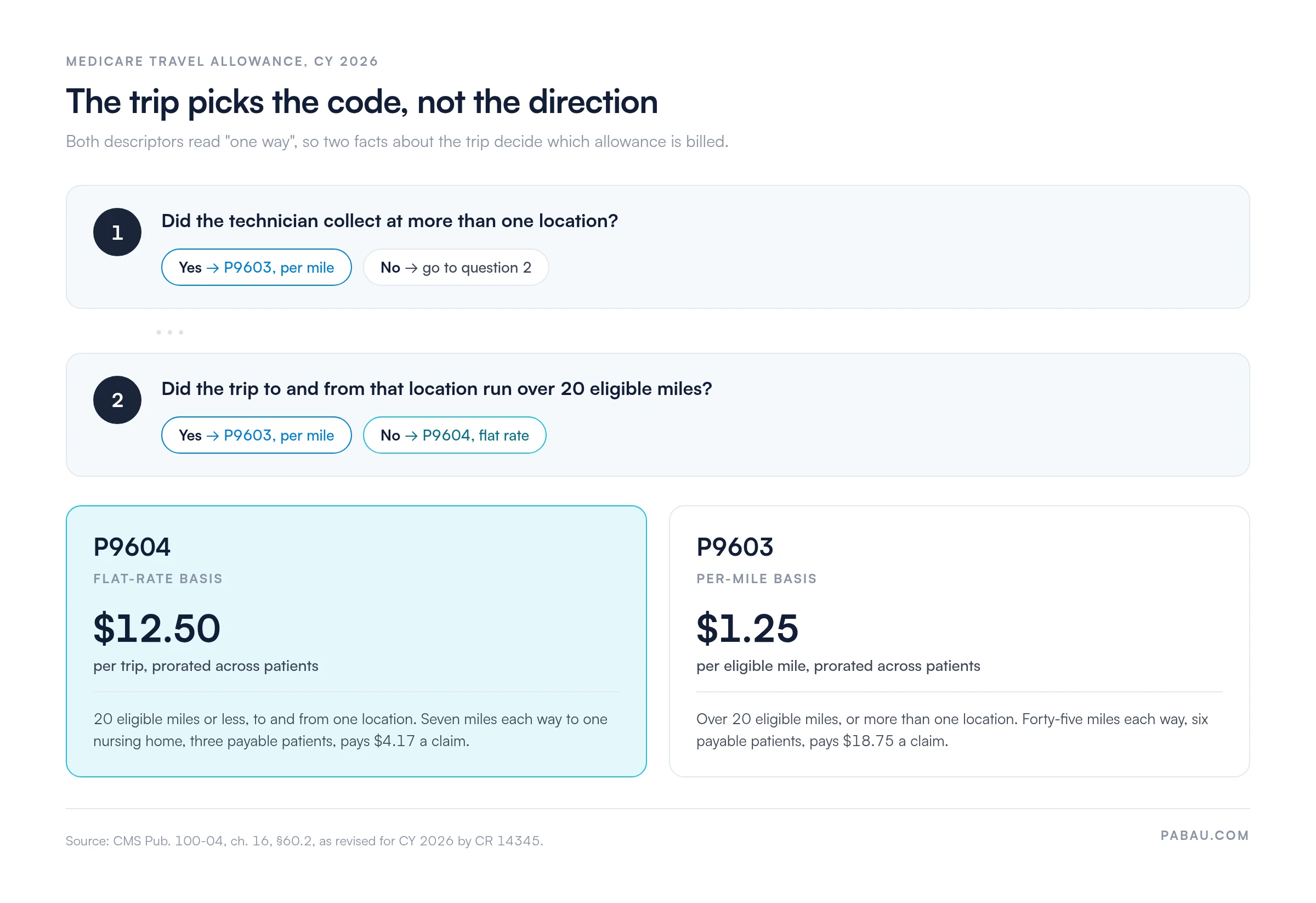
Medicare applies this basis when the round trip to one location runs over 20 eligible miles, or when the trip covers more than one location. The amount is prorated across the Medicare patients whose specimen collection fee is payable. Shorter trips to one location are billed as a flat trip charge under P9604 instead.
Let Pabau's smart automation suggest the right codes, reduce claim denials, and keep your practice compliant—effortlessly.
Automate repetitive tasks and focus on what matters most—your patients.
Reduce coding errors and ensure compliance with the latest regulations.
Clean claims, fewer denials, and faster reimbursements.
Powerful insights and reporting to help your practice thrive.
HIPAA compliant SOC 2 certified GDPR-compliant Trusted by 4,000+ clinics worldwide

HCPCS code P9603 is the per-mile travel allowance for medically necessary laboratory specimen collection from a homebound or nursing home bound patient.
P9603 and P9604 are two separate payment bases, and a trip is billed on one or the other. P9603 pays per eligible mile, while P9604 pays a flat, prorated trip charge.
Use P9603 when the round trip to one location runs over 20 eligible miles. It also applies to any trip covering more than one location.
For CY 2026 the per-mile rate is $1.25. The total is prorated across the Medicare patients whose specimen collection fee is payable, with one claim per patient.
From April 1, 2026, P9603 mileage is billed to the tenth of a mile for trips under 100 eligible miles.
Pabau, the practice software we build, keeps the order, the homebound note, and the claim on one patient record. A mileage line can then be evidenced months later.
HCPCS code P9603 is the Medicare travel allowance code billed on a per-mile basis.
It pays for a trained technician, typically a phlebotomist, to travel to a homebound or nursing home bound patient and collect a specimen.
Its official descriptor, quoted in full in the table below, ends with the words prorated miles actually traveled. Those words mark the per-mile basis. Its companion, HCPCS code P9604, ends with “prorated trip charge” instead.
Among HCPCS codes, P9603 sits in the Level II P-series, which covers pathology and laboratory services. CMS sets the rules in the Medicare Claims Processing Manual, Chapter 16, section 60.2, last revised by Transmittal 13746, effective April 1, 2026.
P9603 covers the transportation and personnel cost of sending a trained technician out to collect a specimen. Three conditions have to hold before the code is payable at all.
Eligible miles start at the laboratory, or wherever the technician’s collection travel begins, and end where that travel ends. Miles driven for any other purpose are excluded. That includes miles to a non-Medicare patient, miles to a stop where no specimen was collected, and personal detours.
Four situations fall outside the code.
P9603 and P9604 are two separate payment bases, and each trip is billed on one basis or the other. Neither code covers a “first mile”, and neither is an add-on for extra miles.
CMS decides the basis from two facts about the trip: how many eligible miles it ran, and how many locations the technician visited. A short four-mile trip to one patient and back is a single P9604 flat trip charge, not P9603.
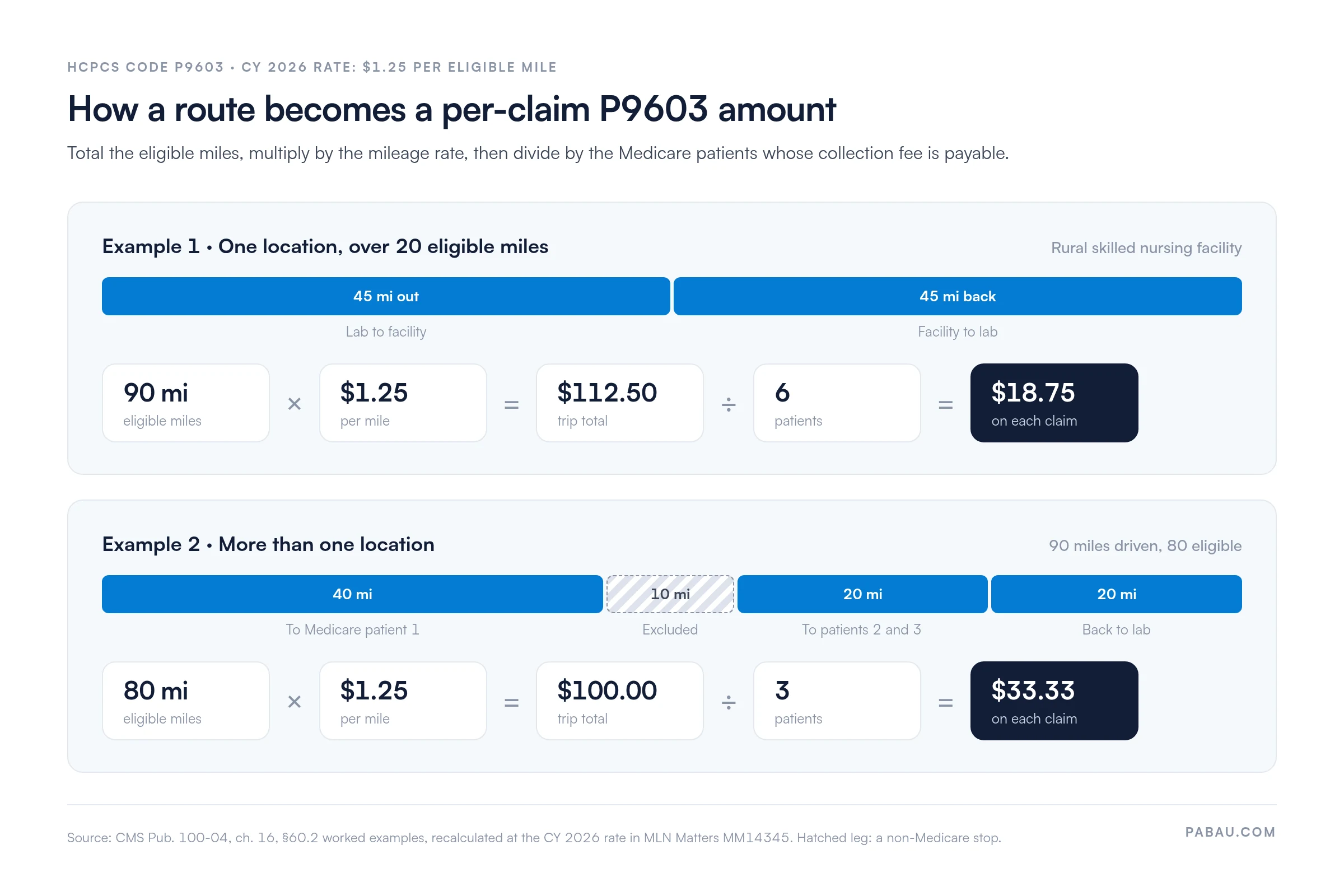
CMS works both of these examples in the manual at the older CY 2024 rate. The figures below apply the CY 2026 rate of $1.25 per mile, published in MLN Matters article MM14345.
A technician drives 45 miles from a city laboratory to a rural skilled nursing facility. Blood is drawn from six Medicare patients, and the technician drives the same 45 miles back.
The round trip comes to 90 eligible miles, which is more than 20, so the per-mile basis applies. Ninety miles at $1.25 gives $112.50. Divided across six patients, each claim carries $18.75 under P9603.
A technician drives 40 miles to a Medicare patient and draws blood. Next comes a 10-mile leg to a non-Medicare patient, then 20 miles to two Medicare patients for catheter urine specimens. The last leg is 20 miles back to the laboratory.
The trip covers more than one location, so the per-mile basis applies regardless of distance. The 10 miles to the non-Medicare patient are left out, which leaves 80 eligible miles. At $1.25 that is $100.00, or $33.33 on each of the three claims.
Set side by side, both routes run through the same three steps: total the eligible miles, apply the rate, then divide by the payable patients.
Change Request 14130 changed how P9603 mileage is reported for dates of service from April 1, 2026. MACs now accept decimal mileage on this code, and only on this code.
Older claim templates that force whole-mile units will now under-report short trips. Check that your billing system accepts a decimal in the units field before the first post-April claim goes out.
Rebuild your travel allowance rate table every January, when CMS issues the annual change request. Keep the dated MLN Matters article with it. If a post-payment review arrives two years later, that saved article shows which rate applied on the date of service.
Billing this code correctly is mostly a matter of recording the trip while it happens. The steps below follow one route from order to submission.
Ask your MAC how it wants the prorated mileage shown in the units field, since contractor billing articles differ on the detail. The collection fee is what makes the travel allowance payable, which is why the two lines are prepared together.
Per-mile claims depend on the trip record more than any other lab line. Four elements carry most of the weight in a review.
Submitting a clean claim for a travel allowance starts at dispatch. A log written then holds up far better than mileage reconstructed from memory at billing time.
Denials on this line cluster around a short list of causes, and most trace back to the trip record rather than the code. Strong denial management treats travel allowance denials as their own category.
Review travel allowance denials every quarter, grouped by the claim adjustment reason code on the remittance. Each reason code points to a different failure, such as the wrong basis, the wrong mileage units, or missing documentation. Grouping by reason code rather than by HCPCS code shows the root cause in one pass.
P9603 is a Medicare construct, and commercial payers are not bound to it. Some plans recognize the code and pay their own amount. Others fold travel into the collection fee, and some do not cover home collection at all.
Long routes are often reconstructed after the fact. The mileage sits with the courier, the homebound note sits in the chart, and the patient count sits in someone’s head. When a reviewer asks about one $18.75 line a year later, assembling the answer costs more than the claim paid.
In Pabau, the order, the clinical note, the visit date, and the submitted codes sit on the same patient file. The evidence for each mileage line is gathered while the visit is fresh.
Pabau’s claims management supports insurance billing in the US, the UK and Australia. Each claim’s status is tracked against the patient record, from submission through to paid. Repeated denials on travel lines then sit side by side, so a pattern is spotted after a handful of claims.

Pabau keeps orders, clinical documentation, and billing records on one patient file. Per-mile travel allowance claims can then be evidenced long after the route was driven.

Every P9603 claim stands or falls on the trip record. Choosing between the per-mile and flat-rate basis is simple once the eligible miles and the stops are known.
So set the trip log up before the next route goes out. Capture the addresses in order, whether a specimen was drawn at each stop, the miles per leg, and the patient count. Then confirm your billing system takes a decimal in the units field.
With those facts recorded at dispatch, a reviewer’s question two years later takes minutes to answer. Book a demo to see how Pabau keeps that evidence on the patient record it belongs to.

Billing a short trip to one location? HCPCS code P9604 explains the flat-rate travel allowance and the 20-mile test in full.
Need the collection code that carries the travel line? CPT code 36415 covers venipuncture billing and its documentation.
Working through a stack of remittance denials? Denial codes in medical billing maps the common reason codes onto their fixes.
Want a broader framework for reducing claim errors? Denial management in healthcare walks through the denial lifecycle from identification to resubmission.
HCPCS code P9603 is the per-mile Medicare travel allowance for medically necessary specimen collection from a homebound or nursing home bound patient. It applies when the round trip to one location is over 20 eligible miles, or when the trip covers more than one location. The total is prorated across the patients whose collection fee is payable.
They are two separate payment bases, and each trip is billed on one or the other. P9603 pays per eligible mile, for longer single-location trips and any multi-stop route. P9604 pays a flat trip charge when the technician travels 20 eligible miles or less to and from one location. A four-mile trip to one patient is one P9604 flat charge.
Keep a signed order and a note showing the patient is homebound or nursing home bound, with the home draw documented as medically necessary. Add a trip log with each address, each stop, and the mileage per leg. Keep the patient count used to prorate the amount, and the collection record for each patient.
The most common causes are a missing payable collection fee, per-mile billing on a short single-location trip, and non-eligible miles in the total. Mileage units reported in the wrong format, an amount that was not prorated, and missing homebound documentation are also frequent.
No. The travel allowance mileage rate is national, and CMS updates it each January. For CY 2026 it is $1.25 per eligible mile. What varies by MAC is claim handling, such as how mileage evidence is submitted.
Medicare Advantage plans cover Medicare-covered services, so the travel allowance is in scope when the criteria are met. Payment amounts and submission rules follow the plan, not the MAC. Verify coverage with the plan before dispatching a technician.