CPT code 49321: Laparoscopy with biopsy billing guide
What is CPT code 49321? CPT code 49321 is the surgical laparoscopy code for a bi...

Last Updated: Oct 7, 2026
L1907 is the HCPCS Level II code for ankle orthosis, supramalleolar with straps, with or without interface/pads, custom fabricated. It describes a custom-fabricated supramalleolar ankle orthosis, built from castings, tracings or measurements, with trim lines ending just above the ankle bones.
Medicare pays it as a brace under the DMEPOS fee schedule. Claims go to the DME MAC under LCD L33686 and Policy Article A52457. Append KX only when every L33686 coverage criterion is met, and GA or GZ when it is not. The main coding risk is billing a prefabricated ankle support under this custom-fabricated code.
Let Pabau's smart automation suggest the right codes, reduce claim denials, and keep your practice compliant—effortlessly.
Automate repetitive tasks and focus on what matters most—your patients.
Reduce coding errors and ensure compliance with the latest regulations.
Clean claims, fewer denials, and faster reimbursements.
Powerful insights and reporting to help your practice thrive.
HIPAA compliant SOC 2 certified GDPR-compliant Trusted by 4,000+ clinics worldwide

L1907 is a custom-fabricated supramalleolar ankle orthosis, paid under the Medicare braces (orthoses) benefit and billed to the DME MAC.
Add the KX modifier only when every LCD L33686 criterion is met and documented, and GA or GZ when it is not.
No LCD diagnosis list applies to L1907, so ICD-10 codes are supporting documentation rather than a coverage list.
CMS RAC topic 0013 reviews ankle-foot and knee-ankle-foot orthosis claims, including L1907, for medical necessity and documentation.
Pabau, the practice management platform we build, lets practices and billing teams submit the claims they have entered through Claim.MD and track their status.
HCPCS Code L1907 is the HCPCS Level II code for a custom-fabricated supramalleolar ankle orthosis with straps, with or without interface or pads. The code set is maintained by the Centers for Medicare and Medicaid Services. The device is individually made from castings, tracings or measurements, which separates it from the prefabricated ankle supports nearby in the L-series.
Orthoses are covered under the Medicare braces benefit in Social Security Act section 1861(s)(9). They follow the DMEPOS route, so L1907 claims go to the DME MAC and pay from the DMEPOS fee schedule.
The supplier needs DMEPOS accreditation from any CMS-approved accrediting organization. For orthotists who furnish custom-fabricated devices, ABC or BOC certification is the usual credentialing route.
L1907 covers a custom-fabricated supramalleolar ankle orthosis, individually made for one patient. Policy Article A52457 describes molded plastic that controls ankle and midfoot motion, with trim lines from the toe tips to just above the malleoli.
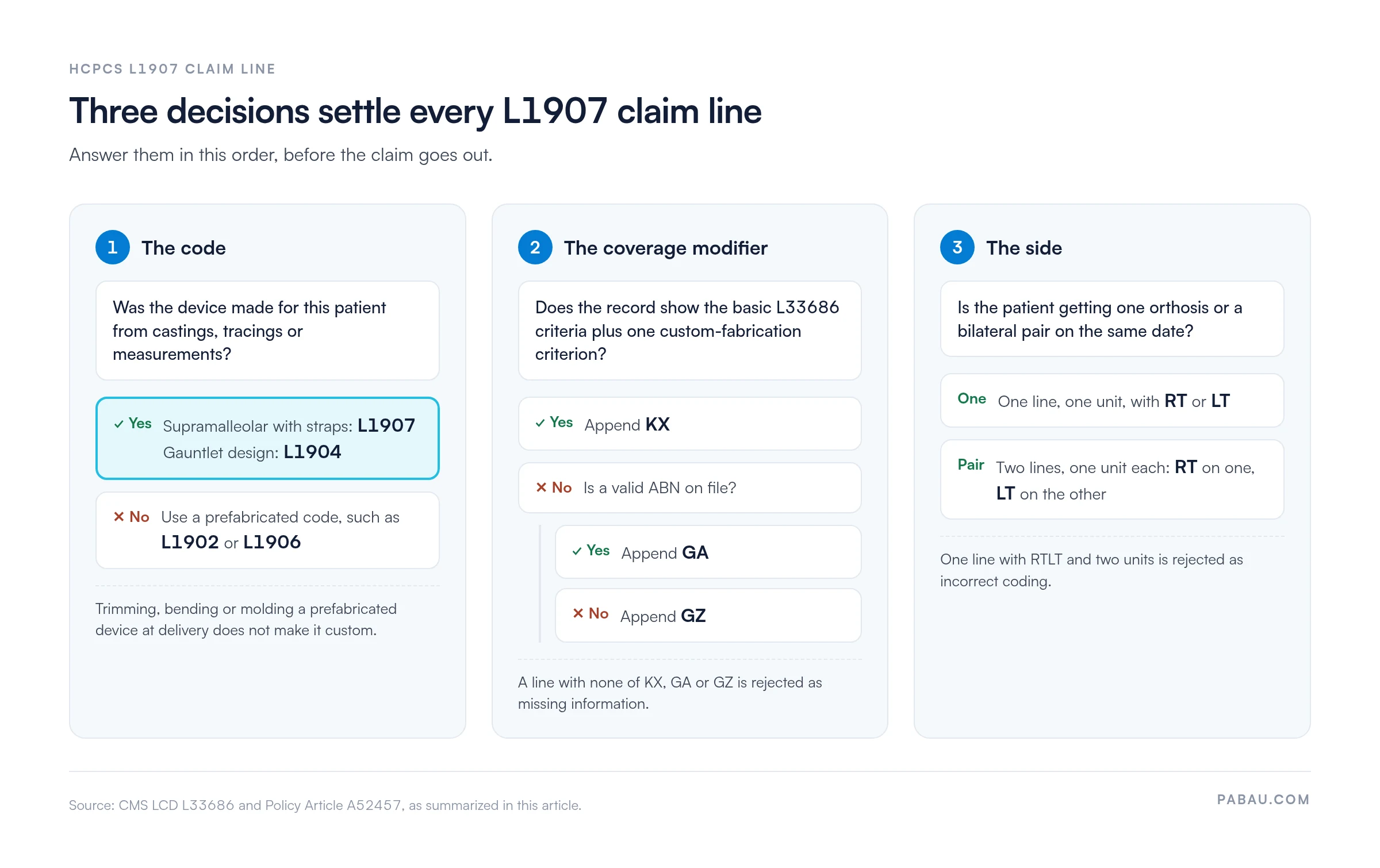
The custom-fabricated versus prefabricated boundary is the main coding risk for L1907. Under A52457, a prefabricated orthosis stays prefabricated even when it is trimmed, bent or molded for one patient. Billing that device under L1907 overstates the item and creates an overpayment. A prefabricated support goes under its own code, such as L1906 or L1902.
Coders most often confuse L1907 with neighboring ankle codes, and the usual dividing line is custom-fabricated versus prefabricated. The table compares the codes closest to it.
Verify the current official descriptor in the CMS HCPCS file before billing any adjacent code. Minor wording changes between releases can affect code selection.
Medicare covers L1907 under the braces (orthoses) benefit when the criteria in LCD L33686 are met. L33686 is one LCD used by all four DME MACs, and Policy Article A52457 sets the coding and billing rules.
The basic criteria cover ambulatory beneficiaries with weakness or deformity of the foot and ankle. They must need stabilization for medical reasons and have the potential to benefit functionally. A custom-fabricated device also needs one of these five reasons:
Orthoses need no Certificate of Medical Necessity. L1907 is not on the CMS master list for a face-to-face encounter and written order prior to delivery, or for prior authorization. A standard written order is still required before the claim is submitted.
Documentation that does not support the LCD criteria is a frequent reason L1907 claims fail review. Keep these elements in the supplier file before the claim is submitted.
LCD L33686 has no covered-diagnosis list for L1907. A52457 requires a diagnosis on the claim only for L4392, L4396, L4397 and L4631. For L1907, ICD-10 codes are supporting documentation, and the record must show the condition behind the device.
Append KX only when every L33686 criterion is met and the evidence is in the supplier file. When it is not, append GA if you hold a valid Advance Beneficiary Notice, or GZ if you do not. Claim lines with none of the three are rejected as missing information.
Since March 1, 2019, a bilateral pair billed on the same date goes on two claim lines with one unit each. One line carries RT and the other carries LT. A single line with RTLT and two units is rejected as incorrect coding. Confirm current modifier rules in Policy Article A52457 before billing.
The diagram below puts the three choices on every L1907 line in order: the code, the coverage modifier and the side.
Medicare pays HCPCS Code L1907 from the DMEPOS fee schedule, which CMS updates each January 1. Orthotic fees are set by state within a national floor and ceiling, so the allowed amount depends on the beneficiary’s state. Pabau’s claims management software sends the claims your billing team has entered through Claim.MD and tracks their status after submission.
For the current allowed amount, check the L1907 row for your state in the CMS DMEPOS fee schedule file.
Medicare Part B does not require prior authorization for HCPCS Code L1907. The code is not on the CMS master list’s prior authorization list, though other payers set their own rules.
L1907 denials cluster around a few preventable errors, and checking for them before submission cuts rework. Our guide to denial management workflows covers how to route the corrections.
For the CARC and RARC codes that appear on L1907 remittances, see our guide to denial codes in medical billing. It maps common denial reason codes to corrective action steps.
CMS Recovery Audit Contractor (RAC) topic 0013, approved in 2017, reviews ankle-foot and knee-ankle-foot orthosis claims. L1907 is on its code list, and the review checks medical necessity and documentation against the medical record.
This is a complex review, so the auditor requests and reads the record. L1907 claims depend on it because the custom-fabrication decision rests on clinical findings that claim edits cannot check. Build a pre-submission check into your medical billing compliance protocols. Confirm the modifier, the custom-fabrication justification, the written order and proof of delivery before each claim goes out.
Payer-specific billing rules for HCPCS Code L1907 diverge across Medicare, Medicaid and commercial insurers. Understanding medical billing workflows by payer type prevents submission errors that require multiple re-submissions.
The Medicaid row uses NC Medicaid as an illustration only. Rules in other states differ, so check the applicable state Medicaid fee schedule and orthotics policy before billing.
Many practices and billing teams keep the written order, fabrication notes and delivery ticket in one system and claim status in another. That split makes it slow to answer a rejected line or a RAC record request.
Pabau holds patient records, clinical notes and signed forms alongside billing. Through the Claim.MD clearinghouse, it submits the claim data your team has already entered and tracks each claim’s status. A rejected L1907 line is visible next to the record your team needs to correct it.
Your team still makes the coding decisions, including the code and its modifiers. Pabau keeps the supporting records and the claim history together for the next review.

Pabau sends the claims your billing team has entered through Claim.MD and tracks their status. Patient records and signed forms sit in the same system.

Denied L1907 claims commonly trace back to a few preventable errors. The usual ones are KX without documented criteria, no custom-fabrication justification, a prefabricated device billed as custom, or side-coding mistakes. RAC topic 0013 reviews medical necessity and documentation, so the supplier file has to stand on its own.
Settle the custom-fabricated versus prefabricated question at the fitting, before anyone builds the claim. Record which L33686 criterion applies and keep the fabrication records, and KX becomes a statement you can defend.
Pabau’s claims management lets practices and billing teams submit the claims they have entered and track their status. The patient record sits alongside each claim. Book a demo to see how Pabau keeps L1907 claims and their supporting records together.

Need to understand how denial codes appear on remittances? Denial codes in medical billing maps the most common CARC and RARC codes to corrective action workflows for DMEPOS claims.
Managing claims across multiple payer types? Medical billing compliance best practices covers documentation standards, audit preparation, and payer-specific rule differences for US practices.
Want to reduce billing rework from upstream errors? Denial management in healthcare explains how structured denial tracking reduces re-submission cycles and accelerates collections.
HCPCS Code L1907 covers a custom-fabricated supramalleolar ankle orthosis with straps, with or without interface or pads. It is individually made for one patient from castings, tracings or measurements. Medicare pays it under the braces (orthoses) benefit, billed to the DME MAC. Prefabricated ankle supports use other codes, such as L1902 or L1906.
Medicare requires a standard written order before the claim is submitted, though not before delivery for L1907. The record must show the basic LCD L33686 criteria and one custom-fabrication criterion. Keep fabrication records and signed proof of delivery in the supplier file. Orthoses need no Certificate of Medical Necessity.
No, Medicare Part B does not require prior authorization for L1907. Medicare Advantage plans, commercial payers and state Medicaid programs set their own rules, so confirm requirements with each payer before fabricating the device.
The 2026 Medicare allowed amount for L1907 varies by state, within a national floor and ceiling. CMS publishes it in the DMEPOS fee schedule file, effective January 1, 2026. Download that file and read the L1907 row for your state, because no single national figure applies.