

HCPCS code E0198: Water pressure pad billing guide
HCPCS code E0198 is a water pad for a standard mattress HCPCS code E0198 is the ...

Last Updated: Oct 13, 2026
A4771 is the HCPCS Level II code for serum clotting time tube, for dialysis, per 50.
Two details decide whether the claim is paid. The first is that per-50 unit of service. The second is whether the supply already sits inside the End-Stage Renal Disease Prospective Payment System (ESRD PPS) bundle.
Let Pabau's smart automation suggest the right codes, reduce claim denials, and keep your practice compliant—effortlessly.
Automate repetitive tasks and focus on what matters most—your patients.
Reduce coding errors and ensure compliance with the latest regulations.
Clean claims, fewer denials, and faster reimbursements.
Powerful insights and reporting to help your practice thrive.
HIPAA compliant SOC 2 certified GDPR-compliant Trusted by 4,000+ clinics worldwide

HCPCS Code A4771 covers a serum clotting time tube for dialysis, and one billed unit equals 50 tubes.
Confirm the quantity dispensed before you submit, because billing 50 units for 50 tubes is a 50x overclaim.
On ESRD facility claims the tubes usually sit inside the ESRD PPS base rate, so check separate billability with your MAC first.
A4771 is a supply code, so any separately payable amount comes from the DMEPOS fee schedule rather than the Physician Fee Schedule.
Pabau’s claims management software helps renal care teams track supply codes, quantity units, and payer rules in one place.
Every word in the A4771 descriptor carries billing weight. “For dialysis” restricts the clinical setting the code applies to. “Per 50” defines the unit of service. Misread either one and the claim is wrong before it reaches the payer.
A4771 falls within the HCPCS Level II A-code series, which the Centers for Medicare and Medicaid Services (CMS) uses to classify medical and surgical supplies. Per the CMS HCPCS overview, Level II codes are national alphanumeric codes maintained separately from CPT codes. They cover supplies and non-physician services the CPT system does not capture. Denial codes in medical billing group the reasons a payer refuses, and the group decides the fix. Missing a provider identifier or a diagnosis code sends a reimbursement claim straight back, so a reimbursement receipt lists both.
The A-series specifically covers medical and surgical supplies, including durable medical equipment items and dialysis consumables. A4771 sits alongside the other dialysis supply codes in the A47xx range, so coders meet it next to A4770 and A4772 on the same claims.
Serum clotting time tubes are used in hemodialysis to monitor a patient’s blood clotting function. Dialysis patients receive anticoagulants during each session to stop blood clotting inside the dialyzer circuit. The tubes let care staff test clotting times at the point of care, before and during treatment.
Consumables billed by the batch are not unique to dialysis. Practices running on IV therapy software face the same counting problem with infusion supplies, and the fix is the same in both settings.
The clinical workflow also sets the documentation standard. The clinical record documentation for each session should show the anticoagulation protocol used and any clotting time measurements taken. That record is the audit trail behind the supply claim.
Medicare rarely pays A4771 as a separate line item for patients on maintenance dialysis. The ESRD PPS bundles most dialysis supplies and services into one per-treatment base rate paid to the facility. Clotting time tubes are the kind of supply that sits inside that bundle.
CMS set the CY 2026 ESRD PPS base rate at $281.71 per treatment, up from $273.82 in 2025. That single figure is what covers the consumables used in a session, tubes included.
Watch the terminology in older guidance and vendor documentation. The composite rate was the payment method the PPS replaced in 2011, so current CMS material refers to the base rate instead. Anything still describing a composite rate is describing a system that no longer runs.
ESRD PPS bundling consideration: Whether A4771 sits inside the bundle depends on the care setting, the date of service, and current CMS policy. Verify separate billability with your Medicare Administrative Contractor (MAC) before you submit A4771 as a standalone line.
Supply codes elsewhere in HCPCS behave the same way, so the habit transfers. B4036 pays one unit per day pays one unit per day rather than per item, and the descriptor’s unit again decides the number on the claim.
The “per 50” unit of service is the most common source of billing errors on codes like A4771. One unit billed equals 50 tubes dispensed. Billing one unit for 50 tubes is correct, and billing 50 units for the same 50 tubes is a 50x overclaim.
Document the quantity dispensed in the patient record before you calculate billed units. Claims management software that enforces quantity-to-unit mapping cuts this error class down sharply. Quantity mismatches trigger pre-payment audits and post-payment recoupment alike.
Run a monthly audit of A4771 claims before submission. Filter by units billed and cross-reference against the dispense logs. Any claim whose units do not divide evenly into 50-tube increments is worth reviewing before it becomes a denial or an overpayment.
A4771 is a supply code, so any separately payable amount comes from the DMEPOS fee schedule. It is not priced on the Physician Fee Schedule. CMS publishes the DMEPOS files by state and revises them quarterly, with the main update each January.
Look A4771 up in the current DMEPOS fee schedule file, or in your DME MAC’s own fee lookup. Dialysis supply claims go to a DME MAC rather than an A/B MAC. Noridian handles Jurisdictions A and D, and CGS handles Jurisdictions B and C.
Expect the file to flag A4771 as bundled or not separately payable in many states. That indicator is itself the answer to the rate question. The cost of the tubes already sits inside the facility’s per-treatment base rate, so no separate allowable applies.
Codes that do carry a published amount look different on the same file. E0293 shows state-by-state allowables and rental modifiers, which is what a genuinely fee-schedule-priced DMEPOS item looks like.
DMEPOS amounts vary by state, and within a state by rural and non-rural area. Competitive bidding can also replace the fee schedule amount for some items in some regions. The file’s effective date therefore matters as much as the code.
Never treat one national figure as your A4771 rate. A supplier billing in Louisiana can see a different allowable than one in California. Both may see a bundled indicator instead of a dollar amount.
Across a group with several dialysis sites, that variation has a configuration cost. Each facility’s fee schedule setup needs to reflect its own state file rather than a shared national average. Otherwise reimbursement estimates drift away from what Medicare pays.
Dialysis supply billing rarely involves one code in isolation. Coders working with A4771 meet the surrounding A47xx codes on the same claim or in the same billing cycle. Knowing the distinctions prevents unbundling errors and builds complete supply claims.
Mixing up A4770 and A4771 is the most common adjacent-code error for dialysis billers. Both share the “for dialysis, per 50” descriptor structure and sit next to each other in every lookup tool. A4770 covers vacuum tubes used to draw specimens, while A4771 covers clotting time tubes used for ACT testing.
Unit definitions cause the same trouble outside the A-codes. Drug codes such as J0630 bill by dosage amount rather than by vial, so the descriptor again sets the number of units.
Many dialysis patients also live with diabetes, which is why A4772 turns up on the same claims. Practices using a metabolic health EMR track those glucose supplies next to renal care in one record.
Teams working on EHR integration for dialysis supply billing benefit from code-level charge mapping. Mapping each supply item to one HCPCS code cuts the risk of adjacent-code substitution at charge entry.
Build a quick-reference card for your billing team listing A4770, A4771, A4772, and A4773 side by side with their supply types. Attach it to your charge entry workflow. The shared per-50 structure makes these codes feel interchangeable when they are not, and one page prevents most swap errors.
Getting A4771 right is part code knowledge and part workflow. The steps below reflect how dialysis centers and patient management software handle supply billing from dispense through submission.
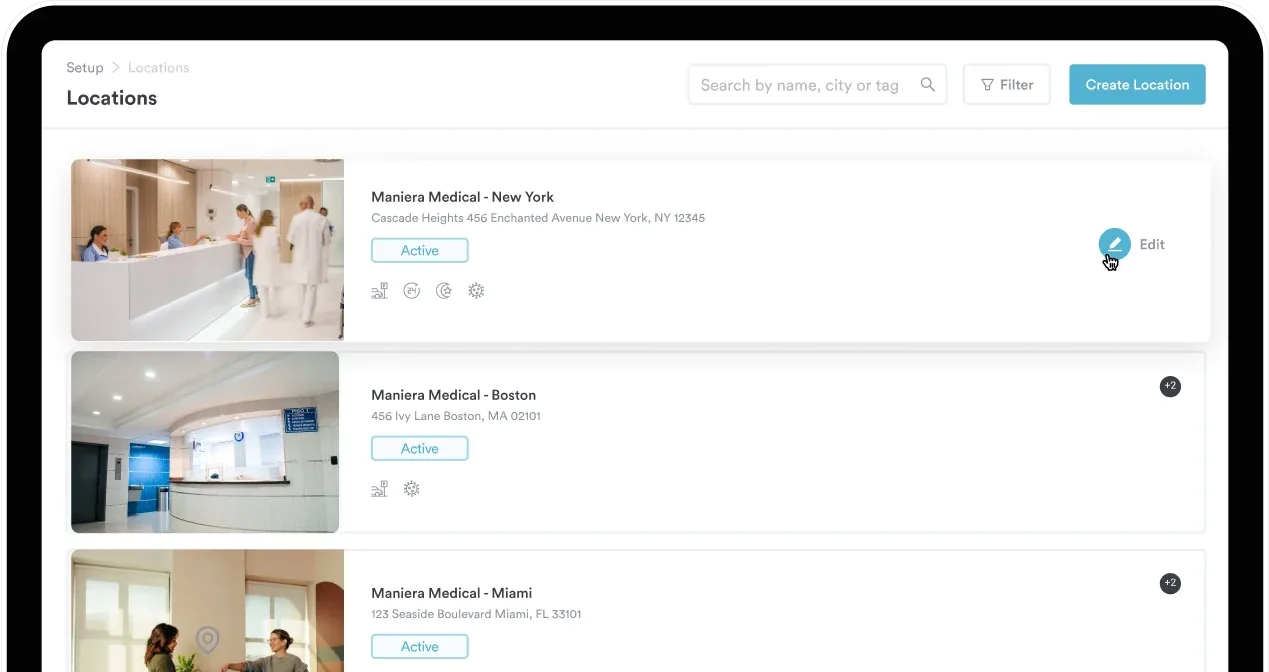
Across multiple sites, keeping supply code configurations consistent is the recurring problem. Multi-location tools that centralize charge masters reduce site-specific coding drift, where one location codes A4771 correctly while another codes A4770 out of habit.
If your team handles supply billing alongside other practice management features such as scheduling, documentation, and reporting, one platform reduces context switching. It also makes the audit trail easier to reconstruct when a claim is challenged.
Most dialysis billing teams reconcile three separate records before an A4771 claim goes out. The dispense count sits in a paper log, the session note sits in the clinical record, and the unit conversion happens in someone’s spreadsheet.
Practice management software like Pabau keeps those three records together. Staff log the tubes dispensed against the session note, and the charge line carries that quantity through to the claim. Nobody retypes a count from a log at the end of the week.
Coverage checks stay attached to the same record. You can flag which payers treat A4771 as bundled, so the check happens before submission rather than after a denial. Every Pabau subscription includes every feature, so supply billing is not a module you add on later.

Pabau’s claims management tools help dialysis teams track HCPCS supply codes, quantity units, and payer rules in one place. Billing staff spend less time chasing denials.

A4771 is a small line item with a high error rate, and both of its usual errors are avoidable. Count the tubes, divide by 50, and establish whether the ESRD PPS base rate already pays for them.
The habit worth building is the coverage check before submission rather than after a denial. Teams that settle the bundling question with their DME MAC once per patient type stop relitigating the same denial every month.
Everything else is bookkeeping that software should carry for you. Book a demo to see how Pabau keeps supply units, documentation, and coverage checks inside one billing workflow.

Billing equipment as well as supplies? E0236 walks through coverage criteria, documentation, and units for a DMEPOS equipment code.
Handling rental items on the same claim? E0217 shows how a DMEPOS item’s coverage rules and modifiers shape what you can bill.
Coding accessories rather than whole items? K0046 explains how component-level codes are itemized on a DMEPOS claim.
Billing an octreotide injection claim? Octreotide injection billing guide covers J2354 unit counts for octreotide given subcutaneously or intravenously in outpatient settings.
HCPCS Code A4771 is a Level II supply code with the descriptor “Serum clotting time tube, for dialysis, per 50.” It sits in the A-series medical and surgical supply codes maintained by CMS. It bills serum clotting time tubes dispensed in dialysis settings, with one unit representing 50 tubes.
A serum clotting time tube is a point-of-care supply used in hemodialysis to measure activated clotting time (ACT). That result guides anticoagulant dosing during the session. In billing terms, A4771 captures the cost of those tubes as a supply line item. The “per 50” unit reflects typical dispense volumes in dialysis centers.
Start by confirming whether the tubes fall inside the ESRD PPS base rate for that patient and date of service. Bundled supplies are not separately payable. Verify separate billability with your Medicare Administrative Contractor (MAC) before submitting. If it is separately billable, bill one unit of A4771 for every 50 tubes dispensed and attach the dispense documentation.
A4771 is priced on the DMEPOS fee schedule rather than the Physician Fee Schedule, with amounts published state by state. Check the current CMS DMEPOS file or your DME MAC’s fee lookup. The right lookup is Noridian for Jurisdictions A and D, or CGS for Jurisdictions B and C, depending on your region. Many files show A4771 as bundled, because the CY 2026 ESRD PPS base rate of $281.71 already covers the supply.
A4770 covers vacuum blood collection tubes for dialysis, per 50, while A4771 covers serum clotting time tubes for dialysis, per 50. The descriptors look almost identical, but the supply types differ. A4770 is for standard specimen collection and A4771 is for activated clotting time testing. Using one in place of the other is an incorrect-code error.
The adjacent A47xx codes are A4770 for vacuum blood collection tubes and A4772 for blood glucose test strips. A4773 covers occult blood test strips. All three are dialysis-specific and all bill per 50. Each covers a distinct supply, so apply the code that matches what was actually dispensed.



