CPT code 51797: Intra-abdominal voiding pressure add-on
What CPT code 51797 covers CPT code 51797 is the add-on code for intra-abdominal...

Last Updated: Oct 19, 2026
J7320 is the HCPCS Level II code for hyaluronan or derivitive, genvisc 850, for intra-articular injection, 1 mg.
Genvisc 850 is supplied as a 25 mg per 2.5 mL prefilled syringe, which works out to 10 mg per mL. The course runs to five weekly intra-articular injections into the knee joint. Verify syringe sizing and the injection schedule against the FDA-approved prescribing information before billing.
Let Pabau's smart automation suggest the right codes, reduce claim denials, and keep your practice compliant—effortlessly.
Automate repetitive tasks and focus on what matters most—your patients.
Reduce coding errors and ensure compliance with the latest regulations.
Clean claims, fewer denials, and faster reimbursements.
Powerful insights and reporting to help your practice thrive.
HIPAA compliant SOC 2 certified GDPR-compliant Trusted by 4,000+ clinics worldwide

HCPCS code J7320 describes hyaluronan or derivative, Genvisc 850, for intra-articular injection, per 1 mg, billed under Medicare Part B
Reimbursement is calculated at ASP+6%, and units billed equal the milligrams administered (one 25 mg Genvisc 850 syringe = 25 units)
J7320 must always be paired with an administration CPT code: 20610 (no image guidance) or 20611 (ultrasound-guided)
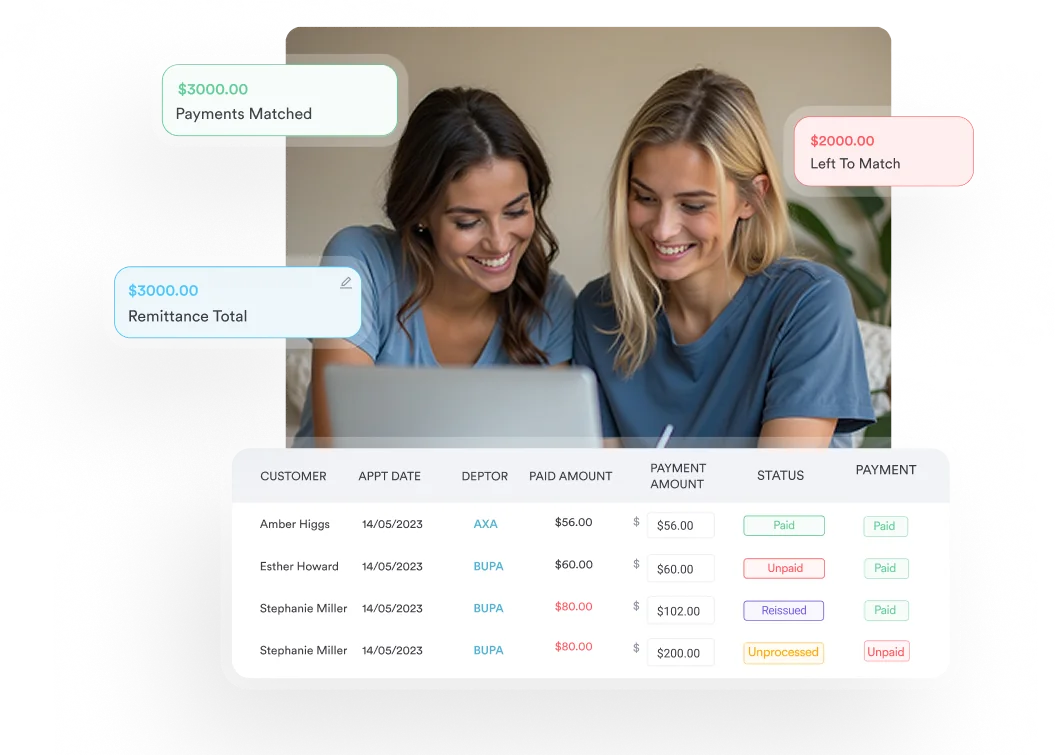
Pabau’s claims management software streamlines buy-and-bill workflows, NDC reporting, and claim submission for physician-administered drugs like J7320
Medicare Part B reimburses J7320 under the Average Sales Price (ASP) methodology. The payment rate equals ASP plus 6% (ASP+6%), which compensates the practice for the cost of acquiring Genvisc 850 plus a handling margin. CMS updates ASP payment limits quarterly, so reimbursement rates fluctuate each quarter based on manufacturer-reported sales data.
Practices billing J7320 should use claims management software that reflects current quarterly ASP rates. Submitting claims at an outdated rate does not change what Medicare pays. It does distort cash flow projections if the practice estimates reimbursement at purchase time.
Always pull the current quarter’s ASP file directly from the CMS Physician Fee Schedule lookup tool before estimating reimbursement for a patient course of therapy.
Coverage under CMS Local Coverage Article A52420 requires the practice to demonstrate medical necessity before billing J7320. Failing to document these criteria is one of the top reasons viscosupplementation claims are denied on post-payment audit. Read the applicable coverage article before the injection is given, not after the payment is recouped.
CMS coverage criteria for intra-articular hyaluronan injections (per Article A52420) generally require:
Coverage limitations and the number of allowable injection courses per year vary by Medicare Administrative Contractor (MAC). Do not apply a universal injection-per-year limit to all patients. Check your MAC’s applicable LCD or LCA for the precise utilization guidelines in your jurisdiction.
Every J7320 claim must be paired with a valid ICD-10-CM diagnosis code from the M17.x category (gonarthrosis, or osteoarthritis of the knee). These are the codes listed in CMS Local Coverage Article A52420 as supporting medical necessity. Submitting J7320 with an ICD-10 code not on the approved list triggers an automatic denial.
Always code to the highest level of specificity. M17.11 and M17.12 are preferred over M17.9 because they capture laterality, which also aligns with the LT/RT modifier requirement on the claim.
If the documentation names a different joint or cause, check the neighboring entries in our ICD-10-CM codes library. Refer to the CDC/NCHS ICD-10-CM tool for the complete current-year code list before submitting.
J7320 covers only the drug component of the injection. The administration itself must be billed with a separate CPT code. Orthopedic and sports medicine practices choose between two codes, depending on whether ultrasound guidance is used.
20611 requires permanent image storage and a written report documenting ultrasound guidance. Billing 20611 without meeting that documentation standard is a compliance risk.
When no ultrasound is used, bill 20610. Never bill both on the same date for the same joint injection. The administration code you choose sets the administration rate, and J7320 stays the drug component either way.
Under Medicare Part B, buy-and-bill is the billing model for physician-administered drugs. The practice purchases Genvisc 850 directly, administers it, and then bills Medicare for the drug (J7320) and the administration service (20610 or 20611). The practice carries the acquisition cost until Medicare pays, so timing matters as much as coding.
Track your Genvisc 850 acquisition cost against the current quarterly ASP before each injection course. If the ASP+6% payment falls below your purchase cost for a given quarter, contact your wholesaler about contract pricing options before administering the next syringe.
Prior authorization (PA) requirements for J7320 vary significantly by payer. Check patient eligibility and PA requirements before the first injection date. Retroactive authorization is rarely approved once the drug has been administered.
Keep all PA approval numbers, approval dates, and expiry dates documented in the patient record. Include the authorization number on the claim when required by the payer.
Medicare auditors target viscosupplementation claims specifically because documentation deficiencies are common. The charge slip for the injection visit is only the starting point. The underlying medical record must support every element of the claim independently.
Required documentation for each J7320 claim includes:
Complete injection notes are the most effective safeguard against post-payment audit recoupment. Practices that rely on templated notes without capturing laterality, NDC, and lot number are the most exposed.
Units and modifiers are where many practices make costly, avoidable billing errors on J7320 claims. The unit reporting rule is straightforward: Bill 1 unit of J7320 per 1 mg administered.
One 25 mg Genvisc 850 syringe means the claim line reads J7320 with 25 units. Billing a single unit regardless of the dose administered results in significant under-reimbursement.
When billing bilateral injections, bill each knee on a separate claim line with the appropriate modifier. Bundling both knees on one claim line without a bilateral indicator causes underpayment. It also triggers a denial for the missing modifier.
Always check that bilateral medical necessity documentation meets your MAC’s requirements, as some LCDs impose additional criteria for same-day injections. The diagram below shows how the two claim lines fit together for one injection visit.
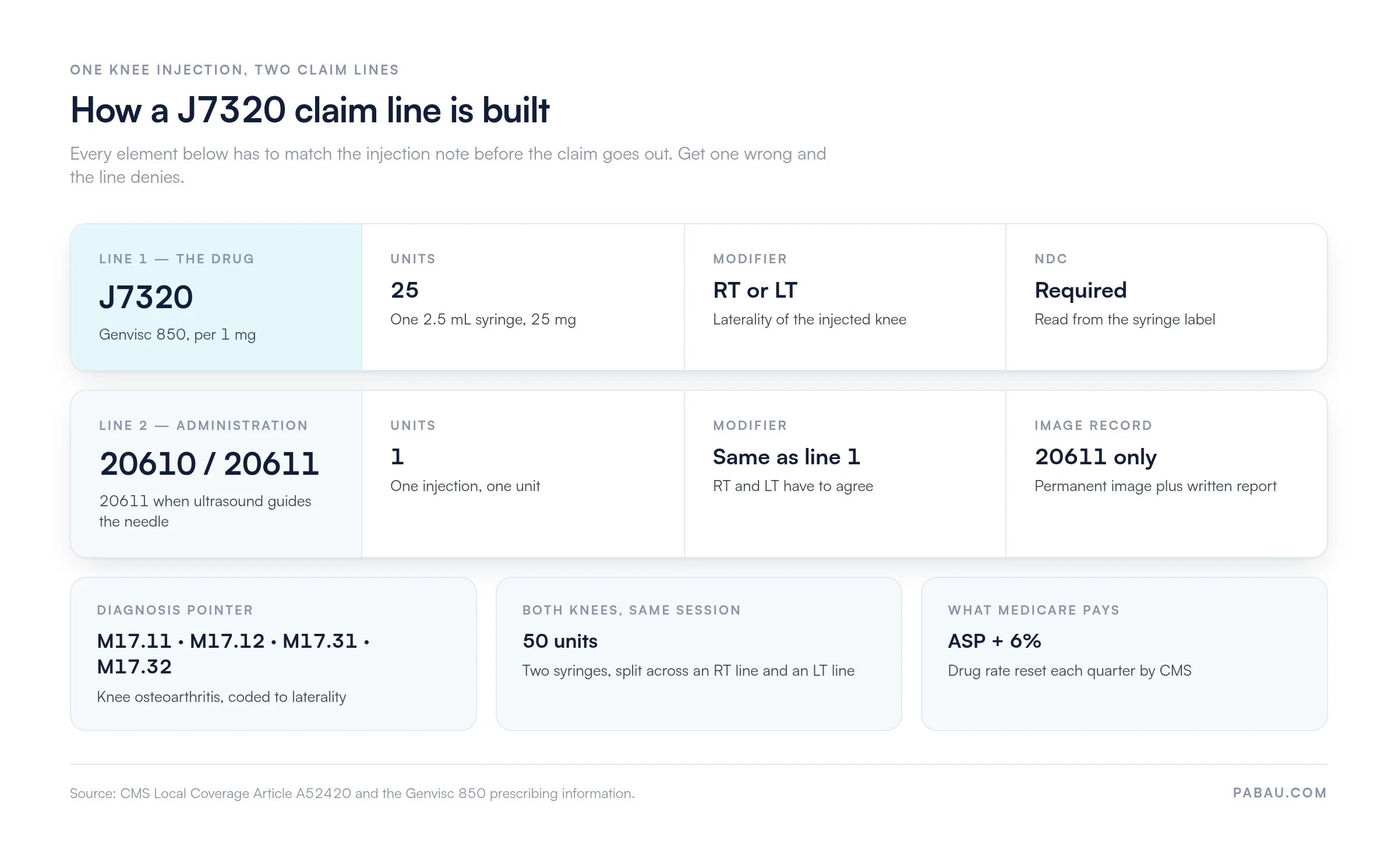
Viscosupplementation claims are among the more denial-prone in orthopedic billing. Most denials trace back to a short list of recurring errors. A pre-submission checklist built around these six failure points removes the most common denial triggers. Building denial management into the submission workflow costs far less than appealing after the fact.
Review denial reason codes by claim type each month. A spike in denials on J7320 claims almost always points to one of the errors above. Fixing the root cause in your billing workflow stops the same error recurring across an entire injection course.
Build a J7320 pre-submission checklist into your billing workflow. Confirm the ICD-10 code against the LCD list and match units to the milligrams administered. Record the NDC from the syringe label, select the administration CPT, and apply the laterality modifier. Add the prior auth number if the payer requires one. Running through those six checks before submission prevents the most common denial patterns.
Genvisc 850 (J7320) is one of several viscosupplement products with their own dedicated HCPCS J-code. Each product-specific code is tied to a single branded drug. Substituting one product for another without changing the J-code is a billing error. Coders who handle more than one viscosupplement should know the full hyaluronan J-code family to avoid crosswalk errors.
Verify injection schedules, syringe or vial sizes, and injection counts against current FDA prescribing information for each product before billing. These details affect units billed and, in some cases, the payer’s utilization guidelines for the number of allowable injection courses. For full code lookup and crosswalks, the AAPC Codify HCPCS lookup and the CMS HCPCS overview are the primary reference points.
Most practices track viscosupplementation across three places. The lot number sits in a paper log, the invoice sits with the wholesaler, and the units get typed into the claim from memory. Each handoff is a chance for the dose and the claim line to drift apart.
Practice management software like Pabau keeps the injection note, the product details, and the charge on one patient record. The dose the provider documents is the dose the biller sees. Units on the J7320 line then match the syringe that was administered.
Insurer details live on the same record, so the claim goes out with the payer, the modifier, and the diagnosis already attached. Pabau also flags missing details before submission and tracks denials in one dashboard. Across a five-injection course, that means reworking one line instead of rebuilding the course.

Pabau’s claims management tools handle NDC reporting, claim submission, and denial tracking for physician-administered drugs. See how it works for injection-based practices.

J7320 leaves no room for approximation. Get the units wrong, omit the NDC, or pair the code with the wrong ICD-10, and the line denies.
Buy-and-bill also puts the practice’s own money on the line. You pay for the syringe first and recover it only through a clean claim. That makes the pre-submission check the most valuable minute in the whole workflow.
Pabau’s claims management tools cover the full buy-and-bill cycle, from NDC capture through submission and denial tracking. To see how that works on injection-heavy billing, book a demo.

Need to understand how claim submissions are processed? Medical claims clearinghouse explains how electronic claims move from practice to payer and where errors get flagged before payment.
Want to reduce repeat denials across your billing team? Submitting a clean claim covers the elements every Part B claim must have before submission to avoid automatic rejections.
Looking to verify coverage before every injection session? Verifying patient eligibility outlines the pre-visit checks that prevent denied viscosupplementation claims downstream.
J7320 is the HCPCS Level II J-code for Genvisc 850 (hyaluronan or derivative), a viscosupplement injected intra-articularly into the knee for the treatment of osteoarthritis. Practices bill it under Medicare Part B using the buy-and-bill model, paired with an administration CPT code (20610 or 20611). The claim also needs a supporting M17.x ICD-10 diagnosis code.
Medicare Part B reimburses J7320 at ASP+6% (Average Sales Price plus 6%). The exact dollar rate changes each quarter when CMS publishes updated ASP drug pricing files. Check the current quarterly ASP file on the CMS website. The Physician Fee Schedule lookup tool also gives the rate in effect on the date of service.
J7320 must always be paired with an administration code. Use CPT 20610 for a major joint injection without ultrasound guidance, or CPT 20611 when ultrasound guides the needle and the image is recorded. J7320 covers the drug cost only; the administration CPT covers the service. Billing J7320 alone without an administration code will result in the service component being denied.
Traditional Medicare fee-for-service generally does not require prior authorization for J7320, though individual MAC policies may differ. Medicare Advantage plans and most commercial payers do require prior authorization, typically including documentation of conservative therapy failure. Verify PA requirements with each payer before administering the first injection in a course.
The ICD-10 codes supporting J7320 medical necessity are M17.11 and M17.12 for primary osteoarthritis of the right and left knee. M17.31 and M17.32 cover secondary osteoarthritis, and M17.9 covers an unspecified knee. Use only codes listed in your MAC’s applicable LCD or CMS Local Coverage Article. Other diagnosis codes will result in a medical necessity denial.
J7320 is specific to Genvisc 850 (OrthogenRx), while J7321 covers Hyalgan (Fidia Farmaceutici) and Supartz FX (Seikagaku). Each hyaluronan product has its own dedicated J-code because ASP pricing is calculated per product. Billing J7321 when Genvisc 850 was administered (or vice versa) is a coding error that may trigger a false-claim exposure on audit.
Bill 1 unit of J7320 per 1 mg administered. Genvisc 850 comes as a 25 mg syringe, so bill 25 units of J7320 on the claim line. Do not default to 1 unit per syringe or per injection, as this under-reports the dose and results in significant under-reimbursement across a five-injection course.