CCSD code 20210: Pure tone audiogram billing guide
CCSD code 20210 is the UK private billing code for a pure tone audiogram by air ...

Last Updated: Nov 16, 2026
J7306 is the HCPCS Level II code for levonorgestrel (contraceptive) implant system, including implants and supplies.
CMS added the code on January 1, 2006, and lists it as not payable by Medicare. No levonorgestrel implant is currently marketed in the United States, so most implant claims today use J7307 for Nexplanon instead.
Let Pabau's smart automation suggest the right codes, reduce claim denials, and keep your practice compliant—effortlessly.
Automate repetitive tasks and focus on what matters most—your patients.
Reduce coding errors and ensure compliance with the latest regulations.
Clean claims, fewer denials, and faster reimbursements.
Powerful insights and reporting to help your practice thrive.
HIPAA compliant SOC 2 certified GDPR-compliant Trusted by 4,000+ clinics worldwide

HCPCS Code J7306 reports a levonorgestrel contraceptive implant system placed under the skin. It is not the code for Mirena, which is J7298.
CMS added J7306 on January 1, 2006, yet no levonorgestrel implant is marketed in the United States today.
CMS gives J7306 coverage code I, meaning not payable by Medicare, and no separate Part B price.
For Nexplanon, bill J7307 with CPT 11981, 11982 or 11983. For a hormonal IUD, bill its brand-specific J-code instead.
HCPCS Code J7306 is the Level II code for a levonorgestrel (contraceptive) implant system, including implants and supplies.
The Centers for Medicare & Medicaid Services (CMS) maintains the code set and lists J7306 as active in its October 2026 alpha-numeric HCPCS file.
The code describes a subdermal implant placed under the skin of the upper arm. It does not describe an intrauterine device. The descriptor bundles the implants and their supplies into one system, so one unit reports one complete system.
Levonorgestrel implants reached US practices as Norplant, a capsule system the FDA approved in 1990. Its distributor withdrew it from the US market in 2002, and worldwide production stopped in 2008, according to GLOWM. The same review notes that Jadelle, a two-rod levonorgestrel implant, holds FDA approval but is not marketed in the United States.
The code itself is still active. J7306 took over from deleted code A4260 on January 1, 2006, and it still appears in the October 2026 CMS file. That leaves a valid code with no product a US practice can buy and supply under it.
In practice, J7306 should rarely appear on a current claim. If it still sits in your charge master or superbill, check which device the procedure note records before the line goes out.
Most J7306 errors start with a mix-up between devices that share a hormone. The table maps each common contraceptive device to its code, using the CMS descriptors.
The trap is the shared active ingredient. Mirena, Liletta, Kyleena and Skyla all release levonorgestrel, so a code search for the drug name can surface J7306 first. Those devices are intrauterine systems, and each one has its own brand-specific code, such as J7298 for Mirena. The diagram sorts all seven devices by where they sit in the body.
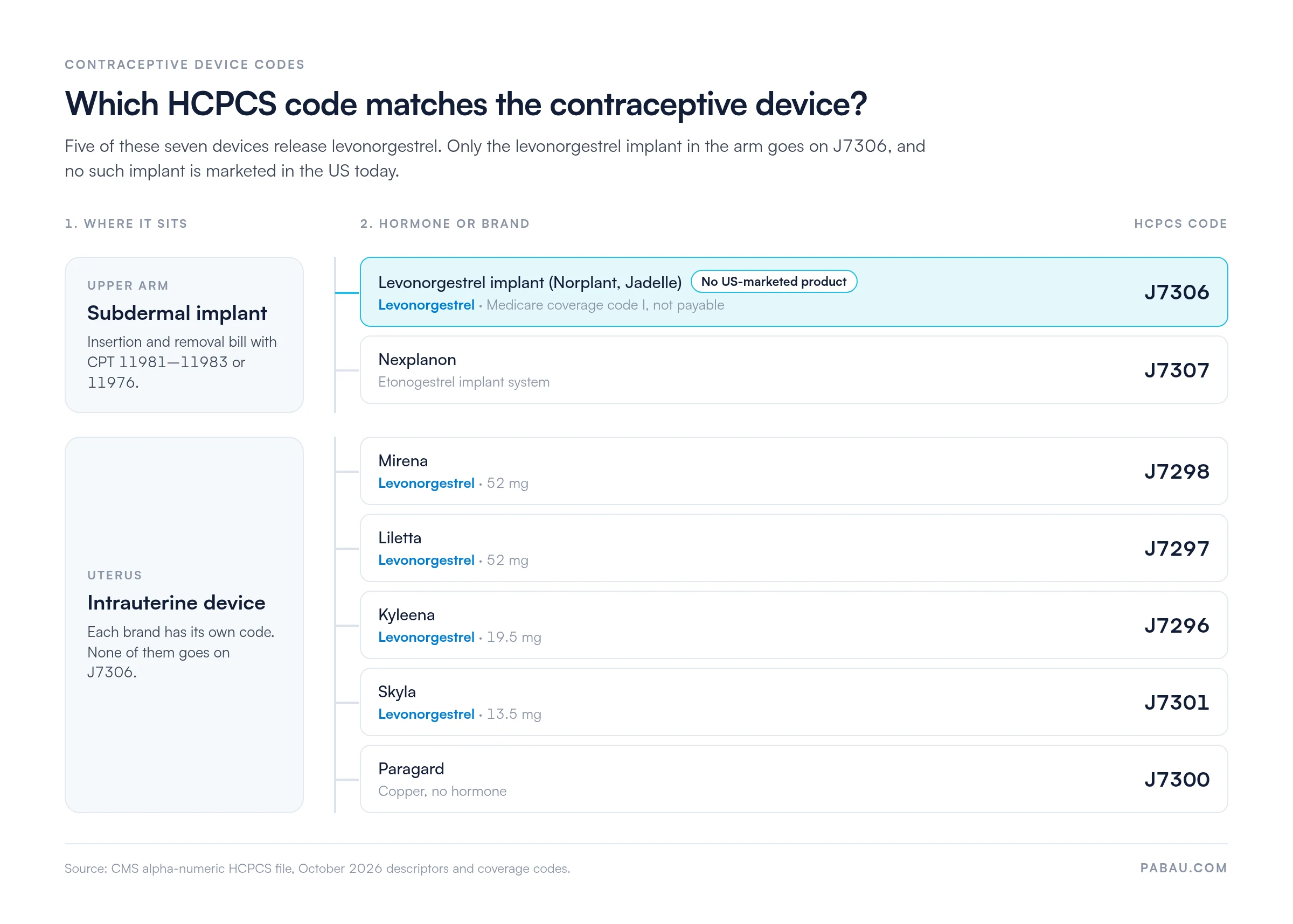
Read the code off the device packaging and the procedure note. A levonorgestrel IUD never goes on J7306. Nexplanon belongs on J7307, because its hormone is etonogestrel.
J7306 reports only the implant system. The insertion or removal is a separate procedure, reported with a CPT code from the integumentary section, such as 11981 for insertion. The IUD procedure codes 58300 and 58301 do not apply to an implant in the arm.
CPT 11976 stayed in the code set to report removal of Norplant capsules, as AAPC explains. A removal-only visit carries no supply code, because the practice supplies no device.
The Reproductive Health Access Project implant coding sheet lists modifier 25 for a separately identifiable E/M service on the same day. It lists modifier 51 for multiple procedures in one session, such as an IUD removal plus an implant insertion.
Before any J7306 line goes out, work through these checks. Each one either confirms the code or points you to the right one.
Search your superbill templates and charge master for J7306 once a year. If it is still mapped to a hormonal IUD or to Nexplanon, fix the mapping before the next claim goes out.
CMS assigns J7306 coverage code I, which means not payable by Medicare. Its pricing indicator is 00, so Part B sets no separate price for it. CMS gives J7307 the same coverage code.
Medicare Advantage plans set their own supplemental benefits, so check the individual plan before billing. Medicaid programs set their own contraceptive coverage, fee schedules and NDC rules, which vary by state.
Most non-grandfathered commercial plans must cover FDA-approved contraceptives without cost sharing under the Affordable Care Act. That rule covers the method, not a specific billing code, so confirm the plan still recognizes J7306.
Prior authorization rules also vary by payer and plan type. Where a plan requires it, submit the request before the procedure, because most payers will not approve it after the fact.
Most J7306 denials trace back to a code that doesn’t match the device or the payer’s coverage. Logging each root cause across claims shows which superbill template keeps producing the same denial.
Our guide to medical billing denial codes explains each adjustment reason above and how it applies to other J-code claims.
Every implant claim needs a supporting ICD-10-CM code. Since October 2016, ICD-10-CM has carried implant-specific Z30 codes, so the IUD codes in the Z30.43 subcategory no longer belong on an implant claim. A check, removal or reinsertion goes on Z30.46, and a first insertion goes on Z30.017.
Payer policies differ on which diagnosis codes they accept with each procedure. Check the payer’s coverage policy before submitting, especially for a removal-and-reinsertion visit.
The chart has to support the claim on the day it is billed. Sound medical billing compliance starts with these elements for any contraceptive implant visit.
Many practices still bill contraceptive visits from superbills built years ago. A stale mapping, such as J7306 for a hormonal IUD, then repeats on every claim until a denial exposes it.
Pabau, the practice management platform we build, records the device behind each charge. Stock carries a batch number and an expiry date, and the batch is logged against the patient and the appointment. Your biller can then check the HCPCS line against the device placed at that visit.
US practices send claims through Pabau’s claims management software, which files CMS-1500 and 837P claims through Claim.MD. Eligibility checks and ERA remittances come back to the same record. Prior authorization codes, dates and sessions sit on the patient’s case, with a warning when one is missing.

Pabau logs the device batch against each appointment and sends US claims through Claim.MD. Your implant and IUD lines then match the device you placed.

J7306 is a valid code with no current US product behind it. Medicare won’t pay for it, and the levonorgestrel IUDs and Nexplanon each have their own codes.
Treat any J7306 line as a prompt to recheck the visit. Confirm the device, pair the right CPT and Z30 code, and fix the template that produced the line. That way one stale mapping stops at one claim. Book a demo to see how Pabau ties each contraceptive claim to the device recorded at the visit.

Billing Nexplanon instead? HCPCS code J7307 is the code reference for the etonogestrel implant kit.
Placing a hormonal IUD? HCPCS code J7298 is the code reference for Mirena, the 52 mg levonorgestrel IUD.
Placing a copper IUD? HCPCS code J7300 is the code reference for Paragard.
Need a full framework for managing claim denials? Denial management in healthcare covers root-cause analysis, appeal workflows, and tracking strategies for OB/GYN and primary care billing teams.
Building a compliant billing operation? Medical billing compliance outlines the documentation standards, audit triggers, and internal controls that apply to physician-administered drug claims.
HCPCS Code J7306 reports a levonorgestrel (contraceptive) implant system, including implants and supplies. It describes a subdermal implant in the arm, not an intrauterine device.
No. Mirena is a levonorgestrel IUD and is billed with J7298. Liletta uses J7297, Kyleena uses J7296 and Skyla uses J7301.
J7306 reports a levonorgestrel implant system, and J7307 reports an etonogestrel implant system. Nexplanon is an etonogestrel implant, so it is billed with J7307.
No. CMS assigns J7306 coverage code I, which means not payable by Medicare, and pricing indicator 00. Medicare Advantage plans may differ, so check the individual plan.
Use 11981 for insertion, 11982 for removal and 11983 for removal with reinsertion of a rod implant. Removal of older Norplant capsules uses 11976.
Yes. J7306 has been active since January 1, 2006, and it appears in the October 2026 CMS HCPCS file. No levonorgestrel implant is currently marketed in the United States, though.