HCPCS code J3473: Billing guide for recombinant hyaluronidase (Hylenex)
HCPCS code J3473: Official descriptor and drug overview HCPCS code J3473 is the ...

Last Updated: Nov 3, 2026
J2360 is the HCPCS Level II code for injection, orphenadrine citrate, up to 60 mg. It reports the drug supplied for an intravenous or intramuscular dose of this muscle relaxant, billed in 60 mg units.
The code sits in the J-series for drugs administered other than oral method. It is billed with a separate CPT administration code, and Medicaid and many commercial payers also require the NDC.
Let Pabau's smart automation suggest the right codes, reduce claim denials, and keep your practice compliant—effortlessly.
Automate repetitive tasks and focus on what matters most—your patients.
Reduce coding errors and ensure compliance with the latest regulations.
Clean claims, fewer denials, and faster reimbursements.
Powerful insights and reporting to help your practice thrive.
HIPAA compliant SOC 2 certified GDPR-compliant Trusted by 4,000+ clinics worldwide

HCPCS Code J2360 covers orphenadrine citrate injection, up to 60 mg per billing unit, given by the IV or IM route. Oral formulations are excluded.
One unit equals up to 60 mg, so a dose above 60 mg bills as additional units.
Medicaid and many commercial payers require an 11-digit NDC on J2360 claims, while Medicare Part B does not generally ask for one.
Pabau, the practice management platform we build, scrubs each claim for missing or invalid details before it reaches the payer.
HCPCS Code J2360 is the Level II code for an injection of orphenadrine citrate, up to 60 mg.
The Centers for Medicare and Medicaid Services (CMS) maintains it. You bill one unit for each 60 mg given, alongside a separate CPT code for the injection itself.
According to CMS’s HCPCS overview, the J-series covers drugs administered other than oral method. Injectable orphenadrine citrate, given by IV or IM injection, sits squarely in that range.
J2360 covers one drug in one form: injectable orphenadrine citrate, billed in 60 mg units. Anything outside that scope needs a different code.
Covered under J2360:
Excluded from J2360:
Every J2360 claim must be backed by a medical record that documents the administration in full. A claim with a clean NDC and correct units can still be recouped in a post-payment audit if the chart note is missing key elements.
The medical record must include all of the following before submitting the claim:
Billing J2360 correctly means getting the unit count, the paired CPT administration code and any modifiers right at the same time. An error in any one of them can lead to a denial or a recoupment request. The breakdown below shows how those pieces fit together with the NDC and the diagnosis on a single claim.
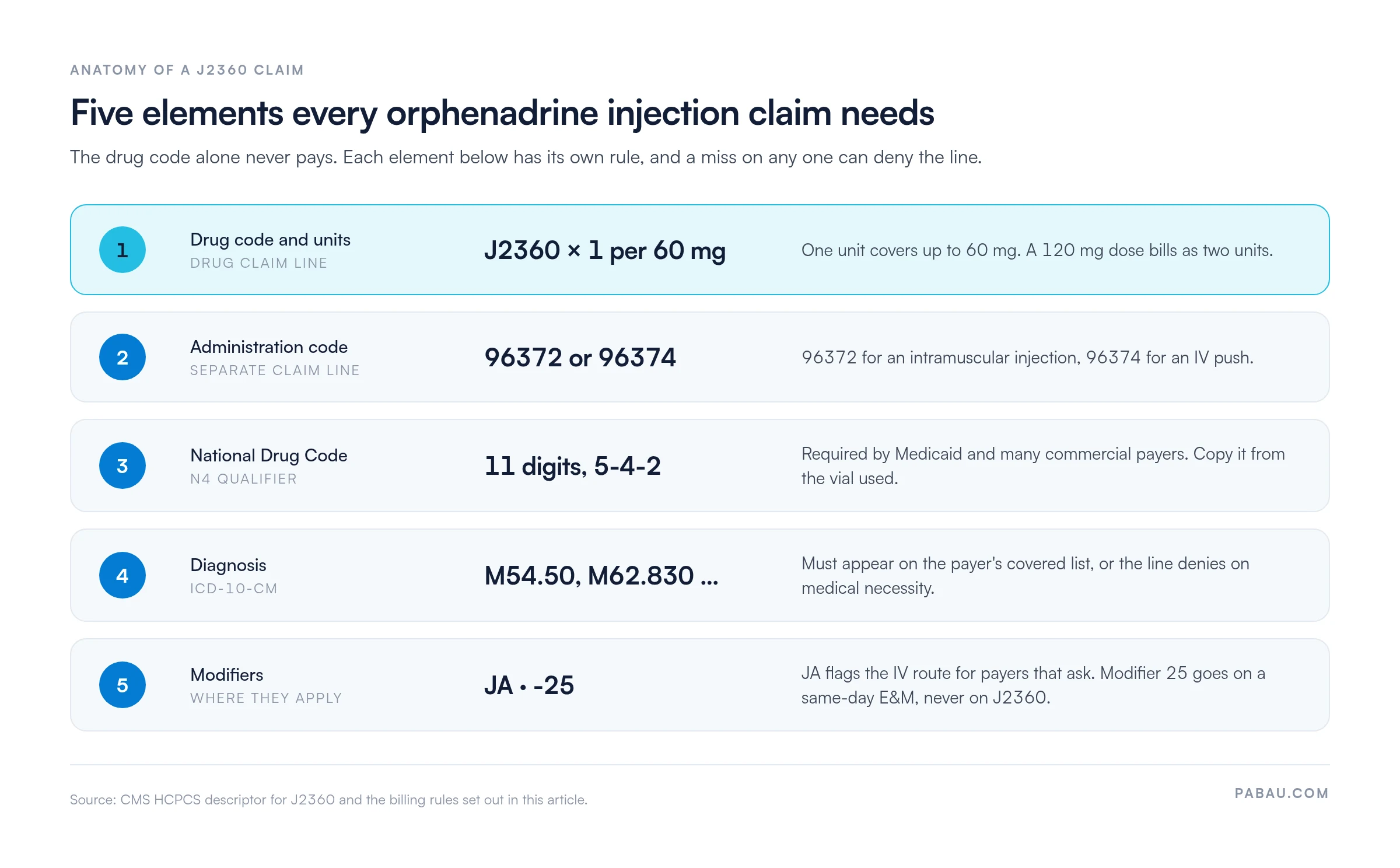
One unit of J2360 equals up to 60 mg. The standard 60 mg/2 mL vial maps to exactly one billable unit. If the order calls for a higher dose, bill additional units. For example, a 120 mg dose bills as two units of J2360.
The J2360 code covers the drug only, so a separate CPT administration code must accompany it on the claim. The route decides which one: an intramuscular injection pairs with CPT 96372, and an IV push pairs with CPT 96374.
Note: National Correct Coding Initiative (NCCI) bundling edits can change quarterly. Before submitting, verify that the administration code and J2360 are not bundled under the current NCCI edits. The AAPC HCPCS code lookup lists current modifier indicators that signal whether an edit can be bypassed.
The National Drug Code (NDC) is a required field on many J2360 claims. Medicaid requires it so states can collect manufacturer drug rebates. Many commercial payers require it too, while Medicare Part B does not generally ask for one. Where a payer requires the NDC, a missing one rejects the claim before adjudication begins.
The NDC must be reported in 11-digit format (5-4-2 segments, e.g. 00069-3145-02). Claim forms handle it differently depending on submission method:
To confirm whether a payer needs the NDC for J2360, check that payer’s drug billing policy. For Medicaid claims, your state program’s NDC-to-HCPCS crosswalk shows which NDCs bill under the code. Recheck both when onboarding a new drug or when a supply change brings a new NDC into use. Practices billing several injectable drugs can make NDC capture a required step in their medical billing workflow.
Pull the NDC from the vial label used for each patient encounter, not from your drug reference sheet. When a supplier ships a new lot, the NDC often changes. Billing the old NDC against a different lot can trigger a crosswalk mismatch and a denial. Train staff to photograph or scan the vial label at the point of administration.
Every J2360 claim requires at least one ICD-10-CM diagnosis code that establishes medical necessity for a skeletal muscle relaxant injection. Payers check the reported diagnosis against their Local Coverage Determination (LCD) policies. If the diagnosis is not on the covered list, the claim denies on medical necessity, however accurately the drug code and units were billed.
Note: The retired code M54.5 (low back pain) was replaced by M54.50, M54.51, and M54.59 effective October 1, 2021. Claims still carrying M54.5 will reject on code validity. Verify the current status of any diagnosis code in the CDC/NCHS ICD-10-CM web tool before billing.
Medicare Part B covers orphenadrine citrate injection under its drug benefit. The injection must be given incident-to a physician’s professional service and meet medical necessity criteria. CMS reimburses J2360 on an ASP-plus-6% basis. The allowable equals the drug’s Average Sales Price for the quarter, plus a 6% add-on for handling and overhead.
ASP-based rates update quarterly, and CMS publishes the current file on its ASP Drug Pricing page on cms.gov. Avoid cached rate sheets from prior quarters, because the allowable can shift between publication cycles. Check the file for the current period before quoting any reimbursement figure to clinical or finance staff.
Medicare traditionally does not require prior authorization (PA) for J2360. Commercial payers and Medicaid managed care organizations vary widely, though. Some require PA for any scheduled muscle-relaxant injection, others only after a dose in the previous 30 days, and others only above a set dose.
Before the first administration, check the payer’s current policy by calling the provider services line or using an eligibility and benefits verification tool. When PA is required, the authorization request typically needs to include:
Turnaround times for standard PA requests range from 24 to 72 hours across most commercial plans. Urgent requests submitted with supporting clinical documentation typically resolve within 24 hours. Record the authorization number in the patient’s billing record and include it in Field 23 of the CMS-1500 before submitting the claim.
Pair the authorization with an insurance eligibility verification check before the visit. That way coverage and the PA requirement are both settled before the vial is opened.
Under the ASP+6% methodology, the Medicare allowable for J2360 is calculated from CMS’s quarterly ASP file and applies across all Medicare Administrative Contractor (MAC) jurisdictions. The 6% add-on is already included in the fee schedule amount, so practices do not add it separately. Patient cost-sharing is 20% of the Medicare allowable after the Part B deductible is met.
Injectable orphenadrine citrate has seen periodic supply and availability changes, so verify that a current NDC-bearing product is available before billing this rate. If the drug is unavailable and a therapeutic alternative is used, a different J-code or the unlisted code J3490 may apply. Confirm with the prescriber before submitting.
J2360 denials follow predictable patterns, so billing staff can fix root causes rather than chase individual claims. Each rejection comes back with an adjustment reason code, which you can look up in our guide to denial codes for billers.
Practices with high J-code volume benefit from a structured denial management workflow that sorts rejections by root cause and tracks resolution rates. Without one, the same NDC or unit errors repeat across dozens of claims before anyone spots the pattern.
Orphenadrine citrate is one of several injectable skeletal muscle relaxants with dedicated J-codes. Selecting the wrong code is easy when the chart says “muscle relaxant injection” without naming the drug.
The most damaging substitution is J3490 in place of J2360. Billing an unlisted drug code when a specific code exists is a coding error that can trigger a payer audit. J3490 is reserved for drugs with no code of their own, and orphenadrine citrate has one. When a chart names a drug you can’t place, check the PGM Billing HCPCS lookup tool before reaching for J3490.
When the chart note says ‘muscle relaxant injection’ without naming the drug, do not assume J2360. Return the record to the clinical team for clarification before billing. Coders who guess at the drug identity risk upcoding or downcoding, and both carry compliance exposure. A one-day hold on claim submission is always preferable to a recoupment request six months later.
In many practices, a J2360 claim is still assembled by hand. The nurse charts the dose, someone copies the NDC off the vial, and a biller keys units, route and diagnosis into a separate system. Each handoff is a chance for a unit mismatch or a blank NDC field.
Pabau keeps the encounter and the claim in one record. Its claims software for practices scrubs each claim for missing or invalid details before submission. A flagged claim links straight to the field that needs correcting. Prior authorizations are stored as cases and attached at booking, so the authorization number carries through to the claim.
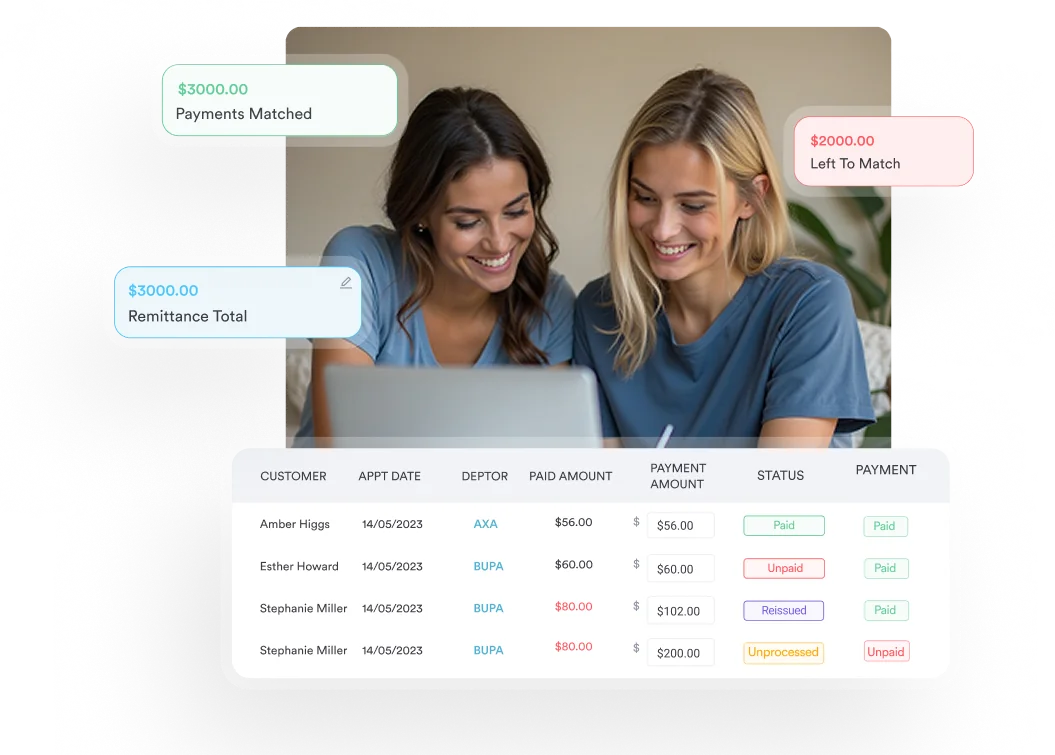
When a payer does reject a claim, Pabau flags it as needing action and shows the reason. Your billing team corrects and resubmits it while the encounter is fresh, rather than rediscovering it at month end.

Pabau scrubs every claim for missing or invalid details before submission and flags rejections with the reason attached, so drug claims get fixed fast.

J2360 itself is rarely the problem. The claims that fail are the ones where the NDC, units, route and diagnosis were pieced together from memory after the visit.
So move the checks upstream. Photograph the vial label at the point of care and count units from the charted dose. Confirm the payer’s NDC and authorization rules before the patient is booked. That costs a minute of extra charting per injection, which is far cheaper than reworking a denial months later.
Book a demo to see how Pabau keeps the encounter and the J2360 claim in one record, so fewer drug claims come back unpaid.

Need a structured medical billing workflow? What is medical billing walks through the end-to-end revenue cycle process for healthcare practices.
Struggling with repeated claim rejections? Denial management in healthcare covers how to categorize, track, and systematically reduce denial rates.
Want to understand the 837P transaction standard? 837 file guide explains how electronic claim files are structured and submitted to payers.
HCPCS Code J2360 is the billing code for injection of orphenadrine citrate, up to 60 mg, given by the intravenous or intramuscular route. It bills the drug component of a muscle relaxant injection in outpatient and office settings. Submit it alongside a separate CPT administration code for the injection service itself.
One unit of J2360 covers up to 60 mg of orphenadrine citrate. If the documented dose exceeds 60 mg, bill additional units, so a 120 mg dose bills as two units. Always reconcile billed units against the milligram dose in the chart note before submitting.
Medicaid requires an 11-digit NDC on J2360 claims, and so do many commercial payers. Medicare Part B does not generally require one. Where it is required, report it with the N4 qualifier in 5-4-2 format (e.g. 00069-3145-02). Pull the NDC from the vial used, not from a reference list, as lot-specific NDCs can differ from the product NDC.
Medicare traditionally does not require prior authorization for J2360. Commercial payers and Medicaid managed care plans vary, however. Some require PA for any scheduled muscle-relaxant injection, others only under specific clinical conditions. Verify the individual payer’s current policy before each administration to avoid a retroactive denial.
The most frequent triggers are a missing or badly formatted NDC, units that don’t match the documented dose, and an unsupported ICD-10 diagnosis code. A missing prior authorization number is another. So is billing J2360 with a same-day E&M code that lacks modifier -25. Capturing the NDC at the point of care removes the most common single denial reason.
J2360 is specific to orphenadrine citrate, up to 60 mg. Adjacent codes cover different drugs. J2800 covers methocarbamol (up to 10 mL, a volume-based unit), and J3490 is the unlisted drug code used only when no specific J-code applies. Never substitute J3490 for J2360 when a specific code exists. Doing so flags the claim for manual review and may trigger a payer audit.