CCSD Code L8621: Ultrasound-guided foam sclerotherapy
What CCSD Code L8621 covers CCSD Code L8621 describes ultrasound-guided foam scl...

Last Updated: Nov 3, 2026
J1726 is the HCPCS Level II code for injection, hydroxyprogesterone caproate, (Makena), 10 mg. It bills at one unit per 10 mg, so a standard 250 mg intramuscular dose is reported as 25 units.
Makena was withdrawn from the US market in April 2023, but J1726 is still an active code. Coverage now depends on each payer's policy, and NDC reporting is stricter than when Makena was on the market. Other hydroxyprogesterone caproate products bill under J1729, not J1726.
Let Pabau's smart automation suggest the right codes, reduce claim denials, and keep your practice compliant—effortlessly.
Automate repetitive tasks and focus on what matters most—your patients.
Reduce coding errors and ensure compliance with the latest regulations.
Clean claims, fewer denials, and faster reimbursements.
Powerful insights and reporting to help your practice thrive.
HIPAA compliant SOC 2 certified GDPR-compliant Trusted by 4,000+ clinics worldwide

J1726 bills at one unit per 10 mg, so a standard 250 mg weekly dose equals 25 units on the claim line.
Makena was withdrawn from the US market in April 2023, but J1726 remains an active code with payer-specific coverage.
J1726 is for Makena only; other hydroxyprogesterone caproate products bill under J1729, and compounded 17P never bills under J1726.
A missing or invalid 11-digit NDC with the N4 qualifier is a frequent reason J1726 claims are denied on first submission.
Pabau, our practice management software, scrubs each claim for missing details and flags claims without a prior authorization on file.
HCPCS code J1726 covers the injection of hydroxyprogesterone caproate (Makena), per the CMS HCPCS Level II code set. It bills at one unit per 10 mg. Hydroxyprogesterone caproate (17-OHPC, or 17P) is a synthetic progestogen given by intramuscular injection.
It was used to reduce the risk of recurrent preterm birth in women with a singleton pregnancy and a prior spontaneous preterm delivery. J1726 is specific to the brand-name product Makena, and other hydroxyprogesterone caproate products bill under J1729. The FDA withdrew Makena from the US market in April 2023, so verify current payer coverage before submitting a claim.
J1726 covers only the physician-administered intramuscular injection of Makena-brand hydroxyprogesterone caproate at the 250 mg/mL concentration. Coders frequently misapply the code to related but distinct products.
The FDA ordered withdrawal of Makena in April 2023 after a confirmatory clinical trial failed to demonstrate efficacy. Covis Pharma complied, removing the product from the US market. Payers have since answered the coverage question in different ways, so the same claim can pay with one plan and deny with another.
Three practical consequences affect every practice still treating patients for recurrent preterm birth prevention:
J1726 bills at one unit per 10 mg. The standard clinical dose is 250 mg IM, given weekly from 16 to 20 weeks of gestation through 36 weeks. A single encounter therefore requires 25 units on the claim line. Guidance quoting 250 units dates from J1725, which billed per 1 mg. CMS deleted J1725 on December 31, 2017 and moved billing to J1726.
A unit calculation error is a common denial reason on buy-and-bill drug codes. In the medical billing workflow, convert milligrams to units before the charge is entered, not after the remittance comes back.
Sample claim line: J1726 × 25 units | NDC: [11-digit NDC, N4 qualifier] | Diagnosis: O09.212 (second-trimester example) | Modifier: None standard | Service date: [date of injection]
Medicare and most commercial payers require an 11-digit NDC on every J1726 claim. The NDC must match the vial administered, and on a J1726 claim that is a Makena NDC. Since Makena is no longer available, many payers now reject those NDCs. Practices administering another hydroxyprogesterone caproate product report that product’s NDC under J1729, J7999 or the code the payer designates.
J1726 is a drug code only. The intramuscular administration is billed separately with CPT 96372, the code for a therapeutic, prophylactic or diagnostic subcutaneous or intramuscular injection. Both codes appear on the same claim for a physician-office administration encounter.
Check the National Correct Coding Initiative (NCCI) edits before submitting. Some payers bundle 96372 into an office visit E/M code when both are billed on the same date. If denied, verify whether a modifier 59 or XU may apply.
Bill J1726 and CPT 96372 on separate claim lines, each with the correct date of service. Grouping both codes on a single line causes parsing errors in most clearinghouse edits and returns the claim before it ever reaches the payer.
Coverage for HCPCS code J1726 has changed substantially since Makena’s withdrawal. The table reflects the general policy landscape as of this writing. Verify each payer’s current LCD or provider manual before billing. An eligibility and benefits check before each injection flags a coverage problem while the vial is still unopened.
Most Medicaid programs and the majority of commercial health plans require prior authorization before administering hydroxyprogesterone caproate. Maintaining strong medical billing compliance records is especially important for J1726. Retroactive denials are common when documentation does not match the PA criteria at the time of service.
Typical PA criteria include:
ICD-10-CM codes that establish medical necessity for a J1726 claim:
O09.21 requires correct trimester sub-classification. Submitting the parent code without a trimester sixth character is a frequent specificity error. It triggers a denial with adjustment reason code CO-11 (diagnosis inconsistent with the procedure). The same specificity rule holds for the diagnoses paired with IVF CPT codes.
With Makena off the market, the J1726 versus compounded-17P coding question is now the central billing decision for practices that continue offering this therapy. The product and the payer decide the answer. J1726 is for Makena only, while J1729 covers other hydroxyprogesterone caproate products at the same 10 mg unit.
J1729 is the not-otherwise-specified code for hydroxyprogesterone caproate, and some payers direct non-Makena product there. J7999 is the not-otherwise-classified injectable drug code, used when no specific HCPCS code applies. Some state Medicaid plans have issued provider bulletins on compounded hydroxyprogesterone. Check current provider manuals rather than relying on guidance issued before 2023.
Medicare reimburses physician-administered Part B drugs at the Average Sales Price plus 6% (ASP+6%), updated quarterly by CMS. Check the CMS ASP Drug Pricing Files for the most current quarterly rate. Figures in search results and articles, including this one, are often outdated within weeks of a quarterly update.
With no FDA-approved product on the market, CMS may carry J1726 at a zero or near-zero ASP when no manufacturer reports sales data. Verify the rate in the current quarter’s ASP Drug Pricing File before assuming a reimbursement amount.
These six denials recur on J1726 remittance advice, and each has a documented fix. Our guide to denial codes explains each adjustment reason code in more depth.
Every denial in the table maps to a check you can run before submission. Run them in the order a biller meets them, starting with the product in the vial.
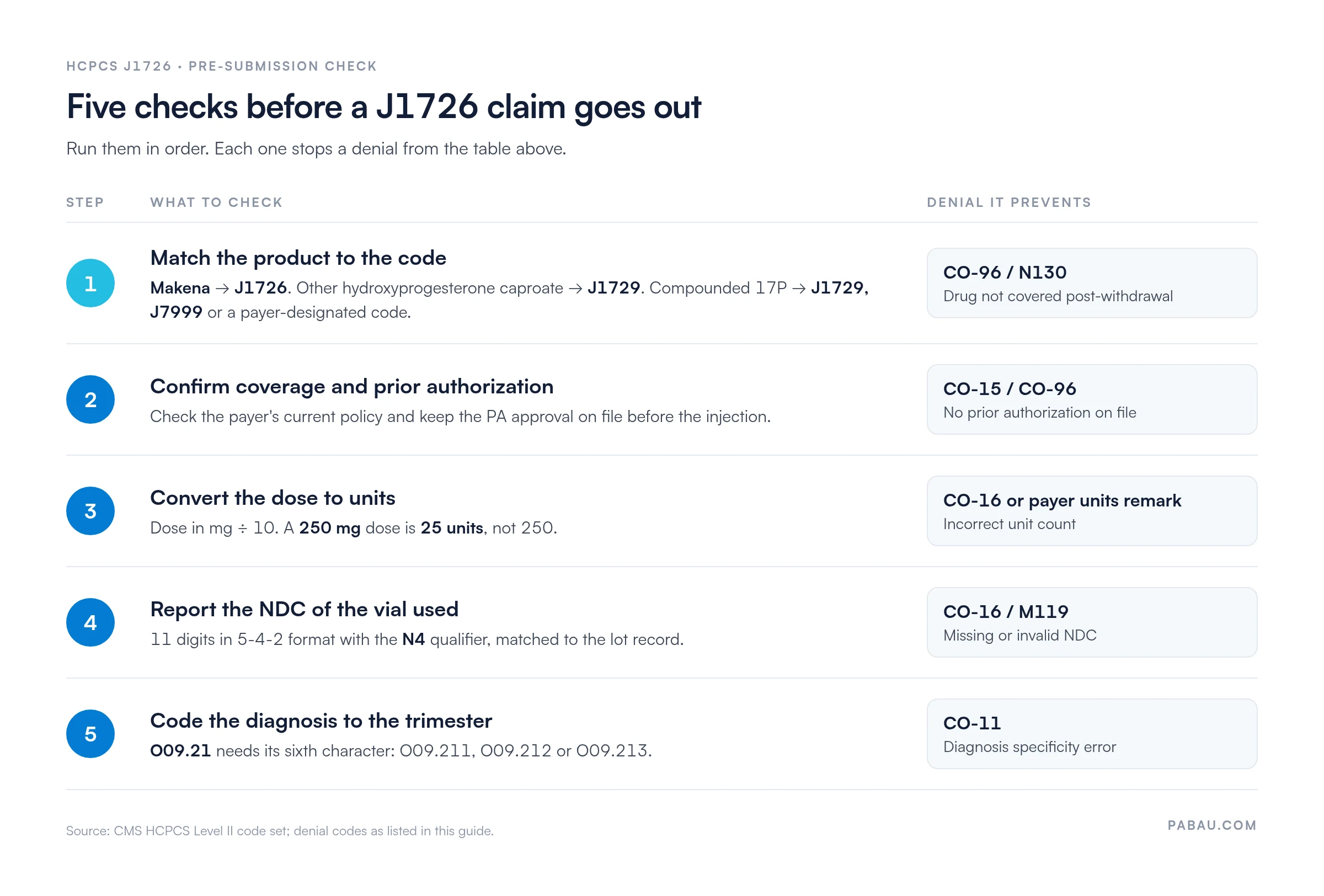
Payers audit J1726 claims because the drug is expensive and its withdrawal has raised questions about medical necessity. A complete injection record protects the practice if a claim is selected for review. The record for each injection encounter should contain the following:
Documenting the lot number alongside the NDC matters more post-withdrawal. If a payer questions whether the drug was FDA-approved or compounded, the lot number is traceable evidence. Coders should cross-check the NDC on the claim against the lot-number record in the patient chart before submitting.
The J1726 denials above all trace back to a field that could have been checked before submission. Catching it after the remittance arrives means rework, an appeal and a delayed payment.
Pabau’s claims management software scrubs each claim for missing or invalid details before it leaves for the clearinghouse. Prior authorizations are stored as cases, so a claim without one on file gets flagged. Eligibility checks run through Claim.MD before the visit.
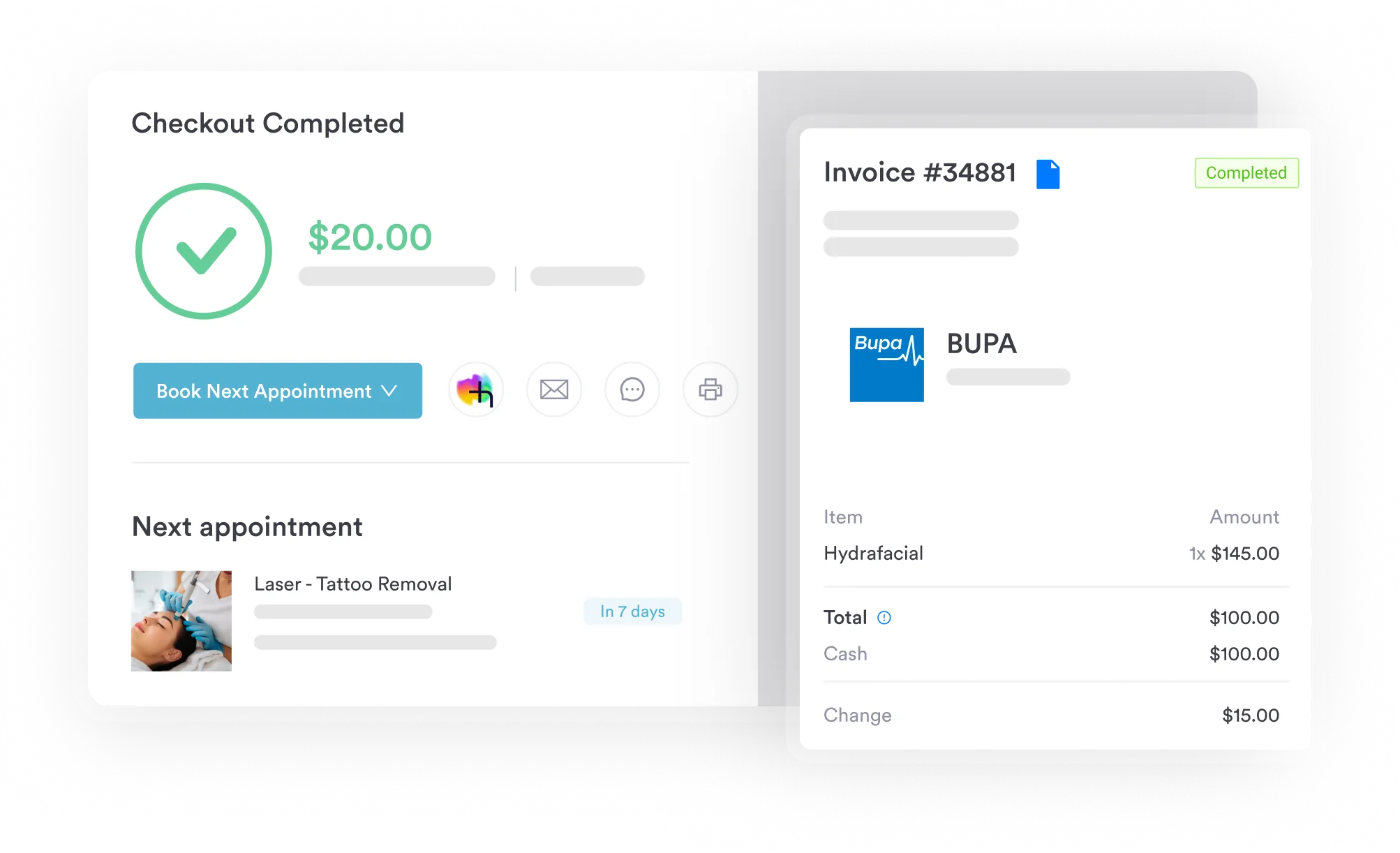
When a payer still rejects a claim, Pabau marks it as needing action and shows the rejection reason. Your team corrects the line and resubmits without digging through the remittance file.

Pabau scrubs each claim for missing or invalid details and flags claims without an authorization on file. Your team fixes J1726 errors before the payer sees them.

Treat every J1726 claim as a coverage question first and a coding question second. The unit math never changes: 10 mg per unit, so 250 mg is 25 units. Whether a payer still accepts the code is what changed in April 2023.
If the vial is not Makena, J1726 is the wrong code, whatever a payer paid before the withdrawal. Confirm the product, the NDC and the payer’s written policy before the injection, not after the denial.
Pabau helps your team catch missing NDCs and prior authorizations before submission, and track denial patterns by payer. Book a demo to see how it handles drug code billing for your OB/GYN practice.

Need to understand denial coding patterns? Medical billing fundamentals explains how claim lines, modifiers, and remittance advice codes connect across the revenue cycle.
Billing the injection itself? CPT code 96372 covers the administration code billed alongside a J1726 drug line.
Billing a compounded or unlisted injectable? HCPCS code J7999 covers the not-otherwise-classified drug code that some payers direct compounded 17P to.
Billing for other reproductive health procedures? IVF and fertility procedure codes covers CPT coding for assisted reproduction services.
HCPCS code J1726 covers the intramuscular injection of hydroxyprogesterone caproate (Makena). It bills at one unit per 10 mg, so a 250 mg dose is 25 units. Makena was the brand-name formulation for reducing recurrent preterm birth risk; other hydroxyprogesterone caproate products bill under J1729. Since Makena was withdrawn from the US market in April 2023, the code remains listed but coverage depends on each payer’s current local coverage determination.
Report the 11-digit NDC of the vial administered. Use the N4 qualifier on the CMS-1500, or the LIN segment qualifier on the 837P electronic claim. On a J1726 claim that is a Makena NDC, and many payers now reject them because the product was withdrawn in April 2023. A non-Makena or compounded product bills under J1729, J7999 or a payer-designated code, with that product’s own NDC. A missing or legacy NDC is a frequent cause of denials.
Yes, J1726 is still an active HCPCS code, but whether a claim will be reimbursed depends entirely on the payer. Medicare Part B coverage has become uncertain post-withdrawal; most Medicaid programs and commercial plans have updated their LCDs or medical policies. Verify the current policy for each payer before administering the drug, and do not assume prior coverage policies still apply.
J1726 applies specifically to Makena, billed per 10 mg. Other hydroxyprogesterone caproate products bill under J1729 (not otherwise specified, 10 mg). Compounded hydroxyprogesterone is not billable under J1726. Use J1729, J7999 (not-otherwise-classified injectable drug) or a payer-designated code. The distinction matters because a claim for compounded 17P submitted under J1726 will generally be denied for a product mismatch. Check the AAPC HCPCS code lookup and your payer’s LCD to confirm which code applies in each situation.
Yes, prior authorization is required by most Medicaid programs and the majority of commercial health plans for J1726. Medicare Advantage plans also commonly require PA. Fee-for-service Medicare prior authorization requirements for Part B drugs vary by MAC; check the applicable LCD. If the drug is administered without a PA on file, expect a retroactive denial.