CPT code 93503: Swan-Ganz catheter billing and modifiers
CPT code 93503: Official descriptor and procedure overview In the AMA CPT code s...

Last Updated: Oct 23, 2026
J1380 is the HCPCS Level II code for injection, estradiol valerate, up to 10 mg. It covers intramuscular estradiol valerate, sold as Delestrogen, for menopause symptoms, hypoestrogenism, gender-affirming hormone therapy and palliative prostate cancer care.
One unit equals up to 10 mg, so a 20 mg dose is billed as 2 units. Medicaid and many commercial payers also require the 11-digit NDC on the claim line.
Let Pabau's smart automation suggest the right codes, reduce claim denials, and keep your practice compliant—effortlessly.
Automate repetitive tasks and focus on what matters most—your patients.
Reduce coding errors and ensure compliance with the latest regulations.
Clean claims, fewer denials, and faster reimbursements.
Powerful insights and reporting to help your practice thrive.
HIPAA compliant SOC 2 certified GDPR-compliant Trusted by 4,000+ clinics worldwide

HCPCS Code J1380 covers intramuscular injection of estradiol valerate (brand name Delestrogen), billed per unit of up to 10 mg.
One billing unit equals up to 10 mg, so a 20 mg dose is billed as 2 units.
NDC reporting is required by Medicaid and many commercial payers, and by Medicare only for dual-eligible crossover claims.
Medicare Part B pays J1380 at the average sales price plus 6%, and the rate updates every quarter.
Pabau’s claims management software keeps the treatment note, stock record and claim in one patient file, so units and codes match.
HCPCS Code J1380 is a Level II HCPCS drug code that describes injection, estradiol valerate, up to 10 mg, given by intramuscular route. The Centers for Medicare and Medicaid Services (CMS) maintains HCPCS Level II codes, including J1380, in its annual code set release.
Estradiol valerate is a prodrug of 17β-estradiol. Under the brand name Delestrogen, it is supplied as an oil-based injectable in 10 mg/mL, 20 mg/mL and 40 mg/mL strengths. J1380 applies only to the valerate ester given intramuscularly, not to oral tablets, patches, gels or other estrogen formulations.
J1380 covers only provider-administered intramuscular injections of estradiol valerate. Several formulations that look similar to coders fall outside this code.
The most common coverage confusion is between J1380 and J1000. J1000 is estradiol cypionate, and J1380 is estradiol valerate. The two drugs share the same estradiol base but use different ester groups, release at different rates and carry different NDC numbers. Billing J1000 when Delestrogen was given, or the reverse, is a coding error to correct before the claim goes out.
Medical necessity for J1380 is established through the diagnosis code on the claim. Payers use the ICD-10-CM code to decide whether the drug is indicated for the patient’s condition. The table below maps the most common clinical indications to their accepted diagnosis codes.
Always verify accepted diagnosis codes against the Medicare Administrative Contractor (MAC) Local Coverage Determination (LCD) for hormone therapy in your jurisdiction. Codes for gender-affirming care have changed across several fiscal year releases, so confirm that your code set is current.
Correct claim setup for J1380 takes three steps. Calculate the units, report the NDC in the proper format, and pair the drug code with the right administration code. Missing any one of them is enough to trigger a denial or an audit flag. Claims management software that supports injectable drug billing cuts the chance of a manual entry error on each element. A clean claim submission is always faster than working a denial.
The diagram below puts all five claim elements on one page, including the modifiers that usually stay off a Delestrogen claim.
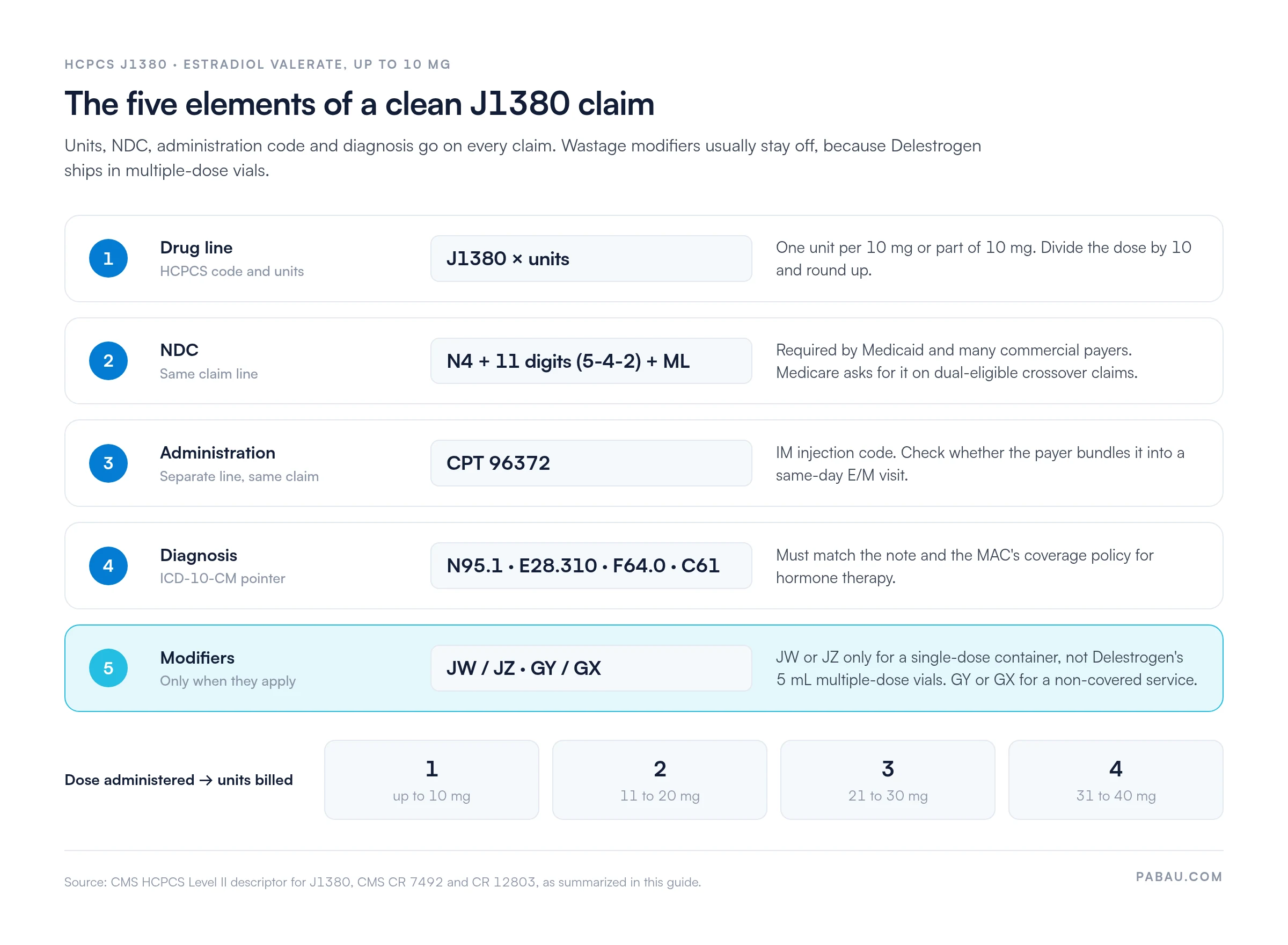
One billing unit of J1380 equals up to 10 mg of estradiol valerate. Bill units by dividing the administered dose by 10 and rounding up to the nearest whole number.
NDC reporting is required by Medicaid and many commercial payers, and by Medicare for dual-eligible crossover claims (CR 7492). The Medicaid requirement comes from the Deficit Reduction Act of 2005. Report the NDC in 11-digit format (5-4-2 structure) on the claim line with qualifier N4. Follow it with the quantity dispensed and the unit of measure, typically ML for milliliters.
A missing or incorrectly formatted NDC is one of the most common administrative denials on J-code claims.
96372 is the CPT code for a therapeutic, prophylactic or diagnostic injection given subcutaneously or intramuscularly. It’s billed alongside J1380 in an office setting and must appear on the same claim as the drug code. Some payers bundle it into a same-day E/M visit, so confirm the payer’s bundling policy before submitting both.
Medicare Part B reimburses J1380 under the Average Sales Price (ASP) methodology. The payment amount equals ASP plus 6% in physician office settings. Because ASP comes from manufacturer-reported sales data, the J1380 rate updates every quarter. Verify the current rate in the CMS quarterly ASP Drug Pricing File before submitting claims or calculating expected reimbursement.
For commercial payers, the allowable amount is contract-specific and not publicly available. Most commercial plans reimburse injectable drugs at a percentage of Average Wholesale Price (AWP) or at a negotiated flat rate per NDC. The AAPC’s HCPCS code lookup gives code-level detail that helps when querying payer fee schedules.
Pull the CMS ASP drug pricing file each quarter and cross-reference J1380 payment amounts before your monthly billing cycle. Rates change on January 1, April 1, July 1 and October 1. An outdated rate in your fee schedule leads to underbilling or balance-billing errors.
Prior authorization (PA) requirements for J1380 vary by payer, plan type and clinical indication. Medicare Part B generally does not require PA for J1380 billed with a covered diagnosis, but Medicare Advantage plans may set their own rules. Most commercial payers require PA for ongoing hormone therapy.
Gender-affirming hormone therapy claims carry a heavier PA burden. Some plans want step therapy documentation, behavioral health letters of support, or diagnosis confirmation from a relevant specialist before they approve injectable estradiol.
Never assume a prior authorization from one plan year carries forward. Confirm the authorization is active before each injection series, especially when a patient’s plan year resets.
Four codes account for most J1380 substitution errors. Compounded preparations usually land on J3490, and the table below shows when each code applies.
Complete documentation for J1380 covers both the clinical record and the claim itself. A single missing element can trigger an audit or a denial that delays payment by weeks. A well-structured superbill that captures each required field at the point of care keeps omissions off the claim.
Most J1380 denials are preventable. Denial management workflows for J-code drug claims follow a consistent pattern. Identify the CARC reason code, correct the source error, then resubmit or appeal with supporting documentation.
JW and JZ became mandatory for single-dose containers under CR 12803 in 2023. GY and GX apply when a service is non-covered. Because Delestrogen is supplied only in 5 mL multiple-dose vials (10, 20 and 40 mg/mL), JW and JZ normally stay off a J1380 claim.
Build a standard J1380 claim template in your billing system that leaves JW and JZ off by default, since Delestrogen comes in multiple-dose vials. Add a modifier only when a single-dose product is used, or GY or GX when the service is non-covered.
Gender-affirming hormone therapy carries the most complex coverage picture of any J1380 indication. Unlike menopausal HRT, transgender HRT claims vary at the plan level, the state policy level and the payer network level at once.
The primary diagnosis code for gender-affirming estrogen therapy in MTF (male-to-female) patients is F64.0 (Transsexualism; inclusion term gender dysphoria in adolescents and adults). Some plans also accept Z87.890 (personal history of sex reassignment). Accepted codes differ by payer, so verify the preferred code with each one before submitting.
Coverage and PA rules for gender-affirming care change often in response to state legislation and insurer policy updates. Practices billing J1380 for this population should review payer policies at least once a year and assign staff to watch for mid-year changes.
Most J1380 denials start with retyping. The dose sits in the treatment note, the NDC sits on the vial, and the diagnosis sits in the chart. A biller then copies all three into a separate claims tool, one field at a time.
Pabau keeps those pieces in one patient record instead. The treatment note, the vial logged from stock, the invoice and the claim sit together. Units and diagnosis codes are checked against the same visit.
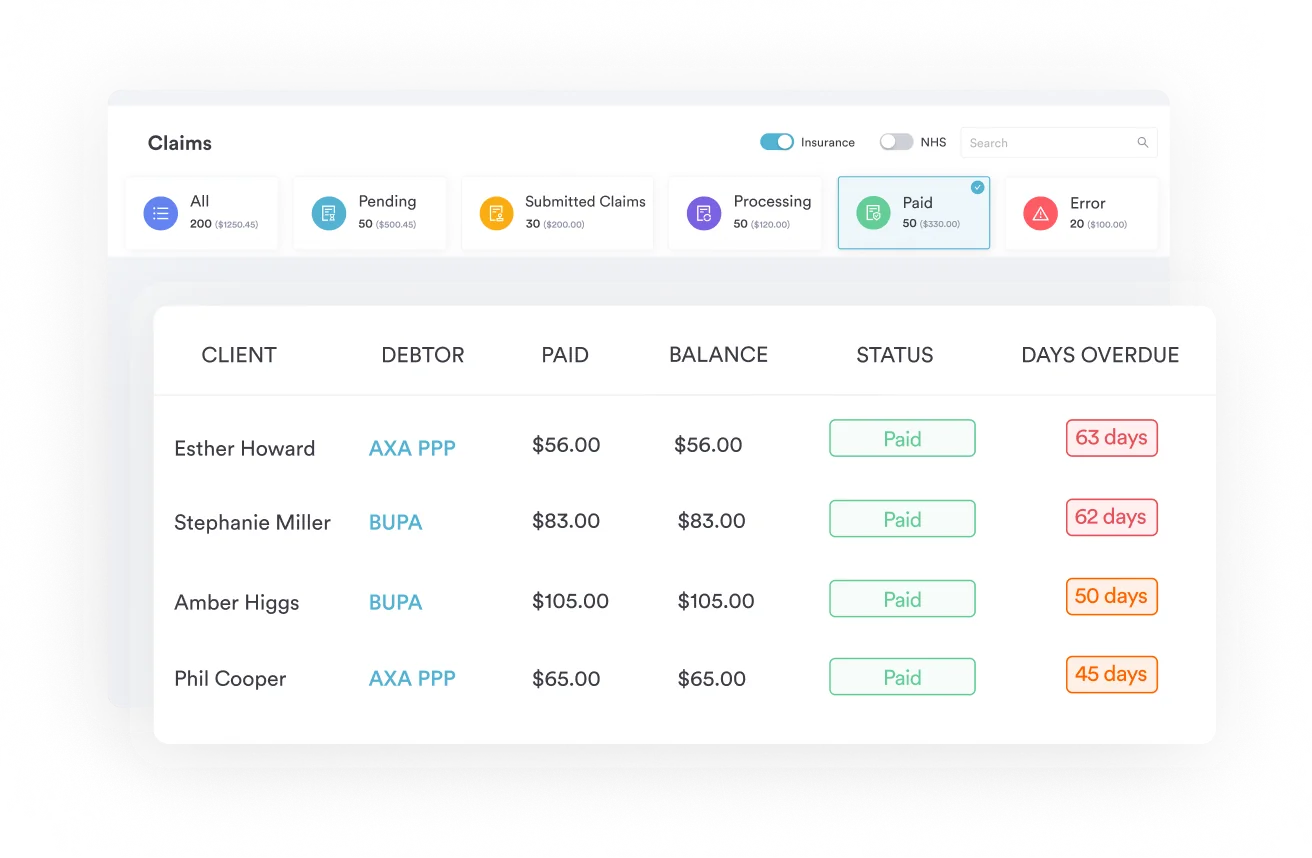
The result is fewer resubmissions. Your team works errors from one dashboard instead of chasing remittances, and the days-overdue column shows which payer is holding money longest.

Pabau keeps the treatment note, stock record and claim in one patient file, so J1380 units, NDC and diagnosis match before the claim goes out.

J1380 is a forgiving code once the setup is right. The descriptor is narrow, the unit math is simple, and Delestrogen’s multiple-dose vials keep wastage modifiers off most claims.
The risk sits in the payer rules around the code. Check NDC and prior authorization requirements before the first injection in a series, not after the first denial. For gender-affirming care, recheck coverage every plan year, because state rules and plan terms shift.
Book a demo to see how Pabau keeps dose, NDC and diagnosis in one record so your J1380 claims go out clean.

Billing estradiol cypionate instead? HCPCS code J1000 covers Depo-Estradiol units, NDC rules and the differences from J1380.
Waiting on a payer approval? The prior authorization process walks through each step from request to approval.
Need to understand denial codes on your remittance? Denial codes in medical billing explains CARC and RARC codes and how to respond to each.
Want a primer on the revenue cycle for injectable drug claims? What is revenue cycle management covers the end-to-end claim workflow from eligibility through payment posting.
HCPCS Code J1380 covers intramuscular injection of estradiol valerate (brand name Delestrogen), billed in units of up to 10 mg each. It applies only to the valerate ester given by a provider in an office or clinical setting. Oral estradiol, topical estrogen, estradiol cypionate (J1000) and compounded preparations without an FDA NDC fall outside this code.
Bill one unit of J1380 for each 10 mg, or fraction of 10 mg, of estradiol valerate administered. A 20 mg dose is 2 units, and a 40 mg dose is 4 units. Always round up to the nearest whole unit when the dose does not divide evenly by 10.
Report the 11-digit NDC of the vial you administered, with qualifier N4 on the claim line. Follow it with the quantity and unit of measure (typically ML). It is required by Medicaid and many commercial payers, and by Medicare only for dual-eligible crossover claims. Check it against the vial label before billing.
PA requirements for J1380 vary by payer. Medicare Part B generally does not require PA for covered indications, but Medicare Advantage and most commercial plans do. Gender-affirming HRT claims face the heaviest PA burden, often needing a clinical letter of support and diagnosis confirmation. Always check the plan’s requirements before the first injection.
Yes. Delestrogen is the brand name for estradiol valerate injection, and J1380 is the HCPCS code for that drug. When a provider gives Delestrogen intramuscularly, J1380 is the correct code, whether the claim names the brand or the generic.
JW and JZ apply to J1380 only when the drug comes from a single-dose container, as required under CMS Change Request 12803 since 2023. Delestrogen is supplied only in multiple-dose vials, so neither modifier normally applies. GY marks a non-covered service, and GX marks one where a voluntary ABN was issued.
CPT 96372 (therapeutic, prophylactic, or diagnostic injection, subcutaneous or intramuscular) is the standard administration code billed with J1380 in an office setting. Check the payer’s bundling policy, because some plans bundle 96372 into a same-date E/M visit and deny a separately billed administration code.