HCPCS Code G0163: Skilled nursing observation and assessment
What is HCPCS Code G0163? HCPCS Code G0163 is a deleted Level II code for skille...

Last Updated: Oct 15, 2026
J1165 is the HCPCS Level II code for injection, phenytoin sodium, per 50 mg.
HCPCS code J1165 bills injectable phenytoin sodium, and it pays per 50 mg rather than per vial. A 250 mg dose is five units, not one. Coders rarely pick the wrong J-code for phenytoin. They misread the billing unit, or they leave the waste modifier off a single-dose vial, and the line comes back denied.
Both errors cost the practice a drug it has already paid for, and both get fixed at charge capture rather than in the denial queue. The arithmetic is the place to start, followed by the two modifiers CMS expects on this code.
Let Pabau's smart automation suggest the right codes, reduce claim denials, and keep your practice compliant—effortlessly.
Automate repetitive tasks and focus on what matters most—your patients.
Reduce coding errors and ensure compliance with the latest regulations.
Clean claims, fewer denials, and faster reimbursements.
Powerful insights and reporting to help your practice thrive.
HIPAA compliant SOC 2 certified GDPR-compliant Trusted by 4,000+ clinics worldwide

HCPCS code J1165 bills injectable phenytoin sodium, and one unit means 50 mg administered.
Divide the milligrams that reached the patient by 50 to get the unit count.
J1165 sits on CMS’s single-dose container list, so each claim needs JZ or a matching JW line.
Phenytoin sodium has no approved subcutaneous route, so modifier JB never belongs on the claim.
Pabau captures the dose, route, and discarded amount at the point of care, then feeds them into the J1165 line.
J1165 describes “Injection, phenytoin sodium, per 50 mg”. It is the HCPCS Level II J-code for the drug itself, billed from a physician office, a hospital outpatient department, or an ambulatory surgical center. Giving the dose is billed separately, with a CPT administration code.
Phenytoin sodium is a hydantoin anticonvulsant, first approved in the United States in 1953. The injectable form exists for the moments when a capsule is not an option. Because the code pays per 50 mg, one administration usually fills several units on a single claim line.
Here are the administrative attributes worth checking before the claim goes out.
Two of those rows move during the year. The descriptor holds steady. The payment limit per unit is refreshed every quarter, and the code’s status is confirmed in the annual HCPCS update files. Check both against the date of service rather than last year’s fee schedule.
Divide the total milligrams administered by 50. That number is the unit count, and getting it wrong is the most consistent source of J1165 denials and underpayments.
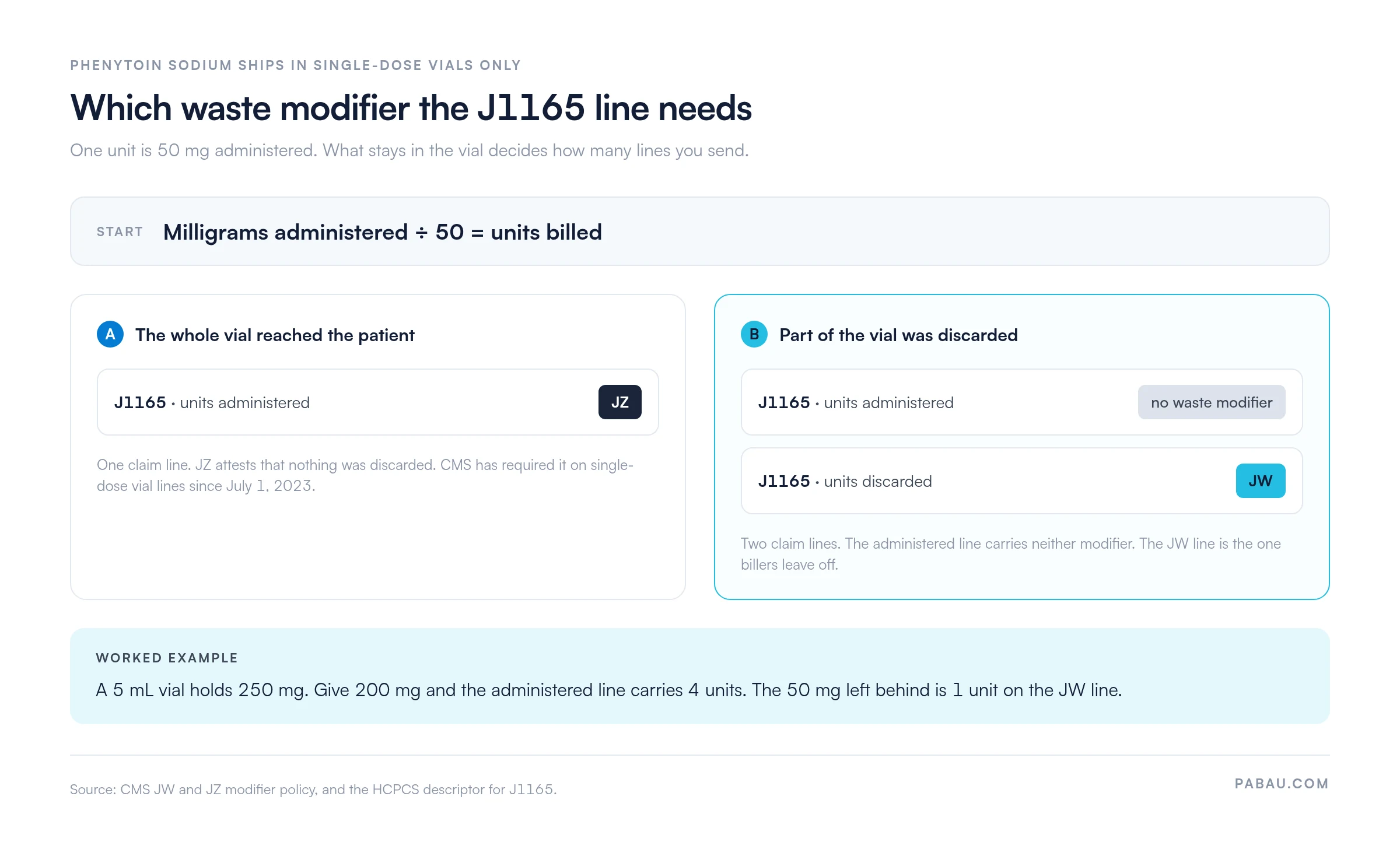
Bill the amount administered, not the amount drawn up. A 5 mL vial holds 250 mg. If 200 mg reaches the patient, the administered line carries four units. The 50 mg left in the vial is discarded drug, and it belongs on a second line with a waste modifier.
Doses that do not divide evenly are the awkward case. Give 225 mg from that same vial and the administered line cannot carry half a unit. Ask the plan how it wants the remainder handled, because commercial billing manuals differ on the rounding.
The FDA-approved labeling for phenytoin sodium injection lists two routes: intravenous and intramuscular. There is no third option, and the label’s own warnings explain why. Any billing guidance that treats a subcutaneous dose as a normal variation for this drug is describing something the label tells clinicians to avoid.
Per the FDA prescribing information, the labeled indications are:
The boxed warning caps the intravenous rate at 50 mg per minute in adults. For pediatric patients the limit is 1 to 3 mg/kg per minute, or 50 mg per minute, whichever is slower. A 10 to 15 mg/kg loading dose therefore takes roughly 20 minutes to run in a 70 kg adult. That pace has a billing consequence, because the administration is usually an infusion rather than an IV push.
The label also directs the drug into a large peripheral or central vein, through a large-gauge catheter, with a saline flush before and after. Those details belong in the note, since they are what support an infusion code later.
The label states that phenytoin sodium injection should ordinarily not be given intramuscularly, because absorption is erratic and local toxicity is a risk. It also rules the route out for status epilepticus, since peak serum levels can take up to 24 hours to arrive.
Where an intramuscular dose is genuinely appropriate, the label calls for a dose 50% greater than the oral dose to hold therapeutic levels.
The solution carries a pH of 10.0 to 12.3, with sodium hydroxide added to keep it there. That alkalinity is what damages tissue when the drug reaches somewhere other than the bloodstream. The label’s local toxicity section describes soft tissue irritation ranging from slight tenderness to extensive necrosis and sloughing.
Skin necrosis and limb ischemia have required fasciotomy, skin grafting, and in rare cases amputation. Clinicians avoid subcutaneous and perivascular delivery for that reason. So no modifier attesting a subcutaneous route can describe a compliant J1165 administration, and that matters as soon as you reach the modifier field.
J1165 takes a waste modifier, not a route modifier. The modifiers that matter here describe discarded drug, because phenytoin sodium injection ships only in single-dose vials. CMS lists J1165 on its JW and JZ modifier policy HCPCS code list, which covers codes assigned only to single-dose containers.
Every J1165 claim needs a waste answer. Report the administered units with JZ when the whole vial went in. When part of the vial was discarded, the administered units take one line and the discarded units take a second line with JW.
A claim with no waste answer at all is an easy denial and an obvious audit flag. CMS sets out the mechanics on its discarded drugs and biologicals page.
The two branches below are the whole rule, in the order a biller meets them.
The JA and JB pair belongs to dialysis billing. The CMS requirement sits in the Medicare Claims Processing Manual chapter on end-stage renal disease. It attaches to erythropoiesis-stimulating agents such as epoetin alfa and darbepoetin alfa.
Those drugs can be given either intravenously or subcutaneously, so the route changes what the payer needs to know.
Phenytoin sodium is not on that list. It is also absent from the self-administered drug exclusion articles that extend JA and JB to other products.
Its two approved routes are intravenous and intramuscular, so no modifier has an intravenous-versus-subcutaneous choice to record. Strip JA and JB out of any J1165 charge template that carries them by default.
Route still has to appear in the clinical record. It is a documentation requirement rather than a modifier requirement, and payers audit the note instead of the modifier field.
A repeat rejection on the same code usually points at one bad template rather than one unlucky claim.
Medicare Part B pays physician-administered drugs at the average sales price plus 6%. CMS refreshes ASP pricing every quarter, so the dollar amount per J1165 unit moves during the year. Sequestration then takes 2% off the payment, which puts the effective rate closer to ASP plus 4.3%.
The place-of-service code on the claim tells the payer which rule to apply. Three settings, three answers.
Check the current payment limit per unit in the CMS ASP drug pricing files for the quarter of the date of service. Then compare the payment on the remittance against that limit. An underpaid drug line shows up there long before anyone notices it in a month-end report.
In an ambulatory surgical center, the payment indicator assigned to J1165 decides how the drug gets paid. It either draws a separate payment or gets packaged into the procedure payment.
CMS publishes the indicator in the annual ASC addendum files, and new values take effect on January 1. Assuming last year’s status carried over is how a practice ends up absorbing drug cost it could have billed.
Buy-and-bill means the practice purchases phenytoin sodium, administers it in the office, and bills J1165 to recover the drug cost. It is the standard model for Medicare Part B physician-administered drugs, and it is distinct from a prescription the patient fills at a pharmacy.
Six steps, in order:
Steps two and three are where the claim is won or lost. Both happen at the bedside, minutes apart, and both are gone from memory by the time a biller opens the encounter.
Commercial coverage for J1165 is not uniform. Four differences from Medicare are worth confirming before the date of service:
So read the plan’s own coverage policy rather than assuming Medicare rules carry across. A practice billing six plans cannot keep six rulebooks in one person’s head.
Claims software for billing teams keeps each payer’s rule beside the administration record, so the biller sees both before the line goes out.
J-code errors cluster around the same few root causes. Catching them in a pre-submission edit costs far less than working the denial afterwards.
Notice how many of those start upstream of the biller. Most are settled in the charge template and the administration note, which is why a template fix outperforms a denial appeal.
Run a quarterly report on J1165 claim lines and look for two patterns. First, unit counts of 1. Second, lines carrying neither JZ nor JW. If your clinical team regularly gives 200 mg or more, single-unit submissions point to systematic under-reporting. Fix the charge capture template first, then review the prior quarter for corrected claims.
Run these five before the claim leaves the practice. Each one takes seconds, and each one maps to a denial reason you would otherwise work later.
Turn the list into a required field set on the charge ticket and it stops depending on who is on shift.
The record has to support every element of the claim. Audits of injectable drug codes go straight to one question: does the note substantiate the units billed and the route reported? Ambiguous documentation is the main driver of post-payment recoupment on J-code claims.
A J1165 claim needs the following in the chart:
Documentation captured at the point of care beats documentation reconstructed afterwards, and waste is the clearest example. Nobody remembers on Thursday how much was left in Monday’s vial.
J1165 rarely travels alone. Most phenytoin claims carry an infusion administration code beside the drug line, and CPT 96365 is the usual partner. The neighboring J-codes are also easy to transpose at the keyboard.
For lookups across the J-code series, the CMS HCPCS overview page carries the annual updates and the deleted code notices. Coders who bill injectables week to week can work through the other HCPCS Level II codes in the same format.
In most practices the phenytoin record and the phenytoin claim live in separate places. A nurse writes the dose and route in the chart. A biller reads it days later, converts milligrams into units, and guesses whether anything was discarded.
Each hand-off is a chance for the unit count or the waste modifier to drift away from what happened.
Practice management software like Pabau keeps the two together. The administration record captures the drug, the milligrams given, the route, and the discarded amount while the clinician is still with the patient.
Those values populate the J1165 line directly, so the unit arithmetic and the JZ or JW attestation come from the note rather than from memory.
Claims management in the same system then follows the line through to the payer response. When a J1165 claim is rejected, the reason sits next to the record that produced it.
The response is a correction rather than an investigation. Fewer denials reach the point where someone has to reconstruct a dose from a paper note.

Pabau connects in-office drug administration records directly to claim line items. The dose, route, and units are captured once at the point of care, not reconstructed later from paper notes. See how billing accuracy improves when documentation and claims management share the same record.

A J1165 line fails for three reasons: a unit count that ignores the per-50-mg structure, a missing waste answer, and a note that supports neither. Route modifiers are not on that list. JA is optional at best, and JB describes a route this drug does not have.
None of the three is a coding judgment call. Each one is a fact that existed at the bedside and went missing on the way to the claim. Shorten that distance and the same denial stops coming back, which is worth more than working it faster.
That is the argument for keeping the administration record and the claim in one place. Book a demo to see how Pabau carries the dose, the discarded amount, and the JZ or JW attestation onto the claim line.

Need to understand how denials are categorized? Denial codes in medical billing breaks down the most common reason codes and what they mean for corrected claim submission.
Want to build a cleaner claim submission process? What makes a clean claim covers the payer-specific requirements that keep J-code claims out of the denial queue.
Billing an intramuscular dose instead of an infusion? CPT code 96372 sets out the administration code that pairs with an intramuscular injection.
Reconciling what Medicare paid on a drug line? Electronic remittance advice explains how to read a remittance and spot an underpaid drug line.
Reviewing your revenue cycle for drug billing losses? Revenue cycle management fundamentals explains how drug acquisition, administration, and billing fit into the full workflow.
Part B. Phenytoin sodium injection is a physician-administered drug given in the office. That puts it under the Part B drug benefit, not the pharmacy benefit. Part D covers drugs a patient administers at home.
Medicare Part B claims do not require one, but many Medicaid programs and commercial plans do. Report the 11-digit NDC from the vial you used, plus the quantity and unit of measure, alongside the HCPCS units.
J1165 bills phenytoin sodium itself. Q2009 bills fosphenytoin, a prodrug, and its unit is 50 mg of phenytoin equivalent rather than 50 mg of fosphenytoin. Read the phenytoin equivalent figure on the label before dividing.
Medicare applies a medically unlikely edit, or MUE, to most drug codes. Check the current MUE value for J1165 before submitting a high unit count, and make sure the chart records the full dose given.
Hospital outpatient claims usually report it under revenue code 0636, which covers drugs requiring detailed coding. The HCPCS code, the units, and the waste modifier still belong on that same line.