HCPCS Code G0163: Skilled nursing observation and assessment
What is HCPCS Code G0163? HCPCS Code G0163 is a deleted Level II code for skille...

Last Updated: Oct 15, 2026
J1162 is the HCPCS Level II code for injection, digoxin immune fab (ovine), per vial.
Coders also have to keep J1162 apart from J1160, the code for digoxin itself. Confuse the two and you have billed the opposite drug.
Let Pabau's smart automation suggest the right codes, reduce claim denials, and keep your practice compliant—effortlessly.
Automate repetitive tasks and focus on what matters most—your patients.
Reduce coding errors and ensure compliance with the latest regulations.
Clean claims, fewer denials, and faster reimbursements.
Powerful insights and reporting to help your practice thrive.
HIPAA compliant SOC 2 certified GDPR-compliant Trusted by 4,000+ clinics worldwide

HCPCS code J1162 covers injection of digoxin immune fab (ovine), per vial, the antidote used to reverse life-threatening digoxin toxicity.
One vial administered equals one unit of service, so a six-vial dose is billed as six units.
Medicare Part B pays J1162 at ASP plus 6 percent, so check the current quarter’s pricing file before you submit.
Every single-dose vial line needs JW or JZ, and mixing J1162 up with J1160 bills the opposite drug.
Keep the physician order, vial count, lot number, and NDC together, because high-cost drug claims draw audits.
J1162 is an active HCPCS Level II code maintained by the Centers for Medicare and Medicaid Services (CMS). It sits in the J-code series, which covers drugs a provider administers rather than drugs a patient picks up. The code is valid for 2025 and 2026.
The code sits in the J1100 to J1999 range of HCPCS Level II. Three answers shape the claim before the code does: who the payer is, where the drug was given, and how the practice bought it.
DigiFab is the brand name for digoxin immune fab (ovine). It is built from antibody fragments of sheep origin, which bind digoxin in the bloodstream and clear it.
The indication is life-threatening digoxin toxicity, whether from an overdose or from a therapeutic dose that built up.
Each vial holds 40 mg of digoxin immune fab and is reconstituted with sterile water before infusion.
Dosing works in whole vials, calculated from the amount of digoxin the patient has on board. So a patient who needs six vials generates six units of J1162, which is the detail the whole claim rests on.
Buy and bill means the practice pays for the vials up front, then recovers the cost through the claim. A denied line is money already spent.
This is where J1162 coding errors start. The two codes sit next to each other and read alike, but they cover opposite treatments. Billing J1160 for a DigiFab infusion draws a denial, or worse, a paid claim that will not survive review.
The clinical picture settles it. Digoxin given to treat heart failure is J1160. The antibody fragment antidote given to reverse toxicity is J1162. When the encounter you are coding is the first of those, J1160 carries its own unit rules and pricing.
Medicare Part B prices J1162 under the average sales price method, known as ASP.
For most provider-administered drugs, CMS pays 106 percent of the drug’s average sales price from an earlier reference quarter. The dollar figure moves every quarter as CMS publishes a new file.
DigiFab is a high-cost antidote, so the per-vial allowable sits well above a routine injection code. Check the figure in the quarterly CMS ASP pricing file or the Physician Fee Schedule lookup tool before the claim period closes. Working from last quarter’s number is the quiet way to underbill.
CMS builds ASP from what manufacturers collect, not from list price. The calculation averages the net selling price to non-exempt purchasers, after rebates, chargebacks, and discounts. Manufacturers report quarterly, and each quarter’s figure sets payment for a later one.
Download the CMS ASP drug pricing file for the current quarter before you submit J1162 claims. Filter for J1162 to find the exact payment limit. A claim submitted above that limit is adjusted down by the MAC, and no error message tells you it happened.
Those variables are units of service, place of service, modifiers, and the NDC detail attached to the line. Miss any one of them and the claim denies or underpays.
The walkthrough below follows the order a claim actually moves in, from the administration record to the clearinghouse.
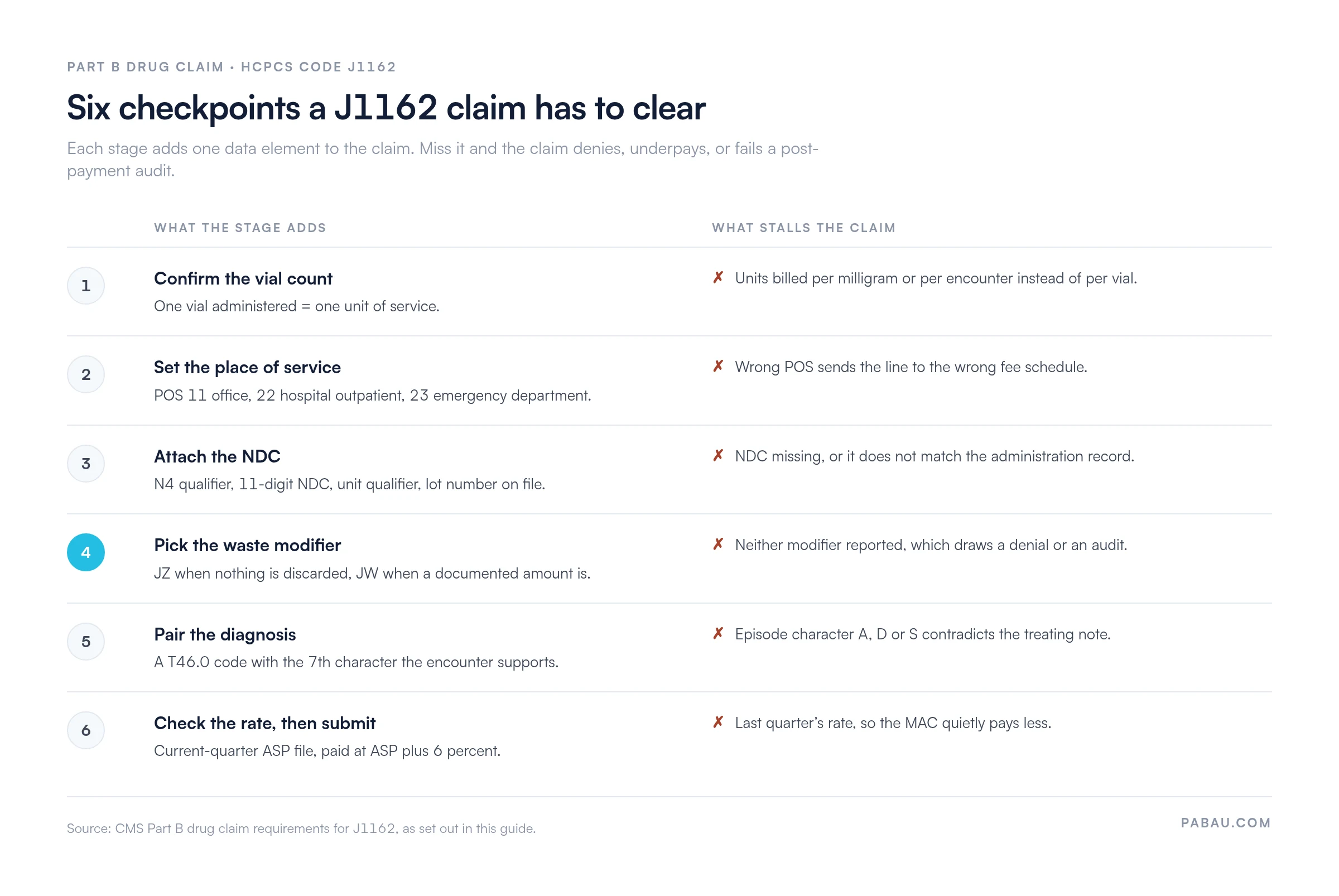
JW is not the new rule. It has been mandatory nationwide since January 1, 2017 for the discarded amount left in a single-dose vial. JZ is the recent one. CMS made it mandatory on July 1, 2023, then began denying claims that carry neither modifier in October 2023.
Because the billing unit is the whole vial, most J1162 lines carry JZ. JW applies only when a documented amount from an opened vial is discarded. A line with neither modifier is now an easy denial and an obvious audit flag.
Take a patient treated in the emergency department who receives eight vials of DigiFab. The J1162 line carries eight units, place of service 23, and the NDC from the cartons used. Every vial was reconstituted and infused, so the line takes JZ rather than JW.
The diagnosis comes from the T46.0 series. Its 7th character depends on whether the note describes an accidental overdose, intentional self-harm, or an adverse effect of prescribed digoxin. The infusion itself is reported separately, on its own line, with the matching CPT administration code.
Every J1162 claim needs at least one ICD-10-CM code that establishes medical necessity. Digoxin toxicity sits in the T46.0 series, inside the poisoning, adverse effect, and underdosing chapter.
Which code applies depends on the clinical intent and on the episode of care.
The 7th character is where these lines fail. A is the initial encounter, D is a subsequent encounter, and S is a sequela.
Match it to the treatment stage described in the note, not to the date the claim was created. For neighboring T46 subcategories and their 7th characters, the ICD-10-CM code library is the quicker lookup.
Medicare Part B covers J1162 when the drug is medically necessary and given in a covered Part B setting.
Prior authorization is generally not required, because DigiFab is used in emergencies where there is no time for it. Commercial and Medicaid managed care plans set their own policies, and those change.
An emergency leaves no room for a benefits check. Document the clinical urgency in the record instead, then use it to support a retrospective authorization request if the payer asks for one.
Accurate coding gets the claim submitted. Complete documentation gets it paid, and keeps it paid through a post-payment review.
A J1162 claim carries a high per-vial cost. MACs and commercial payers read the supporting records more closely than they would on a routine injection.
Treat the list below as a minimum rather than a wish list. A missing item is audit exposure, and a recoupment if the claim is ever pulled for review.
Capture those fields at the point of care. Reconstructing a vial count or a lot number from memory at billing time is how the record and the claim stop agreeing.
Coders working cardiac drug lines should recognize a few neighbors, both to confirm J1162 is right and to catch cross-code errors during review.
The AAPC HCPCS Level II lookup is a quick way to check an adjacent code’s description and effective dates.
Reaching for J3490 when a specific code exists is a slow mistake. Unclassified drug lines need extra documentation and usually land in manual review, so payment arrives weeks later than it needed to.
Reconcile vials against the pharmacy or ED dispensing log before the claim goes out, not after the remittance lands. On a per-vial code, one uncounted vial is a full unit of revenue. Recovering it later takes a claim adjustment nobody has time for.
Most of what stalls a J1162 line is data that lives somewhere else. The vial count sits in the administration record, the NDC is on the carton, and the diagnosis is in the note.
Practice management software like Pabau holds those in one patient record, so the claim is built from what the clinician documented.
Pabau’s claims management pre-fills the claim form from that record, so the codes already attached to the service land on the charge line. It also carries ICD-10-CM and CPT/HCPCS lookup libraries, refreshed with each official release. A coder can check J1162 or a T46.0 code without leaving the claim.
Before a claim can be sent, Pabau checks that the required submission fields are complete, so a half-finished claim never reaches the payer.
From there it tracks claim status and posts electronic remittance. That is how a shortfall on a high-cost drug line gets noticed in days rather than months.

Pabau builds the claim from the patient record, checks the required fields before it sends, then tracks status and remittance. Your team spends less time reworking claims that never had to fail.

J1162 is a low-volume code with a high price per line, and that combination makes small errors expensive. One miscounted vial, one missing waste modifier, or an NDC that does not match the record can undo the whole line.
So build the check in once and stop relying on memory. Confirm the vial count against the administration record. Put JZ or JW on every line, and price the claim from the current quarter’s ASP file. Do that consistently and a code with real audit exposure turns into a routine line.
If you would like to see how a drug claim is built straight from the patient record, book a demo with our team.

Want a tighter pre-submission check? Clean claim standards for medical billing covers the checks that stop the most common drug-code errors.
Need the documentation side of buy-and-bill nailed down? Superbill best practices shows how to structure billing documents for provider-administered drugs.
Getting denials on high-cost drug lines? Denial management in healthcare walks through the workflow that reduces write-offs.
Worried about a post-payment audit? Medical billing compliance covers the protocols that keep J-code claims defensible.
No. J1162 pays for the drug only. The infusion is reported separately, with the CPT administration code that matches the encounter. Both lines go on the same claim, each with its own units.
Part B. DigiFab is given by a provider in a clinical setting, which is what puts a drug on the Part B side. Part D covers drugs a patient takes at home, so a J1162 line sent to a Part D plan will be rejected.
No. Drugs given to an admitted inpatient are paid inside the MS-DRG, so the vials earn no separate payment. J1162 belongs on outpatient and physician claims. A hospital may still record the code for charge capture, but it will not pay on its own.
Take it from the carton or vial label of the product administered, then convert it to the 11-digit format. Manufacturers print a 10-digit NDC, so the segment that is short by one digit gets a leading zero. Use the NDC from the vials that were given, not a default saved in the system.