CPT code 93641: ICD defibrillation threshold testing billing guide
CPT code 93641: Official descriptor and key details The official AMA CPT descrip...

Last Updated: Nov 13, 2026
J0875 is the HCPCS Level II code for injection, dalbavancin, 5 mg. It reports Dalvance, a long-acting IV antibiotic for acute bacterial skin and skin structure infections, with one billing unit for every 5 mg administered.
A 1,500 mg single dose therefore bills as 300 units. Claims also need prior authorization from most commercial, Medicaid and Medicare Advantage plans. Medicaid claims need the National Drug Code (NDC), and payers expect a specific skin-infection diagnosis.
Let Pabau's smart automation suggest the right codes, reduce claim denials, and keep your practice compliant—effortlessly.
Automate repetitive tasks and focus on what matters most—your patients.
Reduce coding errors and ensure compliance with the latest regulations.
Clean claims, fewer denials, and faster reimbursements.
Powerful insights and reporting to help your practice thrive.
HIPAA compliant SOC 2 certified GDPR-compliant Trusted by 4,000+ clinics worldwide

HCPCS code J0875 bills dalbavancin (Dalvance) injection at 5 mg per unit of service, not per vial or per dose.
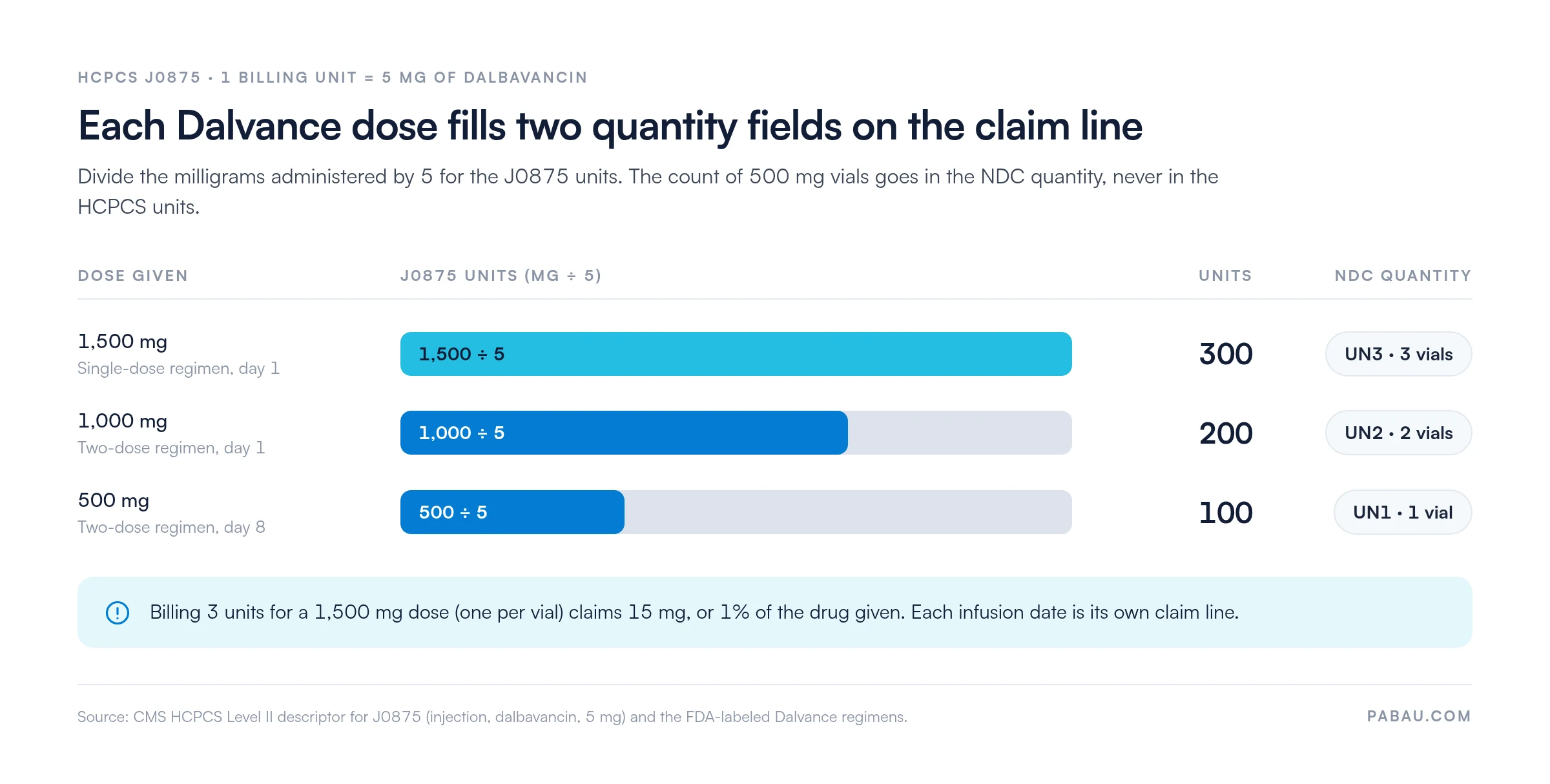
Divide the milligrams administered by 5, so a 1,500 mg single dose is 300 units on the claim line.
On Medicaid claims the vial count goes in the NDC quantity, so three 500 mg vials report as UN3.
Most commercial, Medicaid and Medicare Advantage plans require prior authorization before the infusion, while traditional Medicare Part B does not.
Pair J0875 with a specific ABSSSI diagnosis and bill the IV infusion separately with an administration code such as CPT 96365.
HCPCS code J0875 is the Level II drug code for dalbavancin hydrochloride injection, billed in units of 5 mg. The Centers for Medicare and Medicaid Services (CMS) maintains it in the HCPCS Level II code set. The code covers dalbavancin only, so it can’t be used for oritavancin, vancomycin or any other antibiotic.
The quick-reference table below covers the fields a biller checks first. New to drug claims? Our guide to how medical billing works follows a charge from the chart to a paid claim.
CMS publishes and maintains J0875 in the annual HCPCS Level II Alpha-Numeric code file. Verify the descriptor and any updates at the CMS HCPCS overview page before billing each year, because descriptors can change with the annual code update.
Dalbavancin is a long-acting lipoglycopeptide antibiotic. The FDA approved it for acute bacterial skin and skin structure infections (ABSSSI) caused by susceptible gram-positive bacteria. These include methicillin-resistant Staphylococcus aureus (MRSA), Streptococcus pyogenes, Streptococcus agalactiae and the Streptococcus anginosus group. Its long half-life permits either a one-dose or a two-dose regimen, which suits treatment that continues outside the hospital.
Two FDA-approved dosing regimens exist, and each drives a different unit count on the claim:
Dalbavancin is administered intravenously and is not available as an oral formulation. Claims must reflect IV infusion administration codes alongside J0875 (see the administration code pairing section below).
The billing unit for J0875 is 5 mg per unit of service, and unit errors are the most common source of denials for this code. Counting 500 mg vials or doses instead of milligrams administered bills a fraction of the correct amount. A miscount in the other direction trips a maximum-units edit.
Each infusion date is billed as a separate claim line with the units for that day’s dose. For the two-dose regimen, bill 200 units on the day-1 date of service and 100 units on the day-8 date of service. Never combine both doses onto one claim line.
On a Medicaid claim, the same dose fills a second quantity field, the NDC unit count, and that one counts vials. The chart sets both fields side by side for each FDA-labeled dose.
Confirm the milligrams documented as given in the administration record before calculating units. If a dose is reduced due to renal impairment or partial administration, bill only the milligrams documented as administered. Billing the ordered dose when less was given is a compliance risk.
Payers require a diagnosis code that reflects an FDA-approved indication for dalbavancin. ABSSSI is the supported category, so submit the most specific code available. Unspecified skin infection codes may pass some payers but are a frequent trigger for medical necessity review.
ABSSSI requires a minimum lesion area of 75 cm² per FDA criteria. Document wound measurements in the clinical record. Payers may request this documentation during a post-payment audit if the diagnosis is an infected wound or abscess rather than straightforward cellulitis.
Medicare Part B reimburses J0875 at the average sales price (ASP) plus 6% under the standard Part B drug pricing methodology. CMS updates ASP rates quarterly, so the per-unit allowable changes four times per year.
Never hardcode a dollar amount into your billing workflow. Pull the current rate from the CMS Physician Fee Schedule and ASP drug pricing file at the start of each quarter.
Site of service affects the total payment. In a physician office (Place of Service 11), the drug is reimbursed under the Part B drug allowable.
In a hospital outpatient department (Place of Service 22), payment falls under the Outpatient Prospective Payment System (OPPS). Its ambulatory payment classification (APC) rate may differ from the physician-office rate. Confirm the applicable rate for your setting before billing.
Medicaid reimbursement is state-specific and can differ substantially from Medicare rates. Some state Medicaid programs place dalbavancin on a preferred drug list (PDL) with restricted access. They require step therapy, meaning documented failure of first-line antibiotics, before approving J0875. Verify your state Medicaid fee schedule with the state agency before administering the drug. Never assume Medicare rates apply.
Prior authorization (PA) is required by most commercial plans, most state Medicaid programs, and the majority of Medicare Advantage plans for J0875. Traditional Medicare (Parts A and B fee-for-service) does not require PA for dalbavancin under Part B, but Medicare Advantage plans set their own PA rules.
Assume PA is required unless you have confirmed otherwise in writing from the specific plan.
Typical PA documentation requirements include:
PA approval timelines vary from 24 hours (urgent cases) to 5-7 business days for routine review. Submit the PA request before scheduling the infusion.
Administering dalbavancin without an approved PA on file is the second-most-common denial cause for this code, and retroactive PA approval is rarely granted. Build a prior authorization checklist into every dalbavancin workflow, so the approval is on file before the infusion is scheduled.
Medicaid and many commercial payers require the National Drug Code (NDC) on drug claims. Missing or incorrectly formatted NDC information is one of the leading denial causes for J0875 on Medicaid claims. For high-cost infused drugs, capture the NDC at the charting step rather than adding it during billing.
NDC reporting rules for J0875 on Medicaid claims:
The NDC for Dalvance (AbbVie) can be verified on the vial label or in the FDA’s NDC directory. Commercial payers can set NDC format rules that differ from the Medicaid standard, so check the payer’s billing guide before submitting.
J0875 denials follow predictable patterns. The table below maps each common denial reason to the corrective action, drawing on the billing requirements covered in this reference. Systematic denial management processes for high-cost drug J-codes should include a pre-submission checklist against each row below.
Keep a list of common denial codes to hand when reading the remittance advice remark codes on returned J0875 claims. The remark code narrows the specific edit that triggered the denial and guides the corrective path.
J0875 covers the drug only. The intravenous infusion service is reported separately using CPT administration codes. The correct code depends on infusion duration and whether additional drugs are infused in the same encounter. Payer policy on separate payment for the administration code varies, and some payers bundle it into the drug allowable.
In a non-facility (physician office) setting, 96365 is typically billable alongside J0875 and separately reimbursed by Medicare. In a facility setting (hospital outpatient), administration codes are often bundled into the OPPS APC payment for the drug. Record the infusion start and stop times in the administration record, because the duration decides which administration code applies.
J0875 covers dalbavancin only. Other antibiotics, including other lipoglycopeptides, have separate codes with their own billing units. Daptomycin, for example, bills under J0878 at 1 mg per unit. Tigecycline, labeled for complicated skin infections in adults, also bills per 1 mg, under HCPCS J3243. Using J0875 for any drug other than dalbavancin is a coding error that leads to denial or audit exposure.
Oritavancin, a structurally related lipoglycopeptide, is the likeliest mix-up. Orbactiv is J2407 (per 10 mg), and Kimyrsa is J2406. Confirm both in the AAPC HCPCS code lookup tool before billing, because J-codes for newer drugs can be revised.
Medical necessity documentation for J0875 must be in the chart before the claim is submitted. Post-payment audits for high-cost drug claims are common, and inadequate records lead to recoupment. Medical billing compliance for injectable antibiotics requires the following documentation elements:
Payers conducting drug-claim audits typically request the physician order, the administration record, and the lab results. Infusion centers should keep these records for at least seven years. That matches standard Medicare retention requirements and OIG guidance for high-cost drug claims. File all three against the patient record so an audit request can be answered from one place.
Run a vial-to-claim reconciliation before submitting any J0875 claim. Count the vials administered and multiply by vial size to confirm the milligrams match the units billed. A 1,500 mg dose using three 500 mg vials of Dalvance should produce 300 units on the claim line, not 3.
In many infusion practices, the prior authorization sits in a payer portal and the dose sits in the administration record. Someone then builds the claim by hand from both. Each handoff is a chance to bill the vial count, drop the NDC or infuse before the approval arrives.
Pabau, the practice management platform we build, keeps the authorization on the patient’s case. The auth code, its dates and its approved sessions are tracked there, and staff see a warning when an authorization is missing. US claims go out through Claim.MD as CMS-1500/837P claims, and Pabau’s claims management software also runs eligibility checks and posts ERA remittances.
The result is a J0875 claim built from the same record as the infusion and the approval. Your billing team spends less time reworking denials on a drug that costs several thousand dollars per dose.

Pabau tracks prior authorization codes on the patient’s case and sends US claims through Claim.MD. Each high-cost drug claim goes out with its approval on record.

J0875 claims get paid when they are built from the administration record rather than the order or the vial count. Bill per 5 mg, get the authorization before the infusion, and send the NDC with every Medicaid claim.
The trade-off is a few minutes of checking before each submission, set against a denial on a drug that costs several thousand dollars per infusion. A vial-to-claim reconciliation catches the most common error before the payer does.
Pabau sends US claims through Claim.MD, with CMS-1500/837P submission, eligibility checks and ERA remittances handled in one place. Book a demo to see how Pabau carries a high-cost drug claim from the authorization to the paid remittance.

Need a denial management framework for drug J-codes? Common denial codes in medical billing explains remittance advice remark codes and how to map them to corrective actions.
Billing oritavancin instead? HCPCS code J2407 covers Orbactiv, the oritavancin product most often confused with dalbavancin.
Switching a patient to daptomycin? HCPCS code J0878 covers daptomycin injection billing, which runs at 1 mg per unit.
Billing the infusion itself? CPT code 96365 covers the initial IV infusion that sits alongside J0875 on the claim.
Want to understand the broader billing compliance picture? Medical billing compliance covers OIG audit risk areas, documentation standards, and how to build a compliant billing workflow.
HCPCS code J0875 bills dalbavancin (Dalvance) injection at 5 mg per unit. Dalbavancin is a long-acting antibiotic for acute bacterial skin and skin structure infections (ABSSSI) caused by gram-positive organisms, including MRSA.
Divide the total milligrams administered by 5. A 1,500 mg single dose is 300 units, a 1,000 mg first dose is 200 units, and a 500 mg second dose is 100 units. Bill each infusion date as a separate claim line.
Traditional Medicare Part B fee-for-service does not require prior authorization for J0875, but most Medicare Advantage plans, commercial plans, and state Medicaid programs do. Confirm PA requirements with the specific plan before administering the drug.
Yes, for Medicaid and most commercial payers. Report the 11-digit NDC in 5-4-2 format with qualifier N4 and unit of measure UN (units). Read the NDC from the vial administered, because lot numbers vary.
Medicare Part B reimburses J0875 at the average sales price (ASP) plus 6%, updated quarterly by CMS. Check the current quarter’s ASP drug pricing file on the CMS website rather than relying on a fixed figure.
J0875 covers only dalbavancin (Dalvance). Oritavancin has its own codes, J2407 for Orbactiv and J2406 for Kimyrsa. Using J0875 for oritavancin is a coding error and will result in a denial.