HCPCS code J3471: Hyaluronidase ovine injection billing guide
HCPCS code J3471: Descriptor, code type, and quick-reference data HCPCS code J34...

Last Updated: Oct 14, 2026
K0073 is the HCPCS Level II code for caster pin lock, each.
It is a low-volume, low-complexity code on paper. It still generates denials when billers skip the modifier or ship the claim without a valid Standard Written Order.
Let Pabau's smart automation suggest the right codes, reduce claim denials, and keep your practice compliant—effortlessly.
Automate repetitive tasks and focus on what matters most—your patients.
Reduce coding errors and ensure compliance with the latest regulations.
Clean claims, fewer denials, and faster reimbursements.
Powerful insights and reporting to help your practice thrive.
HIPAA compliant SOC 2 certified GDPR-compliant Trusted by 4,000+ clinics worldwide

HCPCS Code K0073 describes a caster pin lock, each. It is a Level II HCPCS code in the K series used to bill durable medical equipment (DME) wheelchair accessories to Medicare.
K0073 is billed under the Medicare Part B DME benefit through a Durable Medical Equipment Medicare Administrative Contractor (DME MAC). Payment rates vary by MAC jurisdiction.
A Standard Written Order (SWO) plus medical necessity documentation held in the patient record is the current requirement. CMS eliminated Certificates of Medical Necessity for dates of service on or after January 1, 2023.
K0074 and K0075 were deleted in 2006. Caster tires, wheels, and forks are now billed with E2214, E2219, E2225, and E2226.
Practice management software like Pabau handles HCPCS code entry, modifier selection, and DME claim tracking, so errors get caught before the claim reaches the payer.
HCPCS Code K0073 has an official description of “Caster pin lock, each.” It is a medical billing code maintained by the Centers for Medicare and Medicaid Services (CMS) as part of the HCPCS Level II code set.
According to CMS’s HCPCS overview, Level II codes cover items and services not described by CPT codes. That is primarily durable medical equipment (DME), prosthetics, orthotics, and supplies (DMEPOS).
K codes sit within a sub-series CMS created for DME and wheelchair accessories that lack a matching CPT descriptor. K0073 falls in the power and manual wheelchair accessory range. The “each” qualifier in the description matters. Billers must submit one unit per lock, not bundle multiple units under a single line item.
A caster pin lock is a mechanical component that secures the front caster wheel of a manual or power wheelchair. It prevents the wheel from rotating when the chair is in a fixed position.
Clinically, the lock is prescribed when a patient needs positional stability that the standard caster assembly alone cannot provide. Transfers and therapeutic activities are the two situations that most often justify it.
The table below summarizes the key administrative attributes of HCPCS Code K0073 for quick reference during coding and claim preparation.
Medicare reimbursement for HCPCS Code K0073 is set through the annual DMEPOS fee schedule published by CMS. Two contractors administer the four DME MAC jurisdictions.
Noridian handles Jurisdictions A and D. CGS handles Jurisdictions B and C, and both contractors apply the same national fee schedule file. Competitive bidding program pricing may apply in designated areas.
Fee schedule amounts change each January 1 and may be adjusted again mid-year. Verify current rates against the CMS fee schedule search tool or your DME MAC’s published fee schedule before billing.
The table below reflects the general rate structure applicable to K-series wheelchair accessory codes. Confirm the actual dollar figures for K0073 from the current CMS DMEPOS fee schedule file.
Annual update note: CMS applies an update to the DMEPOS fee schedule each January, and K0073 follows the general DMEPOS adjustment. Suppliers in competitive bidding areas should cross-check the standard fee schedule rate against their contracted competitive bid amount. The lower of the two typically applies.
Take the dollar figures from one of two places only. Use the current CMS DMEPOS fee schedule file, or your own DME MAC’s published rates. A rate quoted on a third-party code lookup can lag a year behind the file your claim is priced against.
Billing K0073 to Medicare follows the standard DMEPOS claim workflow. Each step below maps to a point where errors commonly occur, and skipping any one of them is the fastest route to a denial.
Billing K0073 cleanly means assembling a complete documentation package before the claim goes out. Medicare’s definition of medical necessity requires the item to be reasonable and necessary for the diagnosis or treatment of the patient’s condition. For a caster pin lock, the clinical record has to support why standard caster function is insufficient.
The documentation rules changed in 2023, and old billing checklists still carry the retired step. CMS Special Edition article SE22002 eliminated Certificates of Medical Necessity (CMNs) and DME Information Forms (DIFs) for all DMEPOS items.
The change applies to dates of service on or after January 1, 2023. There is no CMN to complete for K0073 anymore. A claim that still carries CMN or DIF information for a current date of service is rejected in its entirety.
Suppliers should confirm whether their DME MAC has issued an LCD covering caster components. Noridian (Jurisdictions A and D) and CGS (Jurisdictions B and C) publish their own policy articles, and documentation expectations can differ between them. Always check the contractor for the beneficiary’s state, then hold the file for the full seven-year retention period.
Selecting the right modifier is non-negotiable for K0073. A wrong modifier, or a missing one, is one of the top reasons DME claims deny on first submission. The table below covers the modifiers most commonly applied to K-series wheelchair accessory codes, including K0073.
Practical rule: for most K0073 purchase claims, the combination is NU plus KX. That means new equipment, with documentation confirming the LCD requirements are met. If the patient’s medical necessity is borderline and an ABN has been signed, substitute GA for KX. Verify modifier requirements with your specific DME MAC, since LCD-specific modifier rules can vary by jurisdiction.
Run a modifier audit on your caster claims quarterly. Pull K0073, K0072, K0077, and E2225 claims from the past 90 days. Check that every claim carries at least one transaction modifier (NU, RR, or UE) and, where your MAC’s LCD requires it, the KX modifier. Missing KX is the single most correctable source of first-pass denials on wheelchair accessory codes.
Medicare Part B covers durable medical equipment when the item meets four statutory criteria. It must be durable enough to withstand repeated use, and primarily medical in nature. It also has to be generally not useful without illness or injury, and appropriate for home use.
A caster pin lock satisfies all four for eligible beneficiaries who use a wheelchair as their primary mobility device.
Beyond the statutory criteria, coverage for wheelchair accessories like K0073 requires that the base wheelchair itself be covered and medically necessary. A beneficiary cannot receive a covered accessory for an uncovered chair. Confirm that the beneficiary’s wheelchair coverage is active before you bill the accessory.
No ICD-10 code describes a caster pin lock. The accessory claim carries the same diagnosis that justified the base wheelchair. The diagnosis on the K0073 line should match the one supporting the chair itself. Check the descriptor in our ICD-10-CM code reference when the chart wording leaves the choice open.
The codes below are the mobility-limiting diagnoses most often seen on wheelchair accessory claims.
Two habits cause avoidable denials here. Leading with Z99.3 as the primary diagnosis gives the reviewer no clinical reason for the lock. Copying a diagnosis forward from an old order also fails, because the chart has to reflect the patient’s condition on the date of service. Code from the encounter note that supports this dispense.
K0073 sits in a tight cluster of caster codes, and picking the wrong one is a common source of claim edits. The cluster also carries a trap. K0074 and K0075, the old pneumatic and semi-pneumatic caster tire codes, were deleted by CMS effective January 1, 2006.
Caster tires, wheels, and forks moved to the E2000 series. The map below shows what is billable today, and the table under it carries the full descriptors.
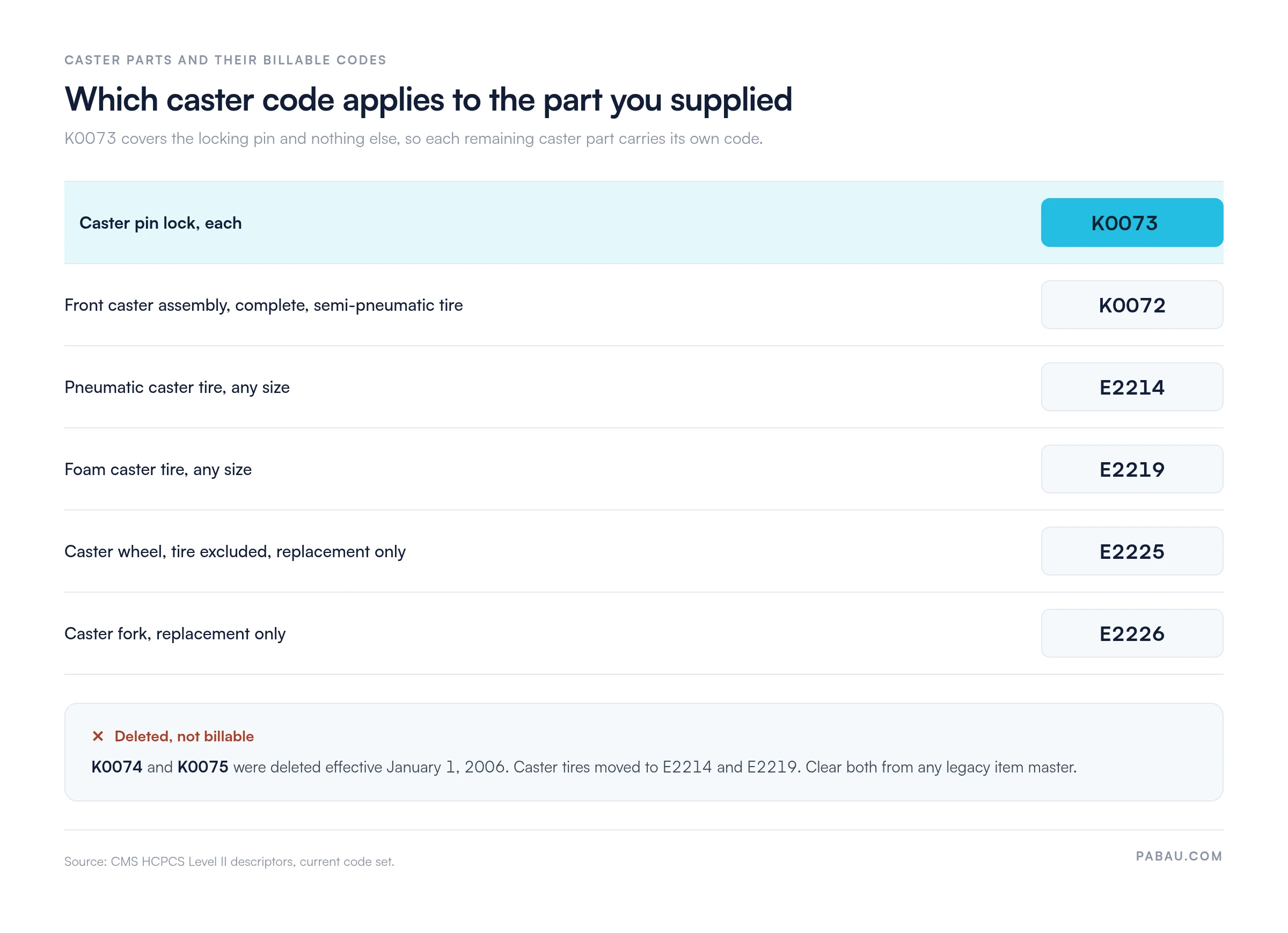
Unbundling risk: billing K0072 for a complete assembly alongside K0073 for the pin lock creates exposure. That applies when both go on the same caster and the same date of service. If the full assembly is supplied, K0072 is the correct code and K0073 is subsumed.
Confirm with your DME MAC’s LCD whether component codes may be billed alongside assembly codes. Cross-reference descriptors in the CMS quarterly HCPCS update file before claim submission. A code deleted twenty years ago can still sit in an old fee table.
When the part you supplied has no descriptor anywhere in the caster range, K0108 is the not-otherwise-specified option for wheelchair components. Reach for it only after checking that no listed code fits, because a specific code always survives review better.
Most K0073 denials are preventable. The errors below account for most first-pass rejections on wheelchair accessory K code claims. Each one maps to a corrective action you can embed in your pre-bill workflow.
Tracking denial reason codes by HCPCS code turns single denials into a pattern you can act on. A monthly denial report filtered to K0073 shows whether one error keeps recurring. Fix that upstream step once and you stop appealing the same claim every month.
Most DME suppliers run billing through a patchwork of spreadsheets, standalone billing platforms, and manual order tracking. That setup holds until claim volume grows or a MAC audit arrives.
Practice management software like Pabau brings HCPCS code entry, modifier selection, and claim status tracking into one workflow. Its built-in claims management lets your team complete the steps above without switching between systems.
Some practices bill both clinical services and DMEPOS items. Rehabilitation practices, orthotics and prosthetics providers, and multi-specialty groups that supply wheelchair accessories all sit in that category. Consolidating billing into one platform keeps the order, the clinical note, and the claim in the same record.
That record is where the errors in this guide start. Pabau’s reporting shows denial rates by code. A practice manager can spot a recurring caster denial in the month it appears, rather than at audit.
Set up a caster code group in your billing software for pre-submission review. Have it flag any claim containing K0073, K0072, K0077, E2214, E2219, E2225, or E2226. A 60-second check confirms the SWO is complete, the modifier is right, no deleted code slipped in, and no unbundling exists. That check catches the errors that take weeks to resolve after a denial.

Pabau’s claims management tools let your team enter HCPCS codes, select modifiers, and track DME claim status without switching between systems. See how practices reduce first-pass denials with built-in billing workflows.

HCPCS Code K0073 is a straightforward code with a narrow scope, one caster pin lock, each. The complexity comes from the requirements around it.
A complete Standard Written Order, the right modifier, the competitive bidding rules, and the unbundling risk against K0072 all have to line up. Getting each of those right on first submission is what separates a paid claim from a denial that ties up staff time.
Two housekeeping jobs are worth doing once and never repeating. Strip the retired CMN step out of your K0073 checklist, and clear K0074 and K0075 out of your item master. Then build a pre-bill check that covers the SWO, the modifier logic, and the POD.
A checklist only holds if the software enforces it, which is where the pre-bill step belongs. Book a demo to see how Pabau keeps the order, the modifier, and the proof of delivery on one DME claim record.

Need to understand how DME claims move through the system? What is medical billing walks through the full revenue cycle from order to payment, including DMEPOS-specific steps.
Seeing repeated denials on your HCPCS claims? Denial management in healthcare covers how to build a denial tracking and appeal workflow that reduces write-offs.
Want a reference for common denial reason codes? Denial codes in medical billing lists the remark and reason codes most frequently seen on DME and HCPCS claims.
HCPCS Code K0073 is a Level II HCPCS code that describes a caster pin lock, each. It is a mechanical locking component for a wheelchair’s front caster wheel. CMS maintains the code, and enrolled DMEPOS suppliers bill it under the Medicare Part B DME benefit.
A caster pin lock secures the front caster wheel of a manual or power wheelchair in a fixed position, preventing rotation. It is prescribed when a patient needs positional stability during transfers, therapeutic activities, or mobility tasks that the standard caster assembly cannot safely support.
Medicare reimbursement for K0073 is set annually in the CMS DMEPOS fee schedule and varies by DME MAC jurisdiction. Rates change each January 1 and may be adjusted again in competitive bidding areas. Verify the current rate against the CMS fee schedule search tool or your DME MAC’s published schedule before billing.
Billing K0073 requires a Standard Written Order (SWO) signed by the treating physician or NPP. You also need medical necessity documentation in the beneficiary’s medical record. Add proof of delivery signed by the beneficiary. Face-to-face encounter documentation must fall within the timeframe the applicable LCD requires. Retain the file for at least seven years.
No. CMS Special Edition article SE22002 eliminated Certificates of Medical Necessity and DME Information Forms for all DMEPOS items. It applies to dates of service on or after January 1, 2023. A claim that still carries CMN or DIF information for a current date of service is rejected in its entirety.
K0072 is a front caster assembly, complete, with semi-pneumatic tire, replacement only, each. K0073 is only the caster pin lock component. Billing both for the same caster position and date of service is an unbundling error. K0073 is subsumed when the complete assembly is supplied.
No. CMS deleted K0074 and K0075 effective January 1, 2006, and neither is a valid billable code. Use E2214 for a pneumatic caster tire and E2219 for a foam caster tire. E2225 covers a caster wheel excluding the tire, and E2226 covers a caster fork.
No. CPT codes (Level I HCPCS) are maintained by the AMA and cover physician services and procedures. HCPCS Level II codes like K0073 are maintained by CMS and cover items not described by CPT. That means DME, prosthetics, orthotics, and supplies billed to Medicare and Medicaid.