

CCSD code G5100: Bypass of duodenum billing guide
CCSD code G5100 bills a bypass that leaves the duodenum in place CCSD code G5100...

Last Updated: Oct 16, 2026
J0207 is the HCPCS Level II code for injection, amifostine, 500 mg. Amifostine (Ethyol) is a cytoprotective drug given by IV before cisplatin chemotherapy or head-and-neck radiation, and one billing unit equals 500 mg.
Unit miscalculation and missing JW/JZ modifiers are common reasons J0207 claims come back denied. Each rejection delays payment while the practice absorbs the acquisition cost. This reference covers units, ICD-10 diagnoses, modifiers, Medicare ASP reimbursement, prior authorization and denial fixes.
Let Pabau's smart automation suggest the right codes, reduce claim denials, and keep your practice compliant—effortlessly.
Automate repetitive tasks and focus on what matters most—your patients.
Reduce coding errors and ensure compliance with the latest regulations.
Clean claims, fewer denials, and faster reimbursements.
Powerful insights and reporting to help your practice thrive.
HIPAA compliant SOC 2 certified GDPR-compliant Trusted by 4,000+ clinics worldwide

HCPCS code J0207 bills amifostine in 500 mg units, and the billed units cover the dose given plus any whole unit discarded.
Medicare requires the JW or JZ modifier on J0207 claims because amifostine comes in single-dose vials.
Medicare pays J0207 at ASP plus 6%, and the rate changes every quarter, so check the CMS ASP pricing file before billing.
Use of amifostine in non-small cell lung cancer is off-label, so its coverage depends on your MAC’s LCD.
Pabau, the practice management and billing platform we build, tracks drug claims, modifiers and denials in one place.
HCPCS code J0207 is the Healthcare Common Procedure Coding System Level II code for “Injection, amifostine, 500 mg,” with one billing unit per 500 mg. Amifostine, sold under the brand name Ethyol, is a cytoprotective (radioprotective) drug given intravenously. It is used before cisplatin chemotherapy or head-and-neck radiation to reduce kidney damage and xerostomia (dry mouth).
The Centers for Medicare and Medicaid Services (CMS) maintains J0207 in the HCPCS Level II code set. J0207 remains an active code in the current HCPCS Level II file.
J0207 covers amifostine injection for two FDA-approved indications. The first is reducing cumulative kidney toxicity from repeated cisplatin in patients with advanced ovarian cancer. The second is reducing xerostomia after head-and-neck cancer surgery, when the post-operative radiation field includes a substantial portion of the parotid glands.
Local Coverage Determinations (LCDs) issued by Medicare Administrative Contractors (MACs) set medical necessity criteria by jurisdiction, so coverage rules can differ by region. Use in other cancers, such as non-small cell lung cancer, is off-label and depends on your MAC’s LCD and compendia support.
Not covered under J0207:
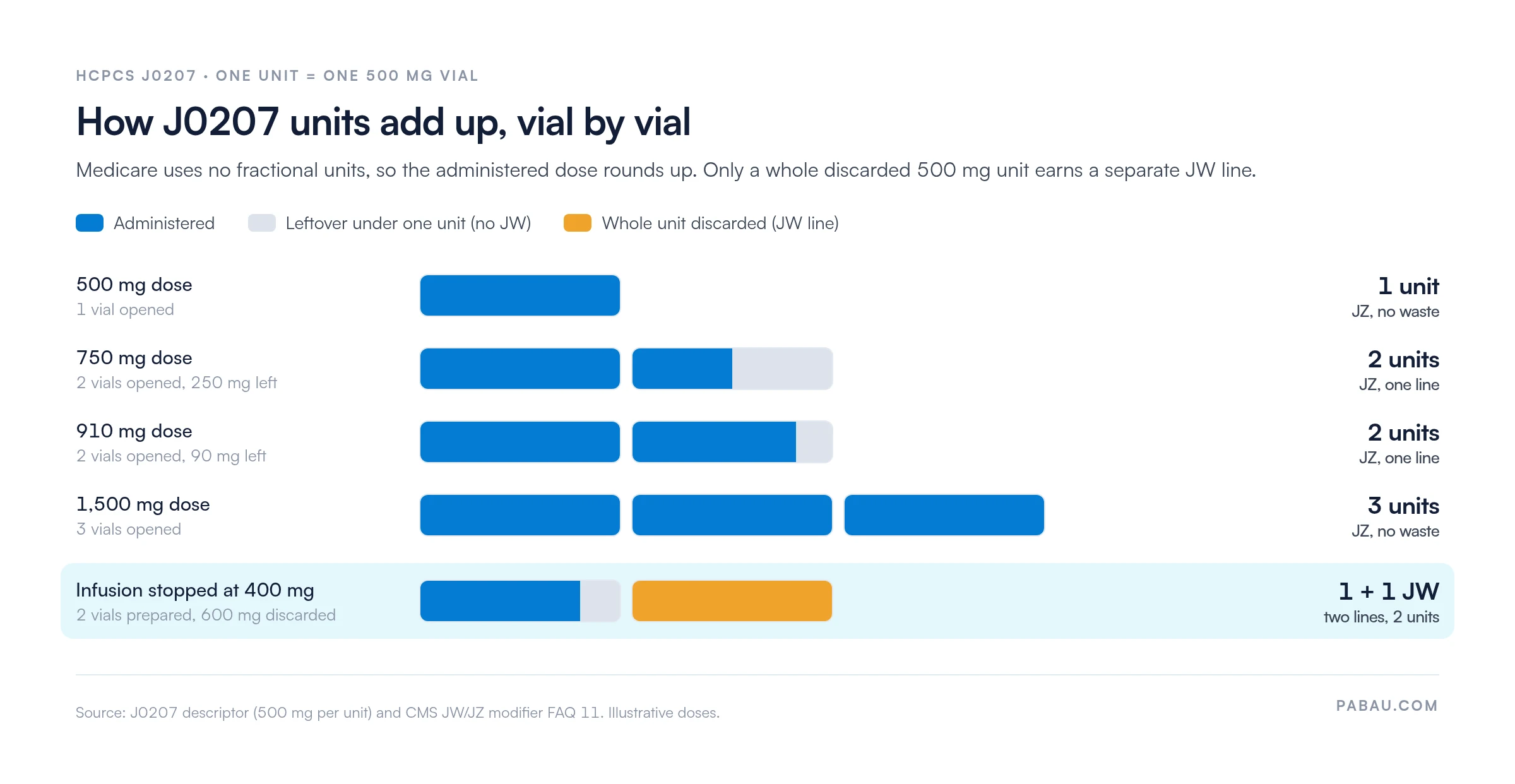
The J0207 descriptor is per 500 mg, so one billing unit equals 500 mg of amifostine. Bill the units for the dose administered plus any drug discarded from the vials opened for that patient. Medicare does not accept fractional units, so the administered dose rounds up to the next whole unit.
Because one unit equals one 500 mg vial, a leftover smaller than 500 mg is already paid inside the rounded-up unit. CMS FAQ 11 says that case takes the JZ modifier, with no JW line. A JW line appears only when a whole unit or more is discarded, so the claim total always matches the vials used.
Seen vial by vial, the pattern is simple, and the diagram below shows where the JW line comes in.
For cisplatin cytoprotection, the label starting dose is 910 mg/m2, given as a 15-minute IV infusion 30 minutes before chemotherapy. A reduced dose of 740 mg/m2 applies only in later cycles, after hypotension at the full dose. For radiation-related xerostomia, the dose is 200 mg/m2.
The milligram dose depends on the patient’s body surface area, so units will vary per encounter. Always document the calculated dose and administered volume in the clinical record before billing.
Every J0207 claim requires a covered ICD-10-CM diagnosis code that establishes medical necessity. The diagnosis must match the approved indication: Nephroprotection during cisplatin therapy or xerostomia prevention during radiation. MAC LCDs define covered codes by jurisdiction. The table below lists the most widely accepted diagnoses, but always verify your MAC’s current LCD before billing.
List the encounter code (Z51.0 or Z51.11) as the primary diagnosis when it describes the reason for the encounter. The active malignancy C-code supports the encounter code as a secondary or additional diagnosis. Submitting only a C-code without an encounter code may result in a medical necessity denial from some MACs.
Medicare Part B requires the JW or JZ modifier on claims for drugs from single-dose containers. JW has been required for discarded amounts since January 1, 2017. JZ became required on July 1, 2023, for claims with no discarded amount. Amifostine is supplied in single-dose vials, so J0207 claims fall under this requirement.
Since October 1, 2023, claims without the right modifier can be returned unprocessed, and they may also be audited. That makes modifier use a standing item in any medical billing compliance review.
How to split the claim line when waste occurs: Bill the administered units on one line with HCPCS code J0207, plus any other applicable modifiers. Then report the wasted units on a separate J0207 line with modifier JW. Medicare pays for the discarded amount on the JW line, up to the amount on the vial label.
Medicare Part B reimburses J0207 at the average sales price (ASP) plus 6 percent (ASP+6%). CMS updates the ASP quarterly, so the payment rate for HCPCS code J0207 changes every three months. Any dollar figure in a reference article is only accurate for the quarter it was published. Retrieve the current rate from the quarterly Medicare Part B ASP pricing file on cms.gov before billing.
For commercial payers, reimbursement rates are contract-specific and not published in a central file. Some payers tie rates to a percentage of average wholesale price (AWP) rather than ASP. Check your participation agreements for each payer before assuming Medicare rates apply, and add a quarterly rate check for every J-code drug on your formulary.
Run a quarterly ASP audit on every physician-administered drug your practice stocks. Pull the CMS ASP+6% file at the start of each quarter and compare it against your fee schedule. Update your billing system before the new rates take effect. Medicare pays the lower of your charge and the fee schedule amount, so a stale charge for amifostine can leave money unpaid.
Amifostine follows the buy-and-bill model: The practice buys the drug, administers it, then bills the payer for the drug (J0207) and the administration. The practice carries the acquisition cost from the day it buys the vial until the payer pays the claim.
Medicaid requires the National Drug Code (NDC) alongside J0207, and many commercial payers ask for it too. The NDC identifies the manufacturer, product and package size given to the patient. Missing the NDC is a standalone denial reason for those payers, so report it on every J0207 claim.
Companion CPT administration codes: J0207 covers the drug only. The infusion or injection service requires a separate CPT code billed on the same claim.
When amifostine and chemotherapy are both infused in the same encounter, the chemotherapy administration code (96413 or 96415) is typically the primary service code. Amifostine given as the only drug infused in an encounter uses 96365. Bundling rules apply: Confirm with your payer that no payment bundle zeroes out J0207 or the administration CPT code.
Check the documented infusion time as well. CPT counts an infusion of 15 minutes or less as an IV push. A short amifostine infusion may need a push code instead of 96365.
Medicare does not require prior authorization (PA) for J0207 at the national level, but many commercial payers do. PA requirements vary by payer, plan, and plan year, so no single policy applies universally. Verify PA before each administration rather than only at the start of a treatment course, because mid-treatment plan changes can affect coverage.
J0207 denials cluster around a predictable set of billing errors. Tracking your denial reasons at the code level, rather than across the whole practice, lets you fix the workflow step that caused them. Effective denial management workflows catch these patterns before they compound.
For the remark codes behind each rejection, see our guide to medical billing denial codes.
J3490 (“Unclassified drugs”) and J3590 (“Unclassified biologics”) are not-otherwise-classified (NOC) codes for drugs with no specific J-code. Because J0207 is the specific code for amifostine, billing it under J3490 or J3590 is incorrect. Payers that check drug-to-code mapping will deny it. The AAPC HCPCS code reference and the PGM Billing HCPCS lookup tool both list J0207 as the current active code for amifostine.
NOC codes also require invoice documentation and often a letter of medical necessity with the claim. Using J3490 when J0207 exists adds administrative work and slows payment. The one narrow exception is a new amifostine product that CMS has not yet mapped to a specific code. Even then, confirm with your MAC before billing J3490.
Clean claim submission for HCPCS code J0207 depends on complete documentation at the point of care. A missing element in the medical record is far harder to fix after adjudication than before the infusion ends. Building a clean claim checklist into your drug administration workflow prevents the most avoidable denials.
Required documentation for every J0207 encounter:
The superbill documentation for each drug administration encounter should capture all of these elements before the claim is generated. Practices using electronic infusion logs can automate much of this capture, which cuts transcription errors between the clinical record and the claim.
Without connected software, a J0207 claim gets rebuilt by hand. The dose sits in the infusion note, the vial count on a waste log, and the NDC on the box. A biller then retypes all three, and a missed modifier only surfaces when the claim comes back.
Pabau’s error-catching claims management software keeps the clinical record and the claim in the same system. It tracks drug administration claims and surfaces denial patterns by code, modifier and payer. You fix the step that keeps failing instead of reworking claims one at a time.

Pabau tracks physician-administered drug claims, modifier requirements, and denial patterns in one integrated workflow. Book a demo to see how billing teams reduce J-code errors and speed up reimbursement.

J0207 rewards the practice that does its arithmetic at the chair. Record the dose, the vials opened and any discarded drug before the infusion ends. The units, the JW or JZ modifier and the NDC on the claim then follow straight from the note.
The trade-off is a minute of documentation per infusion against weeks of rework on a returned claim. Pull the ASP file and your MAC’s LCD each quarter, and flag lung cancer use as off-label before the claim goes out.
Book a demo to see how Pabau keeps J-code drug claims, modifiers and denials in one billing workflow.

Need to understand how denials are classified and appealed? Denial management in healthcare walks through the denial lifecycle, CARC codes, and appeal workflows for physician-administered drug claims.
Want a checklist for what makes a claim clean before submission? Submitting a clean claim covers every field required on the CMS-1500 and 837P, including NDC and modifier placement.
Looking to benchmark your billing processes against compliance requirements? Medical billing compliance outlines the audit risk areas CMS and OIG flag most often for J-code drug billing.
Infusing amifostine alongside chemotherapy? CPT code 96367 covers each additional sequential infusion of a new drug in the same encounter.
Wondering when an unclassified drug code is allowed? HCPCS code J3490 explains the NOC drug code and the documentation payers expect with it.
HCPCS code J0207 covers injection of amifostine (Ethyol), a cytoprotective agent, billed per 500 mg. It applies to two FDA-approved indications. The first is reducing cisplatin-induced kidney toxicity in advanced ovarian cancer. The second is reducing xerostomia from head-and-neck radiation.
Bill one unit of J0207 for each 500 mg of amifostine, rounding up to the next whole unit because Medicare does not accept fractional units. A 910 mg dose bills as 2 units, and a 1,500 mg dose bills as 3 units.
Medicare Part B does not require prior authorization for J0207 at the national level, but many commercial payers do. Verify PA requirements with each commercial payer before administration, as requirements vary by plan and can change between plan years.
Report the wasted units on a separate J0207 line with modifier JW when a whole 500 mg unit or more is discarded. When no billable amount is discarded, add JZ to the single J0207 line. JZ or JW is required on Medicare claims for drugs from single-dose containers.
J0207 is the specific HCPCS code for amifostine and must be used when billing this drug. J3490 is the NOC code for unclassified drugs, meant only for drugs without a specific J-code. Using J3490 for amifostine is incorrect, and payers that verify drug-to-code mapping will deny it.
Medicare reimburses J0207 at ASP+6% (average sales price plus 6%), and the rate changes quarterly. Retrieve the current figure from the quarterly Medicare Part B ASP pricing file at the start of each quarter. Published articles go out of date within 90 days.



