HCPCS Code G0163: Skilled nursing observation and assessment
What is HCPCS Code G0163? HCPCS Code G0163 is a deleted Level II code for skille...

Last Updated: Oct 15, 2026
E0316 is the HCPCS Level II code for safety enclosure frame/canopy for use with hospital bed, any type.
The accessory status is where E0316 claims come apart. The enclosure inherits the bed's coverage decision, so a denied hospital bed takes the enclosure down with it.
In short, this guide covers the descriptor, capped rental payment, coverage criteria under LCD L33820, documentation, modifiers, the ICD-10 crosswalk, common denials, and related E-series codes.
Let Pabau's smart automation suggest the right codes, reduce claim denials, and keep your practice compliant—effortlessly.
Automate repetitive tasks and focus on what matters most—your patients.
Reduce coding errors and ensure compliance with the latest regulations.
Clean claims, fewer denials, and faster reimbursements.
Powerful insights and reporting to help your practice thrive.
HIPAA compliant SOC 2 certified GDPR-compliant Trusted by 4,000+ clinics worldwide

HCPCS Code E0316 describes a safety enclosure frame or canopy for use with a hospital bed of any type.
Medicare treats E0316 as an accessory, so it pays only when the hospital bed underneath it is itself covered.
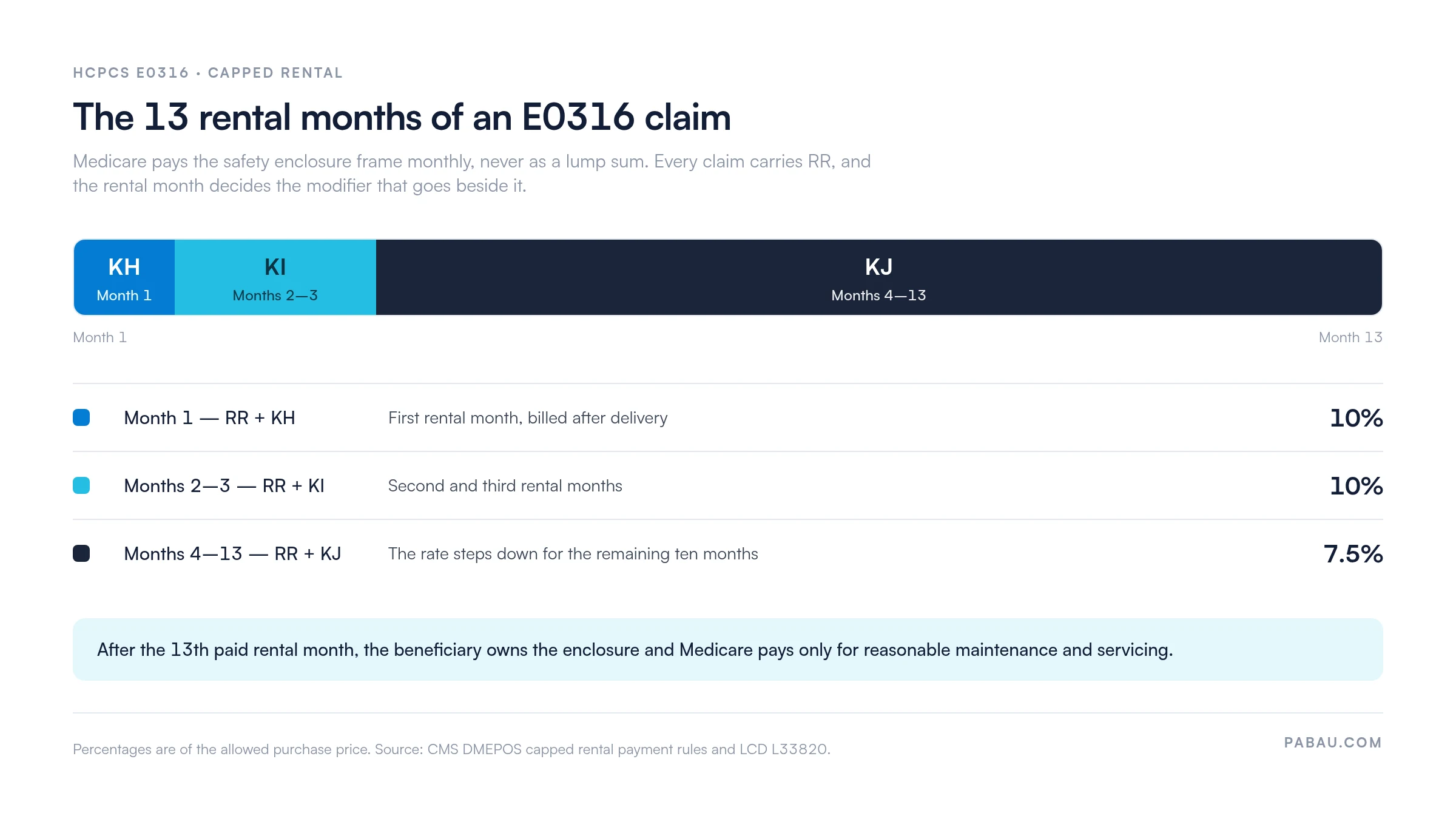
E0316 is a capped rental item. Claims carry RR plus KH, KI or KJ, depending on the rental month.
The KX modifier signals that the criteria in LCD L33820 are met, and GA applies when a signed ABN is on file.
Pabau’s claims management software submits DME claims electronically, checks eligibility, and tracks each claim through to remittance.
HCPCS Code E0316 is a Healthcare Common Procedure Coding System Level II code. Specifically, it describes a safety enclosure frame or canopy for use with a hospital bed, any type. The code sits in the hospital beds and associated supplies range of the CMS HCPCS Level II code set. Notably, it covers the frame or canopy attachment, never the bed underneath it.
The equipment attaches to a standard, semi-electric, or full-electric hospital bed. In particular, its clinical purpose is fall containment for patients who cannot safely manage the boundaries of the bed. Cognitive impairment, physical instability, and agitation are the usual reasons. In practice, coverage turns on the setting, on the bed’s own coverage decision, and on what the treating practitioner documented.
Medicare pays E0316 as a capped rental item rather than a purchase. The DMEPOS fee schedule assigns it pricing indicator 36, which caps continuous rental at 13 months. Instead, suppliers confirm the current allowed amounts in the CMS DMEPOS fee schedule files, not the physician fee schedule lookup.
The rental month decides both the modifier and the rate, and the rate steps down once at month four.
There is no active competitive bidding contract to work around in 2026. The program has been in a temporary gap period since January 1, 2024, when the Round 2021 contracts expired. Medicare pays former bidding areas from adjusted fee schedule amounts instead. Check the current quarterly DMEPOS file before you quote a patient their 20% share.
All four DME MACs apply the same policy to this code. Specifically, it is Local Coverage Determination L33820, Hospital Beds and Accessories, with the billing detail in Policy Article A52508. Specifically, five conditions have to hold before the claim will pay.
The dependency in the first criterion is the one that trips suppliers up. If the bed is denied, an otherwise clean enclosure claim goes down with it. Therefore, confirm the bed’s coverage decision before the frame leaves the warehouse.
Medical necessity is established when the patient presents with a documented condition that creates a specific fall or containment risk. For example, published payer policy, including Aetna’s Clinical Policy Bulletin 0543, points at the same qualifying conditions:
Pediatric cases carry an extra expectation. Where an enclosure replaces an enclosed pediatric bed, the DME MACs look for a written monitoring plan. The ordering practitioner and every treating practitioner has to approve it.
Documentation failures cause most E0316 denials. Accordingly, each record below belongs in the patient file before delivery, not after a claim comes back.
Therefore, retain all of it for at least seven years. CMS and the DME MACs audit paid DME claims retrospectively, and a capped rental leaves 13 months of claims to review rather than one.
E0316 is not currently on the CMS national prior authorization list for DME. However, requirements still vary by MAC jurisdiction and by commercial payer. Some MACs run a Pre-Claim Review program for selected DME items in selected states, so check whether E0316 falls inside that scope in your region. Commercial payers such as Aetna may require prior authorization independently of Medicare rules.
Run a payer-specific prior authorization check every time an E0316 order arrives, even for an established Medicare beneficiary. Pre-Claim Review scope and commercial payer policies change mid-year. A five-minute eligibility and authorization check before delivery costs far less than a retrospective denial on 13 rental months.
Billing E0316 follows a fixed sequence, and modifier assignment is where most preventable denials start. In practice, a written intake checklist, worked through on every order, catches the missing pieces while they can still be fixed.
Modifier assignment is where DMEPOS billers make the most avoidable errors on this code. Specifically, a capped rental needs two modifiers on every line: RR, and the one that matches the rental month.
KX carries the policy attestation and the rental-month modifier carries the payment math. Leave either one off and the claim stalls. As a result, billing E0316 with NU claims a purchase for an item Medicare only rents, and the DME MAC returns it.
The diagnosis code has to describe the qualifying clinical condition rather than the equipment. For reference, our ICD-10-CM code list carries the full descriptors, and the AAPC HCPCS code lookup cross-references the diagnoses commonly paired with E-series DME.
A diagnosis code on its own never establishes coverage for E0316. The DME MACs decide from the clinical record, so pair the code with notes that describe the fall risk and the measures already tried.
Denials for this code cluster around a handful of repeat mistakes. In fact, most of them are visible at order intake, well before the claim is built.
Working these nine checks into order intake removes most E0316 denials before the first claim is built. On a capped rental the payoff compounds, because one intake error otherwise repeats across 13 monthly claims.
E0316 sits within a wider family of E-series codes covering hospital beds and their accessories. Indeed, picking the wrong one is easy when several items are ordered together. For that reason, the CGS Medicare coding verification resource is a useful reference for confirming code assignment on DMEPOS accessories.
The line between E0316 and the side rail codes is containment. E0305 and E0310 hold the patient along one plane of the bed. By contrast, a safety enclosure frame surrounds the sleep surface and contains the patient on every side.
Billing rails when an enclosure was delivered understates the item, and billing E0316 when only rails were supplied is upcoding. In short, both are compliance problems. E0300 and E0329 already provide their own containment, so E0316 has no separate role alongside either of them.
The same holds for E0328, the manual version of E0329. Its 360-degree side enclosures come with the bed, which rules out a separate E0316 line.
When a hospital bed and a safety enclosure are supplied together, bill each under its own HCPCS code on its own claim line. Bundling them causes underpayment and audit exposure at the same time. Check each code and its payment category against the current DMEPOS fee schedule before submission. A purchase item and a capped rental item bill very differently.
Most DMEPOS suppliers run E0316 through two disconnected systems. The clinical record lives in one place, and the claim gets keyed into a payer portal somewhere else. As a result, rental month four goes out as month three, and nobody spots it until the remittance comes back short.
Practice management software like Pabau keeps the patient record and the claim in one system. Our claims management, built for billing teams, submits claims electronically through Claim.MD, runs eligibility checks before delivery, and tracks each claim’s status through to remittance. In addition, every subscription includes it.
For a supplier working a 13-month capped rental, that means one view of the whole run. Paid months, pending months, and denied months sit side by side. Meanwhile, the coding judgment stays with your team. The submission, the eligibility check, and the chasing stop being manual.

Pabau’s claims management submits your DME claims electronically, runs eligibility checks, and tracks every claim through to remittance. Your team sees where each rental month sits without leaving the patient record.

Two checks decide almost every E0316 claim. Is the hospital bed under the enclosure covered, and which of the 13 rental months does this claim represent? Ultimately, settle both at order intake and the modifiers and documentation follow from there.
A capped rental spreads the risk across 13 claims rather than one. A documentation problem missed in month one repeats every month until an audit finds it. In short, the cheapest place to fix an E0316 claim is before the first one is sent.
Pabau’s claims management software submits DME claims electronically, checks eligibility, and tracks each rental month through to remittance. Book a demo to see how DMEPOS suppliers keep 13 months of E0316 claims in a single view.

Need to understand how denials get resolved after submission? Denial management in healthcare covers the workflows DMEPOS teams use to appeal and resolve rejected claims.
Unsure how the broader billing cycle connects to HCPCS claims? Revenue cycle management explained breaks down every stage from patient eligibility to remittance reconciliation.
Want to see what a clean DME claim looks like before submission? Clean claim standards for medical billing outlines the technical and documentation requirements that prevent first-pass denials.
HCPCS Code E0316 is a Level II durable medical equipment code. It describes a safety enclosure frame or canopy for use with a hospital bed of any type. Additionally, enrolled DMEPOS suppliers bill it to Medicare and commercial payers when the equipment is prescribed for home use. Its job is to prevent falls from bed and contain patients with cognitive or physical impairment.
Yes, but only as an accessory. Medicare covers E0316 when the hospital bed it attaches to is itself covered and the enclosure is required by the patient’s condition. The equipment also has to be used at home, and the billing supplier must be enrolled and accredited. LCD L33820 governs the decision.
Medical necessity for E0316 is met when the patient has a documented fall risk, such as a history of falling out of bed. Cognitive impairment causing unsafe bed exits also qualifies, as does agitation or involuntary movement that side rails cannot address. The treating physician must attest in writing that the safety enclosure frame is clinically required. Furthermore, LCD L33820 applies across all four DME MAC jurisdictions.
HCPCS Code E0316 is not currently subject to CMS’s national prior authorization requirement for DME, but individual MAC jurisdictions and commercial payers may require it. Aetna, for example, may require prior authorization based on its Clinical Policy Bulletin criteria. Always verify prior authorization requirements with the specific payer before delivering the equipment.
Commonly paired ICD-10-CM codes include Z91.81 for history of falling, plus F03.90 and F03.91 for dementia. Also, G20 covers Parkinson’s disease, R55 covers syncope and collapse, and R26.9 covers abnormalities of gait and mobility. The selected code must reflect the patient’s specific qualifying condition and must appear on the covered diagnosis list in the applicable MAC LCD.
Only Medicare-enrolled and CMS-accredited DMEPOS suppliers can bill HCPCS Code E0316 to Medicare. Suppliers must meet the DMEPOS supplier standards, hold valid accreditation from a CMS-approved accreditation organization, and be enrolled in the Medicare DMEPOS program. Therefore, claims from unenrolled or unaccredited suppliers are automatically rejected.
E0316 is a capped rental item under the DMEPOS fee schedule, so Medicare pays it monthly rather than as a lump sum. Rental is capped at 13 months of continuous use. Months one to three pay at 10 percent of the allowed purchase price, and months four to thirteen at 7.5 percent. Eventually, the beneficiary owns the enclosure once the thirteenth month is paid.