CCSD code E4800: Therapeutic bronchoscopy billing guide
CCSD code E4800: definition and clinical scope CCSD code E4800 is the Classifica...

Last Updated: Oct 16, 2026
E0162 is the HCPCS Level II code for a sitz bath chair. It describes a chair-style unit the patient sits in for warm-water soaks, rather than a portable basin placed over a toilet.
The code sits in the E-series of durable medical equipment and is billed under Medicare Part B to the regional DME MAC. Its neighbors E0160 and E0161 cover portable basins, so the device dispensed decides the code.
Let Pabau's smart automation suggest the right codes, reduce claim denials, and keep your practice compliant—effortlessly.
Automate repetitive tasks and focus on what matters most—your patients.
Reduce coding errors and ensure compliance with the latest regulations.
Clean claims, fewer denials, and faster reimbursements.
Powerful insights and reporting to help your practice thrive.
HIPAA compliant SOC 2 certified GDPR-compliant Trusted by 4,000+ clinics worldwide

HCPCS Code E0162 covers a sitz bath chair. E0160 and E0161 cover portable basins, and only E0161 includes a faucet attachment.
Medicare Part B covers E0162 under the DMEPOS benefit when medical necessity is documented and a written physician order is on file.
Medicare ties sitz bath coverage to an infection or injury of the perineal area, treated as part of a planned regimen at home.
Modifier KX is required when the medical necessity criteria for the claim are met and documented.
Pabau, the practice management platform we build, scrubs each E0162 claim for missing or invalid details before it reaches the payer.
HCPCS Code E0162 is the HCPCS Level II code for a sitz bath chair, and the official CMS long descriptor reads simply “Sitz bath chair.” It describes a chair-style unit the patient sits in, rather than a basin placed over a toilet or commode.
The Centers for Medicare and Medicaid Services (CMS) maintains this code within the E-series of the HCPCS Level II code system.
That series covers durable medical equipment, prosthetics, orthotics, and supplies (DMEPOS). E0162 is an active code in the current CMS annual HCPCS file. Its E-series neighbors are listed in our HCPCS code index.
The chair design is what separates E0162 from its neighbors. E0160 and E0161 both describe portable basins, and the only difference between those two is the faucet attachment on E0161. Physicians order all three for warm soaks after anal or perineal surgery, episiotomy repair, or hemorrhoid treatment.
Billing DMEPOS items follows different rules from professional or facility billing. E0162 claims go to the relevant DME Medicare Administrative Contractor (DME MAC) for your jurisdiction, not to the standard Part A/B MAC.
Three HCPCS codes cover sitz baths, and picking the wrong one is a common coding error on these claims. Two questions settle it. Is the device a basin or a chair? If it is a basin, does it come with a faucet attachment?
The physician order or clinical notes should name the device the patient needs. If the order says “sitz bath chair,” E0162 is the code. A portable basin that sits over a toilet or commode is E0160, or E0161 when it ships with faucet tubing. The decision runs in this order:
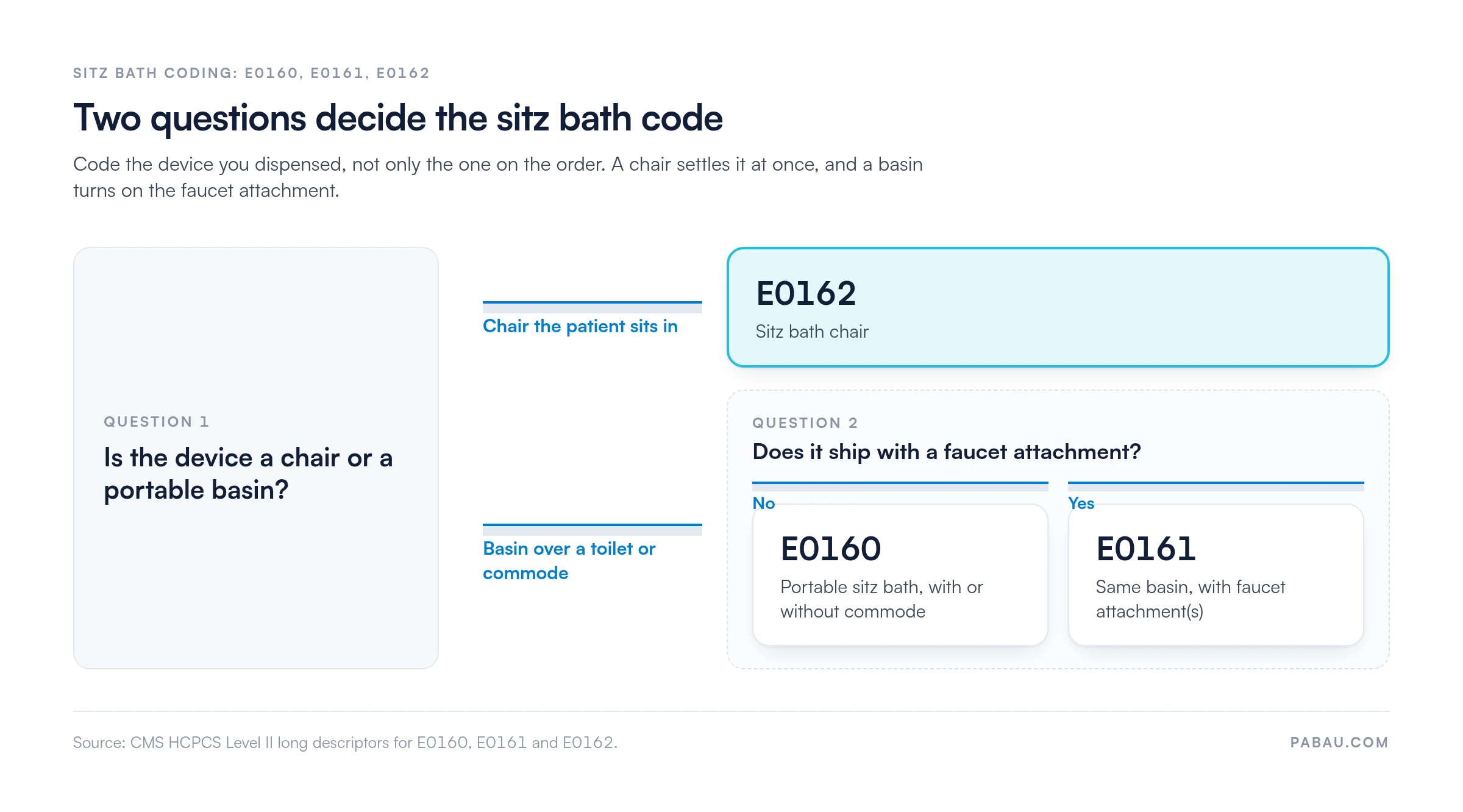
Check the physical device dispensed, not only the physician order. A basin billed as E0162, or a chair billed as E0160, misstates what you supplied and can trigger recoupment on audit. Record the device model number in the supplier file alongside the HCPCS Code E0162 claim line.
Medicare Part B covers E0162 under the DMEPOS benefit when the order supports medical necessity. Medicare’s Durable Medical Equipment Reference List (NCD 280.1) covers a sitz bath when the prescription ties it to a perineal infection or injury. The item must also be part of a planned treatment regimen in the patient’s home.
Coverage is not automatic. The supplier must verify that the patient’s condition, as documented by the treating physician, qualifies before dispensing the chair. Check your DME MAC’s current policy articles as well, since contractors can add their own billing instructions.
Reimbursement is based on the CMS DMEPOS fee schedule, which publishes national and regional rates updated each January. On that schedule, E0162 falls in the inexpensive or routinely purchased (IRP) payment category. That category lets the supplier bill a new purchase, a used purchase, or a monthly rental.
HCPCS Code E0162 is not on the current DMEPOS Required Prior Authorization List, so the claim needs no prior authorization. CMS revises that list periodically, so confirm it against the current year’s version.
Maintaining medical billing compliance means rechecking coverage rules each year instead of relying on last year’s assumptions.
Documentation is where most E0162 claims fail audits rather than at initial submission. CMS and DME MACs require the supplier to obtain and retain specific records before billing. A clean claim submission depends on having complete documentation in the supplier file before the claim goes out.
Required documentation typically includes:
Most DME MAC jurisdictions do not require a Certificate of Medical Necessity (CMN) for E0162. Check your DME MAC’s current guidance all the same. A missing signed written order is one of the most frequent audit findings on low-cost DMEPOS items.
The diagnosis on the claim has to explain why the patient needs a sitz bath chair. A payer reads the ICD-10-CM code first, and a mismatch there can end the claim before anyone opens the documentation. The codes below commonly support a sitz bath order.
List only diagnoses the physician documented in the chart, at the level of detail the note supports. Adding a code to improve the odds of payment is fraud.
A valid diagnosis also has to match the perineal infection or injury criterion before the claim qualifies. For a postpartum patient, check the coding notes for O87.2 before you pair it with E0162.
HCPCS Code E0162 claims typically require at least one modifier to indicate transaction type and medical necessity status. Using the wrong modifier, or omitting a required one, generates an automatic denial from the DME MAC.
Modifier 99 is a placeholder modifier that signals to the payer that additional modifiers are listed in the claim remarks or elsewhere.
Applying Modifier 99 when only one or two modifiers are needed creates unnecessary confusion in claim processing and may trigger a review request. Use it only when the claim genuinely requires three or more modifiers at once.
E0162 denials cluster around a predictable set of causes. Knowing them before submission is the fastest way to improve first-pass acceptance rates.
Practices and suppliers with a high volume of DME claims should track denial patterns by code. Good denial management strategies show whether E0162 denials come from missing documentation, code selection errors, or modifier issues.
E0162 claims follow the standard DME MAC submission workflow. Each step below has a documentation checkpoint, and skipping one raises the odds of a denial.
When E0162 paperwork is tracked by hand across dozens of monthly claims, delivery receipts and written orders go missing. The denial shows up weeks later on the remittance, long after anyone remembers the delivery.
Pabau’s claims management software scrubs every claim for missing or invalid details before it leaves the platform. A claim missing a required field is flagged with the specific error, so your biller fixes it before the DME MAC ever sees it. US claims go out as CMS-1500 claims through Claim.MD to thousands of payers.
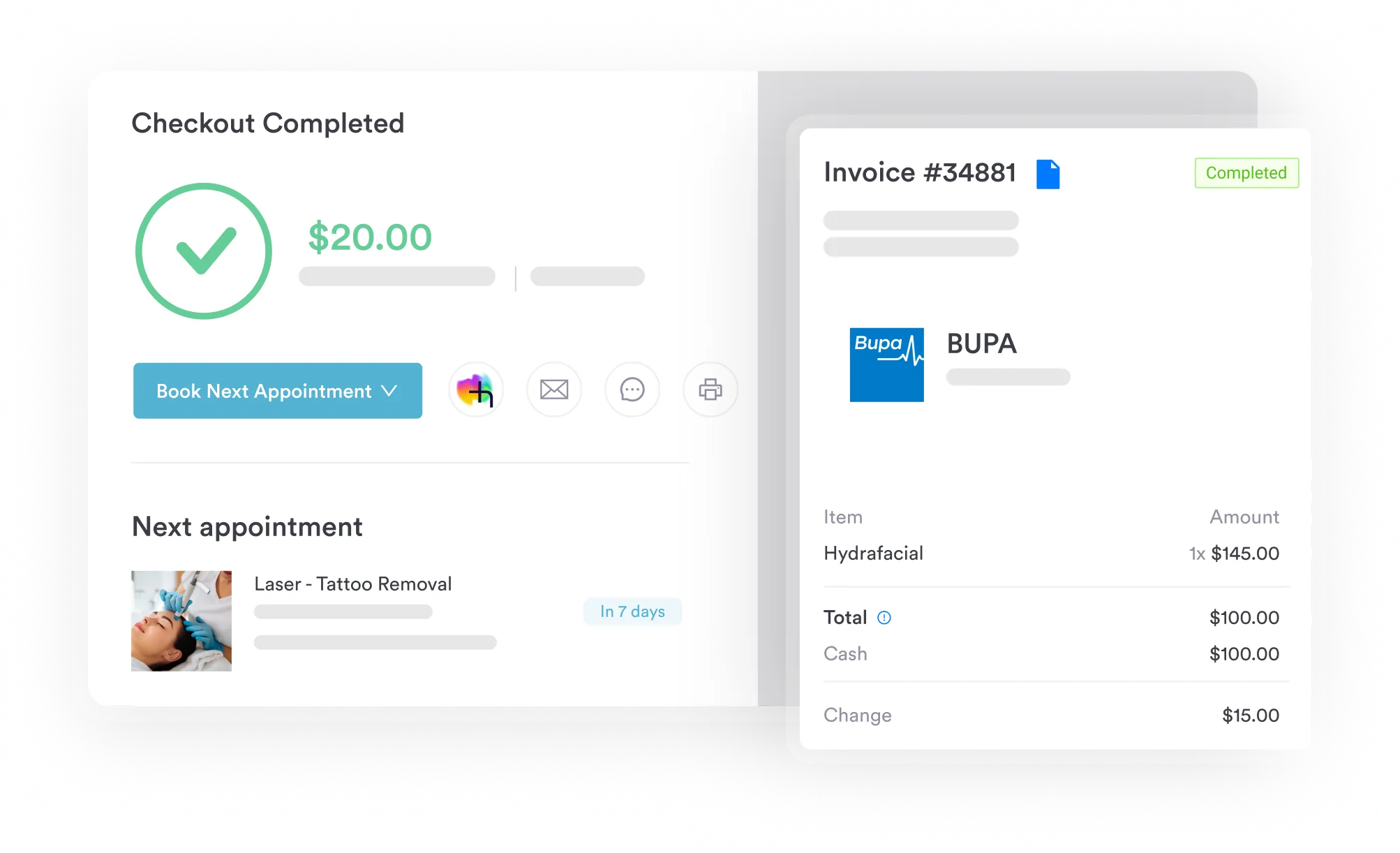
After submission, Pabau tracks every claim through the same stages, from pending to paid, with live counts on one dashboard. Electronic remittance advice files settle against each claim, so a denied E0162 line shows up as soon as the file posts. You spend the week resubmitting a handful of flagged claims instead of auditing the whole DME batch.
Run a quarterly audit of your E0162 denials grouped by reason code. CO-4 points to a modifier mismatch, and CO-15 or CO-197 point to a missing or invalid prior authorization. Missing documentation shows up as CO-16, so check whether the physician order, the delivery receipt, or the coverage notes were absent. Then fix the intake process at that step rather than reviewing each claim individually.

Pabau scrubs every claim for missing or invalid details before submission, then tracks it from pending to paid. Your E0162 claims reach the DME MAC complete.

HCPCS Code E0162 is a straightforward DME code for a sitz bath chair, and its denials rarely come from coverage disputes. They come from missing paperwork and from confusing the chair with the basins billed as E0160 and E0161.
Settle the code at the point of dispensing and keep a written order and proof of delivery in every supplier file. Most E0162 claims then pay on first submission.
Many billing teams manage DMEPOS alongside clinical scheduling and patient records. A platform that connects documentation to claim submission removes the manual handoff where errors usually creep in. Book a demo to see how Pabau’s billing workflows handle DME documentation requirements end to end.

Submitting clean claims every time? Clean claim submission outlines the nine fields payers check first and how to prevent technical rejections before they become denials.
Want to understand DMEPOS billing in context? Medical billing workflows explained covers how DME, professional, and facility claims differ and what each requires from the billing team.
Supplying other bathroom DME? HCPCS code E0240 walks through billing a bath or shower chair, a separate bathroom code outside the sitz bath family.
HCPCS Code E0162 covers a sitz bath chair, a chair-style unit the patient sits in for warm-water soaks. It is classified as durable medical equipment under HCPCS Level II. Physicians order it for post-surgical perineal wound care, hemorrhoids, and similar conditions treated with soaking at home.
E0160 covers a portable sitz bath basin used with or without a commode, while E0162 covers a sitz bath chair. The difference is the form of the device: a basin that sits over a toilet, or a chair the patient sits in. Billing one for the other misstates the equipment supplied and can trigger recoupment on audit.
The transaction-type modifiers for E0162 are NU (new equipment purchase), RR (rental), and UE (used equipment). KX is added when Medicare medical necessity criteria are met. GA is used when an Advance Beneficiary Notice is on file. Modifier 99 applies only when three or more modifiers must be reported simultaneously on one claim line.
Yes, Medicare Part B covers E0162 under the DMEPOS benefit when medical necessity is documented. The prescription must tie the chair to a perineal infection or injury treated at home. The supplier must hold a valid Medicare DMEPOS supplier number, obtain a written physician order before dispensing, and maintain proof of delivery. Beneficiaries pay 20% coinsurance after the Part B deductible.
Required documentation starts with a written physician order dated before dispensing and clinical notes establishing medical necessity. The file also needs a signed proof-of-delivery receipt and supplier records of the device model and dispensing date. A Certificate of Medical Necessity is not typically required for E0162 in most DME MAC jurisdictions, but billers should verify against the active LCD.
Reimbursement for E0162 is set by the CMS DMEPOS fee schedule, which varies by geographic region and is updated each January. Because rates change annually, always verify the current allowed amount through the CMS fee schedule lookup tool rather than relying on prior-year figures.
E1399 is the HCPCS Level II miscellaneous DME code used when a specific code does not exist for the equipment being billed. E0162 is a specific, active code for sitz bath chairs. Billing E1399 when E0162 is the correct code is a coding error. E1399 claims typically require additional documentation explaining why no specific code applies, and they are subject to higher scrutiny on review.