CPT code 21011: Excision of soft tissue tumor of the face
CPT code 21011: Official descriptor and procedure overview CPT code 21011, as pu...

Last Updated: Oct 8, 2026
E0240 is the HCPCS Level II code for bath/shower chair, with or without wheels, any size.
Let Pabau's smart automation suggest the right codes, reduce claim denials, and keep your practice compliant—effortlessly.
Automate repetitive tasks and focus on what matters most—your patients.
Reduce coding errors and ensure compliance with the latest regulations.
Clean claims, fewer denials, and faster reimbursements.
Powerful insights and reporting to help your practice thrive.
HIPAA compliant SOC 2 certified GDPR-compliant Trusted by 4,000+ clinics worldwide

HCPCS Code E0240 describes a bath/shower chair, with or without wheels, any size, and CMS lists it as non-covered by Medicare
E0240 has no DMEPOS fee schedule amount and no Part B coinsurance, because NCD 280.1 denies bath seats as convenience items
Bill E0240 with the GY modifier when a secondary payer needs a formal Medicare denial, and add GX if you issued a voluntary ABN
The KX modifier is never valid on E0240, since a statutory exclusion has no local coverage criteria to meet
Medicaid, Medicare Advantage supplemental benefits, commercial policies, and self-pay are the routes that actually pay for a shower chair
E0240 is an active Level II HCPCS code maintained by the Centers for Medicare and Medicaid Services (CMS). It describes a bath/shower chair, with or without wheels, any size. The code sits in the bathing supplies range E0240 through E0249, part of the HCPCS Level II system.
Active does not mean payable. In the January 2026 alpha-numeric HCPCS file, E0240 carries coverage code M, which means non-covered by Medicare. Its pricing indicator is 00, so Part B does not price the code separately.
The “any size” language in the descriptor is intentional. E0240 covers standard, bariatric, and pediatric shower chairs without a separate code for each variant. Wheels make no difference either, and neither changes the coverage answer.
Medicare Part B does not cover bath or shower chairs. NCD 280.1, the durable medical equipment reference list, denies bath tub seats and bath tub lifts outright. CMS calls them convenience items that are not primarily medical in nature.
The statutory basis is section 1861(n) of the Social Security Act. An item has to be primarily medical in nature to qualify as durable medical equipment. A shower chair fails that test regardless of how frail the patient is.
That verdict does not move with the diagnosis or the strength of the order. The exclusion does change six things at the claim level.
E0240 stays on the DMEPOS jurisdiction list, so any claim you file goes to the DME MAC. The denial comes back as a statutory exclusion rather than a medical necessity failure. Those are different denials with different next steps, and only one of them is worth appealing.
File E0240 to Medicare only when the patient’s secondary plan needs a denial on file first. Append GY, add GX if you issued a voluntary ABN, and treat the denial as the expected result. Appending KX instead creates a compliance problem and a slower answer.
Non-covered by Medicare is not the same as never paid. Four routes remain open, and each one runs on its own rules.
Verify the benefit before the chair leaves the shelf. A benefits check takes minutes, while a chair delivered against a benefit that does not exist costs the practice the full price.
Nothing. E0240 has no allowed amount in the 2026 DMEPOS fee schedule and no locality-based rate behind it. The pricing indicator 00 says Part B does not price the code at all.
That also rules out the lookup tools billers reach for by habit. The physician fee schedule search does not price DMEPOS items. The DMEPOS fee schedule does, and E0240 is absent from the file.
Search the 2026 DMEPOS fee schedule file for E0240 before you quote anyone a figure. The empty result is the answer, and it settles the argument with whoever insists Medicare pays 80%. Set a cash price from your acquisition cost instead.
On a statutorily excluded item, modifiers tell Medicare that you expect the denial and why you filed anyway. Two of them do almost all the work on this code.
GY is the modifier that matters. It produces a clean statutory denial, which is what a Medicaid or commercial secondary plan wants to see before it pays. A shower chair is also sold rather than rented, so rental modifiers rarely belong on the claim line.
KX is the error to watch for. It asserts that criteria in an active local coverage determination have been met, and no such determination exists for E0240. Strip it out of any claim template that still carries it.
Medicare offers no documentation pathway for E0240, so the paperwork serves two other purposes. It satisfies whichever payer might cover the chair, and it protects the practice when the patient pays.
A diagnosis code will not make Medicare pay for E0240. It matters for the payers that do cover bath safety equipment, and for the record behind a self-pay sale. The codes below are illustrative examples rather than a coverage guarantee. Use the CDC/NCHS ICD-10-CM web tool to confirm current code status before you submit.
The E0240 through E0249 range covers bathing and bathroom safety equipment. Coding accuracy still matters on a non-covered item, because the code has to match what you delivered. Check the current HCPCS quarterly update file for full descriptor language and coverage codes before you choose between adjacent codes.
E0245 and E0247 are the codes most often confused with E0240. If part of the item extends over the tub edge to allow a lateral transfer, E0247 is usually correct. If the item is a seated chair placed inside the shower or tub, E0240 applies.
Billers often assume every E-series item works the same way. Setting E0240 next to a commode chair shows how far apart two neighboring codes can sit.
E0163 covers a commode chair with fixed arms, mobile or stationary, and it carries coverage code D. That letter means special coverage instructions apply. It has rows in the DMEPOS fee schedule, so an allowed amount, coinsurance, and a medical necessity review all exist.
E0240 carries coverage code M and no fee schedule row at all. Same code series, opposite billing path. Set side by side, the two codes split on every mechanic of the claim.
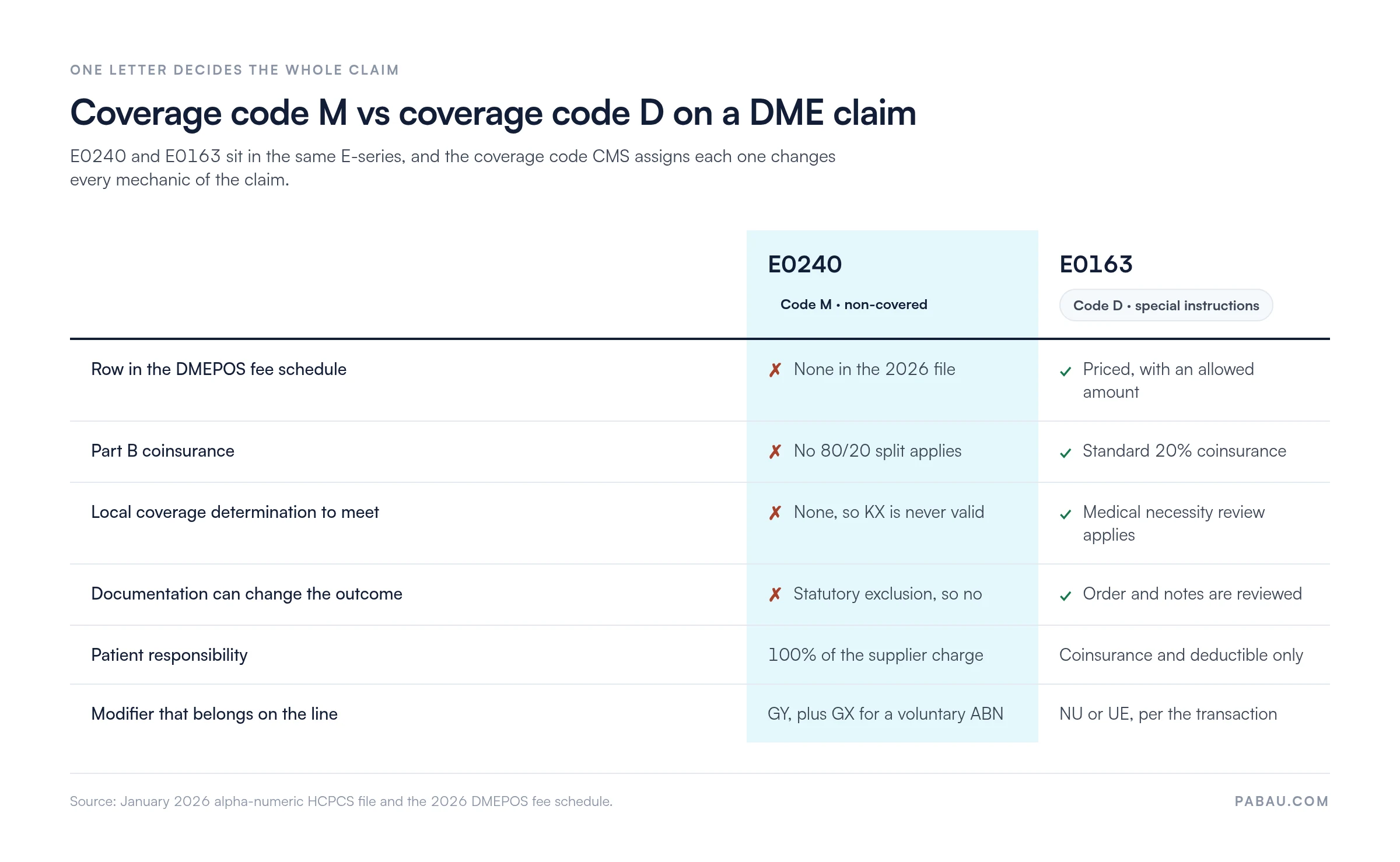
That is the check worth building into your process. Read the coverage code before you build any DME claim, because one letter tells you whether documentation can change the outcome.
The workflow below assumes the patient wants the chair and Medicare is somewhere in the picture. The point is to remove the surprises before delivery rather than after the denial.
Denials on this code cluster around one assumption. Billers treat E0240 as a covered DME item, and the table below shows what that produces. The denial codes in medical billing guide maps CARC and RARC interpretation in detail.
Audit the E0240 claim template once instead of auditing claims every quarter. If the template carries KX, a retired certificate of medical necessity prompt, or a 20% patient estimate, every claim built from it repeats the error. Fixing the template costs one afternoon.
A non-covered item creates work at the front desk rather than in the claim scrubber. Someone has to quote a price, collect a signature, and take the payment. Practice management software like Pabau keeps those three steps on one patient record.
Pabau’s claims management software files the Medicare claim when a secondary payer needs the denial, and records what came back. Pabau’s digital forms hold the written order, the ABN, and the delivery sign-off against the same patient.
Checkout closes the loop. The chair gets invoiced, the patient pays, and the balance stops sitting in an unassigned bucket. Your billers spend their time on the claims that can actually be paid.
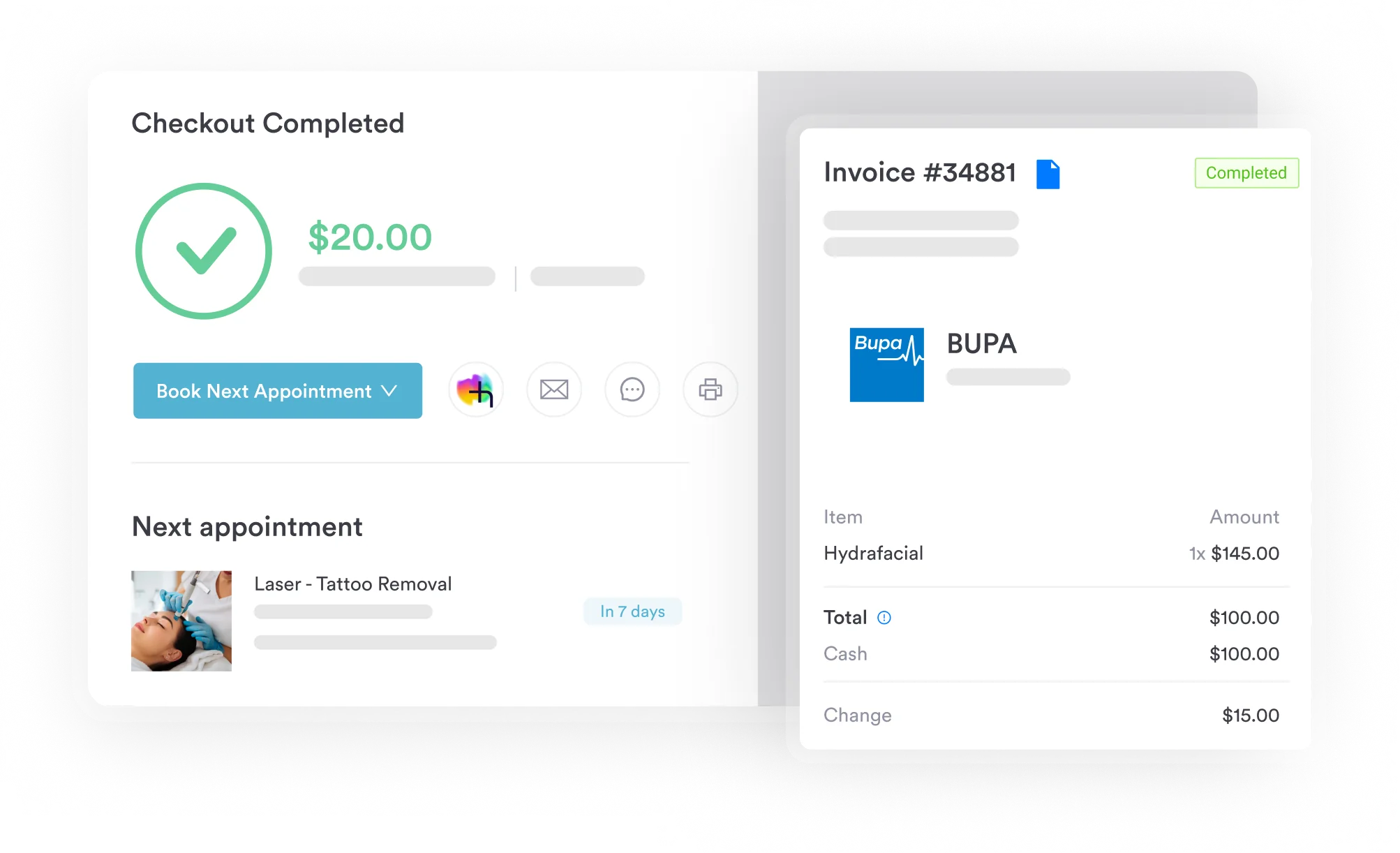

Pabau’s claims management and digital forms hold the written order, the ABN, and the delivery receipt on one patient record. Your team can quote a price, collect it at checkout, and file a Medicare denial when a secondary payer needs one.

E0240 is a code you use, not a code you get paid on. Medicare classifies a bath or shower chair as a convenience item, so there is no fee schedule amount and no medical necessity review to win.
That makes the workflow shorter than most DME billing. Bill GY when a secondary payer needs the denial on record. Check Medicaid and Medicare Advantage benefits before you call the patient self-pay, and put the price in writing first.
Book a demo to see how Pabau ties supply charges to the order, the notice, and the payment behind them.

Billing a commode chair instead? E0163 shows what the documentation looks like on a code Medicare actually covers.
Want to understand how clean claim submission reduces denials? Clean claim standards explains what makes a claim pass initial payer edits and reach adjudication.
Looking for a reference on DMEPOS denial codes and how to respond? Denial codes in medical billing maps common CARC and RARC codes to the right correction.
HCPCS Code E0240 is a Level II HCPCS code describing a bath/shower chair, with or without wheels, any size. The code is active for 2026, but CMS assigns it coverage code M, meaning non-covered by Medicare. It sits in the bathing supplies range E0240 through E0249.
Shower chairs use a HCPCS Level II code, E0240, rather than a CPT code. CPT codes cover physician procedures and services. Equipment and supplies fall under HCPCS Level II, which CMS maintains. Being listed there does not make an item covered, and E0240 is not.
No. NCD 280.1, the durable medical equipment reference list, denies bath tub seats and lifts as convenience items that are not primarily medical in nature. E0240 has no DMEPOS fee schedule amount and no Part B coinsurance. Medicaid, Medicare Advantage supplemental benefits, commercial plans, or self-pay are the routes that may pay.
GY is the main one, because it reports an item statutorily excluded from Medicare. Add GX when you issued a voluntary ABN. NU and UE describe new or used equipment on the claim line. GA is reserved for items where an ABN is mandatory. KX is never valid on E0240.
No. CMS eliminated certificates of medical necessity for all DME claims on January 1, 2023, and the standard written order replaced them. No order form makes E0240 payable, because Medicare excludes bath seats outright. Medicaid and commercial payers may still require a written order or prior authorization.