HCPCS Code G0163: Skilled nursing observation and assessment
What is HCPCS Code G0163? HCPCS Code G0163 is a deleted Level II code for skille...

Last Updated: Oct 15, 2026
E0157 is the HCPCS Level II code for crutch attachment, walker, each.
In short, whether the claim pays comes down to the supporting ICD-10 diagnosis, the written physician order, and the billing unit. According to the Centers for Medicare and Medicaid Services (CMS), HCPCS Level II codes are updated annually. Coverage rules also differ by Medicare Administrative Contractor (MAC) jurisdiction.
Let Pabau's smart automation suggest the right codes, reduce claim denials, and keep your practice compliant—effortlessly.
Automate repetitive tasks and focus on what matters most—your patients.
Reduce coding errors and ensure compliance with the latest regulations.
Clean claims, fewer denials, and faster reimbursements.
Powerful insights and reporting to help your practice thrive.
HIPAA compliant SOC 2 certified GDPR-compliant Trusted by 4,000+ clinics worldwide

HCPCS Code E0157 describes a crutch attachment designed for use with a walker, billed per each unit under the DME benefit.
Medicare Part B covers E0157 when medical necessity is documented, and the non-facility rate applies to most claims.
Billing without a supporting ICD-10 diagnosis code or a physician order is the most common denial trigger for E0157 claims.
Practice management software like Pabau gives billing teams one place to track E0157 submissions, monitor payer responses, and cut denials.
HCPCS Code E0157 is a Level II HCPCS code maintained by CMS. It falls under the E-series (Durable Medical Equipment) code range and has been in the HCPCS code set since 1986. In this case, the billing unit is “each,” meaning one attachment is billed per line item.
Clinically, the attachment converts a standard walker into a forearm or platform walker configuration. For example, some patients cannot grip a standard walker handle at all. Wrist fractures, arthritis, and neurological conditions affecting hand function are the usual reasons, so the attachment shifts the weight to the forearms.
Per the AAPC HCPCS Level II code lookup, E0157 sits in the same walker accessory series as E0153 through E0159.
In particular, E0157 covers a single crutch attachment intended to be mounted onto a walker frame. It is the accessory itself, not the walker, and it changes how a patient bears weight while walking.
Medicare Part B covers E0157 under the DME benefit, provided that the equipment is medically necessary, ordered by a treating physician or qualified practitioner, and supplied by an enrolled DME supplier.
Coverage requires all of the following conditions to be met:
State Medicaid programs may also cover E0157. Coverage criteria, prior authorization requirements, and reimbursement rates vary by state, so verify payer-specific rules before you submit.
Medicare reimbursement for E0157 is set through the annual CMS DME fee schedule. In addition, rates vary by MAC jurisdiction (the geographic region that processes your Medicare DME claims). The non-facility rate applies for most DME supplier claims, since the equipment is delivered to the patient’s home rather than billed from a facility setting.
Important note on rates: In fact, Medicare DME fee schedule amounts change each calendar year. The table below explains the fee schedule structure rather than quoting amounts. Verify the current year’s allowed amounts through the CMS DMEPOS fee schedule or your DME MAC before billing.
The electronic remittance advice (ERA) maps each allowed amount back to its line item. That is where an underpayment or a jurisdiction mismatch shows up, so read it line by line rather than at the claim total.
Most E0157 denials trace back to the documentation. CMS and DME MACs require specific elements in the clinical record before a claim is payable. As a result, missing any one of them triggers an automatic denial or a medical review request.
Required documentation includes:
Indeed, complete records are a compliance requirement, not simply good practice. Capturing the ordering practitioner, the diagnosis, and the equipment ordered in one document keeps the claim intact before it leaves the practice.
Review your DME MAC’s Local Coverage Determination (LCD) for walker and walker accessories before billing E0157. LCDs specify covered diagnoses, documentation requirements, and any quantity limits that apply in your jurisdiction. Noridian and CGS publish these freely on their websites.
A supporting ICD-10 diagnosis code is required on every E0157 claim. Specifically, the diagnosis must establish why the patient cannot use a standard walker handle, making the forearm or platform crutch attachment medically necessary. The table below covers the diagnoses most often paired with E0157.
Always verify ICD-10 code pairing against your DME MAC’s LCD or the CMS ICD-10 codes page before submitting. A diagnosis missing from your jurisdiction’s covered list is denied regardless of clinical justification. Our ICD-10-CM code library is a quick way to confirm a descriptor before it goes on the claim.
E0157 sits in a series of walker and ambulatory aid codes. Selecting the wrong adjacent code is a common mistake, particularly when the patient needs a complete walker system rather than just an accessory. The table below covers the most frequently referenced codes in this series to help coders select the correct code.
E0156 and E0157 sit next to each other in the HCPCS code series and are frequently confused. In fact, the distinction matters clinically: one is a seat, while the other is a forearm or platform crutch attachment, and billing the wrong one produces a denial that takes weeks to appeal.
A patient may sometimes need both a seat attachment and a crutch attachment on the same walker. In that case, bill E0156 and E0157 on the same claim as separate line items, and document the distinct clinical rationale for each accessory in the patient record.
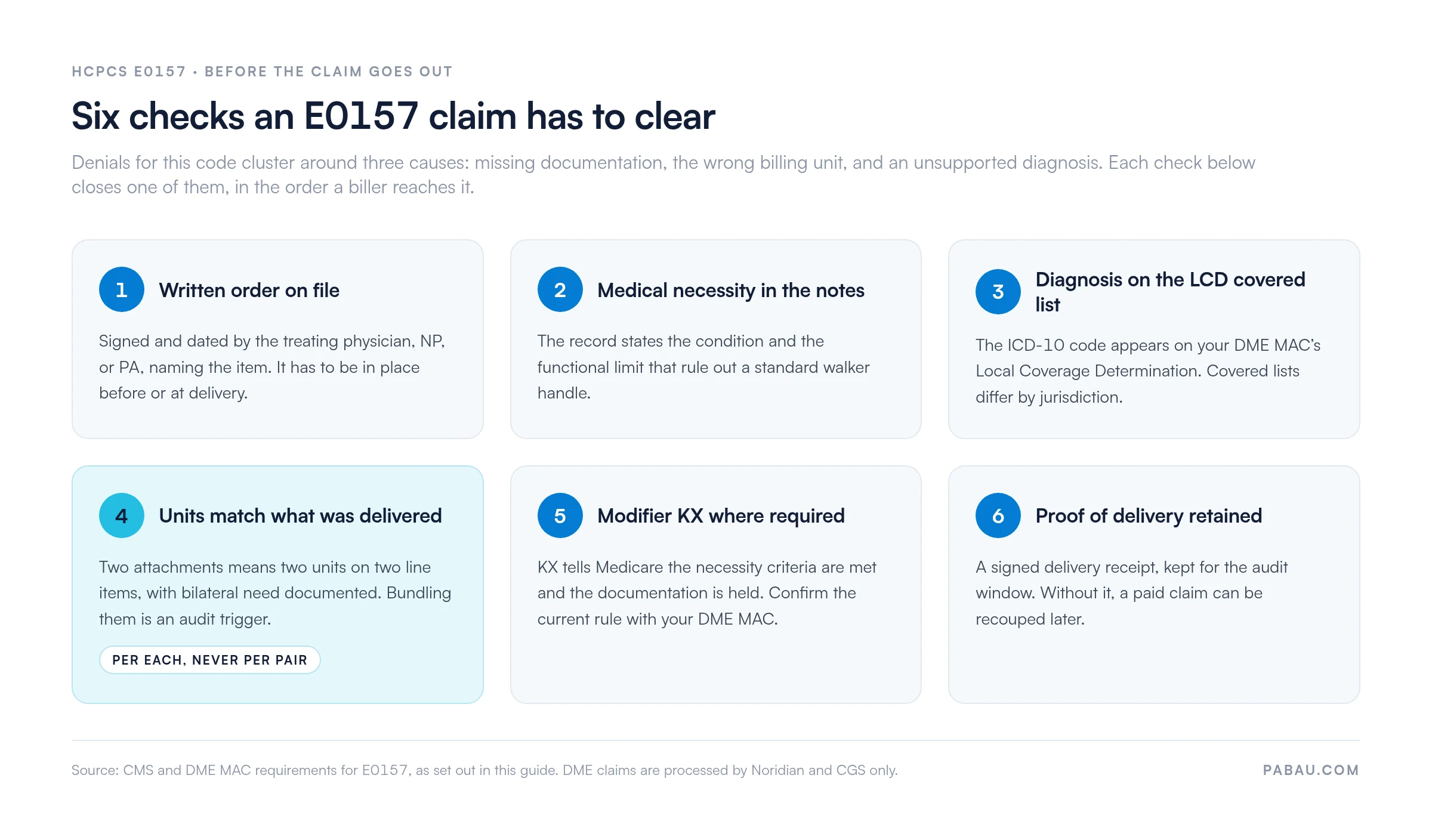
Getting E0157 paid on the first submission requires attention to a handful of common pitfalls. Denials for this code cluster around three issues: missing documentation, wrong billing units, and unsupported diagnosis pairings.
A practice that handles DME billing alongside clinical care carries the most handoffs, and each one is a place for an order or a diagnosis to go missing. As a result, moving that work into claims management software removes most of those steps.
A centralized claim workflow captures the order, links the diagnosis, and tracks the payer response in one place. That beats reconciling spreadsheets and fax logs after the remittance lands.
Run a pre-submission check on every E0157 claim. Confirm the written order is signed and dated. Confirm the ICD-10 diagnosis appears on your DME MAC’s LCD covered list. Then confirm the billing unit matches the number of attachments delivered, and that modifier KX is there if required. A 60-second pre-submission checklist eliminates the majority of first-pass denials.
DME billing usually runs across three places: the order sits in the chart, the diagnosis sits on a coding sheet, and the claim status sits in a payer portal. Consequently, reconciling the three is manual work, and it normally happens after a denial has already landed.
Overall, Pabau keeps the client record, the invoice, and the claim in one system. Your team submits from the record that already holds the encounter, then tracks the payer response against it. Therefore, nothing gets re-keyed into a separate billing tool.
So a denied E0157 line stays visible next to the encounter it came from. In short, your billers can see which claims are outstanding, which came back short, and which need a corrected resubmission, without opening a portal for every payer.

Pabau gives your billing team one place to submit claims, track payer responses, and work denials on HCPCS codes like E0157. That means fewer handoffs and fewer missing orders at submission.

Overall, E0157 is a small line on a claim that fails for predictable reasons. Check the diagnosis pairing, the written order, the unit count, and your jurisdiction’s covered list before you submit. Doing them in that order turns a denial-prone code into a routine one.
The trade-off worth remembering is that per-each codes reward precision over speed. Indeed, bundling two attachments into a single unit saves one keystroke and invites an audit.
If DME lines are a regular part of your billing, holding the record and the claim in one system removes most of the reconciliation. Book a demo to see how Pabau tracks HCPCS submissions and denials for your billing team.

Need a reference for revenue cycle fundamentals? What is revenue cycle management covers the end-to-end billing cycle from patient registration through final remittance, with practical examples for billing teams.
Want to understand how clean claims reduce rework? Submitting a clean claim explains the elements that determine first-pass acceptance and how to build a pre-submission review process for DME codes.
Billing DME items to Medicare? Medicare billing walks through enrollment, claim submission, and the coverage rules that decide whether a Part B claim gets paid.
HCPCS Code E0157 is a Level II code for a crutch attachment fitted to a walker frame, billed per each attachment. It falls under the Durable Medical Equipment (DME) code category. Billers use it for Medicare Part B and Medicaid DME claims when a patient needs forearm or platform weight distribution.
Medicare allowed amounts for E0157 are set annually through the CMS DME fee schedule and vary by MAC jurisdiction. The non-facility rate applies for most DME supplier claims. Rates change each calendar year. Verify the current allowed amount through the CMS DMEPOS fee schedule, or contact your DME MAC before billing.
To bill E0157, you need four items on file. First, a signed written order from a treating physician, NP, or PA. Second, clinical notes documenting why a standard walker handle will not work. Third, a signed proof of delivery. Fourth, an ICD-10 diagnosis code that appears on your DME MAC’s Local Coverage Determination (LCD) covered list. In some cases, an Advance Beneficiary Notice (ABN) is also required before delivery.
Yes. E0157 can be billed on the same claim as the walker itself, such as E0130 or E0135. It can also go alongside accessories like E0156, provided each item serves a distinct documented purpose. Always verify bundling rules with your DME MAC and confirm no LCD restrictions prohibit billing specific code combinations together in your jurisdiction.