CPT code 93503: Swan-Ganz catheter billing and modifiers
CPT code 93503: Official descriptor and procedure overview In the AMA CPT code s...

Last Updated: Oct 23, 2026
C1752 is the HCPCS Level II code for catheter, hemodialysis/peritoneal, short-term. It reports the supply of a non-tunneled hemodialysis or peritoneal dialysis catheter on hospital outpatient claims, not the placement procedure.
The placement is billed separately with a CPT code, usually 36556. A tunneled or cuffed catheter takes C1750, the long-term counterpart, instead. Under OPPS, payment for C1752 is normally packaged into the procedure's APC.
Let Pabau's smart automation suggest the right codes, reduce claim denials, and keep your practice compliant—effortlessly.
Automate repetitive tasks and focus on what matters most—your patients.
Reduce coding errors and ensure compliance with the latest regulations.
Clean claims, fewer denials, and faster reimbursements.
Powerful insights and reporting to help your practice thrive.
HIPAA compliant SOC 2 certified GDPR-compliant Trusted by 4,000+ clinics worldwide

HCPCS Code C1752 reports the supply of a short-term (non-tunneled) hemodialysis or peritoneal dialysis catheter, not the placement procedure.
C1752 belongs on hospital outpatient claims under OPPS, with ASC reporting only where the device has pass-through status. Physician offices and inpatient stays don’t use it.
C1750 is the code for long-term or tunneled catheters. The choice between the two follows the device and the physician’s documentation, not coder judgment.
Practice management software like Pabau keeps patient records, invoices and reporting in one place. That makes the paperwork behind a C1752 line easy to check.
HCPCS Code C1752 describes a catheter used for hemodialysis or peritoneal dialysis access on a short-term basis. The official CMS descriptor is: Catheter, hemodialysis/peritoneal, short-term. That phrase carries three coding decisions: catheter type (hemodialysis or peritoneal), access modality (dialysis), and duration (short-term, meaning non-tunneled or temporary access).
C1752 belongs to the C-code series within HCPCS Level II, the code set maintained by the Centers for Medicare and Medicaid Services (CMS). It mainly covers items CPT doesn’t describe. C-codes capture device costs under the Hospital Outpatient Prospective Payment System (HOPPS, also called OPPS). They belong on hospital outpatient claims, and on ASC claims only where the device has pass-through status. The other C-codes, and the drug and supply series, sit in our HCPCS code library.
The code covers the cost of the catheter device itself. It does not cover the placement procedure, any infusion fluids, or enteral supplies. The CPT code for catheter insertion is billed on the same claim as a separate line item.
C1752 is reported on hospital outpatient claims under OPPS, and on ASC claims only where the device has pass-through status. C-codes are not part of the physician fee schedule, so a physician practice can’t bill one on a CMS-1500 as a separate device charge.
Before submitting a hospital outpatient claim with C1752, confirm the claim form is a UB-04. Then check that the facility’s revenue codes support the supply charge. The revenue code follows the facility’s chargemaster, commonly 270 or 272 for non-implant supplies.
Under HOPPS, CMS assigns services to Ambulatory Payment Classification (APC) groups, and the APC sets the payment rate. New devices can receive transitional pass-through status, which pays them separately for a limited period. C1752 has been active since April 1, 2001, so its pass-through period lapsed long ago. Its cost is normally packaged into the procedure’s APC.
The table below reflects the general HOPPS billing framework for a device supply code like C1752. Confirm the exact 2026 status indicator and any APC details in the CMS 2026 OPPS Addendum B, as they can change each year.
Device pass-through status is granted for a maximum of three years. After that period, CMS folds the device cost into the APC rate and the code loses pass-through designation. Check the status indicator each November, when the new OPPS final rule typically publishes (early November).
Check the CMS OPPS Addendum B file each January for the current year’s status indicator for C1752. Status indicators can change with each annual final rule, and billing against a stale one causes avoidable payment errors.
C1752 covers short-term (non-tunneled) catheters, while C1750 covers long-term or tunneled catheters. Selecting the wrong code is an audit risk because the clinical documentation determines which applies, not the coder’s interpretation.
The distinction hinges on the device itself and the physician’s intent as documented in the operative report. A tunneled, cuffed catheter (such as a PermCath or Hickman-style dialysis catheter) placed for ongoing ESRD access is C1750. That holds however long the patient ends up using it. A non-tunneled catheter placed for acute or temporary dialysis access is C1752. The decision runs in three branches.
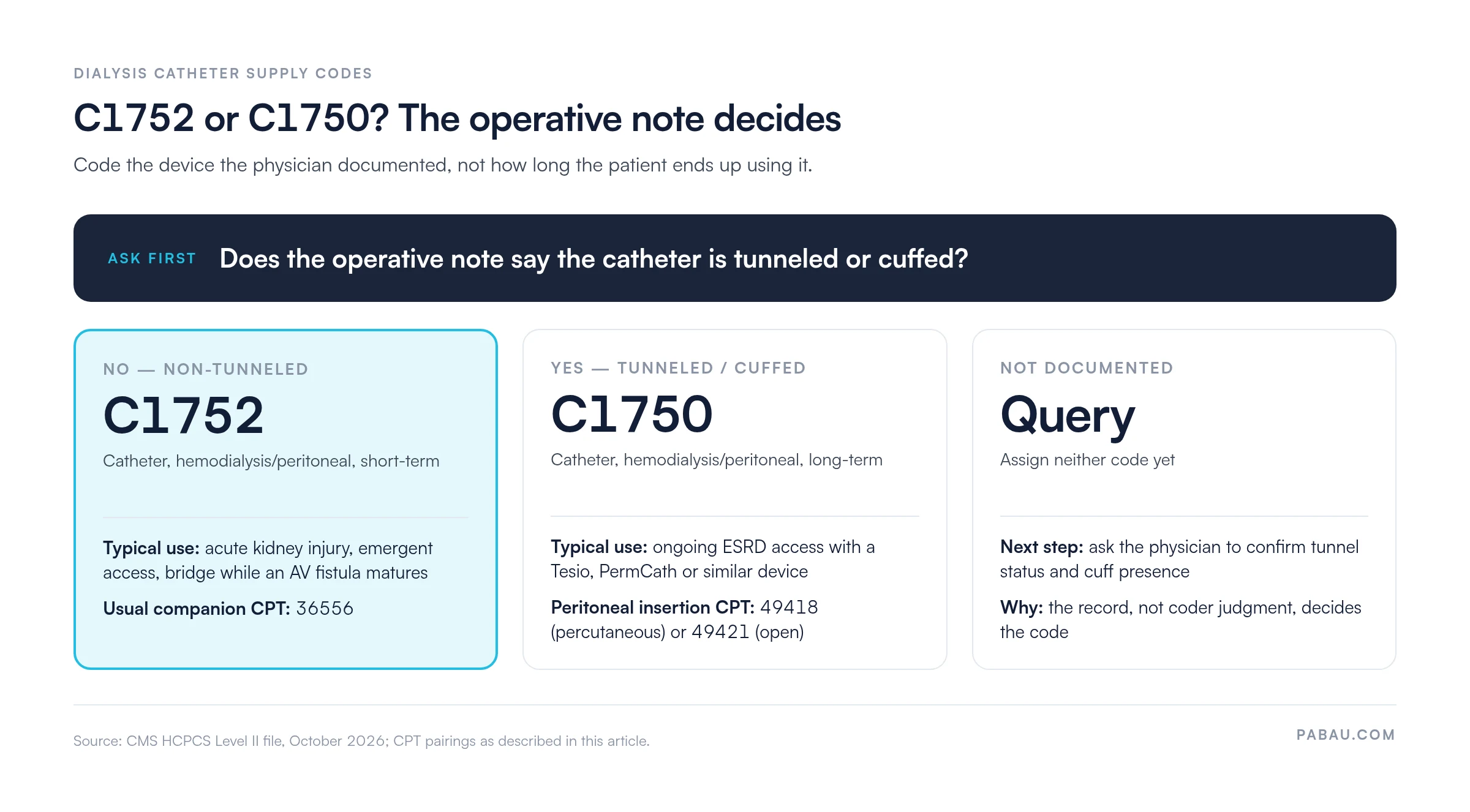
If the operative report does not specify tunnel status or cuff presence, request clarification from the physician before assigning either code. Misclassifying a tunneled catheter as short-term misreports the device on the claim and, if done systematically, may trigger a payer audit.
HCPCS Code C1752 reports the supply, and the CPT code on the same claim reports the placement procedure. Both are typically required on a HOPPS claim for the full service to be reimbursed. For a short-term, non-tunneled dialysis catheter, the usual companion is CPT 36556. It describes insertion of a non-tunneled centrally inserted central venous catheter, age 5 or older.
Peritoneal dialysis catheters follow different codes. CPT 49418 (percutaneous) and 49421 (open) describe tunneled intraperitoneal catheters, so they pair with the long-term code C1750 rather than C1752.
When C1752 carries status indicator N, its payment is packaged into the companion procedure’s APC, so the supply line pays nothing on its own. Check the Addendum B status indicator each year so the chargemaster and payment expectations match.
The medical record must establish both that the device was used and that it was medically necessary. Auditors and Medicare Administrative Contractors (MACs) look for five elements.
Good documentation habits around medical billing workflows prevent many C1752 denials before they happen. A pre-bill checklist that requires a device label, a physician order, and a completed operative note catches missing elements without slowing the billing cycle. Capturing charges at the point of care, the facility version of a superbill, also cuts retrospective queries on supply codes.
Medicare covers C1752 under HOPPS when the service is medically necessary and performed in a covered outpatient setting. No national coverage determination (NCD) governs short-term dialysis catheter supplies as a standalone item. Coverage therefore follows the HOPPS payment rules and any applicable MAC local coverage determinations (LCDs).
Payer policy around dialysis catheter supplies is one area where billing compliance requirements diverge significantly between Medicare and commercial plans. Build payer-specific rules into your verification workflow so staff do not apply Medicare logic to commercial claims.
Traditional Medicare does not require prior authorization for C1752 under the standard HOPPS framework. However, some payers do require it.
C1752 denials tend to repeat the same six patterns, listed below with their fixes. Effective denial management strategies start by tracing each denial to its root cause, using the CARC code as the starting point.
Beyond the denial patterns above, a few proactive steps make a measurable difference in C1752 claim accuracy. Experienced outpatient coders build these habits into their standard workflow.
Billing teams using claims management software with built-in code validation can automate parts of this checklist. Claim lines without supporting documentation are flagged before submission rather than after a denial arrives.
Audit your chargemaster dialysis supply entries once a year, after the CMS OPPS final rule publishes (typically early November). Confirm that C1752 maps to the correct short-term catheter SKUs and that any tunneled catheter SKUs map to C1750 instead. A misaligned CDM entry will generate incorrect claims automatically until it is corrected.
The proof behind a C1752 line is often scattered. The physician order sits in one place, the device details in a paper implant log, and the charge in the billing queue. When a payer questions the claim, someone has to piece the record back together.
Pabau keeps those pieces on one patient record. Treatment notes and digital forms sit next to the invoice for the visit. A billing lead can confirm the order, the procedure note and the device details before the charge goes out.
Reporting then shows which invoices were raised and when, so recurring documentation problems show up as a pattern your team can fix at the source.

Pabau keeps treatment notes, digital forms, invoices and reporting on one patient record. Your billing team can check the documentation behind each supply line before a claim goes out.

C1752 rarely pays on its own anymore, but it still has to be right on the claim. Code the device the operative note describes, report it on the hospital outpatient claim, and recheck its status indicator when each OPPS final rule lands.
When the note doesn’t say whether the catheter is tunneled, stop and query the physician. That one question settles the C1752 versus C1750 choice and keeps the device line defensible in an audit.
Book a demo to see how Pabau keeps notes, forms and invoices on one patient record for every supply line you bill.

Need a framework for managing claim denials across supply codes? Denial management in healthcare covers root cause analysis, appeal workflows, and prevention strategies for outpatient billing teams.
Want to understand how the broader billing process connects to supply codes? What is revenue cycle management explains the end-to-end workflow from charge capture through payment posting.
Looking for compliance best practices when billing device supply codes? Medical billing compliance outlines audit readiness, documentation standards, and payer policy adherence for outpatient facilities.
HCPCS Code C1752 covers the supply of a short-term, non-tunneled catheter used for hemodialysis or peritoneal dialysis access. It reports the device cost only; the catheter placement procedure is reported separately using the applicable CPT code on the same claim.
C1752 is for short-term, non-tunneled dialysis catheters placed for temporary or acute access. C1750 is for long-term, tunneled and cuffed catheters used for ongoing ESRD dialysis access. The distinction is determined by the device type and physician documentation, not the duration of use.
Yes. Medicare covers C1752 under HOPPS for a catheter placed in a hospital outpatient department. Medical necessity must be documented, and the claim goes out on a UB-04. Its payment is normally packaged into the procedure’s APC. Medicare Advantage plans can add prior authorization requirements.
The most common reasons are billing C1752 on a CMS-1500 instead of a UB-04, missing device documentation, and using the wrong revenue code. Another is selecting C1752 when the catheter placed was tunneled and should be C1750. A supply line also pays nothing separately when its cost is packaged into the companion CPT’s APC.
Traditional Medicare does not require prior authorization for C1752. Medicare Advantage plans and commercial insurers may require it, particularly for elective catheter placements above a cost threshold. For emergent placements, many payers allow retrospective authorization within a short window. Check the payer’s policy and document the clinical urgency.
The record needs a physician order specifying catheter type and short-term intent, plus an operative note confirming the non-tunneled device and access site. It also needs the device label or implant record with manufacturer and lot number. Finally, an ICD-10-CM code such as AKI or ESRD with failed permanent access must support medical necessity.