

CCSD code G5100: Bypass of duodenum billing guide
CCSD code G5100 bills a bypass that leaves the duodenum in place CCSD code G5100...

Last Updated: Oct 16, 2026
B4189 is the HCPCS Level II code for compounded, premixed parenteral nutrition solution that supplies 10 to 51 grams of protein per day. The solution contains amino acids, carbohydrates, electrolytes, trace elements, and vitamins, and the code includes preparation.
It is billed per day to the DME MAC that covers the beneficiary's state of residence. CMS dropped certificates of medical necessity (CMNs) for dates of service from January 1, 2023. Claims now rest on a standard written order, LCD L38953 records, proof of delivery, and the KX modifier.
Let Pabau's smart automation suggest the right codes, reduce claim denials, and keep your practice compliant—effortlessly.
Automate repetitive tasks and focus on what matters most—your patients.
Reduce coding errors and ensure compliance with the latest regulations.
Clean claims, fewer denials, and faster reimbursements.
Powerful insights and reporting to help your practice thrive.
HIPAA compliant SOC 2 certified GDPR-compliant Trusted by 4,000+ clinics worldwide

B4189 applies to premix PN solutions with 10 to 51 grams of protein per day. Use B9999 below 10 g and B4193 from 52 g.
Under LCD L38953, Medicare covers PN as a prosthetic device when the patient has a permanent GI impairment. The patient must also be unable to absorb adequate nutrition orally or enterally.
CMS retired certificates of medical necessity in 2023. B4189 claims now rest on a standard written order, LCD L38953 records, proof of delivery, and the KX modifier.
Claims go to the DME MAC for the beneficiary’s state of residence, not the supplier’s location.
Practice software such as Pabau keeps orders, clinical notes, and claims in one patient record, so billing staff can catch PN errors before submission.
HCPCS code B4189 is the Level II billing code for premixed parenteral nutrition when the ordered protein dose is 10 to 51 grams per day. The solution is compounded with amino acids, carbohydrates, electrolytes, trace elements, and vitamins. It sits within the CMS HCPCS Level II B-series and is billed to the DME MAC under the Medicare prosthetic device benefit.
The phrase “including preparation” in the descriptor means the compounding fee is bundled into B4189. A separate line for pharmacy compounding on the same claim is unbundling, and that line may be rejected or returned.
Premix means the pharmacy compounds the full solution before delivery. Amino acids and dextrose can also arrive as separate home-mix components. Each one is then billed under its own code in the B4164 to B4180 range, not B4189. Each of those sits in our directory of HCPCS codes.
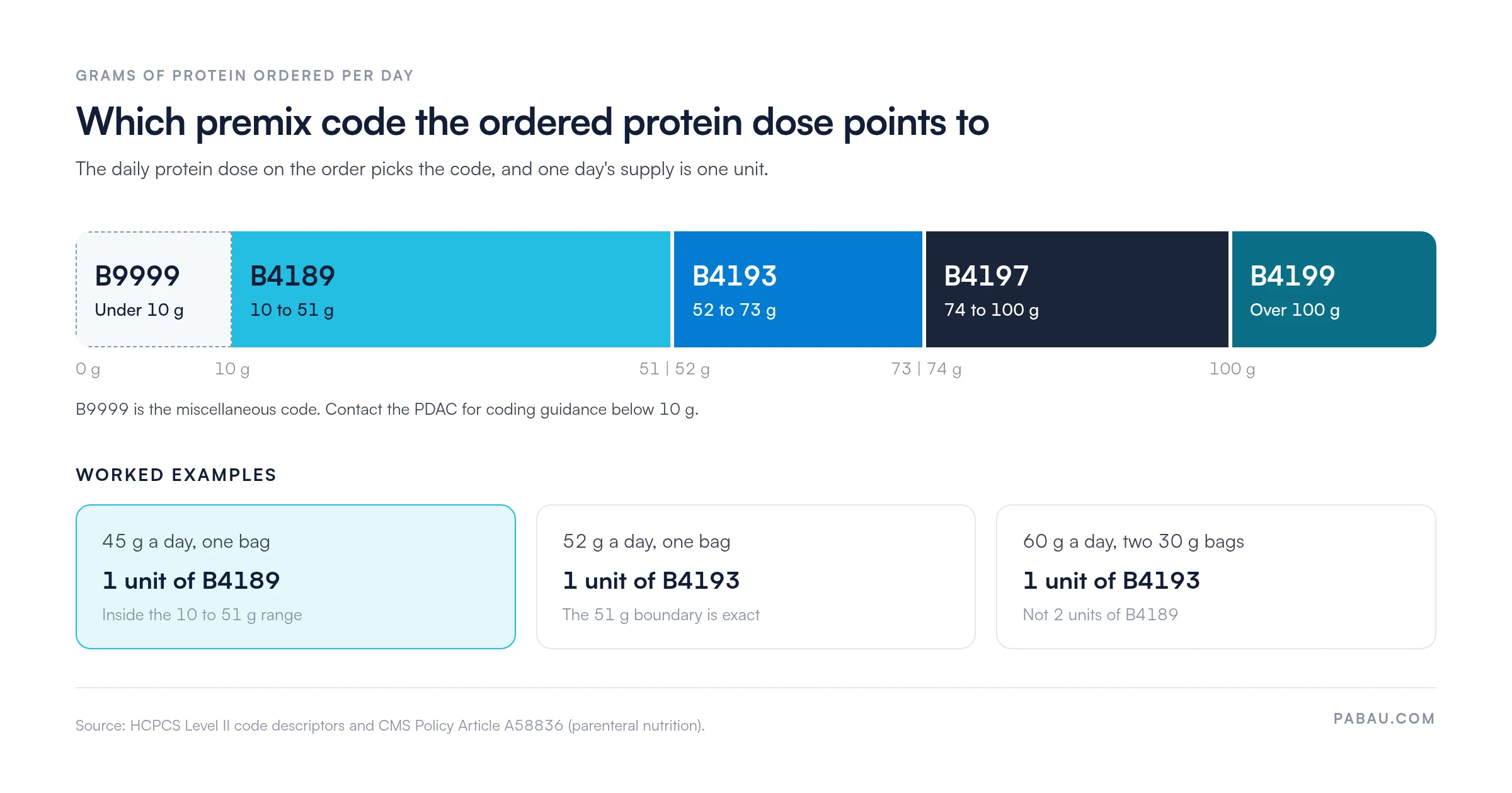
The premix PN codes from B4189 to B4199 are split by the protein dose ordered per day. A misread order leads straight to the wrong code. The table below maps the premix protein-range codes.
The boundary at 51 grams is exact, not approximate. If the order calls for 52 grams, the correct code is B4193, and billing B4189 at that dose is downcoding. Billing B4193 when only 45 grams are ordered is upcoding. Below 10 grams, the solution is coded B9999, and the Pricing, Data Analysis and Coding (PDAC) contractor gives coding guidance.
One unit is one day’s supply, however many bags it comes in. The scale below shows where each dose lands, including the split-bag case that trips up unit counts.
Renal, hepatic, and stress formulas have their own premix codes (B5000, B5100, and B5200), so this gram range does not apply to them.
What B4189 bundles in: Compounded crystalline amino acids, a dextrose or other carbohydrate source, multivitamins, and the pharmacy compounding fee. It also covers electrolytes (sodium, potassium, calcium, magnesium, phosphate) and trace elements (zinc, copper, selenium, chromium, manganese).
What B4189 does not include: Lipid emulsion, which has its own HCPCS codes. Infusion pumps and supply kits are billed on their own lines, and nursing visits are not a DME MAC benefit at all.
Medicare covers parenteral nutrition under the prosthetic device benefit when the patient meets the LCD L38953 criteria. The patient must have a permanent impairment of the gastrointestinal tract and be unable to absorb adequate nutrition orally or enterally. “Permanent” does not mean irreversible.
The Durable Medical Equipment Medicare Administrative Contractor (DME MAC) processes all B4189 claims, not the A/B MAC that handles most Part B services. Two contractors run the four DME MAC jurisdictions: CGS Administrators (Jurisdictions B and C) and Noridian (Jurisdictions A and D). Route each claim to the DME MAC for the state where the beneficiary permanently resides, not the supplier’s location. A claim sent to the wrong MAC may be rejected or returned, which delays payment.
LCD L38953 and Policy Article A58836 publish no list of covered ICD-10-CM codes, so medical necessity rests on the medical record. The codes below are examples of GI conditions that can support parenteral nutrition. The record must still show a permanent GI impairment, and a malnutrition code alone does not establish one.
With no code list to check against, the clinical notes carry the claim. They should name the condition and describe how it impairs absorption. They should also explain why enteral nutrition was ruled out, tried and failed, or would worsen GI dysfunction. The AAPC HCPCS code reference is a useful secondary check, but the LCD and its policy article are the controlling authority.
Medicare reviews B4189 claims against the medical record. CMS eliminated the Certificate of Medical Necessity (CMN) and DME Information Form (DIF) for dates of service on or after January 1, 2023. CGS confirms the change, so no CMN goes in the file now. Instead, these four items must be in place before submission.
Reviewers also commonly look for supporting records that ground the order in clinical measurement.
Audit your PN claim files quarterly. Check that each file holds an SWO dated before the claim, the 30-day practitioner evaluation, and proof of delivery for every billed date. A KX modifier with no records behind it puts the whole claim at risk of recoupment.
CMS prices B4189 as a per-day amount on the DMEPOS fee schedule, under the parenteral and enteral nutrition (PEN) items. The schedule is updated each January.
Rather than rely on a figure that will go out of date, check the current allowable on the CMS DMEPOS fee schedule before you bill. The 80/20 Medicare coinsurance split applies. Medicare pays 80% of the allowable, and the patient or a secondary payer covers the remaining 20%.
Each denial below traces back to a documentation or workflow step you can fix before submission.
For a broader framework on claim rejections across code families, the denial management guide covers appeal workflows and root-cause analysis. Modifier placement and diagnosis pairing are covered in depth in the clean claim reference.
B4189 is billed to the DME MAC when the patient is not in a Part A covered stay. In an inpatient hospital or Part A SNF stay, PN is bundled into the facility payment.
When a skilled nursing facility (SNF) stay is covered by Part A, the SNF bills the PN to its fiscal intermediary. When the SNF stay is not covered by Part A, PN falls under Part B coverage. Either the SNF or an outside supplier may then bill the DME MAC. No B4189 date of service may fall within a Part A covered stay.
Nursing and administration services are not payable by the DME MAC under B4189 or its policy, so they sit outside this code. Understanding how medical billing differs across care settings helps billing staff route each claim correctly.
The Office of Inspector General (OIG) has flagged parenteral nutrition billing as an audit focus, citing missing medical necessity records and incorrect code selection. OIG priorities change each year. PN claims remain in scope for DME MAC targeted probe audits and Comprehensive Error Rate Testing (CERT) reviews.
For billing staff building internal compliance programs, the medical billing compliance guide and the superbill reference provide practical frameworks for documentation control and audit readiness.
Many B4189 denials start before anyone builds the claim. The SWO sits in one inbox and the delivery record in another. Nobody notices the missing document until the DME MAC asks for records.
With Pabau’s claims management software, the order, the practitioner’s notes, and the claim sit in the same patient record. Billing staff can check the HCPCS code, the KX modifier, and the diagnosis against that record before they submit.
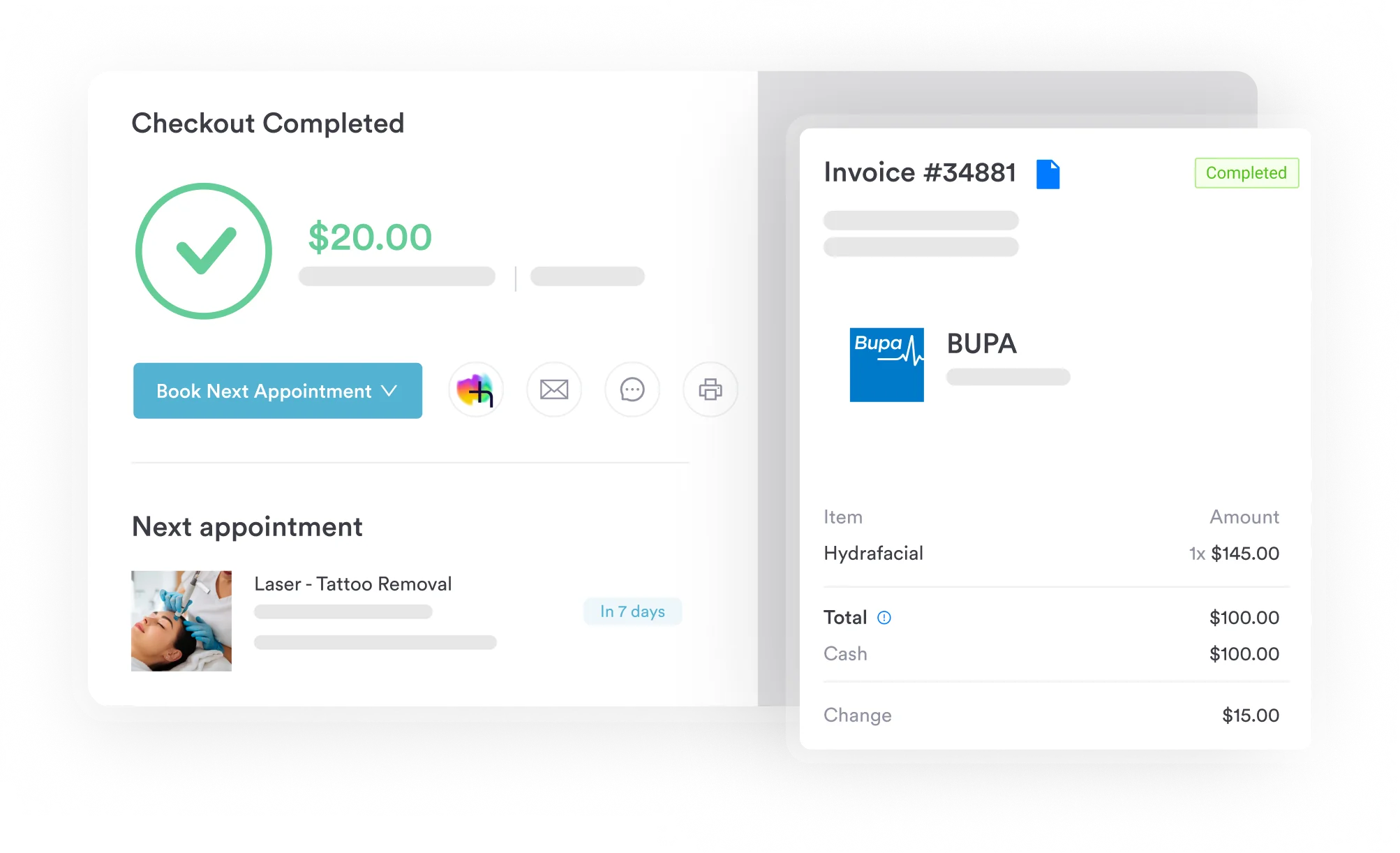
The result is fewer claims sent with a missing document behind them, and a file that is ready when a reviewer asks for it.

Pabau keeps orders, clinical notes, and claims in one patient record, so your parenteral nutrition claims go out with the documentation behind them.

The CMN is gone, but the scrutiny it carried has moved into the medical record. A B4189 claim now depends on whether the SWO, the 30-day evaluation, the enteral rationale, and proof of delivery back up the KX modifier.
A team still working from a CMN-era checklist is chasing a form Medicare no longer uses and missing the records it does review. Rebuild the checklist around the SWO and LCD L38953, and confirm the protein dose against the code table before every claim. Then route each claim by where the beneficiary lives, not where you ship from. Book a demo to see how Pabau keeps orders, notes, and claims together for parenteral nutrition billing.

Need to understand denial patterns across billing codes? Denial management in healthcare covers root-cause analysis, appeal workflows, and prevention strategies for DMEPOS and Part B claims.
Building a compliant billing workflow from scratch? What is medical billing walks through the end-to-end revenue cycle process, from code selection through payment posting.
Want a clean-claim checklist for HCPCS submissions? Clean claim standards details the modifier, diagnosis, and payer-routing requirements that keep HCPCS claims from bouncing on first submission.
Ordering 74 to 100 grams of protein a day? HCPCS code B4197 covers the next premix range up, with its own coding and documentation rules.
HCPCS code B4189 covers a compounded parenteral nutrition solution for patients who need 10 to 51 grams of protein per day. It contains amino acids, carbohydrates, electrolytes, trace elements, and vitamins, and includes the pharmacy preparation fee. It is billed per day to the DME MAC under the Medicare prosthetic device benefit.
B4189 applies when the order calls for between 10 and 51 grams of protein per day. Below 10 grams, use B9999 (not B4187). At 52 grams or more, the correct code is B4193 or higher. The boundary is exact, so a 52-gram order requires B4193, not B4189.
Medicare does not gate B4189 with a traditional prior authorization, and it no longer uses a CMN. CMS eliminated CMNs and DIFs for dates of service on or after January 1, 2023. Coverage now rests on the standard written order, LCD L38953 documentation, proof of delivery, and the KX modifier. Some commercial payers do require prior authorization, so check each payer’s policy.
B4189 claims go to the DME MAC for the state where the beneficiary permanently resides, not the supplier’s location. Two contractors run the four DME MAC jurisdictions: CGS Administrators (Jurisdictions B and C) and Noridian (Jurisdictions A and D). Check the jurisdiction map at CMS.gov before submitting, because a claim sent to the wrong MAC may be rejected or returned.
LCD L38953 publishes no list of covered ICD-10 codes, so medical necessity rests on the record. Examples of GI conditions that can support PN include K50.x (Crohn’s disease), K51.x (ulcerative colitis), and K91.2 (postsurgical malabsorption). Colorectal malignancy codes such as C18.x and C20 can also apply. Whatever the code, the record must show a permanent GI impairment.
CMS sets B4189 as a per-day amount on the DMEPOS fee schedule, under the parenteral and enteral nutrition (PEN) items. The schedule is updated each January, so check the current allowable on the CMS DMEPOS fee schedule page before billing. Medicare pays 80% of the allowable, and the patient or a secondary payer covers the remaining 20%.



