



CCSD code G5100: Bypass of duodenum billing guide
CCSD code G5100 bills a bypass that leaves the duodenum in place CCSD code G5100...

Last Updated: Oct 16, 2026
HCPCS code B4151 is a deleted Level II code that once covered natural intact protein enteral formula. CMS deleted it effective January 1, 2005, so it cannot be billed for any current date of service.
The original descriptor read: Enteral formulae; category I; natural intact protein/protein isolates, administered through an enteral feeding tube, 100 calories = 1 unit. The same products are now billed under the current enteral formula codes, B4149 to B4162.
CMS has not designated a single replacement for B4151. The right current code depends on what the formula contains. Check its protein type, its caloric density, any special metabolic purpose, and whether it is a pediatric product. Units are still counted in calories, with 100 calories equal to 1 unit.

HCPCS code B4151 was deleted effective January 1, 2005, and cannot be billed for any current date of service.
No single replacement code is designated, so the current code for a former B4151 product depends on the formula’s composition.
Every current enteral formula code, from B4149 to B4162, counts 100 calories as 1 unit, never 100 mL.
CMS retired CMNs and DME information forms from January 1, 2023, so enteral claims now rest on the written order and the medical record.
Companion codes such as B4035, B4036, B9002 and E0776 are billed with the current formula code, not with B4151.
HCPCS code B4151 is a deleted Level II code for category I enteral formula given through a feeding tube. The formula was made from natural intact protein or protein isolates. It belonged to the older category-based enteral formula descriptors.
In the January 2005 update, CMS deleted B4151 and revised B4150 and B4152 to B4155 around formula composition. The same update added B4149 and B4157 to B4162, which include the pediatric formula codes.
AAPC lists B4151 as a deleted code, and it does not appear in the current CMS HCPCS file. The CMS HCPCS overview explains how Level II codes are added, revised and deleted each year.
A claim line with a deleted HCPCS code is rejected as invalid before anyone reviews medical necessity. Medicare’s 12-month timely filing limit closed the last window for B4151 dates of service long ago.
The code still causes rejections when it survives in a charge master, an order template or a product file. Replace it at the source, or the same rejection returns on every claim built from that list. Our guide to decoding denial codes explains the remittance codes that come back with it.
Current enteral formula codes are defined by what the formula contains rather than by a numbered category. The table summarizes each descriptor from the CMS HCPCS file. Every one of them is administered through an enteral feeding tube, with 100 calories equal to 1 unit.
Work through the formula’s composition in this order. The first step that matches settles the code.
The map below groups every current code by population first, then by special purpose, protein type and caloric density.
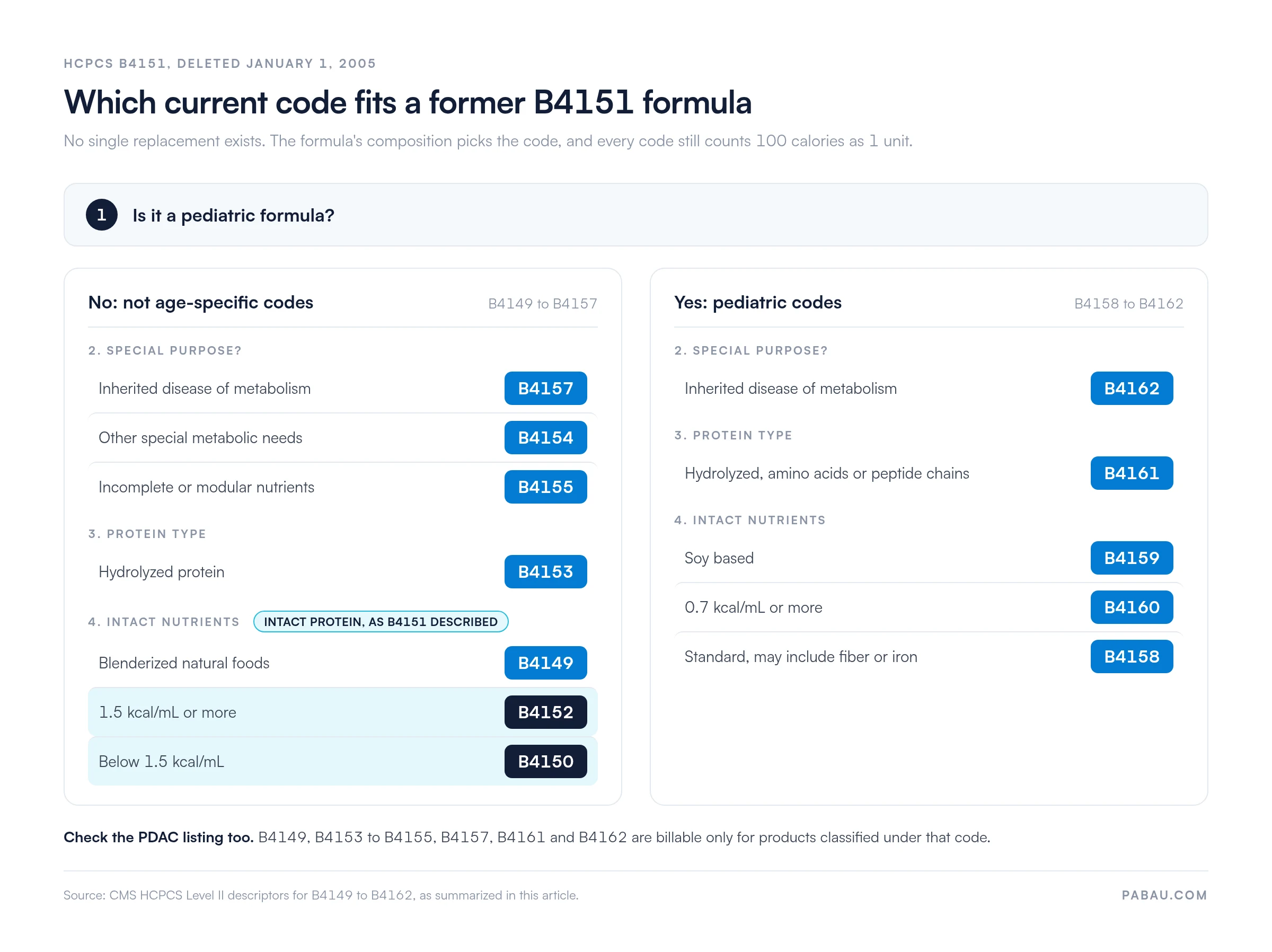
Every current enteral formula code counts one unit as 100 calories. Counting by volume only gives the right answer for a formula at exactly 1 kcal/mL.
Take a patient on 1,400 mL a day of a 1.5 kcal/mL formula. That is 2,100 calories, or 21 units a day and 630 units for 30 days. Counting by volume would bill 420 units, a third fewer than the calories support.
Bill the calories actually dispensed for the period, and keep the order’s daily calories consistent with the units on the claim.
CMS stopped requiring certificates of medical necessity and DME information forms for dates of service from January 1, 2023. For enteral nutrition, that form was the DIF, CMS-10126, not CMS-10128.
Claims now rest on two documents, the written order and the beneficiary’s medical record. Keep them consistent with the code on the claim.
Medicare covers enteral nutrition under the prosthetic device benefit when a permanent impairment makes tube feeding necessary to maintain weight and strength. Permanent means of long and indefinite duration, and the medical record must show it.
Formula taken by mouth carries the BO modifier, and products given only orally are coded A9270. Commercial plans and Medicaid programs set their own prior authorization rules, so check each payer before the first delivery. Our overview of medical billing compliance covers how to keep these records audit-ready.
Enteral formula claims usually carry supply and equipment lines as well. Each companion code goes on the claim with the current formula code, never with B4151.
The supply kit must match the documented delivery method. A B4035 pump kit billed for a gravity-fed patient invites a denial. Confirm descriptors for each companion code with the AAPC HCPCS code lookup for the date of service.
Enteral formula denials tied to B4151 usually trace back to a stale code list, such as an old charge master or order template. A structured denial management process corrects that list at the source, so the next claim goes out on a current code.
Retired codes like B4151 cause trouble when they live on in saved price lists and templates. Every claim built from that list repeats the same rejection.
Pabau, the practice management and billing platform we build, keeps insurer-specific price lists, so a retired code is replaced once instead of claim by claim. Its claims management workflow moves each submission through pending, submitted, processing, paid and error, so a rejected line surfaces quickly.
For US practices, Pabau connects to Claim.MD for claim submission, real-time eligibility checks and ERA posting. Validation checks run in the background each time a claim is sent, so missing details are caught before the payer sees them.
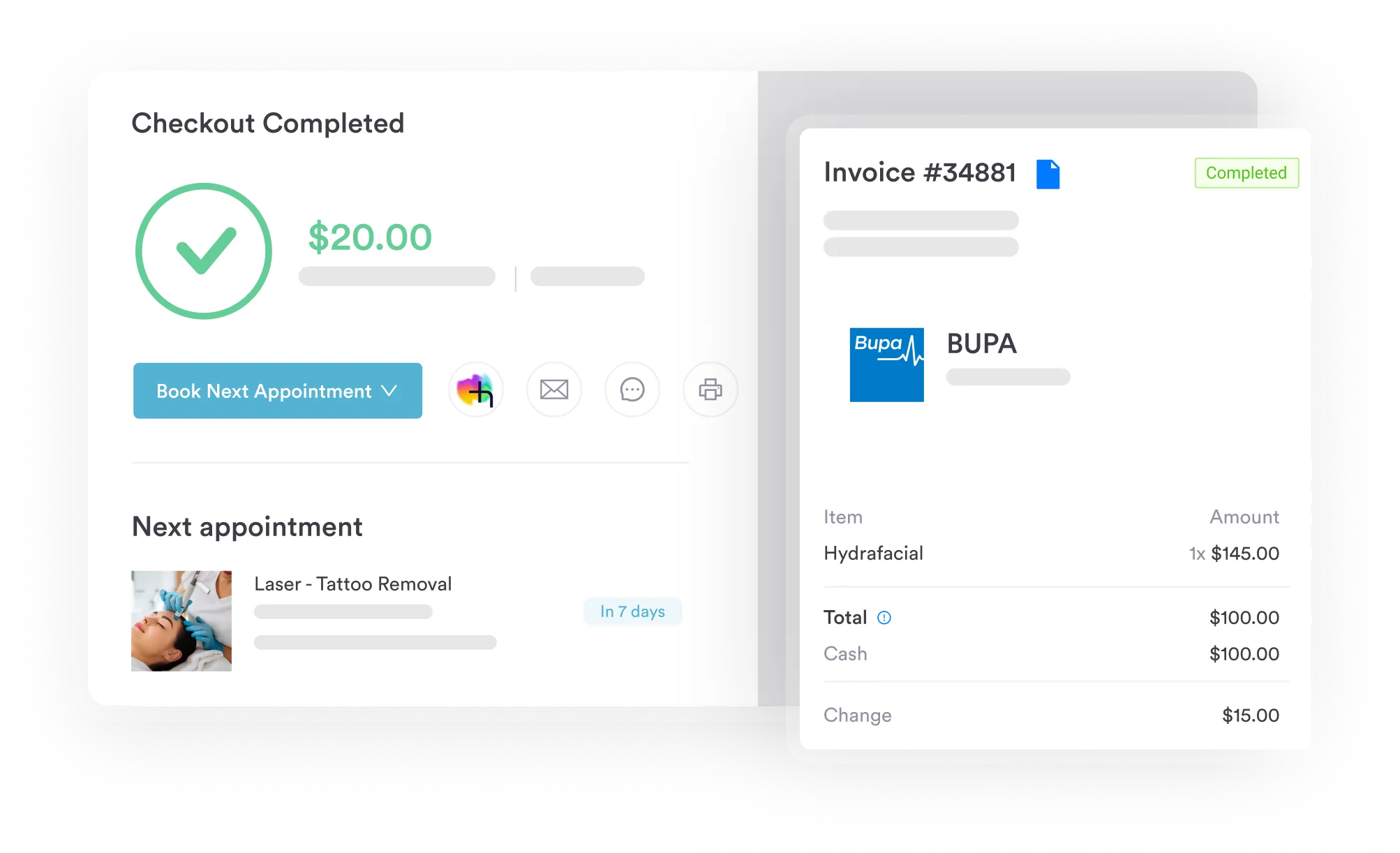

Pabau’s claims management keeps insurer price lists, eligibility checks and claim tracking in one place. Update a retired code once, and new invoices use the current one.

B4151 has been closed for two decades, so the useful question is which current code fits the formula. Settle it from the product’s composition and PDAC listing, then count units in calories.
The order, the medical record and the claim should all describe the same formula and the same daily calories. That takes a little more checking at setup, and it stops the same avoidable rejection from repeating every month.
Book a demo to see how Pabau keeps your billing codes, price lists and claims current.

Need guidance on managing claim submissions? Understanding the medical billing workflow covers end-to-end claim processing from eligibility check to payment posting.
Dealing with claim denials on DMEPOS codes? Denial management in healthcare explains the structured approach to identifying, appealing, and preventing recurring rejections.
Want to ensure documentation meets compliance standards? Medical billing compliance outlines the documentation and audit-readiness requirements that protect suppliers against retrospective recoupments.
Switching a patient to a hydrolyzed formula? HCPCS code B4153 explains the code for nutritionally complete hydrolyzed protein formulas and its PDAC listing requirement.
Billing a blenderized natural food formula? HCPCS code B4149 covers manufactured blenderized formulas with intact nutrients and how to document them.
HCPCS code B4151 was a Level II code for category I enteral formula made from natural intact protein or protein isolates. One unit equaled 100 calories. CMS deleted it effective January 1, 2005.
No. B4151 was deleted effective January 1, 2005, and cannot be billed for any current date of service. Bill the current enteral formula code that matches the product instead.
CMS did not designate a single replacement for B4151. The current code depends on the formula’s composition, such as B4150 for intact nutrients or B4152 for formulas at 1.5 kcal/mL or more.
One unit equals 100 calories for every current enteral formula code. Divide the total calories dispensed by 100, rather than dividing the volume in milliliters.
No. CMS stopped requiring CMNs and DME information forms, including the enteral form CMS-10126, for dates of service from January 1, 2023. The written order and medical record now carry the documentation.
A supply kit, B4034, B4035 or B4036, matches the delivery method, and B9002 covers the pump. E0776, the IV pole, takes the BA modifier. Each goes on the claim with the current formula code, not B4151.



