CPT code 93503: Swan-Ganz catheter billing and modifiers
CPT code 93503: Official descriptor and procedure overview In the AMA CPT code s...

Last Updated: Oct 23, 2026
B4082 is the HCPCS Level II code for nasogastric tubing without stylet.
Most B4082 denials trace back to three things. The tube actually shipped with a stylet. Nobody wrote the word permanent in the chart. Or the supplier crossed a quarterly quantity limit nobody knew existed. None of those are coding puzzles, and all three surface weeks later as a denial or a takeback.
Start with what the code actually describes, because the stylet is usually where the trouble begins.
Let Pabau's smart automation suggest the right codes, reduce claim denials, and keep your practice compliant—effortlessly.
Automate repetitive tasks and focus on what matters most—your patients.
Reduce coding errors and ensure compliance with the latest regulations.
Clean claims, fewer denials, and faster reimbursements.
Powerful insights and reporting to help your practice thrive.
HIPAA compliant SOC 2 certified GDPR-compliant Trusted by 4,000+ clinics worldwide

HCPCS code B4082 covers nasogastric tubing supplied without a stylet, billed as one unit per tube.
Medicare pays for it under the prosthetic device benefit, so the patient’s impairment has to be permanent.
Medicare allows three nasogastric tubes every three months across B4081, B4082 and B4083 combined.
A standard written order must reach the supplier before the claim goes out, and CMN forms no longer apply.
Practice management software like Pabau keeps the orders, notes and forms behind each claim in one patient record.
B4082 is the supply code for a nasogastric feeding tube handed over without an internal stylet. A stylet is the stiff wire that sits inside the tube during placement and gives it enough rigidity to pass through the nose. Take the wire out of the package and the code changes.
The code sits in the enteral and parenteral therapy range, B4000–B9999, maintained by the Centers for Medicare and Medicaid Services. You can confirm the current descriptor in the CMS HCPCS Level II release file, which is republished each year.
One packaging decision separates B4082 from B4081. If the wire is in the box, the claim is B4081. Without it, you are billing B4082. Auditors can check that against your purchase records and your delivery ticket in about a minute, so guessing is expensive.
Enteral nutrition falls under the prosthetic device benefit. That matters, because prosthetic device coverage turns on whether the body part being replaced has permanently stopped working. Rental rules, capped rental periods and equipment maintenance language do not apply here.
Local coverage determination L38955 sets the clinical bar. A patient qualifies when tube feeding is needed to supply enough nutrients to maintain weight and strength, and one of two conditions holds:
Medicare treats an impairment as permanent when it is of long and indefinite duration, ordinarily at least three months. Recovery is allowed to happen later. What the policy will not accept is a condition the record already expects to resolve.
So a patient with bulbar-onset ALS clears the bar easily. A patient with post-operative swelling that should settle in six weeks does not, however sick they look on the day of delivery. The word permanent needs to appear in the clinical record, tied to a named diagnosis.
Only a supplier enrolled in the DMEPOS program can bill B4082 to Medicare. The NPI on the claim has to carry active DMEPOS enrollment, and it has to meet the supplier standards. A claim from an unenrolled NPI is rejected before anyone reads the notes.
Next comes the standard written order, or SWO. It has to reach the supplier before the claim is submitted. Six elements make it valid:
Bill without one and the line denies as not reasonable and necessary. No amount of clinical detail elsewhere in the file rescues it.
B4082 is priced from the DMEPOS fee schedule, which CMS updates every January. Allowables differ by state, and rural rates differ from non-rural rates within the same state. There is no single national figure to quote.
That is why this page does not print a dollar amount. A rate that was correct for one jurisdiction in January can be wrong by spring. Pull the current file from the CMS DMEPOS fee schedule instead, and filter it to your own state.
That last row is worth flagging to your front office. Enteral patients order supplies month after month, so a small coinsurance balance compounds fast. Practices that treat these balances like any other patient collections problem tend to keep them small.
Good practice management software for medical practices turns supplies used in a visit into billed line items automatically.
Bill B4082 by the tube. Two tubes delivered on the same day is a quantity of two on one line, not two lines of one. Nothing about this code is billed per day or per month, which is where billers coming from formula codes often slip.
The quantity limit is easy to read straight past. Medicare considers more than three nasogastric tubes in any three-month period to be unreasonable, and that ceiling is shared. B4081, B4082 and B4083 all draw from the same three.
The three-tube quarterly limit is counted across codes, not per code. Systems that track utilization one HCPCS code at a time will not catch it. They will let a fourth tube ship that quarter under a different code. Build the check at the patient level instead.
Take a stroke patient on home tube feeding, discharged in early January. The quarter looks like this:
That March tube is not automatically non-covered. It does need the clinical story in writing before you ship: what happened, why replacement could not wait, and who authorized it. Send it without that and you are funding the tube yourself.
Modifier choice on enteral claims is less about nuance and more about honesty. Each one below tells the DME MAC something specific about your file, so append the one that is actually true.
KX carries the most weight of the five. Adding it says every coverage criterion is met and you can produce the evidence. Leaving it off when the criteria are met invites a denial you would then have to appeal. Adding it when they are not met is a compliance problem, not a shortcut.
Enteral claims are reviewed on paper, long after the tube was delivered. Post-payment recovery on these codes usually comes down to a file nobody could produce. Sometimes it is a note that never said what the reviewer needed to read.
Five things belong in every B4082 file, and good medical forms at the ordering practice make four of them easier to collect:
No Certificate of Medical Necessity is required for B4082. CMS retired CMNs and DME Information Forms across every category, for dates of service on or after January 1, 2023. That included form CMS-10126 for enteral and parenteral nutrition.
The change was published in CMS article SE22002. Claims submitted with a CMN attached after that date are returned. If your intake workflow still asks staff to chase one, that step is now pure delay, and the written order carries the weight instead.
Retention matters as much as collection. DME MACs expect ordering and delivery documentation to be available for seven years from the date of service. Build that into your record retention rules. Storage also has to stay HIPAA compliant, since these files carry diagnosis and treatment detail.
The diagnosis on the claim has to match the diagnosis in the order. Reviewers read both. The codes below turn up most often on enteral claims. Treat them as a starting point, then check your own MAC’s covered-diagnosis list.
Post-stroke cases deserve extra care, because I69 codes are where permanence claims get challenged most often. A swallow study written up by speech therapy practices carries far more weight than a diagnosis code sitting on its own.
Malnutrition coding needs the same discipline. When metabolic health practices co-manage a tube-fed patient, ask them to keep weights and calorie targets in the shared record. Those numbers are what turn E41 or E46 from a label into evidence.
These two codes describe the same tube in different packaging. That is the whole difference, and it is also why the pair generates so many corrections.
When a new product arrives and nobody is sure which code it maps to, check before the first claim. Some HCPCS codes only pay when the product appears on the PDAC Product Classification List. CGS Medicare’s coding verification lookup tells you whether that applies.
A tube on its own does not feed anyone. Most B4082 patients generate three or four other lines each month, and knowing which code covers what stops the same item being billed twice.
Two rules keep this group clean. Only one supply kit code is payable per day. And the kits already include everything except the tube and the nutrients, so billing a syringe or an administration set separately is a duplicate.
One more thing worth checking in your code master. B4084 and B4085 no longer exist, because CMS deleted both effective January 1, 2002. Old crosswalks still carry them, and so do a few billing systems. Thickened liquids are a different question again, coded as B4100.
DME MACs flag the same handful of problems on enteral claims year after year. Each has a fix that lives in your workflow rather than in an appeal letter.
Six questions, asked in order, catch most first-pass denials on this code:
Practices that run a quarterly chart audit on a sample of enteral files usually find the same two or three habits behind every denial. Fixing the habit is cheaper than appealing the claim.
Notice where most of these failures start. The supplier submits the claim. But the evidence that decides it comes from the ordering practice: the order, the swallow study, the weight trend, the note. A supplier cannot fix a sentence that was never written.
In a lot of practices that evidence is scattered. The order is typed in one system. A swallow study sits as a PDF in a shared drive. Somewhere behind reception, there is a folder with the signed consent. When a records request lands, somebody loses an afternoon assembling it.
Practice management software like Pabau pulls that into one patient record. Treatment notes, uploaded reports, signed forms and correspondence all sit against the same file. The documentation behind an enteral order can then be found and sent in minutes.
On the money side, Pabau handles the practice’s own invoicing and payments. Its claims management software adds a validation step and a status view for insurer submissions, so nothing sits half-finished. Your DME claims still go out through your DMEPOS billing system, and the chart behind them stays in one place. Denial management works backwards from the remittance to the step that caused it. Common claim denial codes repeat by specialty, so the pattern is worth reading before reworking.
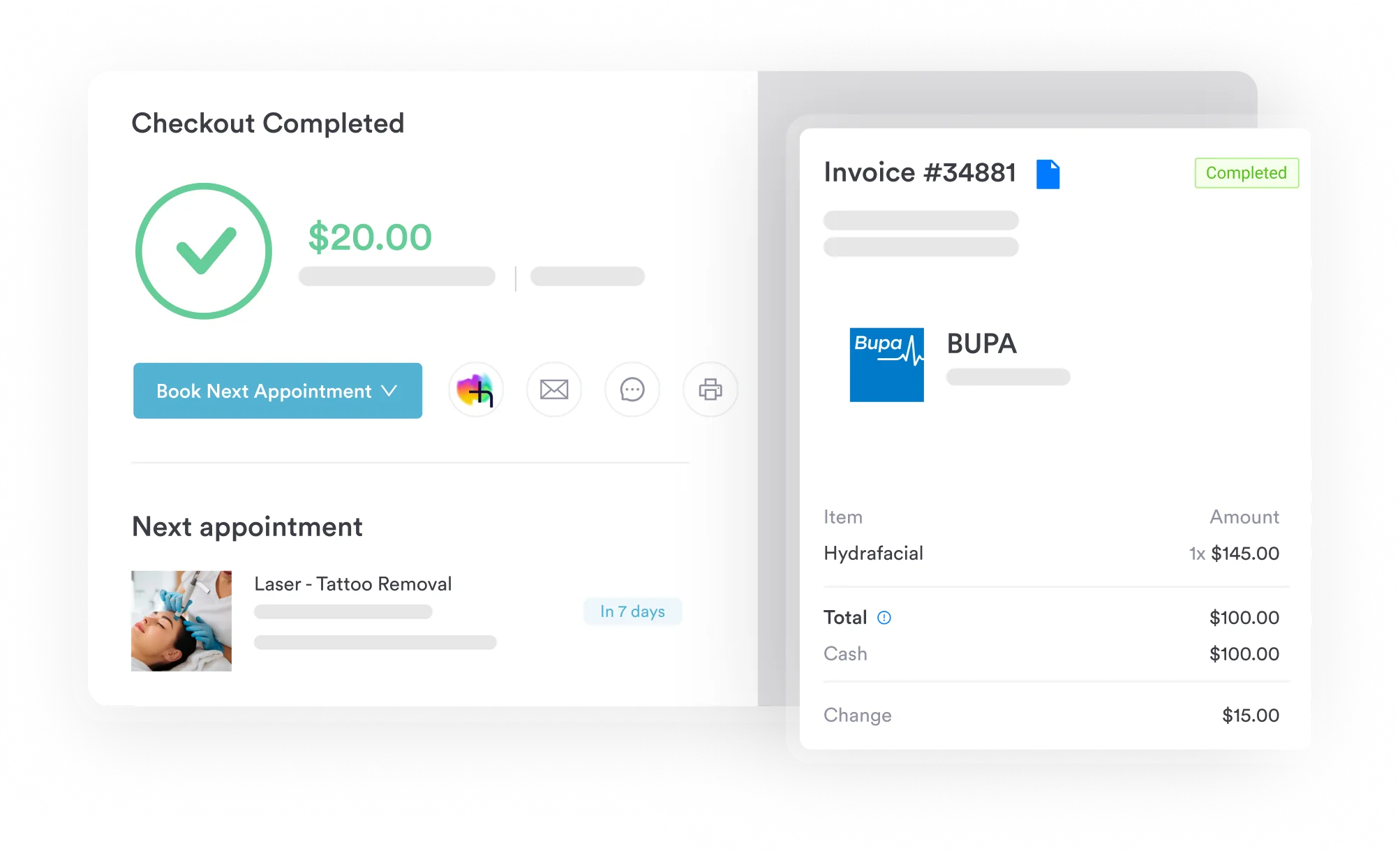

Pabau keeps orders, clinical notes, uploaded reports and signed forms in one patient record. So when a payer asks for the file behind a claim, your team can send it the same day.

B4082 is an easy code to bill and an easy code to lose money on. Almost nothing about it is clinical. The tube either shipped with a wire or it did not. The order either exists or it does not. And this patient either sits inside the quarterly limit or outside it.
So treat it as a documentation job rather than a coding one. Nail the written order at the start. Make sure the word permanent reaches the clinical note. Count tubes at the patient level, not per code. Do those three things and the appeals mostly stop.
The trade-off worth remembering is that none of this can be reconstructed after a denial arrives. It is either captured at the point of care or it is gone. Book a demo to see how Pabau keeps orders, notes and signed forms in one patient record, ready for the next records request.

Billing the formula as well as the tube? B4154 covers special metabolic enteral formula, including when the higher-cost category is justified.
Working with patients who cannot use the gut at all? B4176 sets out the parenteral amino acid solution rules and how they differ from enteral coverage.
Need the wider parenteral nutrition picture? B4180 walks through parenteral solution billing, units and supporting documentation.
Billing a custom-fitted knee orthosis? knee orthosis billing guide covers the KX modifier requirement and the knee instability documentation this custom-fitted orthosis needs.
Billing a single-upright knee orthosis? single-upright knee orthosis guide covers LCD L33318 coverage rules and the three medical necessity criteria for ambulatory patients.
No. Supplies used during an inpatient stay are bundled into the facility’s payment. B4082 is a Part B supplier code for items delivered to a patient at home, billed to the DME MAC by an enrolled DMEPOS supplier.
The treating practitioner managing the patient’s nutrition. That can be a physician, nurse practitioner, physician assistant or clinical nurse specialist. Their name and NPI have to appear on the standard written order, alongside their signature and the order date.
Coverage varies by state. Most Medicaid programs recognize B4082 and follow similar clinical criteria to Medicare, but many set their own quantity limits, prior authorization rules and rates. Check the state’s DME fee schedule and provider manual before you deliver.
Not every HCPCS code carries that requirement. Some codes only pay when the specific product appears on the PDAC Product Classification List. Run the code and your product through a coding verification lookup before you assume either way.
Place of service 12, the patient’s home, covers most home enteral nutrition claims. Jurisdiction follows the beneficiary’s permanent address rather than your warehouse. A supplier shipping across state lines still bills the DME MAC for where the patient lives.