CCSD code F5010: Parotid duct transposition billing guide
CCSD code F5010 covers parotid duct transposition, one side or both CCSD code F5...

Last Updated: Oct 9, 2026
A4248 is the HCPCS Level II code for chlorhexidine containing antiseptic, 1 ml. One unit equals 1 milliliter of a chlorhexidine-based skin antiseptic, the kind used for dialysis catheter care.
CMS places A4248 on its end-stage renal disease (ESRD) consolidated billing list as a supply not payable to DME suppliers. Medicare Part B sets no separate price, so dialysis use is paid inside the facility's bundled treatment rate.
Let Pabau's smart automation suggest the right codes, reduce claim denials, and keep your practice compliant—effortlessly.
Automate repetitive tasks and focus on what matters most—your patients.
Reduce coding errors and ensure compliance with the latest regulations.
Clean claims, fewer denials, and faster reimbursements.
Powerful insights and reporting to help your practice thrive.
HIPAA compliant SOC 2 certified GDPR-compliant Trusted by 4,000+ clinics worldwide

A4248 is the HCPCS Level II code for chlorhexidine containing antiseptic, and one unit equals 1 ml.
Alcohol wipes are a different code, A4245, so never bill an alcohol prep pad under A4248.
CMS lists A4248 among the ESRD supplies not payable to DME suppliers, and Part B sets no separate price for it.
For Medicare dialysis patients, the antiseptic is paid inside the facility’s bundled ESRD PPS treatment rate.
Medicaid and commercial plans set their own A4248 rules, so check each payer before you submit a separate line.
HCPCS code A4248 describes chlorhexidine containing antiseptic, 1 ml. It is a Level II supply code that the Centers for Medicare & Medicaid Services (CMS) maintains in its quarterly HCPCS file. Each unit stands for 1 milliliter of a chlorhexidine-based skin antiseptic.
The CMS file classifies the code as an end-stage renal disease (ESRD) supply. That classification decides how, and whether, the code gets paid. The attributes below come straight from the October 2026 CMS HCPCS file and the CY 2026 consolidated billing list.
A4248 is often mistaken for the alcohol wipes code. Alcohol wipes, per box, is A4245, which sits a few codes earlier in the same antiseptic series. The two codes differ in both the product and the unit, so a swap changes the whole claim line.
Dialysis care leans heavily on chlorhexidine. The CDC’s dialysis infection prevention guidance names an alcohol-based chlorhexidine (>0.5%) solution as the first-line skin antiseptic. It applies to central line insertion and to catheter dressing changes.
A4248 covers that antiseptic supply. Typical uses include cleaning the skin around a hemodialysis catheter exit site, prepping before access, and catheter care in home dialysis. Dialysis nurses and technicians apply it, under a plan of care set by the nephrologist.
The descriptor names no concentration or format. Solutions, swabsticks, and applicators can all fall under the code, as long as they contain chlorhexidine. What it does not cover:
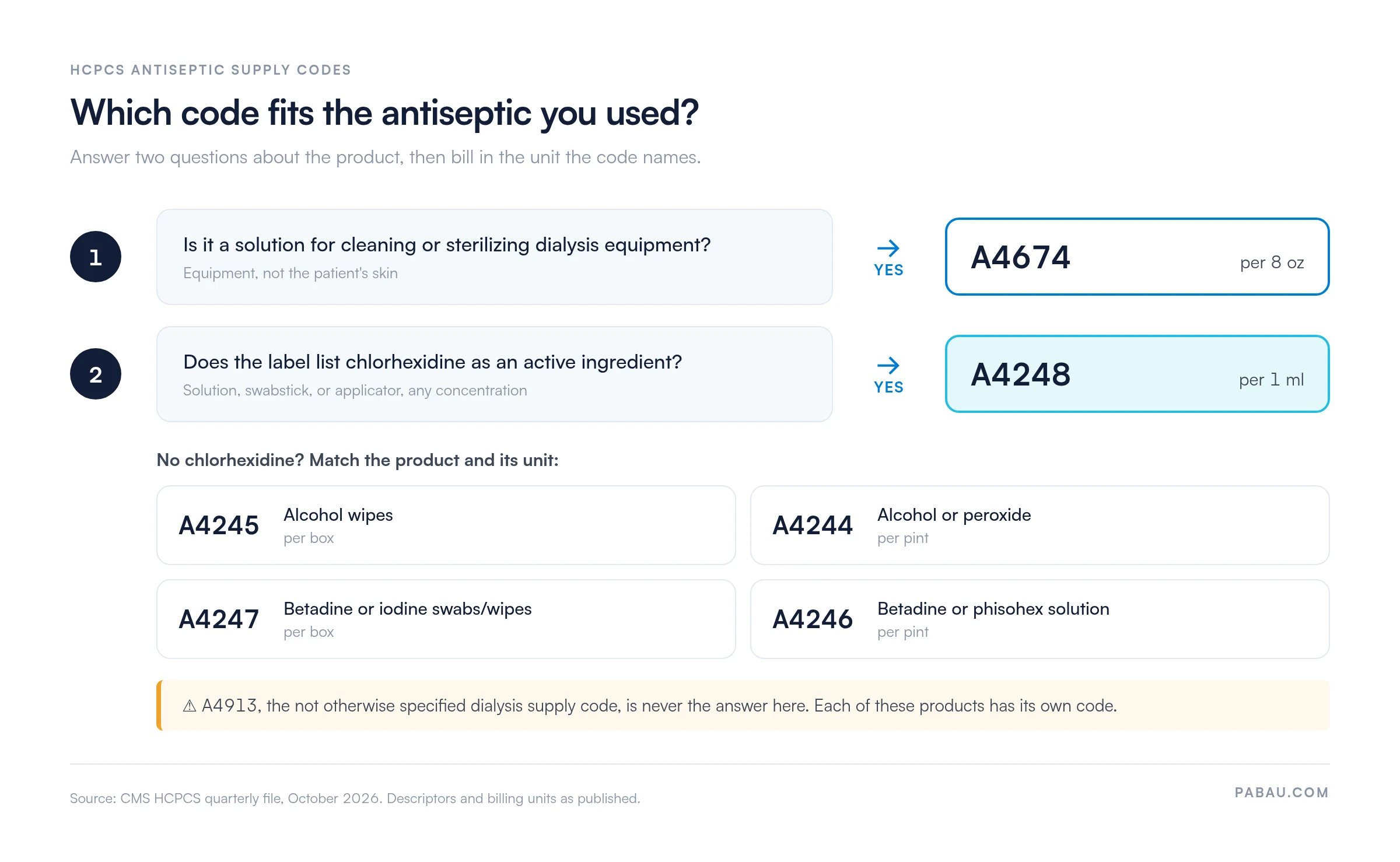
The chart below sorts the whole antiseptic family by product and billing unit, so two label checks place any item.
Medicare does not pay A4248 as a separate line. For a dialysis patient, the antiseptic is part of the facility’s bundled per-treatment payment. The ESRD prospective payment system (PPS) covers the drugs, laboratory tests, supplies, and equipment furnished for ESRD treatment.
CMS publishes the affected codes each year in Attachment B of its ESRD PPS consolidated billing list. The CY 2026 list places A4248 in the group headed “DME ESRD supply HCPCS not payable to DME suppliers.” Alcohol wipes (A4245) and iodine swabs (A4247) sit in the same group.
The CMS file backs this up from a second angle. A4248 carries pricing indicator 00, which means Part B sets no separate price for it. There is no DMEPOS fee schedule amount to look up, whatever the care setting.
Older references still talk about the ESRD “composite rate.” The ESRD PPS replaced that rate starting January 1, 2011, and it now bundles far more than the composite rate did. CMS resets the PPS base rate each January in the annual ESRD PPS final rule.
The setting and the billing entity decide what happens to an A4248 line. The table shows each route.
A facility still counts milliliters at the chair. That figure does not move a Medicare payment. It does feed cost reports, supply reconciliation, and any payer that prices the code on its own.
Start with who furnished the antiseptic, because that decides whether a separate line exists at all. Work through these steps before the claim goes out.
Download the current Attachment B every January. Codes can move between its groups from year to year. A supply that was payable outside the bundle one year can sit inside it the next. The denial that follows rarely looks like a coding error.
Medicare is the primary payer for most patients with ESRD, including many under 65. Medicaid and commercial plans sit alongside it for some patients, and their A4248 policies vary. Billing compliance requirements differ by payer and state, so never treat Medicare’s handling as the default.
Within the HCPCS Level II code set, A4248 sits in a run of antiseptic and dialysis supply codes. The neighbors describe different products and different units, so verify each descriptor against the current CMS file before billing by code number.
Every code in the table appears on the CY 2026 consolidated billing list, so the Medicare payment question is the same for all of them. Our guides to A4244 and A4246 cover the two per-pint solution codes in detail.
Most A4248 errors come from treating it like a home diabetes supply or a DMEPOS item. Denial management in healthcare starts with knowing which of these patterns you are prone to.
Check the product label before you code. If chlorhexidine is not listed among the active ingredients, A4248 is the wrong code, however the item is packaged.
A4248 rarely pays as a separate Medicare line, so the work sits in the record. The plan of care, the treatment note, and the milliliters used need to agree. When they live in separate systems, cost reports and payer claims drift apart.
Pabau, the practice management platform we build, keeps treatment notes, care plans, and consent forms in one patient record. Supply use gets recorded against the visit it belongs to, so the documentation trail is in one place when a payer asks. For faster claims management, Pabau then tracks claim status alongside that record.

Pabau keeps care plans, treatment notes, and supply use in one patient record. Your team can answer payer questions about codes like A4248 without chasing paperwork.

A4248 is a small code with an outsized chance of being misread. It describes chlorhexidine, not alcohol wipes, and it counts milliliters, not boxes. For Medicare, the dialysis bundle absorbs it, so a separate supplier claim has nowhere to go.
Code the product from its label, record the volume used, and read each non-Medicare payer’s policy before you add a separate line. Doing that keeps the claim accurate and your records ready for review. Book a demo to see how Pabau keeps care plans and treatment notes together for supply billing.

Need to understand how clearinghouse submissions work for supply codes? Medical claims clearinghouse explains the end-to-end electronic claim pathway from submission to remittance.
Want to reduce denial rates across all your billing codes? Clean claim walks through the elements every claim needs to pass payer edits without a rework cycle.
Looking for the denial code definitions behind supply-line rejections? Denial codes in medical billing covers CARC and RARC codes, what they mean, and how to respond to each.
Coding the alcohol prep pads used at the same visit? HCPCS code A4245 explains the per-box alcohol wipes code and how it differs from A4248.
Billing the solution that cleans the dialysis machine? HCPCS code A4674 covers equipment antiseptics billed per 8 oz.
HCPCS code A4248 is the Level II code for chlorhexidine containing antiseptic, billed per 1 ml. CMS classifies it as an ESRD supply. For Medicare dialysis patients, it is paid inside the facility’s bundled ESRD PPS rate.
No. Alcohol wipes, per box, is HCPCS code A4245, covered in our A4245 guide. A4248 is only for antiseptics that contain chlorhexidine.
Bill one unit per milliliter of chlorhexidine antiseptic used. Take the volume from the product label. A 30 ml bottle used in full is 30 units, on payers that price the code separately.
No. A4248 carries Medicare pricing indicator 00, meaning Part B sets no separate price. For dialysis patients, the ESRD PPS per-treatment payment to the facility covers the antiseptic.
No. The CMS ESRD PPS consolidated billing list places A4248 among the ESRD supplies not payable to DME suppliers. A supplier claim for the code is denied whatever documentation is attached.
Medicare publishes no fee schedule amount for A4248. Medicaid programs and commercial plans that pay it list the rate in their own fee schedules, so check the payer directly.