



CCSD code G5100: Bypass of duodenum billing guide
CCSD code G5100 bills a bypass that leaves the duodenum in place CCSD code G5100...

Last Updated: Oct 16, 2026
CPT code 99348 is an evaluation and management (E/M) code for a home or residence visit to an established patient. The visit must involve a low level of medical decision making, or at least 30 minutes of total time on the date of the encounter. Medicare allows roughly $78.83 for it in 2026 before any locality adjustment.
Since the 2023 E/M guideline overhaul, code selection for home visits hinges on either total time or medical decision making complexity. The history and physical exam elements that governed billing before that change no longer set the level.

CPT code 99348 covers established patient home visits with a low level of MDM, or at least 30 minutes of total time.
Since 2023, MDM complexity or total time sets the code level, and history and exam elements no longer do.
The national average Medicare non-facility rate for 99348 is approximately $78.83 for 2026, before locality adjustment.
Claims need the right place of service code, which is POS 12 at home, POS 13 in assisted living, and POS 33 in a domiciliary.
Practice management software like Pabau supports home visit billing with built-in CPT code libraries and automated claim submission.
CPT code 99348 describes a home or residence visit for an established patient. The visit requires a medically appropriate history or examination, plus a low level of medical decision making. When total time is used for code selection instead of MDM, 30 minutes must be met or exceeded on the date of the encounter. The American Medical Association (AMA) maintains CPT code 99348 as part of the established patient home and residence services subsection (99347-99350).
The code applies whether the visit occurs in the patient’s private home, an assisted living facility, or a group home. It does not apply to encounters in a skilled nursing facility or a hospital setting, which use separate E/M code families.
Use CPT code 99348 when two conditions hold. The patient has been seen by the same provider, or one in the same group practice, within the past three years. The visit itself involves a low level of MDM. Check eligibility before the visit as well, because some commercial payers treat home visit codes differently from Medicare.
The encounter must take place in one of the following settings to qualify for a home visit code:
Common clinical scenarios for 99348: a check on one stable chronic condition, an uncomplicated post-procedure follow-up, or a medication review with a minor adjustment. Each sits at low MDM because the problem is stable, the data reviewed is limited, and the treatment carries low risk.
The CPT 2023 revision of the home and residence services codes was adopted for Medicare by the Centers for Medicare and Medicaid Services (CMS). Under it, CPT code 99348 maps to a low level of MDM. History and physical exam components no longer drive code selection. The provider selects the code on either the MDM level or the total time spent on the date of the encounter.
Two of those three elements must be met or exceeded for the encounter to qualify as low MDM. In practice that usually looks like one stable chronic illness, limited data to review, and either no new prescriptions or a straightforward one. Independent interpretation of a new test points to moderate MDM instead, as does starting a complex medication regimen. Both support 99349 rather than 99348.
Documentation is what separates a paid claim from a denial or an audit flag. For CPT code 99348 billed under the 2023 guidelines, the note must support whichever selection method the provider uses: MDM complexity or total time.
Required documentation elements for 99348 billed by MDM:
Required elements when billing by total time:
The 837 claim file also requires the correct place of service code. Use POS 12 for the patient’s home, POS 13 for assisted living, and POS 33 for a domiciliary or rest home. Submitting with the wrong POS can trigger an automatic denial regardless of how strong the clinical documentation is.
Document the specific address or facility name for every home visit claim. MAC auditors frequently flag home visit codes when the service address is absent from the claim, even when the clinical note is otherwise complete. A missing address is one of the fastest routes to a documentation-based denial.
Medicare reimbursement for CPT code 99348 varies by geographic locality. The national average non-facility rate for 2026 is approximately $78.83, based on data from the CMS Physician Fee Schedule. Always verify the exact rate for your MAC jurisdiction using the CMS lookup tool. Rates in high-cost localities such as Manhattan or San Francisco can run 20-30% above the national average.
One detail catches practices out in 2026: CMS publishes two conversion factors. Clinicians who qualify as advanced APM participants are paid on $33.5675, and everyone else is paid on $33.4009. The figures on this page use the non-qualifying factor, so a qualifying participant should expect slightly more.
Track the allowed amount alongside the electronic remittance advice for every home visit claim. That pairing catches short payments and payer adjustments early.
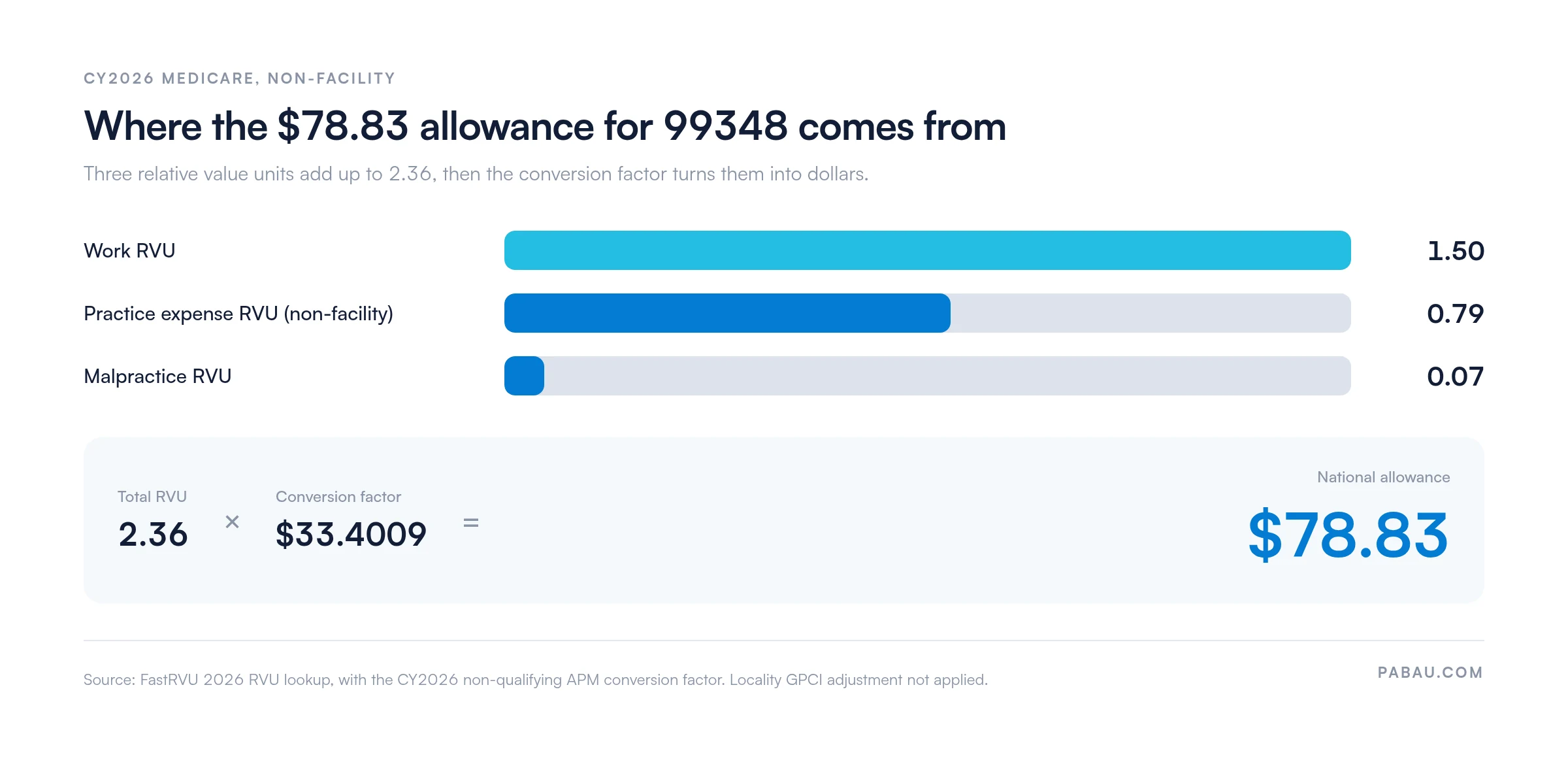
The FastRVU 2026 lookup tool provides current RVU values for 99348. Approximate values are shown below. Verify them against current CMS data before relying on them for budget planning.
Those three components add up to 2.36 RVUs, and the conversion factor turns that total into the allowed amount. The chart below traces the arithmetic end to end.
Use the PCC 2026 RVU calculator to apply your geographic practice cost index (GPCI) to these base values. Practices billing from high-cost localities will see meaningfully higher allowed amounts.
The ICD-10 diagnosis code on a 99348 claim must support medical necessity for the home visit. Pull it from the ICD-10-CM code set that matches the condition documented in the note. The codes below are frequently paired with this service, based on common chronic disease management scenarios. They are examples, not required pairings.
The established patient home visit series spans four codes. Picking the wrong complexity level, even by one step, directly affects reimbursement and audit exposure. Each code pairs one MDM level with one time threshold, and either route supports the code on its own.
New patient home visits use 99341, 99342, 99344, and 99345. CPT deleted 99343 in 2023, so the set is no longer a continuous range. A patient counts as new if they have not received professional services within the past three years. That covers the provider and any provider of the same specialty in the same group practice. New patient codes reimburse at a higher rate, which accounts for the additional work in a first encounter.
Physicians (MD, DO), nurse practitioners (NP), and physician assistants (PA) can bill CPT code 99348 under Medicare. Scope-of-practice rules vary by state, and how non-physician practitioners (NPPs) bill affects what the visit pays.
The key rules for NPP billing:
If your practice uses NPs or PAs for home visits, document the supervising physician relationship clearly in the patient record. For direct Medicare billing at 85%, the NPP’s NPI must be on the claim. For incident-to billing (100% rate), document physician presence at the site. Mixing these up on claims triggers payment errors and audit risk.
Most CPT code 99348 denials trace back to a handful of repeatable errors. Catching them before submission costs far less than appealing afterward. A standing denial management process turns each denial into a fix that stops the next one.
Home visit billing introduces logistical friction that office-based E/M billing avoids. Providers work away from the main system, documentation happens in the field, and claim data often needs reconciling later. Practice management software like Pabau answers that with claims tools for visiting providers. They automate the steps between the clinical encounter and the submitted claim.
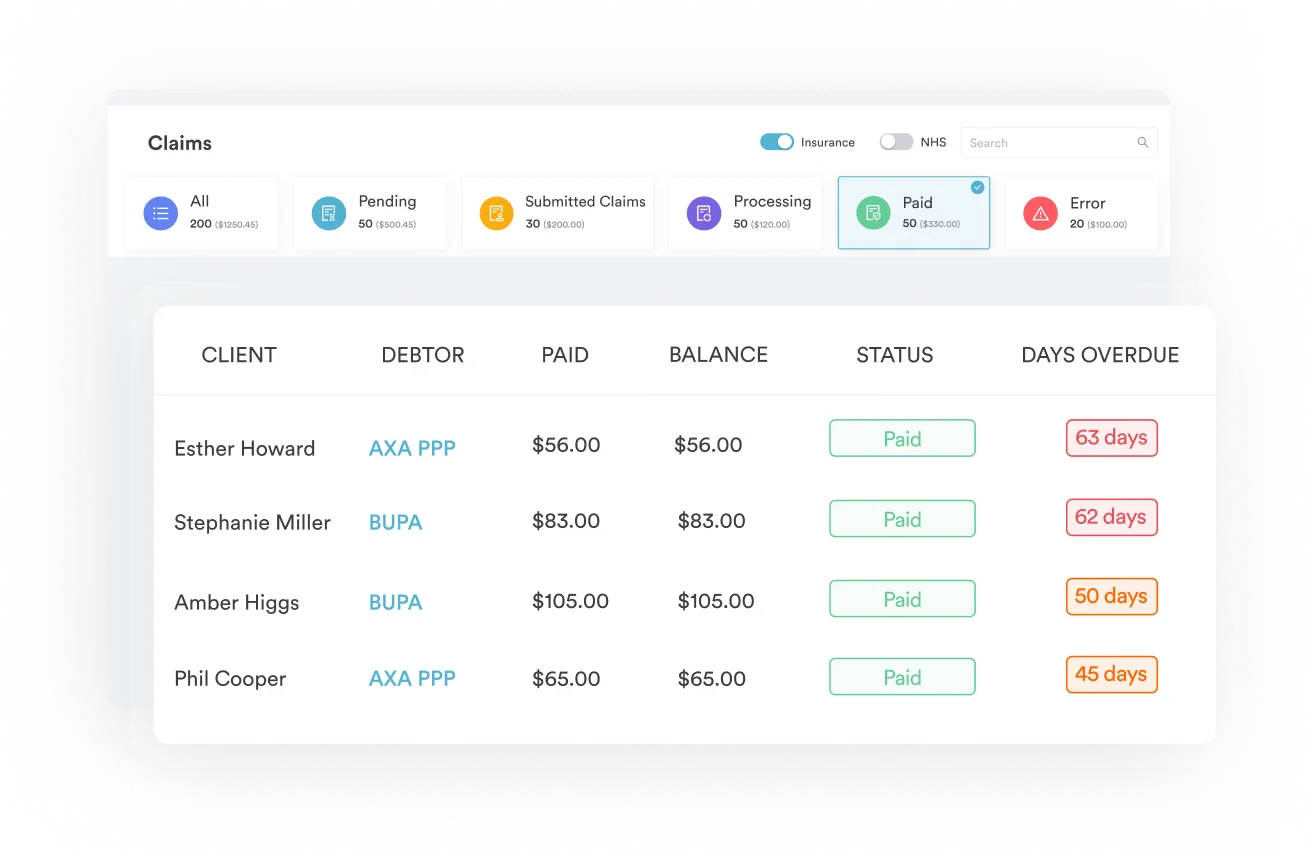
Pabau’s built-in CPT code library includes the full home visit series (99347-99350). MDM complexity prompts help providers document the right level at the point of care. Claim submissions route through the Claim.MD clearinghouse, which validates CPT and ICD-10 code combinations before they reach the payer. A mismatch between 99348 and an unsupported diagnosis code gets caught early.
For practices managing homebound populations, Pabau also automates ERA posting so remittances reconcile against claims without manual entry. That matters because short payments and payer adjustments are common in home visit billing. A backlog of unposted ERAs hides systematic underpayment patterns for months.

Pabau’s practice management software includes built-in CPT code libraries, automated claim submission via Claim.MD, and real-time eligibility checks. Your team spends less time on billing admin and more time with patients.

CPT code 99348 carries most of the routine home-based care load. It covers the stable chronic disease management visits that homebound patients need regularly. Getting the code right starts with confirming the established patient relationship. Match the MDM level or the total time to the 99348 threshold, then submit with the correct place of service code.
Home visit billing accuracy depends more on the capture workflow than on the coder. Pabau’s practice management platform covers both ends, with integrated CPT code libraries, a Claim.MD clearinghouse connection, and automated ERA reconciliation. Book a demo to walk through the home visit billing setup with our team.

Need a primer on how clearinghouses work for home visit claims? Medical claims clearinghouse overview explains the full submission pathway from provider to payer and what happens when a claim is rejected at each stage.
Unsure how to handle denied home visit claims? Revenue cycle management fundamentals covers the end-to-end RCM process including denial appeal workflows.
Want to decode the denial that came back on a home visit claim? Denial codes in medical billing lists the CARC and RARC codes payers use, so you can tell a POS edit from a medical necessity rejection.
CPT code 99348 is an evaluation and management code for a home or residence visit to an established patient. The visit requires a low level of medical decision making. The code can also be selected on total time, when 30 minutes are met or exceeded on the date of the encounter. The code belongs to the established patient home services family (99347-99350) and is maintained by the AMA.
The national average Medicare non-facility rate for CPT 99348 is approximately $78.83 for 2026. That figure comes from 2.36 total RVUs multiplied by the CY2026 conversion factor. The exact amount varies by geographic locality, so check the CMS Physician Fee Schedule Lookup Tool for your MAC jurisdiction.
Yes, nurse practitioners can bill CPT code 99348 directly under Medicare at 85% of the physician fee schedule rate. The service must fall within their state scope of practice. Billing at the full 100% physician rate under incident-to rules requires direct physician supervision on-site, which home visits rarely allow.
Frequently paired ICD-10 codes include I10 (essential hypertension), E11.9 (type 2 diabetes mellitus without complications), and Z00.00 (general adult medical examination). J44.1 (COPD with acute exacerbation) and I50.9 (heart failure, unspecified) are also common. The diagnosis must reflect the patient’s clinical presentation and support medical necessity for the home visit.



